


Most SMBs don't fail compliance because they made some bold, reckless decision. They fail because nobody owned the boring parts. An I-9 that never got a second signature. A termination where the paper trail started after the decision. A pay adjustment made in a hallway conversation that never made it into the system. None of these look dangerous on a Tuesday. They only become expensive later — usually when someone files something, or a buyer's diligence team starts asking for documents you don't have.
The core problem for small and mid-sized companies is that compliance gets treated as a series of one-off fires rather than a system. A 40-person company doesn't have a Chief Compliance Officer. It has an HR generalist who is also running recruiting, also doing onboarding, also fielding benefits questions, and also — somehow — expected to keep the company out of legal trouble. That person can't do everything, so the honest question isn't "how do we become fully compliant?" It's "what do we protect first, and what do we consciously accept as risk?"
That's what an SMB HR compliance operating model actually is. Not a binder of policies nobody reads. A prioritized system that decides where your limited attention goes, builds lightweight controls around the highest-risk areas, and gives you a repeatable way to check that those controls still work.
Why compliance breaks in small companies specifically
The failure pattern is pretty predictable, and it has almost nothing to do with intent.
In a 12-person startup, the founder handles HR "stuff" between other jobs. There's no process because there doesn't need to be one — everyone knows everyone. Then the company hits 30, 40, 60 people, and the informal system silently collapses. The founder is no longer in every conversation. Managers start making promises. Someone gets hired in a second state, which quietly triggers a whole new set of tax and labor obligations nobody flagged. The company is now operating under rules it doesn't even know apply to it.
The danger zone isn't the tiny company or the large one. It's the awkward middle — roughly 25 to 150 employees — where the complexity of a real company has arrived but the infrastructure of one hasn't. You've got enough people to generate real employment-law exposure, but not enough budget to hire someone whose whole job is watching for it.
The second reason it breaks: compliance work is invisible when it's working. Nobody praises HR for the lawsuit that never happened. So it loses every internal budget fight to things with visible ROI — recruiting, a new HRIS module, whatever. The result is chronic under-investment until an incident forces a panicked, expensive catch-up.
Start with risk, not with a checklist
The mistake that wastes the most time: teams try to become compliant with everything at once. They download a 200-item checklist, get overwhelmed somewhere around item 15, and quietly abandon the whole thing.
Eliminate HR bottlenecks with smart automation.
Hiryly simplifies your HR operations so you can focus on people, not paperwork.
- Centralized candidate tracking
- Automated onboarding workflows
- Performance & compliance dashboards
No credit card required
A compliance-first operating model flips this. You rank exposures by two things — likelihood and cost if it goes wrong — and you only build real controls where both are high. Everything else gets a lighter touch or a documented decision to accept the risk for now.
Here's a practical way to tier it:
| Risk area | Likelihood for SMBs | Cost if it fails | Priority tier |
|---|---|---|---|
| Worker misclassification (contractor vs. employee) | High | High (back taxes, penalties, back pay) | Tier 1 — build controls now |
| Wage & hour / overtime errors | High | High | Tier 1 |
| Termination without documentation | Medium-High | High | Tier 1 |
| I-9 / work authorization gaps | Medium | Medium-High | Tier 2 |
| Multi-state registration & tax setup | Medium | Medium-High | Tier 2 |
| Harassment/complaint handling gaps | Medium | High | Tier 2 |
| Benefits eligibility & COBRA notices | Medium | Medium | Tier 3 |
| Policy acknowledgment tracking | High | Low-Medium | Tier 3 |
| Personnel file completeness | High | Low-Medium | Tier 3 |
The point isn't that Tier 3 doesn't matter. It's that a small team physically cannot build airtight controls everywhere, so build them where a single failure can cost six figures — misclassification, wage-and-hour, terminations — before worrying about whether everyone signed the updated remote-work policy.
One thing worth sitting with: for most SMBs, the single most damaging exposure isn't dramatic. It's misclassification. A company treats five people as 1099 contractors to save on payroll taxes and benefits, and it feels fine for two years — until one of them files for unemployment or gets hurt. An agency looks at the relationship, and suddenly the "savings" turn into back taxes, penalties, and reclassification across the whole group. It's the quietest Tier 1 risk, and the one small companies rationalize the hardest.
The operating model in four layers
Think of the model as four layers stacked on top of each other. Each one is useless without the one below it.
Layer 1 — Ownership. Every risk area has exactly one named owner. Not a committee. One person accountable, even if they don't do all the work. If no one owns multi-state tax registration, it will not happen — "HR generally" is the same as no one.
Layer 2 — SOPs. For each Tier 1 and Tier 2 risk, there's a short written procedure. Not a legal document — a checklist a normal person can follow on the day it matters. The test of a good SOP is whether a new coordinator could run it correctly without asking anyone.
Layer 3 — Controls. Lightweight checkpoints that catch mistakes before they compound. A second signature. A required field. An approval gate. These are the things that turn "we have a policy" into "the policy actually gets followed."
Layer 4 — Audit. A quarterly check that the layers above are still working, because they drift. People leave, tools change, shortcuts creep in. Without a recurring audit, a compliant system quietly decays over maybe six to nine months.
Here's a simple visual of the workflow for how the layers connect and depend on each other.
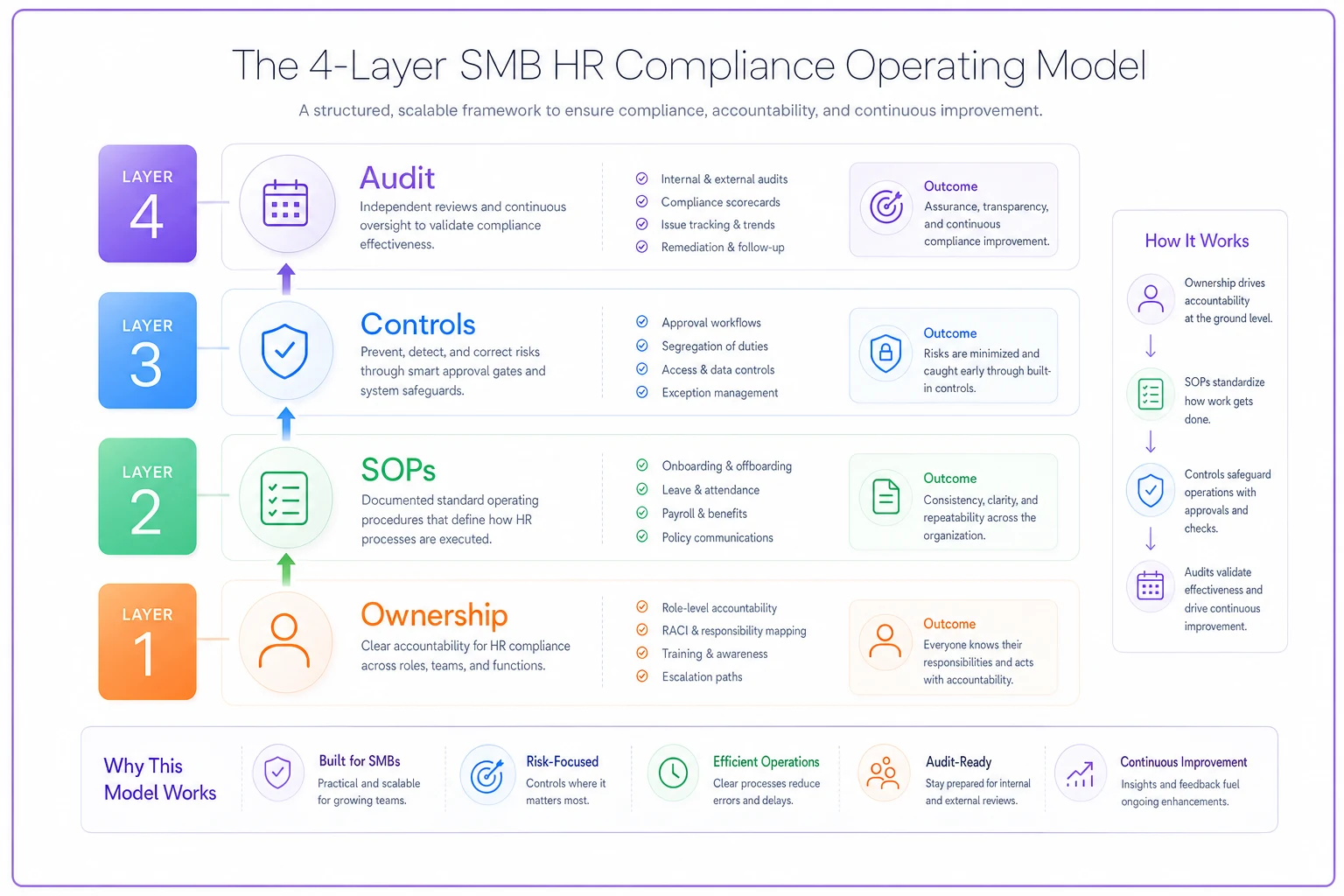
Most SMBs have a shaky version of Layer 2 — some scattered docs — and nothing else. The layers they skip, ownership and controls, are exactly the ones that make the SOPs mean anything.
SOP templates that actually get used
An SOP nobody follows is worse than no SOP, because it creates a paper record that you had a process and ignored it. Keep them short. Here's the skeleton for the three Tier 1 areas.
Termination SOP (the highest-stakes one):
-
Manager submits a termination request with a written reason before anything is communicated to the employee.
-
HR reviews the last 12 months of documentation
performance notes, prior warnings, any recent protected activity (complaints, leave requests, accommodation requests).
-
HR flags any timing risk — a termination two weeks after someone filed a complaint needs extra scrutiny, not because it's necessarily wrong, but because it looks wrong.
-
A second reviewer (owner, another HR lead, or fractional counsel for anything ambiguous) signs off.
-
Final pay is calculated to the state's specific deadline — some states require payment on the last day.
-
Documentation is filed and dated the same day.
The single most valuable control in that entire flow is step 1: nothing gets communicated to the employee before the review. In real operations, the disasters almost always come from decisions that were made emotionally on a Friday and documented on Monday.
Hiring/classification SOP:
-
Every new engagement runs through a classification decision
employee or contractor, exempt or non-exempt.
-
Contractor decisions use a short written test (control over work, integration into the business, permanency, tools provided) and get a second approval.
-
Work location is confirmed before the offer, because a new state means new registration.
Wage & hour SOP:
-
Overtime eligibility is set at hire, not guessed at later.
-
Any off-the-clock work, comp time, or "just finish it tonight" arrangement gets flagged and corrected.
-
Time records are reviewed monthly for non-exempt staff before payroll runs.
Time records are reviewed monthly for non-exempt staff before payroll runs.
Lightweight controls that don't need headcount
Controls scare small teams because they picture bureaucracy. But the effective ones are almost invisible — embedded in workflows you're already doing, so they cost no extra time.
-
Required fields before an action can proceed — you can't finalize an offer without a confirmed work state and classification.
-
Two-person sign-off on Tier 1 events only — terminations and classifications, nothing else. Applying dual approval to everything just teaches people to rubber-stamp.
-
Effective-dated records — every pay change, title change, and policy acknowledgment carries a date. When someone asks "what did we know and when," you have an answer.
-
A single intake path for complaints and concerns, so nothing gets handled informally and then forgotten.
-
A "no verbal-only decisions" rule for anything in Tier 1. If it wasn't written down, it didn't happen — and legally, that's close to literally true.
The mistake here is over-controlling. A team that adds fifteen approval steps in a burst of enthusiasm will find that within a quarter, everyone has learned to work around them. Controls only survive if they're few and clearly worth the friction.
Where the right tooling quietly helps
Scattered spreadsheets are the actual liability here, not the absence of a compliance officer. When your controls live in someone's memory and your records are spread across email, Slack, a shared drive, and three different spreadsheets, the audit becomes nearly impossible and drift is guaranteed.
Centralizing HR records and workflows in a single platform is what makes lightweight controls enforceable instead of aspirational. Modern HR platforms with built-in automation can enforce required fields so an incomplete termination can't be finalized, timestamp every change automatically for the audit trail, and route Tier 1 events to a second reviewer without anyone having to remember to. AI-assisted workflows can also surface patterns a busy generalist tends to miss — a termination that lands suspiciously close to a complaint, a contractor engagement that's started to look a lot like employment, a new hire in a state you're not registered in.
Enforce required fields for Tier 1 events in your HRIS so incomplete submissions are blocked rather than tracked down later.
The value isn't the automation itself. It's that the compliance system keeps running correctly even when the one person who understands it is on vacation, buried in other work, or has left the company. That resilience — the system not depending on a single human's attention — is the whole point for a small team.
The quarterly audit checklist
Compliance decays quietly, so you check it on a schedule instead of waiting for a crisis. This is meant to take an afternoon, once a quarter — not a full-time compliance function.
-
[ ] Pull every termination from the quarter — is documentation complete and dated before or on the termination date?
-
[ ] Sample 5 recent hires — is classification documented and correctly approved?
-
[ ] Confirm every state you employ people in is registered for payroll tax and unemployment.
-
[ ] Review contractor relationships — has any 1099 role drifted into looking like employment?
-
[ ] Spot-check non-exempt time records for off-the-clock or unpaid overtime patterns.
-
[ ] Verify I-9s are complete for all hires and re-verifications are current.
-
[ ] Confirm required notices (COBRA, benefits eligibility) went out on time.
-
[ ] Check that every Tier 1 event had its second sign-off.
-
[ ] Review any complaint intakes — were they logged, handled, and closed on the standard path?
-
[ ] Confirm each risk area still has a living, named owner (people leave).
That last item is the sneaky one. Owners leave, and their responsibilities evaporate without a formal handoff. More than a few compliance gaps trace directly back to a departed employee whose quiet job nobody realized existed until something went wrong.
A real scenario: the 55-person services company
A regional professional-services firm, around 55 employees, had grown fast across three states without ever formalizing HR. One HR generalist ran everything. Policies existed in a folder somewhere, but there was no real ownership, no controls, and no audits.
Two problems surfaced in the same quarter. First, a former contractor — one of six treated as 1099 for over a year — filed for unemployment, which put a spotlight on whether the whole group had been misclassified. Second, a terminated employee's file had no documentation predating the firing; the performance notes had all been written the week after.
Neither blew up into the worst-case outcome, but it was enough of a scare. They spent about a quarter building a basic version of the model above: risk tiering, three Tier 1 SOPs, dual sign-off on terminations and classifications, and a quarterly audit. They reclassified four of the six contractors proactively, which cost some money up front but eliminated a much larger exposure.
The measurable change was mostly in confidence and speed rather than a headline number. Documentation completeness on terminations went from roughly half to nearly all. The generalist stopped spending scattered hours chasing missing paperwork after the fact. And when the company entered acquisition talks about a year later, HR diligence — usually a scramble — took a couple of weeks instead of dragging on for months, because the records and audit trail already existed. That last part is the underrated payoff: a clean compliance system quietly raises the value and speed of an exit.
When to build this — and when not to bother yet
When it makes sense: You're past roughly 25 employees, operating in more than one state, or growing fast enough that informal control has clearly broken. If managers are making commitments you find out about after the fact, you're already past due.
When it's overkill: A genuinely small team — under 10 people, single state, no near-term hiring plans — can get away with just the Tier 1 basics and revisit the rest later. Building four layers of infrastructure for eight people is its own kind of waste.
Who should not run this alone: If you're facing an active claim, a pending audit, or a multi-state expansion into unfamiliar territory, don't treat this as a substitute for actual employment counsel. The model reduces routine risk and keeps you organized; it doesn't replace a lawyer when the stakes spike.
The trade-off honesty matters here. With limited headcount, you will leave some Tier 3 items partially undone, and that's an acceptable, deliberate choice — as long as it's a decision you made on purpose rather than a gap you never noticed. That distinction, made consciously and revisited every quarter, is what separates a company that's managing its compliance risk from one that's just hoping nothing surfaces.
The trade-off honesty matters here. With limited headcount, you will leave some Tier 3 items partially undone, and that's an acceptable, deliberate choice — as long as it's a decision you made on purpose rather than a gap you never noticed. That distinction, made consciously and revisited every quarter, is what separates a company that's managing its compliance risk from one that's just hoping nothing surfaces.
Ready to transform your HR processes?
Join thousands of HR teams using Hiryly to hire faster, engage employees better, and stay compliant effortlessly.