


Most scorecards don't fail because interviewers are careless. They fail because the scorecard asks people to rate things that can't actually be observed in a 45-minute conversation. "Communication: 1–5." "Culture fit: 1–5." "Problem solving: 1–5." Four interviewers, four private definitions, and a debrief that turns into whoever argues most confidently wins. The hiring decision gets made, but the scorecard had almost nothing to do with it.
This is a design problem, not an interviewer-discipline problem. You can run all the unconscious-bias training you want — if the instrument itself invites interpretation, bias walks right in through the gap. Below is a practical breakdown of where scorecards break, how to rewrite competencies into behaviors anyone can observe, how to weight them without lying to yourself, and how to run calibration that actually moves people off their first impression.
The core mistake: rating traits instead of behaviors
A scorecard lists a competency — say, "Stakeholder Management" — and asks for a 1–5 rating. One interviewer scores a candidate a 4 because the person "seemed confident and senior." Another scores the same candidate a 2 because they "didn't give concrete examples." Both ratings are technically about stakeholder management. Neither is measuring the same thing.
The fix is boring and it works: stop rating traits, start rating behaviors you can actually see or hear in the interview. A trait is "collaborative." A behavior is "described a specific disagreement with a peer and explained how they resolved it without escalating." One is a vibe. The other either happened in the conversation or it didn't.
A typical example of the difference:
| Competency (trait-based) | Observable behavior (what you can actually score) |
|---|---|
| "Strong communicator" | Explained a technical concept clearly enough that a non-expert interviewer understood it, and checked for understanding |
| "Takes ownership" | Described a failure they caused, without deflecting, and named what they'd do differently |
| "Analytical" | Walked through how they'd break down an ambiguous problem, including what data they'd look for first |
| "Leadership" | Gave a specific example of influencing a decision without formal authority |
| "Culture fit" | (Delete this. It's where bias hides. Replace with specific values-based behaviors below.) |
The right column doesn't ask whether the candidate is something. It asks whether a specific behavior appeared.
That shift alone cuts a surprising amount of noise, because it's much harder to project your own assumptions onto "did they name a specific failure" than onto "do they seem accountable."
Why "culture fit" is the most dangerous line on your scorecard
Culture fit deserves its own callout because it's the single most abused field in interview scoring. In practice, "fit" tends to mean "reminds me of people who already succeeded here" — which is just pattern-matching to your existing demographic and communication style. It's the field where someone's accent, humor, school, or background quietly gets scored under a respectable-sounding label.
Eliminate HR bottlenecks with smart automation.
Hiryly simplifies your HR operations so you can focus on people, not paperwork.
- Centralized candidate tracking
- Automated onboarding workflows
- Performance & compliance dashboards
No credit card required
If you want to assess values, name the values and convert each into observable behaviors. "We value directness" becomes "gave honest feedback in a scenario rather than softening it into nothing." "We value customer obsession" becomes "spontaneously framed a past decision around user impact, not just internal metrics." Now you're scoring something real instead of scoring how comfortable the candidate made you feel.
The quiet consequence of leaving "culture fit" vague: your diverse pipeline can look healthy at the top of the funnel and still collapse at final interviews, and nobody can explain why because the scorecard never captured the actual reason. The reason was a 2/5 on a field nobody defined.
Translating competencies into observable behaviors (the actual work)
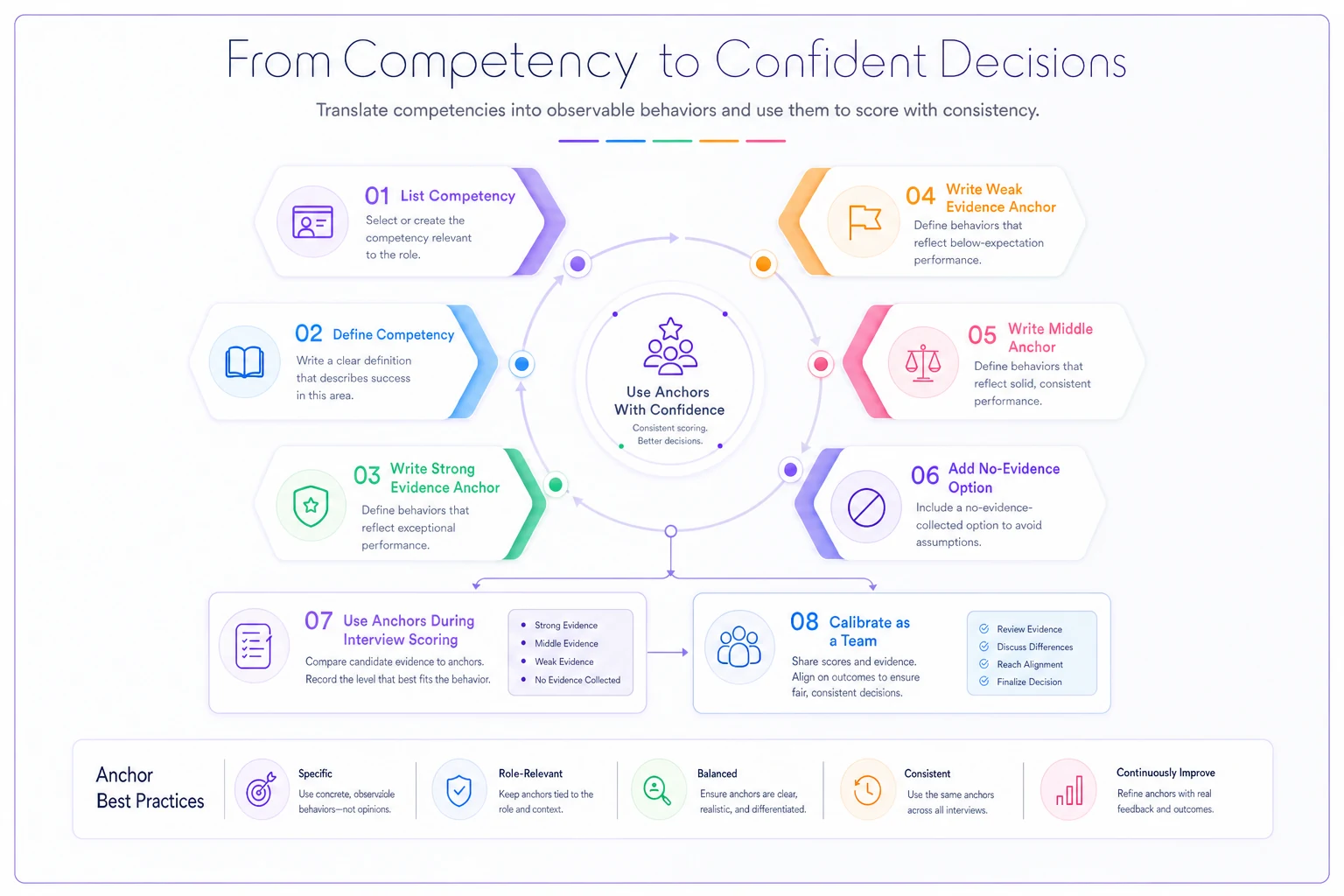
This is the part teams skip, and it's the part that matters most. For every competency on your scorecard, you need three to four anchored behaviors across the rating scale — not just the top. The failure mode is defining what "excellent" looks like and leaving 1, 2, and 3 as empty space for interpretation.
-
List the competency and its real definition in one sentence. If you can't define it in a sentence, it's too fuzzy to score. Cut it or split it.
-
Write the "strong evidence" anchor first. What does a clear 4–5 actually sound like in the room? Be specific enough that two interviewers would recognize it independently.
-
Write the "weak evidence" anchor. What does a 1–2 sound like? Usually it's not "bad" — it's absent. The behavior simply never appeared, or appeared only when prompted repeatedly.
-
Write the middle anchor. A 3 is typically "the behavior appeared but was generic, prompted, or shallow."
-
Add a "no evidence collected" option that is explicitly not a 3. This is critical. An interviewer who never asked the right question should not quietly default to the middle. Missing data is missing data, not an average score.
That last point fixes one of the sneakiest biases in scorecards: the tendency to fill every box. When interviewers feel they must rate every competency, they invent evidence to justify a number. A clean "didn't assess" field keeps scores honest and tells the debrief where coverage gaps are.
Here's a quick visual of the process.
A sample anchored behavior set
Competency: Handling ambiguity
-
Strong (4–5) Asked clarifying questions, stated assumptions out loud, and proposed a path forward despite incomplete information.
-
Moderate (3) Engaged with the ambiguous problem but waited to be told the "right" framing before moving.
-
Weak (1–2) Froze or demanded full requirements before attempting anything.
-
Not assessed No ambiguous scenario was presented in this interview.
Include a 'no evidence collected' option so missing data isn't treated as an average.
Now four interviewers are far more likely to converge, because they're matching what they heard against the same anchors instead of against their gut.
Weighting: the quiet lie most scorecards tell
Even a perfectly behavior-anchored scorecard goes wrong at the weighting stage. The common mistake is treating every competency equally — eight competencies, each worth 12.5%. That's rarely how the job actually works. For a backend engineer, "stakeholder communication" and "code design judgment" are not equally predictive of success, but equal weighting pretends they are.
The opposite mistake is weighting everything so heavily toward one competency that the rest become decorative. If technical skill is 70% of the score, the other fields are theater and everyone knows it.
A sane approach:
-
Separate "must-have" from "contributing." Must-haves are pass/fail gates, not weighted points. A candidate who fails a genuine must-have doesn't get rescued by scoring high elsewhere. Keep these to two or three, maximum.
-
Weight the contributing competencies based on how much they actually predict on-the-job success for this role — not the generic role, the actual one you're filling.
-
Cap any single contributing competency at around 30–35% so no one dimension drowns out the rest.
-
Write the weights down before the first interview. Weighting decided after you've met candidates is just rationalization with math attached.
A realistic weighting split for two very different roles:
| Competency | Senior Backend Engineer | Enterprise Account Executive |
|---|---|---|
| Core domain/technical skill | 35% | 20% |
| Problem decomposition / deal strategy | 25% | 25% |
| Collaboration / stakeholder handling | 15% | 30% |
| Communication clarity | 15% | 20% |
| Handling ambiguity | 10% | 5% |
| Must-haves (gates) | Pass/fail | Pass/fail |
Same competency labels, genuinely different weights, because the jobs are genuinely different. A single universal scorecard applied to every role is a tell that nobody did this work.
The debrief is where good scorecards still die
You can design a solid instrument and still lose everything in the room. The classic debrief failure: the most senior person says their number first, and suddenly everyone's scores drift toward it. Anchoring in a 30-minute meeting undoes weeks of careful design.
A few debrief rules that hold up:
-
Collect scores independently before anyone talks. No "let's go around and share our gut." Submit written scores with evidence notes first, ideally before the meeting starts. If your ATS lets you lock scores at submission, use it — it prevents the quiet post-meeting edit where someone "adjusts" to match the group.
-
Start the discussion on the widest disagreement, not the average. If two interviewers scored "handling ambiguity" a 4 and a 2, that gap is the most useful thing in the room. Work it before anything else.
-
Make people cite the behavior, not the impression. The debrief question is never "what did you think?" It's "what specifically did they say or do that led to that score?" If someone can't point to a behavior, their score gets flagged, not averaged in.
A short debrief script you can lift
> "Before we discuss, everyone's scores are locked and visible. We're not re-litigating numbers to reach agreement — we're explaining the evidence behind them. > First, the two competencies with the biggest spread. [Name], you scored a 4 on ambiguity — what specifically did they do? [Name], you scored a 2 — what did you hear that was missing? > We're not looking for consensus for its own sake. We're checking whether we were watching the same interview. If the gap is real evidence vs. missing evidence, that's a coverage problem we note, not a disagreement we force-resolve."
This keeps the conversation on observable behavior and stops the room from quietly converging on the loudest voice. The muscle here is the same as in any good calibration process — shared evidence, not manufactured agreement.
A calibration exercise that actually recalibrates people
Writing anchors isn't enough. Interviewers need to practice applying them, or they drift back to their private scale. The exercise that works best is straightforward and takes about 45 minutes:
-
Take two or three recorded or transcribed interview answers (real, anonymized, or realistic mock answers) for a single competency.
-
Have everyone score independently using the anchored scorecard — no discussion.
-
Reveal the spread. You will almost always see a two-point range on at least one answer.
-
Discuss the outliers using the anchors. The person who scored high and the person who scored low both have to point to the specific language that justified their number.
-
Refine the anchor wording wherever the disagreement came from ambiguity in the anchor itself, not the candidate.
The insight most teams discover here: half their disagreements aren't about judgment at all — they're about anchors that were written vaguely. Fix the instrument, and next quarter's scores converge on their own. Run this once per quarter and whenever you add interviewers to a panel.
When behavior-based scorecards are overkill
Not every role needs this level of rigor, and pretending otherwise creates process fatigue. A couple of honest limits:
-
Very high-volume, low-variance roles (seasonal warehouse, basic entry-level shifts) often don't justify a full anchored scorecard per competency. A short, structured checklist of pass/fail essentials is usually enough, and over-engineering it just slows hiring with no accuracy gain.
-
One-off, truly senior leadership hires where the pool is five known people and the assessment is mostly reference-and-track-record driven. You still want structure, but a formal weighted scorecard can give false precision to a decision that's genuinely about judgment and fit-to-strategy.
For everything in between — the bulk of professional, technical, and commercial hiring — behavior anchoring and honest weighting pay for themselves fast.
Who should not touch this project yet
If your hiring managers haven't bought into structured interviewing at all, don't start by rolling out anchored scorecards across the company. You'll get malicious compliance — boxes filled in randomly to satisfy the process. Start with one or two roles where the hiring manager actually wants better signal, prove it reduces re-opened searches and bad-hire regret, and let demand pull it outward.
And if your interview questions aren't structured, fixing the scorecard first is backwards. The scorecard measures evidence; the questions generate it. Unanchored questions plus anchored scorecards just means interviewers scoring behaviors that never had a chance to appear.
A real scenario
A roughly 60-person B2B software company kept re-opening the same two engineering roles. Offers went out, hires underperformed within the first few months, and the debriefs in hindsight all had the same pattern: everyone had scored "communication" and "culture fit" high, and nobody could say why. The scorecard had eight equally weighted competencies, all trait-based, all 1–5.
They rebuilt it. Cut "culture fit," replaced it with two values translated into observable behaviors, defined must-haves as pass/fail gates, and reweighted so technical judgment and problem decomposition carried the contributing score. They also added the "not assessed" option and locked scores before debriefs.
The change wasn't dramatic in the numbers — it rarely is. Over the next couple of quarters, interviewer score spread on the same candidate dropped noticeably, debriefs got shorter because arguments were now about evidence instead of impressions, and the two roles stopped bouncing back open. The hiring managers' summary was telling: they weren't making different decisions so much as making the same decision with far less noise and far more defensibility if anyone ever questioned it.
Keeping it consistent as you scale
The hardest part isn't designing one good scorecard — it's keeping forty of them consistent across teams, roles, and new interviewers who join the panel every month. This is where the design quietly degrades: someone copies an old scorecard, tweaks a competency, forgets the anchors, and six months later you're back to trait-rating and equal weights.
Centralizing your scorecard templates — with the anchored behaviors, weights, must-have gates, and locked independent scoring baked into the hiring workflow rather than living in a shared doc someone edits — is what keeps the rigor from eroding. AI-assisted hiring platforms can help flag when scores are being filled in without evidence notes, or surface when a panel's spread is unusually wide and worth a calibration refresh, so the quality-control work doesn't depend on someone remembering to check.
Good interview scorecard design isn't about adding more fields. It's about removing the ones that invite interpretation and anchoring the rest to things you can actually observe. Rate behaviors, not traits. Weight honestly and in advance. Collect scores before anyone talks. Run calibration like you mean it. Do that, and the scorecard stops being paperwork you fill in after you've decided — and starts being the thing that helps you decide.
Ready to transform your HR processes?
Join thousands of HR teams using Hiryly to hire faster, engage employees better, and stay compliant effortlessly.