


The candidate accepted your offer on Tuesday. By the following Monday, they're nowhere to be found. No response to emails, no answer to calls, just radio silence. Your hiring manager is panicking, the team already cleared their calendar for onboarding, and you're scrambling to figure out whether to restart the search or wait another day. This happens to roughly 17% of hires across industries, but the real operational damage goes deeper than one lost candidate.
The hidden operational cost of offer ghosting
When someone accepts an offer then disappears, you lose more than that person. The hiring manager who blocked three days for onboarding now has dead time. IT already provisioned accounts and ordered equipment. Finance processed paperwork that needs reversing. The team that's been covering extra work for months, expecting relief, just got told to keep grinding.
Most companies treat this as bad luck. But there's a clear pattern across hundreds of hiring operations: companies without a structured offer to onboard SOP lose candidates at predictable points, for predictable reasons. The gap between offer acceptance and first day isn't just waiting time — it's an active operational zone that needs managing.
Where the process actually breaks
Here's what typically happens in that two-to-four week window:
Eliminate HR bottlenecks with smart automation.
Hiryly simplifies your HR operations so you can focus on people, not paperwork.
- Centralized candidate tracking
- Automated onboarding workflows
- Performance & compliance dashboards
No credit card required
The recruiter sends a congratulations email with the offer letter. HR sends a DocuSign link three days later. Someone from IT might reach out about equipment preferences. Maybe the hiring manager sends a welcome note. Or maybe not. A benefits enrollment link shows up somewhere in there, arriving whenever HR gets to it. From the candidate's perspective, they're getting random emails from different people at unpredictable intervals. Some need responses, some don't. Some have deadlines, some don't mention timing at all. Meanwhile, their current employer is counteroffering, their spouse is asking questions about benefits they can't answer, and that other company they interviewed with just called back.
Without a clear communication cadence and milestone structure, candidates drift. They haven't psychologically transitioned from "considering options" to "preparing to start." That mental shift requires consistent touchpoints and clear progress markers — things scattered, uncoordinated emails simply can't provide.
Building a time-based engagement system
A proper offer to onboard SOP maps every interaction to specific timeline markers, creating predictable rhythm and clear expectations. Not "we'll send benefits info soon" but "benefits enrollment opens exactly 10 days before your start date."
Week 3 before start (Days 21-15)
-
Day 21
Offer acceptance confirmed
-
Day 20
Welcome package with timeline sent
-
Day 19
Manager introduction call scheduled
-
Day 17
Background check initiated
-
Day 15
Team introduction email with bios
Week 2 before start (Days 14-8)
-
Day 14
Benefits enrollment opens
-
Day 12
IT equipment preferences gathered
-
Day 10
Parking/access/logistics email
-
Day 8
Manager check-in call
Week 1 before start (Days 7-1)
-
Day 7
First day agenda sent
-
Day 5
Direct deposit and tax forms
-
Day 3
Final check-in from recruiter
-
Day 2
"See you Monday" message from team
-
Day 1
Welcome reminder with arrival details
Each touchpoint serves a specific purpose beyond information delivery. The manager introduction call at Day 19 creates personal investment. The team email at Day 15 builds social connection. The Day 8 check-in catches concerns before they become deal-breakers.
Below is a simplified view of how this flows from acceptance to Day 1:
Offer Accepted (Day 21) | v Welcome Package + Timeline Sent (Day 20) | v Manager Intro Call (Day 19) --> Background Check Initiated (Day 17) | v Team Introduction Email (Day 15) | v Benefits Enrollment Opens (Day 14) --> Equipment Preferences (Day 12) | v Manager Check-In Call (Day 8) | v First Day Agenda Sent (Day 7) --> Paperwork + Direct Deposit (Day 5) | v Recruiter Final Check-In (Day 3) --> Team "See You Monday" (Day 2) | v Day 1 Welcome Reminder --> START DATE
Here's a quick visual idea of that workflow.
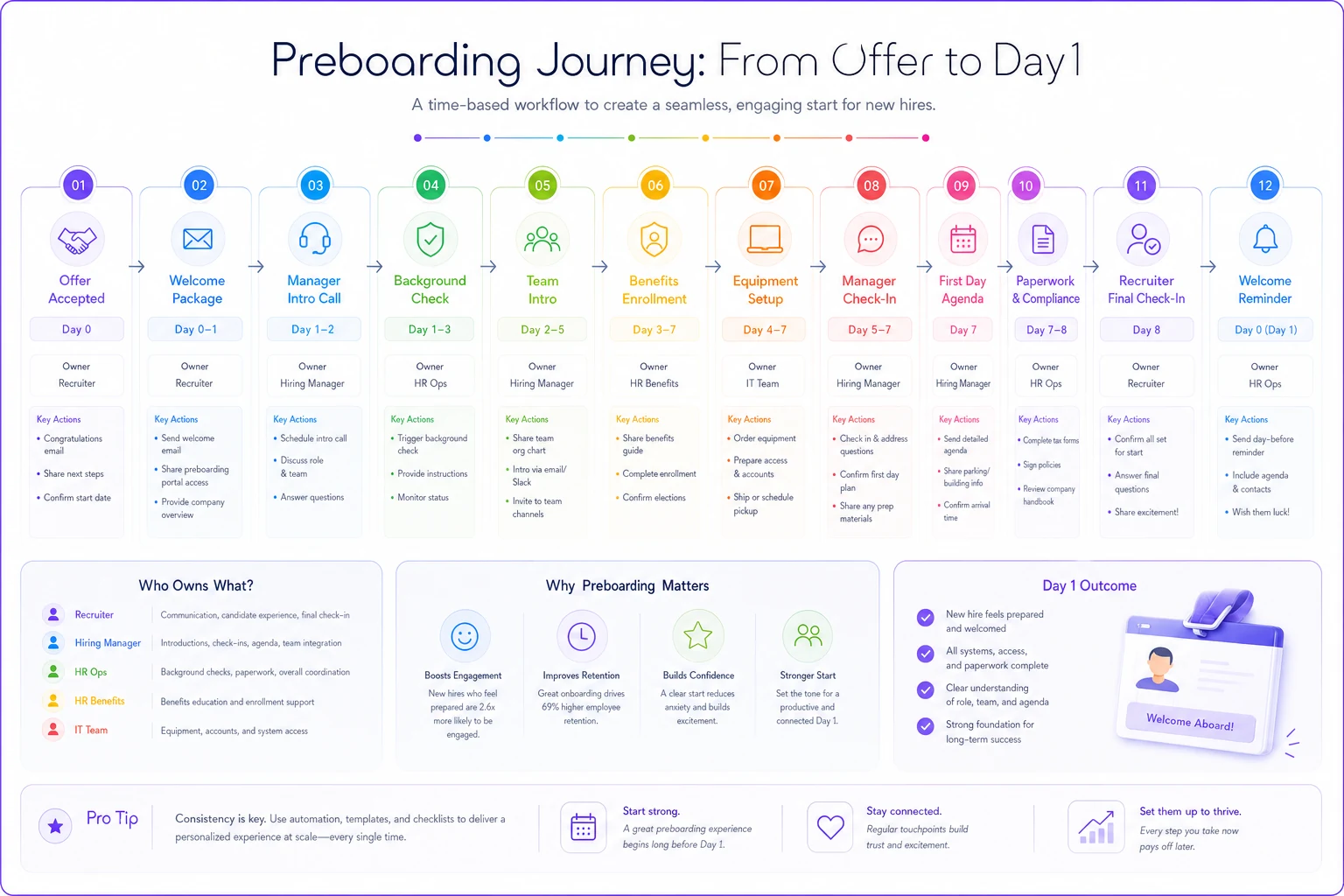
The point of mapping it this way isn't to make it look impressive in a slide deck — it's to force clarity about who does what and when. When that's missing, things fall through the cracks every single time.
Communication templates that actually work
Generic "checking in" emails feel hollow and get ignored. Effective preboarding communication has specific purpose and clear action items.
"Hi Sarah, you're 10 days from joining us. By now you should have:
-
Received your equipment shipping confirmation
-
Completed benefits enrollment
-
Scheduled your Day 1 meetings
If any of these are missing, reply and I'll handle it immediately. Your manager Tom mentioned the team's excited to have you join the product roadmap discussions — he'll send more context on Thursday.
The candidate knows exactly what should have happened, what to do if something's missing, and what's coming next. That specificity reduces anxiety and creates forward momentum.
"Looking forward to having you start next Monday. The team's been preparing your initial projects — you'll dive into the inventory optimization system we discussed, and Maria will walk you through our current workflows. Quick logistics check: Do you have your parking pass info? Building access instructions? First day schedule? If anything's unclear, let me know by Thursday so we can sort it before Monday."
This accomplishes three things: it reinforces the interesting work ahead, shows the team is actively preparing for their arrival, and gives a clear deadline for raising concerns before it's too late to fix anything.
Escalation triggers that prevent drops
Sometimes candidates go quiet despite your best efforts. That's when escalation triggers matter.
Day 18 trigger: No response to welcome package within 72 hours
-
Action
Manager makes personal call
-
Escalation
Recruiter follows up same day
Day 12 trigger: Benefits not enrolled by deadline
-
Action
HR sends reminder with direct phone number
-
Escalation
Extended deadline with personal assistance offered
Day 7 trigger: Multiple unanswered communications
-
Action
Text message + email + call from recruiter
-
Escalation
Hiring manager direct outreach
Day 3 trigger: Final paperwork incomplete
-
Action
Same-day resolution required
-
Escalation
Start date evaluation
The key is catching disengagement early, when recovery is still possible. A candidate who hasn't responded in 5 days might be salvageable. After 10 days of silence, they're probably gone.
Acceptance milestones that lock in commitment
Passive receipt of information doesn't create psychological commitment. Active participation does. Design your preboarding process to require small, meaningful actions that progressively deepen the candidate's investment.
Commitment progression timeline:
Low investment (Days 21-15):
-
Confirm personal information accuracy
-
Select equipment preferences
-
Acknowledge receipt of materials
Medium investment (Days 14-8):
-
Complete benefits enrollment (time investment)
-
Submit professional bio for team intro
-
Schedule coffee chats with teammates
High investment (Days 7-1):
-
Complete preboarding learning modules
-
Submit parking/photo for ID badge
-
Announce departure to current employer
Each completed milestone makes backing out slightly harder. The candidate who's already told their current boss, enrolled in benefits, and scheduled meetings with your team has crossed a psychological line. That's not manipulation — that's just how commitment works.
Preboarding prerequisites mapped to timeline
Not everything can happen whenever. Certain prerequisites need specific timing to avoid bottlenecks and last-minute chaos. Map your prerequisites like this:
| Prerequisite | Days Before Start | Owner | Dependency | Fallback |
|---|---|---|---|---|
| Background check | 14-21 | HR | Offer acceptance | Expedited service |
| I-9 verification | 5-10 | HR | Background clear | First-day completion |
| Equipment order | 10-15 | IT | Address confirmed | Local pickup |
| System access | 3-5 | IT | Background clear | Manual Day-1 setup |
| Benefits enrollment | 7-14 | Employee | Materials sent | Grace period |
| Parking assignment | 3-7 | Facilities | Space available | Temporary pass |
| Team notifications | 7-10 | Manager | Start date confirmed | Same-day intro |
The "Fallback" column matters. When prerequisites slip — and they will — you need predetermined alternatives that don't delay the start date or create last-minute scrambles. One thing worth repeating: the table above only works if someone actually owns the tracking. A shared spreadsheet that nobody updates is worse than nothing because it creates false confidence that the process is being managed.
Making the system auditable
Every interaction in your offer to onboard SOP needs tracking. Not for micromanagement, but for process improvement and compliance.
-
Communication sent (timestamp, sender, channel)
-
Candidate response (timestamp, response type)
-
Milestone completion (date, verification method)
-
Escalation triggers (activated, resolved, outcome)
-
Drop-off points (last interaction, identified cause)
After running this system for six months, patterns emerge. Maybe Day 12 emails consistently get ignored — wrong timing. Maybe manager calls have 90% completion versus 40% for HR calls — wrong messenger. Maybe West Coast candidates need different timing than East Coast hires. The data tells you what's actually happening versus what you assume is happening.
Signs your current process is failing
Before building a new offer to onboard SOP, recognize if your current approach already shows failure patterns:
-
Hiring managers texting you
"Have you heard from [candidate]?"
-
IT asking
"When does that new person start again?"
-
Candidates calling with basic questions days before starting
-
Surprise no-shows on Day 1
-
New hires seeming confused their entire first week
-
Different departments sending contradictory information
-
Offers getting accepted then declined within days
-
Panic-mode onboarding preparation
These aren't isolated incidents — they're system failures.
Building your timeline template
Start with your average time-to-start. If offers typically give 3 weeks notice, build around 21 days. For executive roles averaging 4-6 weeks, extend accordingly. Work backward from Day 1:
Day 1 requirements:
-
Badge ready
-
Workspace prepared
-
System access active
-
Manager available
-
Team notified
Then identify the latest possible moment for each:
-
Badge photos need 2 business days
Day 3 deadline
-
System access needs background clearance
Day 7 minimum
-
Workspace needs IT setup
Day 2 preparation
Start with the latest possible moment for each deliverable and work backward to set realistic deadlines.
This reverse-engineering reveals your critical path and non-negotiables. Most teams skip this step and then wonder why they're scrambling the day before someone starts.
Who should own each touchpoint
Misaligned ownership kills preboarding programs. "Someone from HR" isn't ownership — "Jessica from Benefits" is.
Recruiter owns:
-
Initial acceptance confirmation
-
Timeline overview delivery
-
Week 3 check-in
-
Final pre-start confirmation
-
Escalation coordination
Hiring Manager owns:
-
Welcome call (Day 19)
-
Team introduction facilitation
-
Week 2 check-in
-
Project context sharing
-
Day 1 schedule confirmation
HR Operations owns:
-
Document collection
-
Benefits coordination
-
Compliance requirements
-
Background processing
-
System notifications
IT owns:
-
Equipment logistics
-
Access provisioning
-
Login credentials
-
Security training assignment
When everyone knows their specific touchpoints and timing, the candidate experiences seamless coordination rather than departmental chaos.
Common timeline mistakes that kill engagement
The most damaging error is front-loading everything. Sending fifteen emails in the first three days then going silent for two weeks makes candidates feel abandoned right when doubt creeps in.
Equally damaging is the "hurry up and wait" pattern — demanding immediate responses on paperwork, then taking a week to reply to their questions. That asymmetry signals that their time doesn't matter. Another conversion killer: mismatched urgency. Marking routine communications as "URGENT" while sending critical deadline information casually. Candidates can't prioritize when everything feels equally important or equally unimportant. The worst mistake is assuming acceptance equals commitment. That "yes" on Tuesday doesn't mean they've stopped fielding other offers. Until they've actually started, they're still making decisions.
When timeline automation improves outcomes
Manually tracking a multi-week, multi-touchpoint process across departments is where things reliably fall apart. Someone forgets Friday's check-in. The benefits reminder goes out after enrollment closes. The manager schedules a call during the candidate's vacation week.
This is where automated workflows prevent human error from damaging candidate experience. An AI-powered operational platform can trigger communications based on acceptance date, flag incomplete milestones, and escalate when response patterns indicate a candidate might be drifting.
The automation doesn't replace human interaction — it ensures human interaction happens when planned. The manager still makes the call, but the system prompts them when it's time and logs that it happened. And for teams running multiple concurrent hires, that consistency is hard to maintain manually. Your twentieth hire of the month gets the same thorough preboarding as your first, even when the recruiting team is stretched thin.
Recovery protocols for at-risk candidates
Sometimes despite a solid process, candidates wobble. They delay paperwork, skip calls, or respond tersely when they were previously enthusiastic. These signals need specific recovery protocols.
The "quiet candidate" protocol: When engagement drops suddenly, switch channels. Email non-responders might answer texts. Phone-avoiders might prefer a quick video call. The medium matters less than making contact.
The "competing offer" protocol: When candidates mention other opportunities, accelerate meaningful connections. Schedule an informal virtual coffee with potential teammates. Have the CEO send a personal welcome video. Make them feel wanted, not processed.
The "nervous relocator" protocol: For relocating hires showing anxiety, shift focus from logistics to lifestyle. Connect them with recent relocators. Share neighborhood guides. Introduce them to employee resource groups. Address the human concerns behind the hesitation.
Measuring what actually matters
Tracking "offer acceptance rate" and "Day 1 show rate" misses everything that happens between those two points. Monitor the full funnel:
-
Acceptance to first response time
-
Communication response rate by week
-
Milestone completion velocity
-
Escalation trigger frequency
-
Drop-off point distribution
-
Time-to-full-documentation
-
Preboarding satisfaction scores
If Week 2 response rates consistently drop, your Day 14-8 activities need reworking. If escalations always cluster around benefits, that process needs simplifying. If satisfaction scores are high but show-rates are low, you're creating happy departures — something's broken in the commitment-building phase.
The real test: would your process survive a competitive counter?
Here's the scenario that breaks weak preboarding systems: It's Day 10 before start. The candidate's current employer just offered a 20% raise to stay. Another company they interviewed with came back with a better title. Their spouse just raised concerns about the commute.
Does your offer to onboard SOP create enough investment, connection, and momentum to survive that pressure? If you've been sending random emails from various departments with no clear progression or personal investment, probably not. But if they've already connected with their team, enrolled in benefits, announced their departure, and received consistent reinforcement of their decision — they're far more likely to follow through.
The difference isn't luck. It's systematic relationship building measured in days and touchpoints.
Building durability into your timeline
Your offer to onboard SOP should work whether you're hiring one person or twenty, whether it's December or July, whether your recruiter is experienced or brand new.
-
Documented templates for every communication
-
Clear handoffs between departments
-
Automated triggers for critical deadlines
-
Escalation paths that don't rely on individual judgment
-
Feedback loops that improve the process over time
-
Flexibility for role-specific modifications
-
Compliance checkpoints that can't be skipped
The system should run the same way every time while still allowing for human judgment when circumstances call for it.
Making the business case for process investment
Implementing a proper offer to onboard SOP takes effort. You need stakeholder buy-in, technology setup, template creation, and training. Here's how to justify it:
-
Recruiting time already spent
40-60 hours
-
Interview time across all participants
15-25 hours
-
Opportunity cost of unfilled role
$2,000-5,000 per week
-
Restart costs
3-4 weeks additional timeline
-
Team morale impact
unmeasurable but real
One prevented drop-off pays for months of process improvement. Three prevented drop-offs justify automation investment. Ten prevented drop-offs transform your talent acquisition metrics and your employer brand.
The 90-day perspective
Your offer to onboard SOP isn't just about getting people to show up on Day 1. It's about setting the tone for their entire employment relationship. The candidate who experiences organized, thoughtful preboarding arrives ready to engage. The one who stumbles through chaos arrives skeptical.
New hires who feel valued before starting perform better in their first 90 days. They engage with training more readily, form relationships faster, and commit to the organization earlier. Conversely, those who almost backed out often keep one foot out the door. They remain open to other opportunities. They share negative experiences in their network. They become flight risks within months.
Start with minimum viable process
You don't need perfect automation on day one. Start with a simple timeline in a spreadsheet:
-
Map out 21 days before start
-
Assign 8-10 critical touchpoints
-
Create 3-4 email templates
-
Define 2-3 escalation triggers
-
Pick one person to own tracking
Run this for five hires. Document what breaks. Adjust timing that doesn't work. Add missing touchpoints. Remove redundant ones. After refining through 10-15 hires, you'll have a battle-tested process worth automating. That's when operational software transforms good process into consistent execution at scale.
The psychological architecture of commitment
Every touchpoint in your offer to onboard SOP should deepen psychological investment — not through manipulation, but through genuine relationship building and practical progress.
Early touchpoints create anticipation: "Here's the exciting project waiting for you." Middle touchpoints create connection: "Meet the people you'll work with." Late touchpoints create readiness: "Here's everything you need to hit the ground running." The accumulation of these micro-commitments makes backing out feel like real loss, not just a changed decision.
Beyond the basics: advanced preboarding optimization
Cohort coordination: When multiple hires start the same week, create shared preboarding experiences. Group video calls, Slack channels for questions, peer connections that reduce isolation.
Manager preparedness scoring: Track which managers consistently have engaged new hires versus those whose people ghost. Use that data to improve manager training or adjust communication ownership.
Content personalization: Developers need different preboarding content than salespeople. Remote workers need different logistics than office-based hires. Build role-specific tracks within your core timeline.
Feedback integration: Survey no-shows about what went wrong. Survey successful starts about what helped most. Use both to continuously refine triggers and touchpoints.
The operational reality
Your offer to onboard SOP will never prevent all drop-offs. People's circumstances change. Better offers arrive. Family situations shift. But a well-designed, time-based system dramatically reduces preventable losses.
More importantly, it transforms recruiting from a transaction into a relationship. Candidates feel the difference between companies that send random emails and those that run thoughtful, coordinated engagement. In tight talent markets, that difference determines who actually shows up on Monday.
The path from offer to onboard doesn't have to be a black box where candidates mysteriously disappear. With clear timelines, consistent communication, measurable milestones, and systematic escalation, you can maintain momentum through the entire preboarding journey. The companies winning talent competitions don't just make better offers — they deliver better experiences between "yes" and "welcome." Build the SOP deliberately, run it consistently, and measure it relentlessly. The reduction in drop-offs will justify every hour invested in getting it right.
Ready to transform your HR processes?
Join thousands of HR teams using Hiryly to hire faster, engage employees better, and stay compliant effortlessly.