


Most remote onboarding programs fall apart somewhere around day 23. That's when the initial meetings dry up, Slack messages slow down, and new hires start wondering if anyone actually knows they exist. This pattern shows up constantly across tech startups, accounting firms, marketing agencies—companies lose somewhere around 18% of remote hires within the first quarter, and another chunk become what I'd call "ghost employees" who technically work there but contribute almost nothing.
The problem usually isn't motivation or culture fit. Remote onboarding typically consists of a welcome email, three Zoom calls, and then radio silence while everyone assumes the new hire is "figuring things out." Meanwhile, that person is sitting at home refreshing their inbox, wondering if they should be doing something, slowly losing confidence in their decision to join.
What remote teams actually need isn't another onboarding checklist or culture deck. They need an operational system with clear ownership, measurable checkpoints, and specific deliverables that create momentum instead of confusion. The same pattern keeps surfacing across distributed teams of all sizes: successful remote integration requires deliberate structure, not organic connection.
Why traditional onboarding breaks in remote environments
Office onboarding works through proximity. New hires absorb context through overheard conversations, impromptu desk visits, lunch invitations. They figure out who actually makes decisions by watching meeting dynamics. They learn unwritten rules by observing behavior.
Remove physical presence, and all those invisible knowledge-transfer mechanisms disappear.
Remote onboarding tries to recreate office experiences through video calls and virtual coffee chats. This fundamentally misunderstands the problem. A new remote employee doesn't need more meetings—they need clarity on what success looks like, who owns what, and how to demonstrate progress when nobody's watching.
The typical remote onboarding goes something like this: HR sends login credentials and schedules orientation. The hiring manager books a few one-on-ones. IT ships equipment. Someone creates a Slack channel called #welcome-sarah. Everyone assumes Sarah knows what to do next because she seemed sharp in the interviews.
By week four, Sarah has attended 15 random meetings where people introduced themselves but never explained how their work connects. She's completed generic compliance training. She has access to 47 different tools but doesn't know which ones actually matter. Her manager checks in weekly to ask "how's it going?" but hasn't assigned real work because Sarah is "still ramping up."
This creates a death spiral. Sarah feels useless, so she stops speaking up in meetings. Her silence gets read as disengagement. Projects move forward without her input. By month two, she's essentially invisible. The manager starts wondering if they made a hiring mistake. Sarah starts updating her LinkedIn.
The 90-day milestone framework
Effective remote onboarding needs structure that creates momentum, not meetings that create obligation. The framework below breaks the first 90 days into clear phases with specific deliverables, ownership assignments, and success metrics. Each milestone builds toward full productivity while giving both the new hire and their manager visible progress markers.
Eliminate HR bottlenecks with smart automation.
Hiryly simplifies your HR operations so you can focus on people, not paperwork.
- Centralized candidate tracking
- Automated onboarding workflows
- Performance & compliance dashboards
No credit card required
Days 1–7: Foundation and access
Owner: IT + HR Success criteria: All systems accessible, compliance complete, initial connections made
-
Email account created and tested
-
Calendar connected with initial meetings scheduled
-
Slack/Teams workspace access with channel assignments
-
Core tool access (CRM, project management, code repositories)
-
Equipment shipped and confirmed received
-
VPN or security tools configured
HR owns the human elements:
-
Signed paperwork processed
-
Benefits enrollment scheduled
-
Compliance training assigned with deadlines
-
Org chart and team directory shared
-
First-week meeting schedule created
The new hire delivers their first proof-of-life:
-
Updated profile photos across all platforms
-
Intro message in team channel
-
Completed benefits selections
-
Confirmed equipment setup
-
Calendar availability updated
Manager checkpoint template — Day 5: "Can you access everything on this list? What's broken? What questions came up during setup? Which systems feel confusing? Who haven't you met yet that you expected to?"
Getting these basics right matters more than most managers realize. A new hire who spends their first week troubleshooting access issues starts the job already frustrated and already behind.
Days 8–30: Context absorption and relationship mapping
Owner: Hiring manager + assigned peer buddy Success criteria: Understands team dynamics, knows key stakeholders, has completed first small deliverable
Weeks two through four focus on context building, but with structure. Instead of random coffee chats, the new hire conducts stakeholder interviews using a standard template. Instead of passively shadowing calls, they document observations and questions. Instead of "getting up to speed," they produce something tangible.
The hiring manager creates a stakeholder map identifying:
-
5 critical internal relationships
-
3 cross-functional partners
-
2 external contacts (customers, vendors, partners)
-
Meeting cadences and communication norms
-
Decision-making processes
The peer buddy (someone who's been there 6+ months) owns daily check-ins for the first two weeks, then twice weekly. This isn't mentorship—it's operational support. The buddy answers questions like "where do I find last quarter's reports?" and "who actually approves expenses?" and "is it normal that nobody responded to my Slack message?"
The new hire produces:
-
Stakeholder interview notes (30-minute calls with each person)
-
Team interaction map showing who works with whom
-
Questions document listing uncertainties and knowledge gaps
-
First small deliverable (a process document, analysis, code review—something real but low-stakes)
Manager checkpoint template — Day 21: "Walk me through the team dynamics as you understand them. What surprised you about how we operate? What still feels unclear? Show me your first deliverable and let's talk through feedback. What support do you need for your first real project?"
Days 31–60: First real project ownership
Owner: Hiring manager Success criteria: Completes meaningful project independently, demonstrates role competency, establishes working rhythm
Month two shifts from learning to doing. The new hire owns a real project with actual stakes—not busywork or "training projects," but something that matters. This project should be scoped for three to four weeks of work, have clear success metrics, and require interaction with multiple stakeholders.
-
For a product manager
Own the spec for a minor feature enhancement
-
For an engineer
Build and deploy a small internal tool
-
For a marketer
Launch a targeted campaign for a specific segment
-
For a salesperson
Fully own 10 prospect accounts from research to initial outreach
-
For an analyst
Create a new dashboard solving a real visibility problem
The manager provides:
-
Clear project brief with success criteria
-
Weekly 1
1s focused on project progress
-
Feedback on work style, not just output
-
Connection to resources and stakeholders
-
Public recognition for progress
The new hire demonstrates:
-
Independent project completion
-
Communication style and frequency
-
Problem-solving approach
-
Quality standards
-
Collaboration patterns
Manager checkpoint template — Day 45: "How do you feel about your project progress? What obstacles are you hitting? How are you prioritizing competing requests? Let's review your work together—what would you do differently? What additional context would help? How can I better support you?"
Days 61–90: Full productivity ramp
Owner: Hiring manager + HR (measurement) Success criteria: Operating at 70% productivity, integrated into team rhythms, clear on growth trajectory
The final month transitions from structured onboarding to normal operations. The new hire should be contributing meaningfully, requiring less handholding, and starting to add unique value beyond just executing assigned tasks.
The manager shifts to normal management:
-
Regular 1
1 cadence (weekly or biweekly)
-
Inclusion in planning sessions
-
Stretch assignments introduced
-
Performance feedback documented
-
Development goals discussed
HR measures integration success:
-
Productivity metrics vs. role expectations
-
Engagement survey results
-
Manager satisfaction rating
-
Peer feedback collection
-
Retention risk assessment
The new hire owns:
-
Multiple concurrent projects
-
Proactive communication
-
Process improvement suggestions
-
Relationship building beyond immediate team
-
Professional development planning
Manager checkpoint template — Day 75: "How would you rate your integration from 1–10? What aspects of the role differ from your expectations? Where do you want to focus your growth? What feedback do you have on our onboarding process? Let's discuss your 6-month goals."
By day 90, the conversation should feel less like onboarding and more like a normal performance discussion. That's the goal.
Here's a simple visual workflow to keep at your desk.
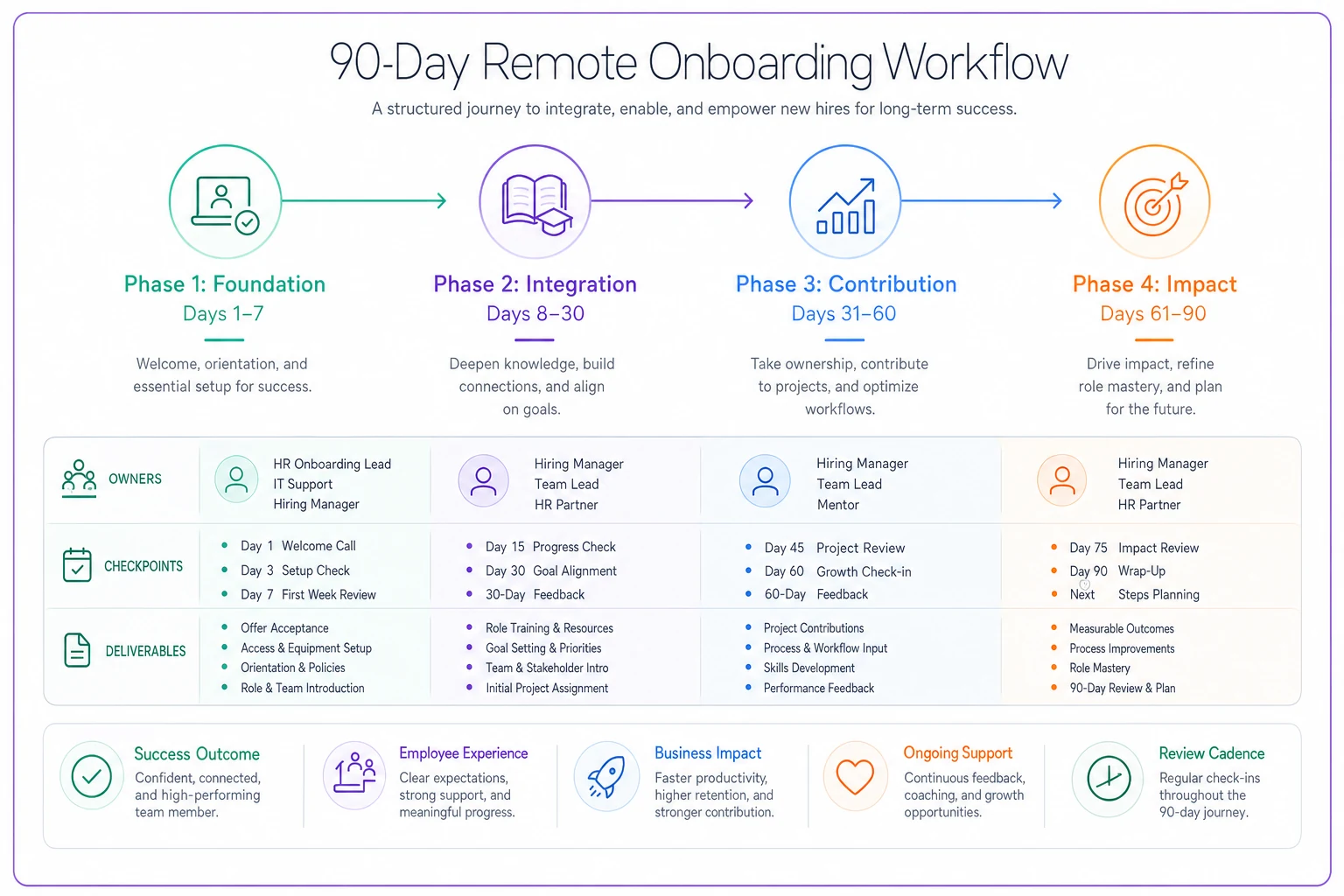
Use it as a checklist during the first 90 days.
The ownership matrix that eliminates confusion
Remote onboarding fails when everyone assumes someone else is handling things. Clear ownership prevents new hires from falling through cracks.
| Timeline | HR Owns | Manager Owns | Peer Buddy Owns | New Hire Owns |
|---|---|---|---|---|
| Pre-arrival | Offer logistics, paperwork, equipment ordering | Role preparation, stakeholder alerts, project planning | None yet | Paperwork completion, equipment confirmation |
| Days 1–7 | Compliance, benefits, system access coordination | Goal setting, team intros, first week schedule | Initial connection, tool orientation | Setup completion, intro messages, availability |
| Days 8–30 | None directly | Stakeholder mapping, first assignment, daily visibility | Daily check-ins, cultural context, unofficial answers | Interview completion, documentation, first deliverable |
| Days 31–60 | Engagement check-in | Project ownership, weekly 1:1s, public recognition | Twice-weekly check-ins, ongoing support | Project delivery, communication, collaboration |
| Days 61–90 | Success metrics, retention assessment | Normal management, development planning | Informal relationship | Full productivity, process feedback |
Print this out and walk through it before every new hire starts. You'll find gaps immediately.
Warning signs that predict remote onboarding failure
Certain patterns at the 30, 60, and 90-day marks predict whether a remote hire will succeed or leave. Catching these early allows for intervention before disengagement becomes irreversible.
Day 30 red flags:
-
Hasn't spoken in team meetings
-
Slack messages only between 9am–5pm exactly
-
No questions asked despite a complex environment
-
Manager can't articulate what they're working on
-
Peer buddy reports minimal interaction
Day 60 danger zones:
-
First project significantly delayed or descoped
-
Still scheduling "intro calls" with teammates
-
Work requires heavy manager editing
-
Misses optional team events consistently
-
Productivity metrics below 40% of target
Day 90 failure indicators:
-
Operating as a solo contributor despite a collaborative role
-
Manager dreads 1
1s
-
Peers route around them for faster results
-
No organic relationship development
-
Already talking about "next opportunities"
The day 60 warning signs are the ones most managers miss. By day 90 it's usually too late to fix without a serious conversation.
Building measurement into the foundation
Most companies measure onboarding success through satisfaction surveys and 90-day retention rates. These are lag indicators—they catch problems after they're already unfixable. Better to build measurement into the process itself.
Track leading indicators weekly:
-
Number of stakeholder touchpoints
-
Slack message frequency
-
Document creation and editing activity
-
Meeting participation rate
-
Project milestone completion
Create visibility through simple dashboards showing:
-
Days since hire
-
Milestones completed vs. scheduled
-
Manager checkpoint completion
-
System access confirmations
-
Productivity ramp percentage
This data helps identify patterns across hires. Maybe engineers consistently struggle at day 40. Maybe salespeople need more stakeholder intros. Maybe the peer buddy program works well for certain roles but not others. Without measurement, these patterns stay invisible and keep repeating. You end up solving the same onboarding problems over and over because nobody connected the dots.
Track three leading indicators weekly to identify role-specific patterns early.
This approach surfaces problems while there's still time to change the onboarding plan for a given hire.
The technology layer that enables execution
Manual tracking of milestones, checkpoints, and deliverables becomes unmanageable beyond a few simultaneous hires. Spreadsheets break. Calendars get messy. Things slip.
This is where thoughtful automation actually earns its place. AI-powered operational platforms can handle the repetitive coordination work—triggering reminders for manager checkpoints, automatically scheduling stakeholder interviews based on calendar availability, tracking deliverable completion, and surfacing warning signs through activity patterns. The technology handles logistics so managers can focus on relationship building and actual capability development.
For companies hiring multiple remote employees monthly, this kind of automation layer means the difference between consistent onboarding experiences and chaotic variance depending on who remembers what. It ensures every new hire gets the same foundational structure while still allowing customization for role-specific needs.
A realistic transformation scenario
Consider a 45-person marketing agency that shifted to fully remote operations. They were hiring two to three people monthly but losing close to 30% within six months. New hires consistently reported feeling isolated and unclear on expectations. Managers complained that productivity took four to five months to materialize.
They implemented this 90-day framework with clear ownership and checkpoints. HR stopped trying to own relationship building and focused on logistics and measurement. Managers received templates and training on remote-specific checkpoint conversations. Peer buddies were assigned from similar roles—people who'd joined within the past year and still remembered what the confusion felt like.
The first cohort under the new system showed obvious differences. By day 30, new hires had completed stakeholder interviews and delivered initial work. By day 60, they owned real projects with visible progress. By day 90, they were operating at roughly 75% productivity versus the previous 40%.
The soft metrics improved too. New hires reported feeling connected despite never meeting colleagues in person. Managers said onboarding felt less burdensome because expectations were clear on both sides. The peer buddy relationships continued long after the formal program ended.
Six-month retention climbed from 70% to 92%. Time to full productivity dropped from around five months to closer to three and a half. The agency estimated each successful onboarding saved roughly $12,000 in reduced replacement costs and faster revenue contribution.
The decision framework for implementation
This structured approach makes sense for companies that are fully remote or hybrid with distributed team members, hiring at least one person monthly, experiencing remote retention problems, or struggling with slow productivity ramps. For companies with fewer than 10 employees where informal onboarding still works fine, or completely co-located teams, this level of structure is probably overkill.
The framework requires real commitment from multiple stakeholders. HR needs to stop trying to own relationship building. Managers need to invest time in structured checkpoints rather than casual check-ins. Someone needs to assign and train peer buddies. And leadership needs patience—it takes a few hire cycles before the framework shows consistent results.
Start with a pilot for the next three to five hires. Document everything. Gather feedback at each milestone. Adjust timelines and deliverables based on what you actually observe.
-
Audit your current onboarding against the ownership matrix—identify who owns nothing and where tasks are assumed rather than assigned
-
Build the pre-arrival IT checklist and assign a single owner accountable for day-one access
-
Identify and brief peer buddies before your next hire starts, not after
-
Set manager checkpoint reminders for days 5, 21, 45, and 75
-
Define the first real project for each new hire before their start date
-
Track at least three leading indicators weekly for the first 90 days
-
Run a retrospective after each hire's first 90 days and update the framework accordingly
After a few months, you'll have a version that fits your specific context rather than a generic template borrowed from someone else's company.
The compound effect of structured remote onboarding
Remote onboarding isn't about recreating office experiences through video screens. It's about building deliberate structures that create momentum, clarity, and connection despite physical distance.
When new remote hires know what success looks like, who owns what, and how to demonstrate progress, they stop wondering if anyone notices their work. They stop waiting for direction that isn't coming. They stop second-guessing whether they made the right decision to join.
Instead, they build momentum through completed milestones. They develop relationships through structured interactions that eventually become something more organic. They contribute meaningfully because expectations are clear and support is available when they need it.
The companies that genuinely excel at remote work don't rely on culture or charisma to integrate new hires. They build operational systems that give every remote employee the same foundational structure—regardless of their manager's skill level or their team's dynamics. That's what turns remote hiring from a risky experiment into something that actually compounds over time.
The companies that genuinely excel at remote work don't rely on culture or charisma to integrate new hires. They build operational systems that give every remote employee the same foundational structure—regardless of their manager's skill level or their team's dynamics. That's what turns remote hiring from a risky experiment into something that actually compounds over time.
Ready to transform your HR processes?
Join thousands of HR teams using Hiryly to hire faster, engage employees better, and stay compliant effortlessly.