


Most quality-of-hire experiments fail because HR teams try to redesign their entire hiring funnel at once. They spend months planning complex A/B tests, arguing about attribution models, then watch the whole thing collapse when hiring managers refuse to follow new protocols.
What actually works is messier and more boring: run micro-experiments on single touchpoints. Change one interview question. Test one reference check tweak. Adjust one onboarding element. Measure after 30 days, keep what works, kill what doesn't.
The experiments that tend to generate measurable improvements share three things: they take less than two hours to implement, they don't require manager buy-in beyond basic participation, and they produce clear signals within 60 days.
The reality of quality-of-hire measurement
Quality of hire is the metric everyone talks about and almost nobody measures properly. The typical approach combines performance ratings, retention data, and manager satisfaction surveys collected 6–12 months post-hire. By then, it's too late to iterate quickly.
For rapid experimentation, you need leading indicators that show up within your 60-day window but still correlate with long-term success—things like ramp-time metrics, early performance indicators, manager confidence ratings at 30 days, peer feedback scores, and onboarding completion velocity.
Accept imperfect but directionally correct data over waiting for perfect long-term validation. A 15% improvement in 30-day manager confidence ratings typically translates to meaningful gains in 12-month retention, even if the correlation isn't airtight.
Run these experiments and you'll start seeing patterns in your own hiring data that no framework or industry benchmark could have predicted.
Experiment 1: The structured reference check upgrade
Hypothesis: Most reference checks are useless because recruiters ask generic questions that generate generic answers. Switching to behavioral reference questions about specific situations will surface red flags and validate strengths more effectively.
Eliminate HR bottlenecks with smart automation.
Hiryly simplifies your HR operations so you can focus on people, not paperwork.
- Centralized candidate tracking
- Automated onboarding workflows
- Performance & compliance dashboards
No credit card required
Current state: Your recruiters probably ask references some version of "Would you hire this person again?" and "What are their strengths and weaknesses?" References give canned responses. Nobody learns anything.
Experiment design: Replace your standard reference questions with these behavioral probes:
-
"Tell me about a time [candidate] had to deliver difficult feedback to a peer. How did they handle it?"
-
"Describe a project where [candidate] faced an ambiguous problem with no clear solution. What was their approach?"
-
"When [candidate] missed a deadline or made a mistake, how did they respond?"
-
"Give me an example of when [candidate] had to work with someone they found challenging."
Sample size needed: 20 hires (10 control, 10 treatment)
Measurement approach:
-
30-day manager confidence rating (1–10 scale)
-
Time to first meaningful contribution (manager reported)
-
Early warning flags identified (performance concerns raised in first 60 days)
Create a simple tracking sheet with columns for hire date, group assignment, manager rating at 30 days, and any performance flags.
Implementation effort: 2 hours to create the new question set and brief your recruiting team.
Expected uplift: 20–25% improvement in 30-day manager confidence scores. You'll also catch a few poor fits you would have missed with generic questions.
Experiment 2: The pre-boarding connection program
Hypothesis: The two-week gap between offer acceptance and start date is when good hires get cold feet and accept counteroffers. Regular touchpoints during this window will reduce dropout and increase day-one engagement.
Current state: After accepting an offer, most candidates hear nothing until a week before their start date when someone sends them paperwork. During that silence, their current employer makes a counteroffer, their spouse starts asking questions, and doubt creeps in.
Experiment design: Create a 5-touchpoint sequence between offer acceptance and day one:
-
Day 1
Hiring manager sends personal video message welcoming them
-
Day 3
Future teammate sends email about current projects
-
Day 7
HR sends "meet your team" packet with bios and fun facts
-
Day 10
Manager schedules optional 15-minute "pre-boarding coffee chat"
-
Day 12
Team member texts asking if they have any questions
Sample script for manager video (keep under 90 seconds): "Hey [Name], just wanted to drop you a quick note to say how excited I am that you're joining the team. We're right in the middle of [specific project], and your experience with [relevant skill] is going to be huge for us. I know starting a new role can feel overwhelming, so don't hesitate to reach out if you have any questions before your first day. Looking forward to having you on board!"
Sample size needed: 30 hires (15 control, 15 treatment)
Metrics to track:
-
Offer acceptance to start date dropout rate
-
Day-one readiness score (self-reported 1–10)
-
Week-one check-in score from manager
-
Time to first project assignment
Implementation effort: 3 hours to set up the templates and brief managers.
Expected uplift: Meaningful reduction in pre-start dropouts, along with noticeably better day-one readiness scores.
Experiment 3: The skills validation exercise
Hypothesis: Interview performance doesn't predict job performance because candidates can fake competence through rehearsed answers. A 30-minute skills exercise that mirrors actual work will better predict success.
Current state: You ask candidates to describe how they've handled situations. They give polished answers about their achievements. You hire them. Three months later, you discover they can't actually do the work.
Experiment design: Add a 30-minute work sample exercise between first and final interview:
-
For analysts
Provide a messy dataset and ask for three insights
-
For managers
Give a team conflict scenario and ask for a resolution plan
-
For salespeople
Role-play a discovery call with a skeptical prospect
-
For engineers
Debug a piece of broken code
-
For marketers
Write three email subject lines for a campaign
Keep it realistic but simple. The goal isn't perfection—it's seeing how they approach real problems.
Sample size needed: 40 hires (20 control, 20 treatment)
What to measure:
-
Exercise score correlation with 60-day performance rating
-
Manager confidence at 30 days
-
Ramp time to full productivity
-
Early performance warnings
Implementation effort: Around 4 hours to design exercises for your top three or four roles.
Expected uplift: Noticeably better prediction of 60-day performance and fewer hires who interview well but can't actually do the job.
Experiment 4: The manager readiness checkpoint
Hypothesis: A lot of bad hires happen because hiring managers weren't actually ready to onboard someone. A pre-opening checkpoint will prevent premature hiring and improve new hire success.
Current state: Manager says they desperately need someone. You rush to fill the role. New hire shows up and discovers the manager has no plan, no projects ready, and no time to train them. The hire struggles and leaves within six months.
Experiment design: Before posting any role, require managers to complete this readiness checkpoint:
-
Document the first 30 days of projects (specific deliverables, not vague goals)
-
Identify the designated buddy/mentor (with their confirmation)
-
Block 2 hours daily for first-week training
-
Prepare a starter project that can be completed in week one
-
Write down three specific skills they'll assess in the first 30 days
If they can't complete this in 30 minutes, they're not ready to hire.
Tracking requirements:
-
Control
Roles opened without checkpoint
-
Treatment
Roles requiring completed checkpoint
Sample size needed: 20 hires (10 per group)
Metrics to track:
-
30-day manager satisfaction with hire
-
New hire ramp time
-
60-day retention
-
"Preparedness score" from new hire at day 7
Implementation effort: 1 hour to create the checkpoint, 1 hour to train managers.
Expected uplift: Faster ramp time and meaningfully higher 30-day satisfaction scores.
Experiment 5: The peer interview addition
Hypothesis: Managers often miss culture fit issues that peers would catch immediately. Adding a 30-minute peer conversation will reduce culture-based turnover.
Current state: Hiring manager loves the candidate's experience. Candidate joins. Team finds them insufferable. Collaboration suffers. Performance tanks. They're gone in four months.
Experiment design: Insert a 30-minute peer conversation between second interview and offer. Not a formal interview—position it as "a chance to ask questions about the day-to-day reality of the role."
-
How does this person handle feedback?
-
Would I want them on my project team?
-
Do they ask thoughtful questions?
The peer provides a simple hire/no-hire recommendation with one paragraph of reasoning.
Sample peer briefing script: "You're meeting with [candidate] for 30 minutes. This isn't a technical interview—we've already validated their skills. I need you to assess whether you'd want them as a teammate. Have a natural conversation about our work, our challenges, how we collaborate. Then tell me: would you want them on your next project?"
Sample size needed: 30 hires (15 control, 15 treatment)
What to measure:
-
Peer hire/no-hire accuracy (compare to 60-day outcomes)
-
Team integration score at 30 days
-
Culture-related exit rates
-
Collaboration feedback from first project
Implementation effort: 2 hours to design the process and brief first peers.
Expected uplift: Meaningful reduction in culture-fit terminations and better team integration scores.
Experiment 6: The realistic job preview upgrade
Hypothesis: Candidates accept offers based on polished job descriptions then discover the actual work is completely different. Showing them real work examples will improve retention and performance.
Current state: Your job description says "strategic thinking" and "stakeholder management." The actual job is Excel spreadsheets and chasing people for approvals. New hires feel deceived and disengage fast.
Experiment design: During the interview process, show candidates these reality-check materials:
-
Screenshots of actual daily tools they'll use
-
Calendar screenshot of a typical week
-
List of the five most common fire drills they'll handle
-
Example of the most boring recurring task
-
Video of team's actual workspace (if on-site)
Present it as "Here's what Tuesday actually looks like in this role..."
Sample size needed: 24 hires (12 per group)
Metrics to track:
-
Offer acceptance rate (might go down—that's actually fine)
-
30-day "role matches expectations" score
-
60-day retention
-
Voluntary turnover citing "not what I expected"
Implementation effort: 3 hours to gather materials for your highest-volume roles.
Expected uplift: Less expectation-mismatch turnover and higher role satisfaction at 60 days.
Experiment 7: The hiring manager calibration session
Hypothesis: Different managers have wildly different standards for "good enough," leading to inconsistent quality of hire across teams. A monthly calibration session will standardize expectations and improve overall hiring decisions.
Current state: Manager A hires anyone with a pulse because they're desperate. Manager B rejects great candidates over minor concerns. Manager C has no idea what they actually need. The result is wildly inconsistent quality across teams.
Experiment design: Run a monthly 60-minute calibration session where managers review recent hiring decisions:
-
Each manager presents one recent hire (5 minutes)
-
Group rates the hire decision (1–5 scale)
-
Discussion of what signals were missed or overweighted
-
Agreement on "must-have" vs "nice-to-have" criteria for common roles
Sample calibration discussion guide:
-
"Let's review Sarah's hire for the analyst role
"
-
What signals suggested she'd succeed?
-
What concerns did we have?
-
Now that she's 30 days in, what do we know?
-
What would we do differently?
Sample size needed: Compare 10 hires from managers who attend sessions vs 10 from those who don't.
Metrics to track:
-
60-day quality scores for hires
-
Variance in quality ratings across managers
-
Manager confidence in hiring decisions
-
Speed of hiring decisions
Implementation effort: 2 hours to design the first session, then 1 hour monthly.
Expected uplift: Reduced quality variance across teams and a modest improvement in average quality scores.
Experiment 8: The early warning system
Hypothesis: Most bad hires show warning signs in their first two weeks, but nobody captures these signals systematically. A simple weekly check-in for the first month will catch problems before they become unfixable.
Current state: New hire struggles silently for two months. Manager assumes they're "just adjusting." By month three, it's obvious they're not working out, but now it's awkward to address. They limp along for six months before leaving.
Experiment design: Implement a week 1, 2, 3, and 4 checkpoint email to managers: "Rate your confidence that [new hire] will succeed in this role (1–10). If below 7, what specific concern do you have?"
When confidence drops below 7, trigger an intervention:
-
HR schedules 30-minute diagnosis call with manager
-
Specific support plan created
-
Follow-up in one week
Sample size needed: 40 hires (20 control, 20 with early warning system)
What to measure:
-
Number of concerns identified in first 30 days
-
Correlation between early warnings and 90-day outcomes
-
Successful interventions (concerns resolved)
-
Time to identify poor fits
Implementation effort: About 1 hour to set up automated emails and a tracking sheet.
Expected uplift: Significantly faster identification of poor fits and a reasonable success rate on early interventions.
Building your measurement infrastructure
None of these experiments work without a simple tracking system. You don't need complex analytics—a Google Sheet with these columns will do:
| Column | What to capture |
|---|---|
| Hire name | Full name |
| Start date | Actual first day |
| Experiment group | Control or treatment |
| Manager | Hiring manager name |
| 30-day score | Manager confidence rating |
| 60-day score | Follow-up performance rating |
| Intervention notes | Any support actions taken |
| Outcome | Still employed / left / PIP |
There's a temptation to overcomplicate this with attribution models and statistical significance testing. Resist it. Look for directional improvements, not perfect proof.
If you're short on time, capture hire name, group, and 30-day score first—it's enough to surface directional signals quickly.
Here's a simple visual of the workflow you'll set up.
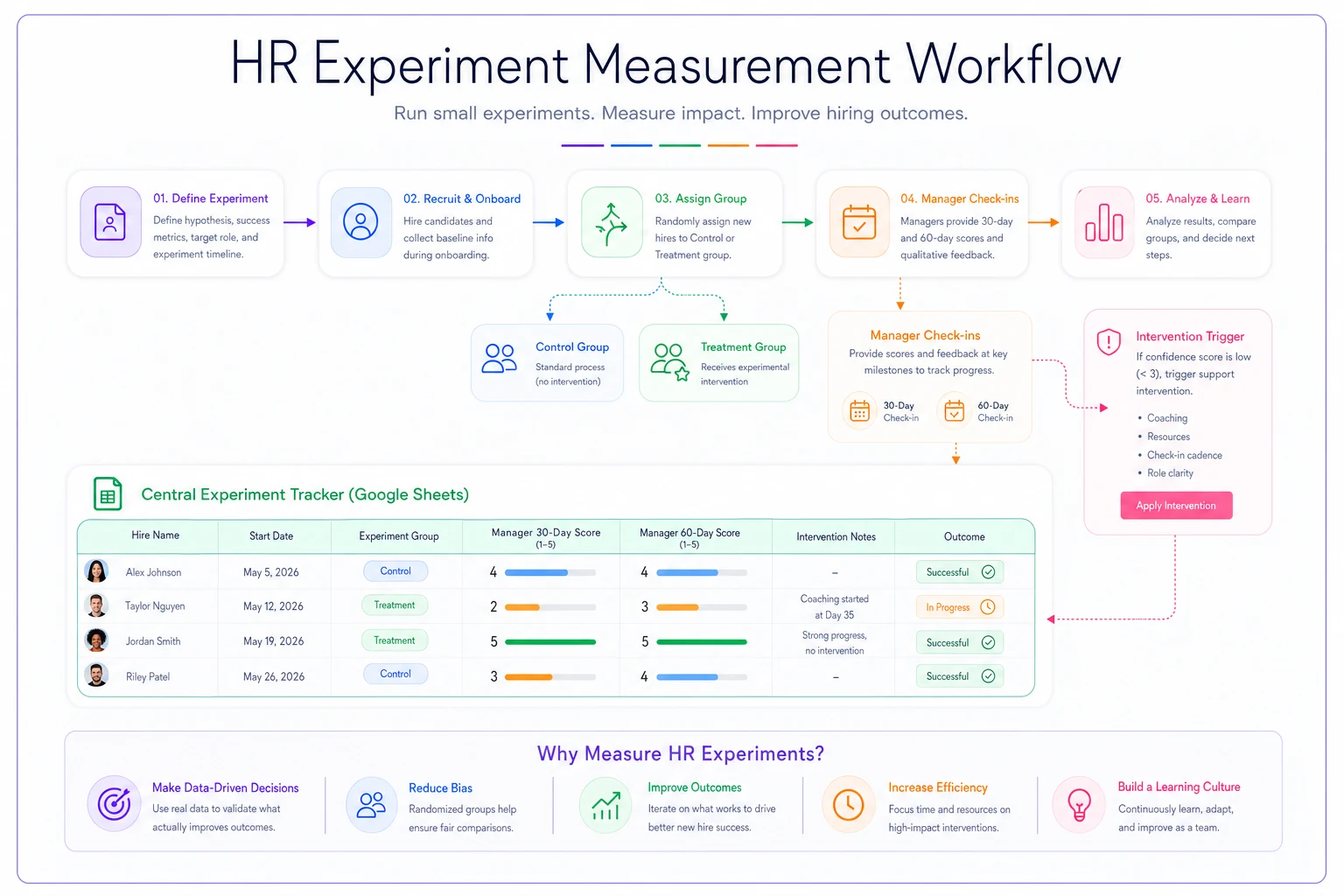
Keep the system obvious and low-friction so people actually use it.
Choosing which experiments to run first
Start with the experiment that addresses your biggest current pain point:
-
If offers keep getting declined
Run the pre-boarding connection program
-
If new hires keep quitting after two months
Try the realistic job preview
-
If quality varies wildly across teams
Start manager calibration sessions
-
If hires look good on paper but can't perform
Add skills validation exercises
You can run two or three of these simultaneously without overwhelming your team. Just keep clean tracking to avoid contamination between experiments.
Common failure modes to avoid
Running experiments too long: If you don't see signal after 30 days, kill it and try something else. The goal is rapid iteration, not perfect data.
Asking managers to do too much: Each experiment should require less than 30 minutes of manager time per hire. Anything more won't get adopted.
Overcomplicating measurement: You need directional accuracy, not statistical perfection. If the treatment group is clearly outperforming control, that's enough signal to expand.
Not killing failures fast enough: Half your experiments will show no improvement. That's fine. Kill them quickly and move on.
Making improvements stick with operational software
Most HR teams fumble at this stage. They identify improvements but can't operationalize them at scale. Behavioral reference checks improve quality, but recruiters gradually drift back to easy generic questions. Pre-boarding touchpoints reduce dropout, but managers forget to send their videos.
This is where AI-powered operational software actually earns its place. Instead of hoping everyone remembers new protocols, you build them into automated workflows. The system prompts recruiters with your validated behavioral questions. It automatically triggers manager video requests on day one after offer acceptance. It tracks completion rates and flags when someone skips a step.
The experiments tell you what works. The operational platform ensures it actually happens, every time, without someone manually chasing it down. AI automation handles the repetitive scheduling, reminder sending, and tracking—so your team can stay focused on the human elements that actually drive quality.
Without that operational backbone, successful experiments decay. Manual processes depend on individual discipline, which degrades under pressure. When your proven improvements are encoded into software workflows, they stop being fragile habits and start being actual competitive advantages.
Quality of hire experiments are about speed, not perfection
Most organizations treat quality of hire like a multi-year research project. They form committees, debate definitions, and design elaborate measurement frameworks that never actually launch. Meanwhile, their competitors are running rapid experiments, learning what works, and gradually pulling ahead.
The experiments outlined here aren't perfect. They won't give you publication-worthy data or definitively prove causation. But they will generate rapid insights about what moves the needle in your specific context.
Start with one experiment next week. Run it for 30 days. Keep what works, kill what doesn't, then try something else. Within 60 days, you'll have more actionable insights than most organizations get from a year of strategic planning.
The real competitive advantage isn't finding the perfect quality-of-hire formula—it's building the operational muscle to continuously experiment, measure, and improve faster than your talent competition.
Start with one experiment next week. Run it for 30 days. Keep what works, kill what doesn't, then try something else. Within 60 days, you'll have more actionable insights than most organizations get from a year of strategic planning.
The real competitive advantage isn't finding the perfect quality-of-hire formula—it's building the operational muscle to continuously experiment, measure, and improve faster than your talent competition.
Ready to transform your HR processes?
Join thousands of HR teams using Hiryly to hire faster, engage employees better, and stay compliant effortlessly.