

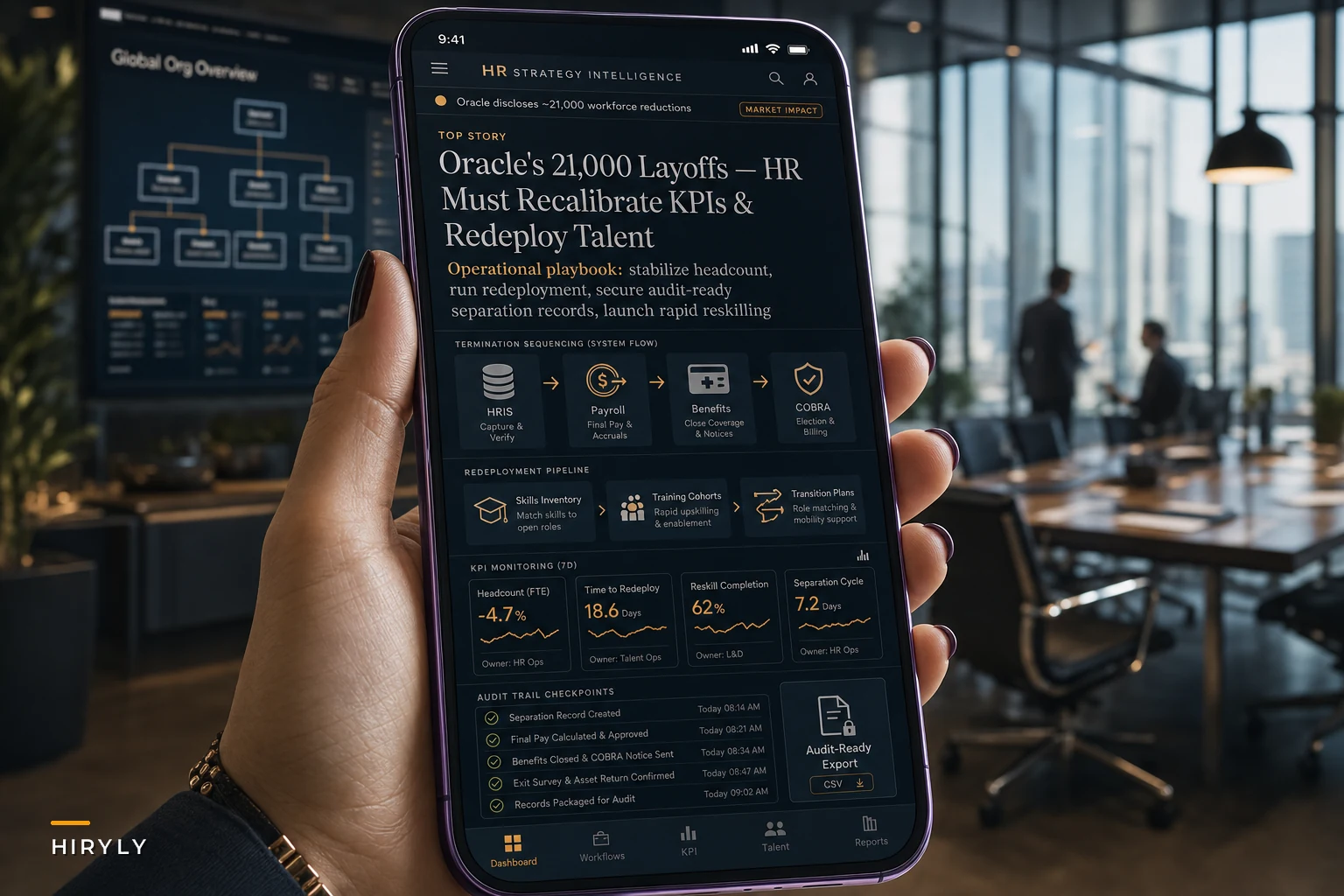

Oracle just reported cutting around 21,000 roles over the past fiscal year—roughly 13% of their workforce. That's not just a headline number. That's thousands of separation packages to process, benefits to terminate, COBRA notices to send, and final paychecks to calculate correctly.
For HR teams watching this unfold, the message is hard to ignore: AI-driven restructuring isn't some future scenario anymore. It's happening at scale, and the operational weight of it lands directly on HR.
What most HR leaders miss during these events is that the entire metrics framework becomes unreliable almost overnight. The headcount forecasts built in Q1? Useless. Cost-per-hire benchmarks? Meaningless when hiring freezes kick in. Retention models? They weren't built to predict voluntary exits during a restructuring panic.
There are three distinct waves of operational chaos that hit HR teams during mass layoffs. First comes the immediate termination processing—the paperwork that needs to be airtight to avoid lawsuits. Then comes the redeployment puzzle, where you're trying to match remaining employees to new roles while half of them are quietly updating their LinkedIn. Finally, there's the metrics rebuild phase, where every dashboard and forecast needs recalibration.
Most organizations handle the first wave adequately. The second and third tend to fall apart.
The termination processing bottleneck nobody plans for
During large-scale reductions, HR operations usually break at one specific point: benefit termination timing. Not the decisions about who gets cut. Not the severance math. The actual sequencing of when benefits end, when COBRA kicks in, and how that aligns with final paycheck processing.
HR gets a list of 500 people to terminate by month-end. Legal reviews severance agreements. Finance approves the packages. Communications drafts the announcement. Everything looks ready.
Then someone realizes the benefits platform only allows bulk terminations on the first or fifteenth. Payroll needs five business days to process final checks. COBRA notices require 44 days from the qualifying event. State unemployment notification windows vary by jurisdiction.
That clean month-end termination turns into a six-week mess where different systems show different employment statuses for the same person.
Termination sequencing matrix:
-
Map every downstream system that needs updating (HRIS, payroll, benefits, 401k, equity, building access, IT)
-
Document the lead time each system requires
-
Build a reverse timeline from the target termination date
-
Add buffer days between critical handoffs
-
Test with a small batch before processing hundreds
One mid-sized tech company had to reverse 47 terminations because benefit cancellations were processed before the final payroll run, triggering deductions that couldn't be clawed back. The rework took three weeks and generated dozens of corrective tax filings.
Why standard redeployment programs fail at scale
Most redeployment efforts follow the same pattern: HR creates a "talent marketplace," posts internal opportunities, and hopes people self-select into new roles.
Eliminate HR bottlenecks with smart automation.
Hiryly simplifies your HR operations so you can focus on people, not paperwork.
- Centralized candidate tracking
- Automated onboarding workflows
- Performance & compliance dashboards
No credit card required
This falls apart quickly when you're moving hundreds of people at once.
The core problem is that redeployment at scale is a supply chain problem, not a job board problem. You need to match skills inventory against role requirements—but more critically, you need to sequence the moves so you don't create operational gaps that nobody planned for.
Take a scenario where a company tries to redeploy 200 engineers into product management and customer success. The engineers need real training—usually four to six weeks minimum. During that window, their previous responsibilities still exist. Move everyone at once and you've got a massive hole in delivery capacity. Stagger the moves and you need temporary coverage plans that most organizations never actually build.
Redeployment operational checklist:
| Phase | Timeline | Critical Tasks | Common Failure Point |
|---|---|---|---|
| Skills Assessment | Week 1-2 | Document current capabilities, identify transferable skills | Using outdated job descriptions instead of actual work performed |
| Role Mapping | Week 2-3 | Match skills to available positions, identify training gaps | Assuming all engineers can become PMs with minimal ramp time |
| Training Design | Week 3-4 | Build accelerated training programs, assign mentors | Generic training that doesn't address specific role requirements |
| Transition Planning | Week 4-5 | Create coverage plans, document handoffs | No contingency for people who don't succeed in new roles |
| Performance Tracking | Week 6+ | Monitor productivity in new roles, adjust support | Measuring with standard KPIs instead of transition-specific ones |
The organizations that actually pull off large-scale redeployment treat it like a production line. Batched training cohorts. Tiger teams handling coverage gaps. And an honest acceptance that somewhere between 20-30% of redeployments won't stick—so they build for that outcome instead of pretending it won't happen.
Recalibrating KPIs when your baseline explodes
After a major restructuring, almost every HR metric becomes suspect. Time-to-fill looks great because nothing's being filled. Turnover spikes, then craters. Training hours per employee jumps during redeployment and then drops to near zero.
Standard KPI frameworks assume some level of organizational stability. When that disappears, you need metrics that actually reflect what's happening during a transition—not what normally happens when things are running smoothly.
Instead of tracking cost-per-hire, track redeployment success rate: what percentage of reassigned employees are still productive at 90 days? Instead of measuring overall turnover, split it—restructuring-related exits versus organic attrition. Instead of time-to-fill, focus on critical role coverage: how many business-critical positions have been vacant beyond what the business can absorb?
The harder challenge is maintaining audit-ready data while your systems are mid-flux. Every termination needs documentation. Every redeployment needs a paper trail. Every metric adjustment needs a rationale someone can explain months later.
This is where a robust HR metrics operating system matters more than usual. Without clear data ownership, defined update cadences, and consistent taxonomies, your numbers become unreliable during exactly the period when people are scrutinizing them hardest. You can't explain to the board why headcount dropped 13% but labor costs only fell 8%. You can't defend severance accruals when finance pushes back. And you definitely can't prove WARN Act compliance when regulators start asking questions.
The audit trail requirements that get overlooked
During mass layoffs, documentation requirements don't scale linearly—they multiply. It's not just recording who was terminated and when. You need to prove selection criteria were non-discriminatory. You need to document every benefits notification. You need records for unemployment claims, COBRA administration, and the litigation that sometimes follows.
Most HR teams focus on selection documentation—the spreadsheets showing performance ratings, tenure, and business justification. But the operational documentation gaps tend to create bigger legal exposure:
-
Email communications about restructuring plans (these become evidence)
-
System access logs confirming when benefits were terminated
-
Training records for staff handling terminations
-
Version control for severance agreement templates
-
Acknowledgment receipts for every required notification
Critical audit documentation checklist:
-
Selection criteria documentation with manager sign-offs
-
Adverse impact analysis by protected class
-
Individual notification letters with delivery confirmation
-
Benefits termination confirmations from each vendor
-
Final paycheck calculations with deduction details
-
WARN Act notifications with required timing
-
Severance agreement execution with consideration periods
-
System access termination across all platforms
-
Return of company property documentation
-
Exit interview records where applicable
A retail company went through a roughly 3,000-person reduction thinking their documentation was solid. About six months later, during an EEOC investigation, they found out their benefits administrator had been using paper forms for COBRA notifications and only scanning them monthly. Nearly 40% of the notifications were missing or misdated. The settlement ended up exceeding the total savings from the headcount reduction.
Building an HR operational framework that holds under pressure
The companies that navigate restructuring without operational collapse don't build their workflows after cuts are announced. They maintain frameworks that can scale in either direction without breaking.
Start with termination processing infrastructure. Build templates, workflows, and checklists during stable periods. Test them with small voluntary separation programs. Document every system dependency and timing requirement so that when volume spikes, the process doesn't require heroics to execute.
Test termination workflows during low-volume periods using voluntary separation pilots to validate sequencing and lead times.
Build your redeployment machinery before you need it. Maintain current skills inventories—not the versions that HR hasn't updated since the last performance cycle, but actual current-state documentation. Establish relationships with training providers. Define clear criteria for what redeployment success and failure look like. And prepare managers to receive redeployed talent, because they often resist it even when those employees have real potential in new roles.
For metrics, assume your current baselines could become obsolete at any point. Build frameworks that accommodate large swings in headcount, sudden hiring freezes, and accelerated attrition at the same time. Define transitional KPIs that can be activated during restructuring and make sure every metric has a clear owner—especially since some of those owners might themselves be part of the reduction.
Treat audit readiness as an operational standard, not a compliance task you think about when something goes wrong. Every document created during restructuring could become evidence. Every email about selection criteria could be subpoenaed. Build documentation habits accordingly, not just documentation archives.
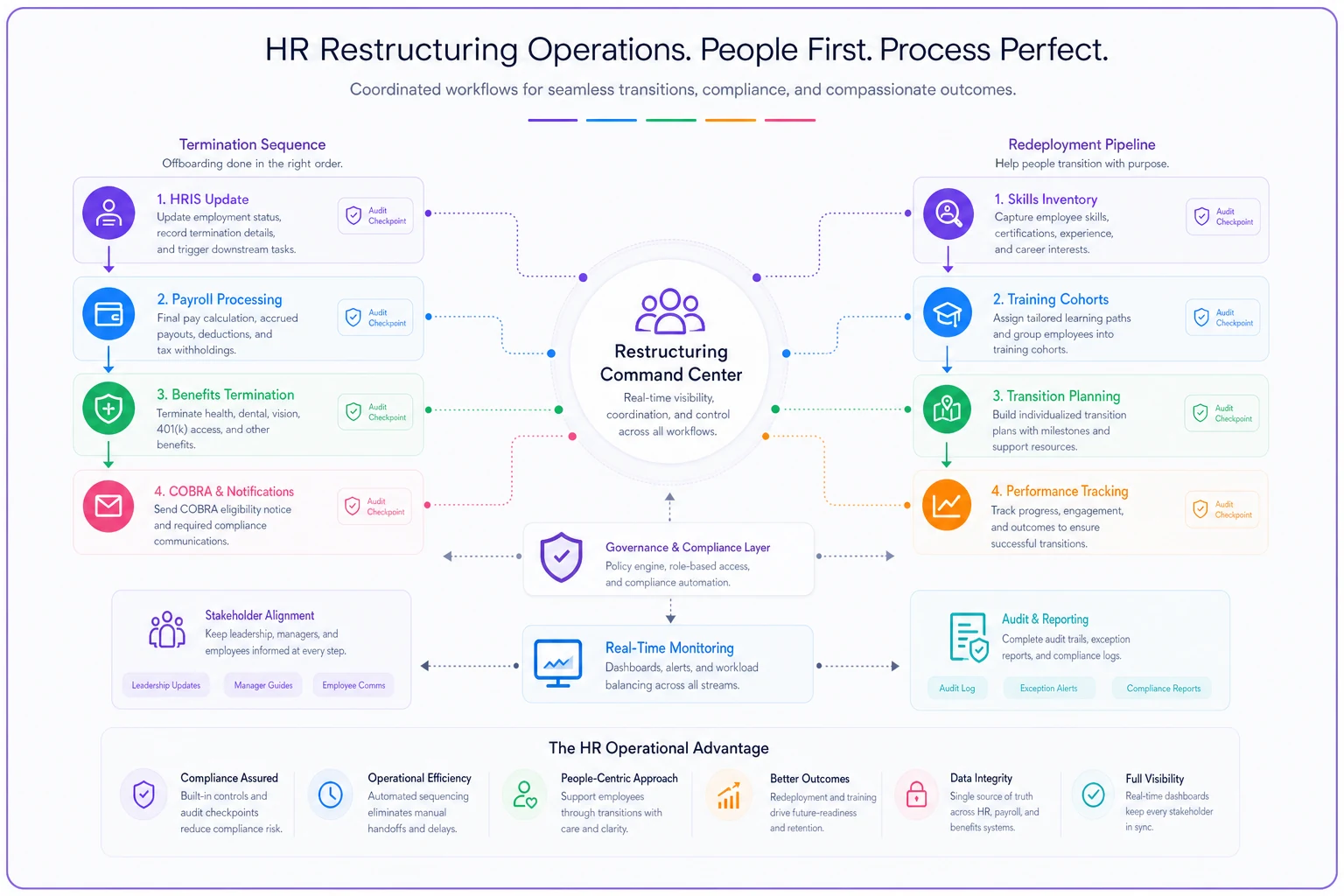
Here's a simple visual of how those pieces should fit together in practice.
Document your termination workflows now. Build your redeployment frameworks before you need them. Make sure your metrics can survive an organization that transforms significantly in a short window. Because when restructuring hits, there's no time to build any of this from scratch.
The uncomfortable reality about AI layoffs and HR response
What Oracle's reduction really signals isn't simply that AI is replacing workers. It's that companies are using AI adoption as cover to restructure operations they should have addressed years earlier. And the HR operational burden from that restructuring far exceeds what most teams are actually built to handle.
The HR organizations that come out of this period intact won't be the ones with the smoothest communications or the most generous severance packages. They'll be the ones whose operational infrastructure can process hundreds of terminations without errors, redeploy talent without creating delivery gaps, and produce reliable metrics when everything else is shifting.
Modern HR platforms with AI-powered workflow automation can genuinely help here—centralizing termination processing, automating benefits notifications, maintaining audit trails without manual effort. But the technology only works if the underlying operational discipline is already there. A better system running bad processes just produces cleaner mistakes.
The next round of restructuring is coming. Oracle won't be the last employer to announce significant cuts while simultaneously claiming AI is making them more efficient. The question isn't whether your HR team will face this—it's whether the operational foundation will hold when it arrives.
Document your termination workflows now. Build your redeployment frameworks before you need them. Make sure your metrics can survive an organization that transforms significantly in a short window. Because when restructuring hits, there's no time to build any of this from scratch.
Ready to transform your HR processes?
Join thousands of HR teams using Hiryly to hire faster, engage employees better, and stay compliant effortlessly.