

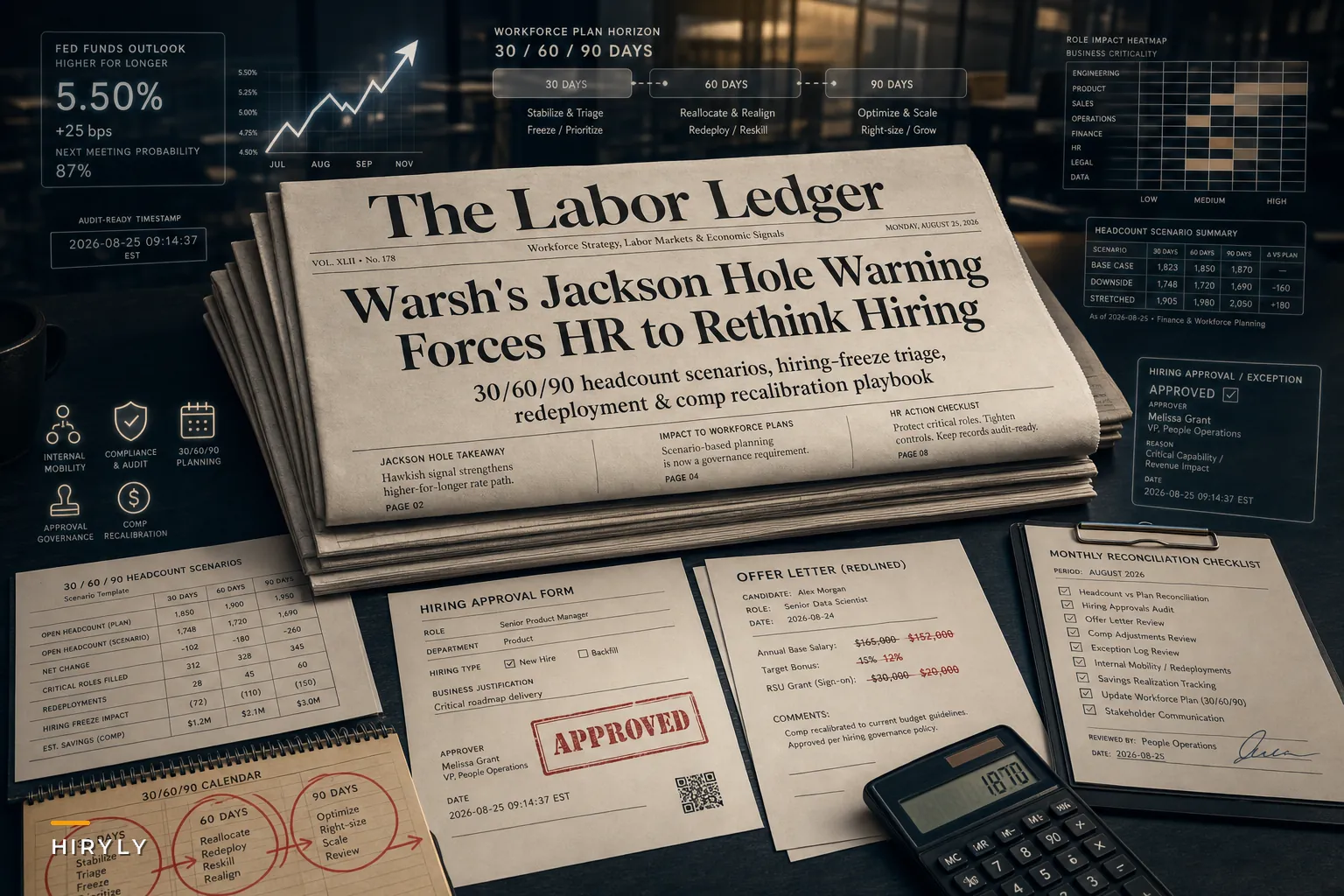

When Kevin Warsh spoke at Jackson Hole in late August, the takeaway wasn't subtle. Markets repriced almost immediately, with analysts shifting from "hold" to "maybe September" within hours. A Reuters roundup of the speech captured just how fast expectations moved.
For most HR leaders, a Fed speech feels like background noise — several layers removed from req approvals and offer letters. It isn't. The path from a hawkish signal to your hiring plan is shorter than people expect, and it almost always runs through Finance before HR is even in the loop.
The mistake most talent teams make isn't ignoring macro news. It's reacting three weeks late, after Finance has already frozen half your open reqs and you're suddenly explaining why time-to-fill numbers fell apart.
How a rate signal reaches your hiring plan
The sequence inside mid-market and enterprise companies is pretty consistent when rate-hike odds jump.
Cost of capital rises — or is expected to. CFOs re-run their models. Anything funded by debt gets a second look: expansion plans, new facilities, aggressive headcount growth. Within a week or two, you start hearing phrases like "let's be surgical about backfills" and "does this role need to be filled right now?"
By the time those phrases reach recruiting, the decision has usually already been made upstream. HR gets handed the outcome, not a seat in the conversation.
That's the real exposure Warsh's comments created — not the rate move itself, but how quickly budget assumptions can shift underneath a workforce plan built on last quarter's certainty. His full remarks are on the Fed's site, but the operational point holds regardless of whether September brings a hike or not: your planning model needs to survive the uncertainty, not just the eventual decision.
The teams that handle this well aren't the ones with a better forecast. They're the ones whose workforce plan already had rate sensitivity built in as a scenario, so a hawkish signal triggers a pre-agreed response instead of a fire drill.
The underlying problem: most workforce plans are single-scenario documents
Walk into a typical annual planning cycle and you'll find a headcount plan built around one revenue forecast, one attrition rate, one hiring pace. It reads like a prediction, not a plan.
Eliminate HR bottlenecks with smart automation.
Hiryly simplifies your HR operations so you can focus on people, not paperwork.
- Centralized candidate tracking
- Automated onboarding workflows
- Performance & compliance dashboards
No credit card required
That's fine when the environment is stable. It breaks the moment a Fed signal forces a mid-year reassessment, because a single-scenario plan has no built-in answer to "what do we cut first?" Every budget shift becomes a negotiation, and negotiations take weeks you don't have.
-
It carries at least two or three scenarios — base, tightening, sharp tightening — each with its own hiring pace and headcount ceiling
-
It ranks open and planned roles by criticality before the crisis, so the cut list already exists
-
It ties each scenario to an observable trigger, not a feeling
-
It separates genuinely deferrable roles from roles that create downstream operational risk if delayed
If you've never built the plan this way, that's the piece worth fixing first. There's a deeper walkthrough of why single-scenario planning consistently misses in this breakdown of workforce planning operating models — the scenario-template approach it describes is exactly what turns a Fed headline into a five-minute decision instead of a three-week scramble.
Triaging your open reqs before Finance does it for you
The instinct when budgets tighten is to freeze everything. That's a blunt instrument, and it usually costs more than it saves — it treats a critical revenue-generating hire exactly the same as a nice-to-have.
A better move is sorting every open and pipeline req into tiers now, while you still control the narrative.
| Req tier | What qualifies | Default action under tightening |
|---|---|---|
| Protected | Revenue-critical, safety/compliance, single points of failure | Keep moving, full speed |
| Conditional | Important but has coverage; role can absorb a short delay | Slow to a 2–3 week hold, reassess biweekly |
| Deferrable | Growth-oriented, speculative, or "build for later" | Pause, revisit next quarter |
| Convertible | Could be filled internally instead of externally | Redirect to internal mobility first |
The value of doing this before a freeze isn't just organizational — it's political. When you walk into the Finance conversation with a tiered list already built, you're offering a scalpel while everyone else is reaching for a hammer. That changes who's in the room when the real cuts get decided.
One thing worth flagging: the "convertible" tier is the one most teams underuse. A hiring slowdown is actually the best moment to push internal redeployment, because the external pipeline is exactly what's under pressure. Roles you were about to post externally can often be filled by a lateral internal move in half the time and at a fraction of the cost.
Prioritize building the tiered list now so Finance sees a surgical alternative to a blanket freeze.
That shift alone often lets you protect revenue-critical work while finding savings elsewhere.
Comp recalibration without blowing up your bands
Rate-driven budget pressure hits compensation from two directions at once, and they pull against each other.
Finance wants to slow comp growth — smaller merit pools, tighter promotion budgets, more scrutiny on off-cycle adjustments. At the same time, if the broader market cools, the external pressure that was inflating your offers may ease, which can actually give you room on new-hire comp.
The mistake is reacting to the first pressure without checking the second. Teams that slash their merit budget while still benchmarking against last year's overheated market end up simultaneously underpaying existing people and overpaying new hires. That's the worst of both outcomes, and it's surprisingly common.
-
Refresh your market data first. Don't adjust bands off stale benchmarks. If the market is softening, your ceilings may have already moved.
-
Separate merit from market. A tighter merit pool is a budget decision. A shifting band is a market decision. Conflating them creates equity problems you'll be auditing later.
-
Protect your top-quartile performers explicitly. When pools shrink, flat distribution feels fair but quietly signals to your best people that performance doesn't matter. Fund the top first.
-
Gate off-cycle exceptions harder — but keep a fast lane. More scrutiny is fine. A fast lane for genuine flight-risk or counteroffer situations is non-negotiable, or you'll lose people to process delays.
-
Model the total-rewards picture, not just base. Sometimes the answer under budget pressure is a benefits or equity lever rather than cash, especially where retention is the goal but base is constrained.
Across-the-board cuts are easy to explain and terrible in practice. They punish your strongest performers the same as everyone else, and your strongest performers have options.
Hiring governance: the part everyone skips until an auditor asks
When reqs get frozen, unfrozen, and re-tiered repeatedly, something quietly breaks: the audit trail.
Roles get paused verbally. Approvals happen in Slack. A hiring manager gets a "yes" from their VP that never makes it into the system. Then three months later, Finance or Legal asks why a particular role was filled during a freeze — and nobody can produce a clean record of who approved what and when.
-
One approval path, no side doors. Every req status change — pause, resume, re-tier, exception — flows through the same recorded workflow. If it happened in a hallway, it didn't happen.
-
Timestamp the decision and the trigger. "Role X paused on the 14th under the tightening scenario" is auditable. "We slowed hiring for a while" is not.
-
Name an owner per exception. Every role that moves against the current freeze needs a named approver on record. This is the single most common thing auditors ask about.
-
Reconcile monthly. A quick monthly pass comparing what the system shows to what actually happened catches drift before it becomes a finding.
In a calm year, req statuses barely move. In a quarter where a Fed signal triggers a mid-cycle reassessment, they move constantly — and every change is a chance for the record and the reality to diverge.
Here's a simple visual workflow to keep approvals auditable without adding side doors.
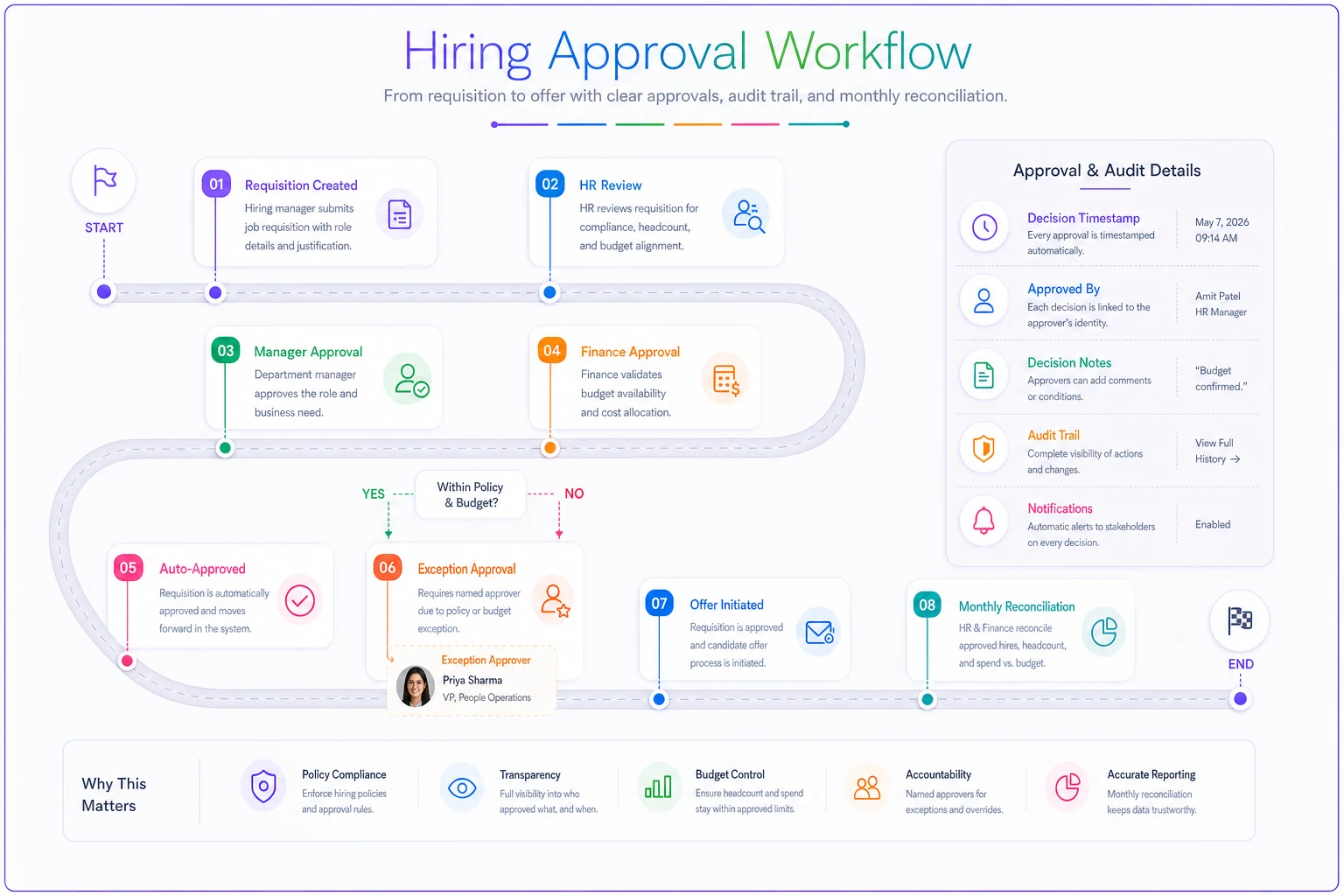
Keep the diagram at hand during Finance reviews so every exception can be traced to a policy and a person.
A short real scenario
A mid-market SaaS company with around 900 employees had roughly 40 open reqs going into the fall when budget pressure hit. Their first instinct was a blanket freeze.
Instead, their talent-ops lead spent two days tiering every open role. About 12 landed as protected, 15 as conditional, 8 as deferrable, and 5 as convertible to internal moves. When they brought that to Finance, the conversation shifted entirely — instead of arguing about whether to freeze, they were negotiating which conditional roles to hold and for how long.
They kept their revenue-critical hires moving, deferred somewhere in the range of $600k–$700k in annualized headcount cost by pausing the deferrable tier, and filled three of the convertible roles internally within about six weeks. When their audit committee reviewed hiring decisions that quarter, every pause and exception had a name and a date attached. No reconstruction after the fact.
The difference wasn't a better forecast. It was having the decision logic ready before they needed it.
When aggressive tightening is the wrong move
Not every rate signal calls for a defensive crouch. Reflexively freezing hiring can quietly damage the business.
Cutting hard is the wrong call when your open roles are directly tied to revenue you're already committed to delivering. Starving a growing revenue engine to save on headcount looks disciplined in a board deck and disastrous six months later when you can't service demand.
It's also the wrong move when attrition is already running hot. Layering a hiring slowdown on top of high voluntary turnover doesn't create savings — it creates a coverage crisis. Backfilling in a panic costs far more than steady hiring ever would.
And over-indexing on a single signal is a mistake full stop. A hawkish speech shifts probabilities; it doesn't guarantee outcomes. The point of scenario-based planning is that you respond proportionally to conditions, not headlines. If you freeze everything the moment a Fed chair sounds cautious, you've handed your workforce strategy over to sentiment.
The teams that come out of tightening cycles strongest aren't the ones that cut fastest. They're the ones who already knew what they'd cut, kept critical roles moving, and could show their work when someone asked.
Bringing it together
Warsh's remarks didn't change what good workforce planning looks like — they just raised the cost of not having it. The organizations feeling real pain right now aren't facing a unique problem. They're facing a rate signal with a single-scenario plan, no req triage, informal approvals, and comp bands benchmarked to a market that may already be shifting under them.
The fix isn't complicated, but it requires doing the work before the pressure arrives: build the scenarios, tier the reqs, separate merit from market, and keep the approval trail clean even when decisions are moving fast. Do that, and a hawkish Fed signal becomes a routine trigger in a plan you already wrote — not a crisis you're improvising your way through.
The fix isn't complicated, but it requires doing the work before the pressure arrives: build the scenarios, tier the reqs, separate merit from market, and keep the approval trail clean even when decisions are moving fast. Do that, and a hawkish Fed signal becomes a routine trigger in a plan you already wrote — not a crisis you're improvising your way through.
Ready to transform your HR processes?
Join thousands of HR teams using Hiryly to hire faster, engage employees better, and stay compliant effortlessly.