

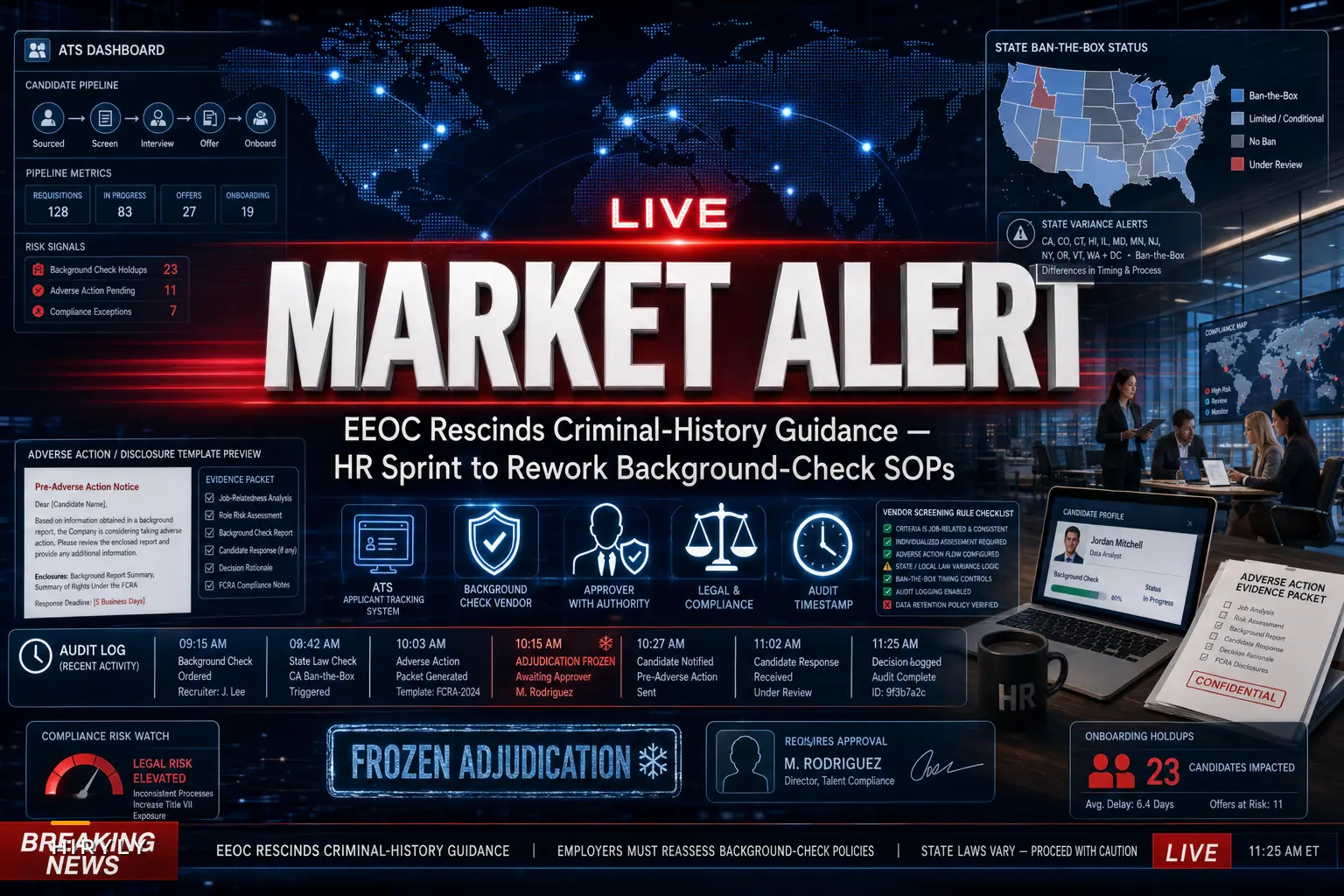

On October 29, 2026, the EEOC voted to rescind its 2012 Enforcement Guidance on the use of arrest and conviction records in employment decisions. The rescission is effective immediately, which means the federal enforcement posture most HR teams built their screening policies around no longer exists in the form they memorized.
The part that trips people up: rescinding the guidance does not rescind Title VII. Disparate-impact liability still lives in the statute. What's gone is the specific federal roadmap — the job-relatedness and business-necessity framework, the individualized assessment language, the "green factors" everyone quietly copied into their SOPs. You're now operating in a gap where the law still applies but the federal interpretation that told you how to comply has been pulled. Legal analysts covering this, including a National Law Review breakdown, have pointed out that state and local ban-the-box rules, FCRA obligations, and existing case law haven't moved an inch.
That's the real operational problem. Most HR teams don't have a clean, version-controlled screening policy they can quickly edit. They have a patchwork — some language in the ATS, some in a vendor contract, some in a PDF nobody's touched since 2019. When the ground shifts, they can't find all the places their old assumptions are baked in.
Why this hits onboarding harder than hiring
Everyone's first instinct is to look at the front of the funnel — job postings, application questions. But the actual exposure sits at the back, in the window between offer and start date, where background checks come back and adverse-action decisions get made under time pressure.
That's exactly where speed and compliance fight each other. A hiring manager wants the person at their desk Monday. The check flags something. Now someone has to decide, in a day or two, whether that record is disqualifying — and whether the decision rests on a documented rationale or just a gut call. Under the old framework, teams at least had the individualized-assessment language to lean on. Remove that without a replacement and you get inconsistent calls, which is precisely what disparate-impact claims feed on.
In practice, this usually goes wrong quietly. Nobody makes a dramatic bad decision. Instead, three recruiters handle three similar records three different ways over a quarter, nobody notices, and the pattern only surfaces when a candidate files a complaint or a plaintiff's attorney requests your adjudication history.
The underlying issue: your screening logic was never really written down
What this rescission exposes is that most teams confused having a vendor with having a policy. The background-check provider runs the search and maybe applies an adjudication matrix you signed off on years ago. But the reasoning — why a seven-year-old offense disqualifies for one role and not another, how recency and relevance get weighted — often lives in people's heads or in a vendor's default settings you never customized.
Eliminate HR bottlenecks with smart automation.
Hiryly simplifies your HR operations so you can focus on people, not paperwork.
- Centralized candidate tracking
- Automated onboarding workflows
- Performance & compliance dashboards
No credit card required
A typical example looks like this: a mid-size logistics company with around 40 hires a month discovers that its "adjudication rules" are actually the vendor's out-of-the-box template, tied to the 2012 framework language. When the guidance disappears, their vendor quietly keeps applying the same logic, and the company has no idea whether that logic still maps to anything defensible. They're exposed and they don't even know it.
This is why the first move isn't "rewrite the policy." It's "find out what your policy actually is right now."
The 30‑day sprint: stabilize before you redesign
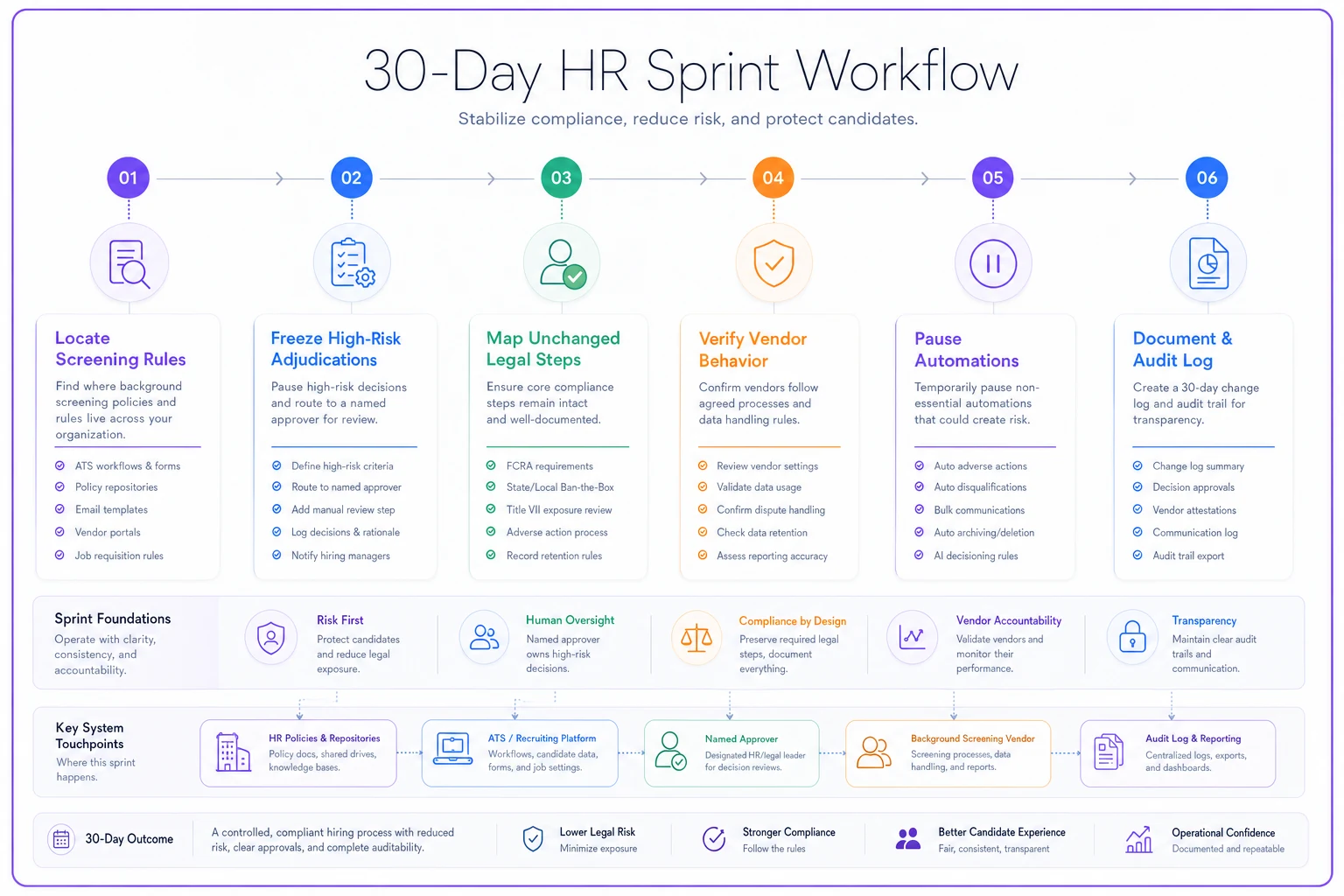
The goal in the first 30 days is not a perfect new framework. It's to stop making undocumented decisions and to locate every place your old assumptions are hiding.
-
Pull your current screening logic out of hiding. Export the actual adjudication matrix from your vendor, screenshot your ATS/HRIS screening flags, and collect every policy PDF and offer-letter clause that references background checks. Put them in one place. You can't fix rules you can't see.
-
Freeze high-risk adjudications under a defined approval path. Until the new policy lands, route any criminal-record flag that could be disqualifying to a single named decision-maker with a short written rationale. Slower is fine. Inconsistent is not.
-
Separate what actually changed from what didn't. Make a one-page map: FCRA pre-adverse/adverse-action steps (unchanged), state and local ban-the-box rules (unchanged), your disparate-impact exposure under Title VII (unchanged), the federal guidance you relied on for the how (gone).
-
Check your vendor's default behavior. Ask your provider directly, in writing, what adjudication logic they're currently applying and whether they changed anything after October 29. Many didn't change a thing, which may or may not be what you want.
-
Pause any auto-rescind or auto-flag automation tied to criminal records. If your HRIS automatically moves a candidate to "withdrawn" based on a screening result, turn that off until a human-reviewed rule replaces it. Automated adverse action without a documented basis is exactly the wrong thing to have running right now.
Visualize the 30-day sprint workflow below.
The reconciliation piece matters more than people expect. If you've already built a disciplined process for matching check results to candidate records and resolving discrepancies, you're in far better shape — the mechanics of that background check reconciliation SOP are exactly what you lean on when you need to re-adjudicate cleanly without stalling start dates.
The 60‑day build: a defensible framework you actually control
Days 30 to 60 are where you replace the vacuum with something that holds up. The mistake here is overcorrecting — either getting so cautious you can't hire anyone with any record, or getting so loose you drop screening discipline entirely. Both create problems.
-
Role-based relevance tiers. Not every role carries the same risk. A driver, a cash handler, and a remote data analyst have genuinely different considerations. Document the connection between the offense categories you screen for and the actual duties of each role family.
-
Recency and seriousness weighting. Keep a consistent, written rule for how old an offense has to be before it stops mattering for a given tier, and what severity threshold triggers review versus automatic concern.
-
An individualized review step. Even without the federal mandate, keeping a documented individualized assessment is smart defense. Give the candidate a chance to provide context, and record that you considered it.
-
A real adverse-action workflow. Pre-adverse notice, the reasonable waiting period, the final notice, the copy of the report, the summary of rights. FCRA didn't change. Confirm every step still fires correctly.
-
An audit trail by default. Every adjudication should generate a timestamped record of who decided, on what basis, and what the candidate was told. If you can't reconstruct a decision six months later, you don't have a defensible process.
Keep the individualized-assessment step documented as a deliberate practice; it pays off during audits or litigation.
Before and after: what changes in practice
| Workflow element | Before (relying on 2012 guidance) | After (self-owned framework) |
|---|---|---|
| Source of adjudication logic | Vendor default / copied guidance language | Documented role-based tiers you authored |
| Decision consistency | Varies by recruiter | Single rule set + named approver |
| Individualized assessment | Treated as federal requirement | Kept deliberately as defensive practice |
| Audit trail | Scattered, hard to reconstruct | Timestamped per-decision record |
| Automation | Auto-flags tied to old assumptions | Human-reviewed, policy-mapped triggers |
Every adjudication should generate a timestamped record of who decided, on what basis, and what the candidate was told. If you can't reconstruct a decision six months later, you don't have a defensible process.
A realistic scenario
A regional healthcare staffing firm hiring roughly 25–30 clinical and admin staff a month found itself exposed the week after the vote. Their screening ran on autopilot — vendor matrix, auto-flags in the ATS, recruiters clearing or rejecting based on whatever the system surfaced. No central log of why anyone was rejected.
In their 30-day sprint, they froze all criminal-record adjudications to a single compliance lead and discovered something uncomfortable: over the prior quarter, two candidates with comparable records for non-patient-facing roles had gotten opposite outcomes. Nothing malicious — just two recruiters, two readings, no shared rule.
By day 60 they'd built three role-relevance tiers, pulled the individualized-assessment step back in as deliberate practice, and routed every adjudication through a short documented rationale. Time-to-start actually improved slightly, because the ambiguity that used to send recruiters into Slack threads for a day now had a clear path. The bigger win was quieter: for the first time, they could reconstruct any screening decision on demand.
Who should move fast — and who has more room
This fast rework makes sense if you hire at volume into roles with genuine safety or fiduciary considerations, or you operate across multiple states with conflicting ban-the-box rules. Your exposure is real and ongoing.
This is lower urgency if you hire infrequently into low-risk roles and already kept a documented, individualized process. You still need to update the language, but you're not firefighting.
Don't overcorrect either way. Blanket-excluding everyone with any record invites disparate-impact claims. Abandoning screening discipline entirely invites negligent-hiring exposure. The defensible middle is consistency plus documentation.
The point most teams miss
The rescission didn't hand you freedom. It handed you responsibility. The federal government stopped telling you how to justify your screening decisions, which means you now have to be the one who can justify them — role by role, candidate by candidate, in writing.
The teams that come out of this fine won't be the ones who reacted fastest. They'll be the ones who already treated screening and onboarding as a documented, reconstructable workflow instead of a set of vendor defaults and individual judgment calls. If your current process can't tell you why a specific candidate was cleared or rejected last March, that's the gap to close first — the guidance change just made it visible.
The teams that come out of this fine won't be the ones who reacted fastest. They'll be the ones who already treated screening and onboarding as a documented, reconstructable workflow instead of a set of vendor defaults and individual judgment calls. If your current process can't tell you why a specific candidate was cleared or rejected last March, that's the gap to close first — the guidance change just made it visible.
Ready to transform your HR processes?
Join thousands of HR teams using Hiryly to hire faster, engage employees better, and stay compliant effortlessly.