

The candidate accepted your offer two weeks ago. Their start date is Monday. It's Thursday afternoon, and the background check vendor just flagged something about a misdemeanor from 2019 — might be a traffic violation, might be something else. Your compliance team wants more documentation. The hiring manager is asking whether to reschedule the new hire's first week of meetings. The candidate is texting asking if everything is okay.
This scenario played out at three different companies last month. Not because background checks are inherently problematic, but because most HR teams treat background check reconciliation like an afterthought instead of the operational discipline it actually requires.
The real cost of a broken background check reconciliation SOP
When background check processes break down, the damage spreads fast. You lose candidates who get spooked by radio silence and take other offers. Hiring managers lose faith in HR's ability to deliver. New hires show up to empty desks because IT didn't get the two-week heads-up they needed.
The frustrating part? Most background check issues aren't real problems. They're administrative hiccups that spiral because nobody has clear ownership or escalation paths. A name variation becomes a three-day email chain. A county court delay pushes a start date. An education discrepancy turns into a compliance fire drill.
One mid-size tech company tracked their background check delays over six months and found that roughly 73% of their start date pushbacks came from reconciliation confusion, not actual red flags. They were losing around $18,000 per delayed start in productivity costs — not counting the candidates who pulled out during the process.
Building your triage-first decision matrix
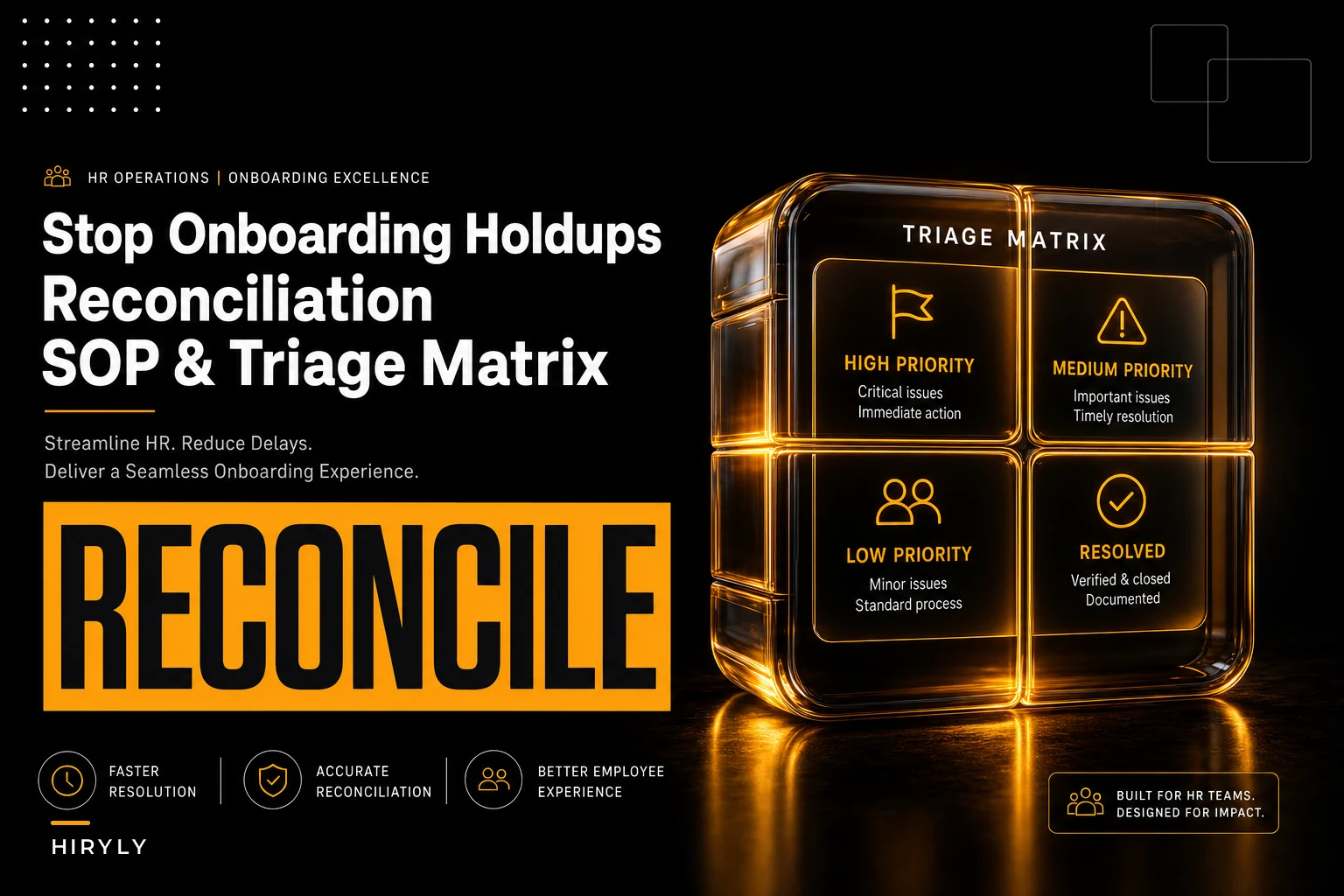
The foundation of a functional background check reconciliation SOP is clear triage rules. Not every flag needs the same response, and treating them all equally is what creates the bottlenecks.
Eliminate HR bottlenecks with smart automation.
Hiryly simplifies your HR operations so you can focus on people, not paperwork.
- Centralized candidate tracking
- Automated onboarding workflows
- Performance & compliance dashboards
No credit card required
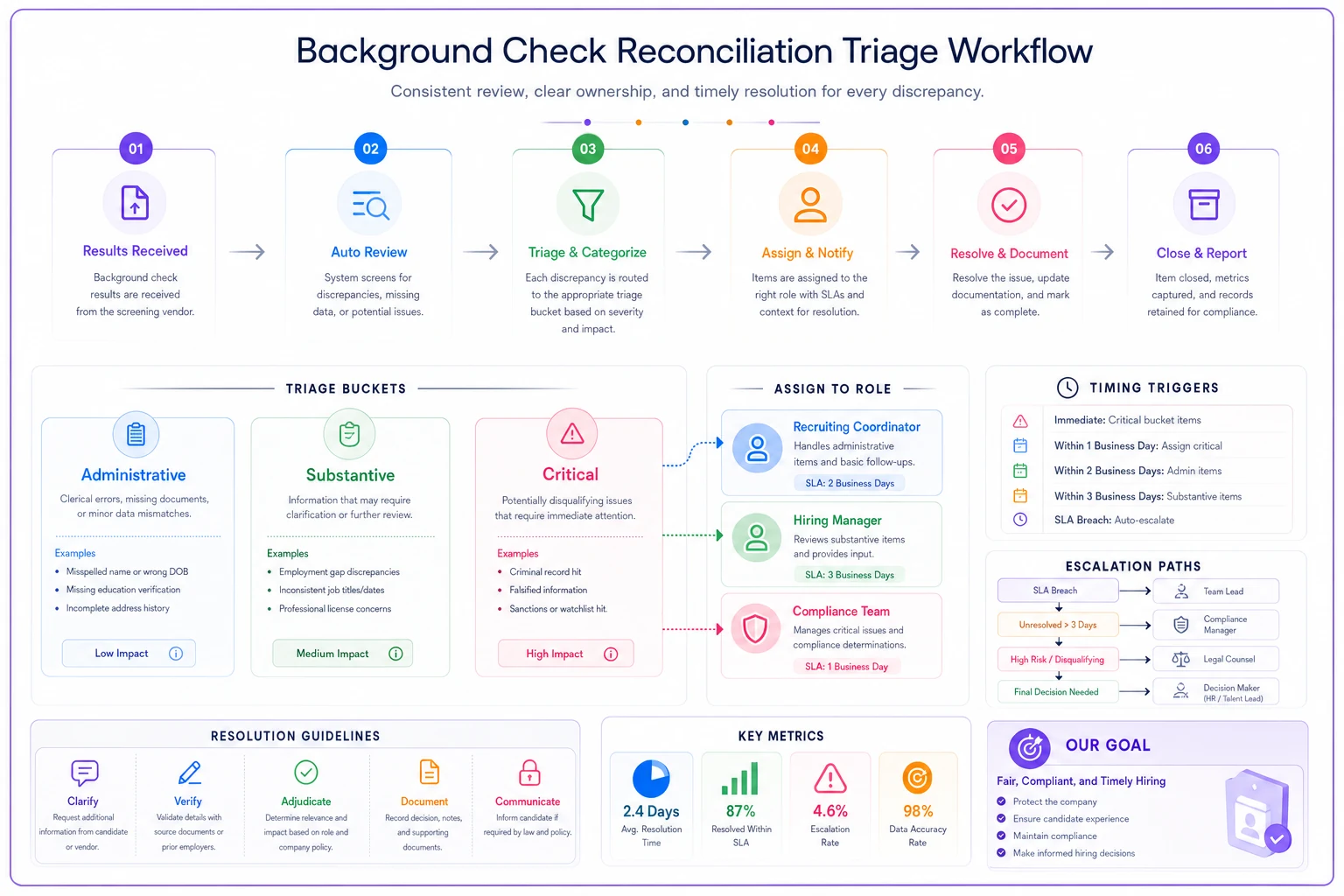
Start by sorting flags into three buckets: administrative, substantive, and critical.
-
Administrative flags are things like name variations, address discrepancies, or incomplete education records. These should never delay a start date.
-
Substantive flags — employment gaps, title discrepancies, minor criminal records that need context — route to the hiring manager.
-
Critical flags, the ones that actually matter like falsified credentials, relevant criminal convictions, or failed drug screens for safety-sensitive roles, escalate immediately to legal or compliance.
Your triage matrix needs to specify exactly who handles what. Administrative flags go to your recruiting coordinator. Substantive flags route to the hiring manager with a recommendation template. Critical flags go straight to compliance with a 24-hour SLA.
Quick visual of the triage workflow and escalation paths.
What most companies miss: you need different triage rules for different roles. A DUI for a software engineer is not the same situation as a DUI for a delivery driver. A credit issue for an accountant carries more weight than one for a marketing manager. Build role-specific decision trees, not a blanket policy.
The matrix also needs timing triggers. If a flag hasn't been resolved in 48 hours, it escalates automatically. If a start date is less than five business days out, decisions compress to same-day. These rules prevent the slow drift that turns minor issues into major delays.
Vendor SLA scorecards that actually drive accountability
Your background check vendor probably promised 48-hour turnarounds. In practice, you're averaging five to seven days with constant follow-ups. The problem isn't just the vendor — it's that most HR teams aren't managing them with real metrics.
Build a vendor scorecard tracking four things: initial turnaround time, flag resolution speed, accuracy rate, and candidate experience score. Weight them based on your priorities. High-volume hourly hiring? Speed matters most. Executive searches? Accuracy comes first.
| Vendor Scorecard Metrics |
|---|
| initial turnaround time |
| flag resolution speed |
| accuracy rate |
| candidate experience score |
The scorecard needs real teeth. Set SLA penalties not just for initial reports, but for flag resolution. If your vendor takes more than 24 hours to clarify a flag, that's a breach. If they incorrectly flag something that delays a start date, that's a penalty event. One retail company cut their background check delays by around 40% just by attaching monetary penalties to vendor-caused start date pushbacks.
Track vendor performance by check type too. Criminal checks might run fine while education verifications consistently lag. Use that data to renegotiate terms or bring in specialized vendors for problem areas. Some companies split across multiple vendors — one for standard checks, another for international verifications, another for financial reviews.
And your vendor should provide real-time status updates through an API or dedicated portal. Email chains about check status are operational debt. If your vendor can't give you programmatic updates, they're not built for modern hiring volumes.
Escalation rules that prevent panic mode
Clear escalation paths are what separate smooth operations from constant fire drills. Everyone involved needs to know exactly when to escalate and to whom — no judgment calls, no ambiguity.
Build escalation triggers around three factors: time to start date, flag severity, and candidate tier. A C-suite hire with any flag gets immediate escalation. An entry-level role with an administrative flag might not escalate at all.
Your escalation chain should also compress based on urgency. If a start date is tomorrow, you skip the three-level approval process. The issue goes directly to the decision-maker with a pre-built recommendation framework. Specify exactly what the escalation should contain: flag details, business impact, recommended action, and required decision timeline.
Document every escalation outcome. Each resolved case becomes a precedent. After six months you'll have a decision library that cuts resolution time on common scenarios dramatically. That ambiguous misdemeanor? You've already ruled on similar ones. That education discrepancy? There's a documented approach on file.
HRIS integration checklist for seamless data flow
Manual data entry between your background check system and HRIS creates errors and delays. But most HR teams approach integration as a big-bang technical project instead of incremental operational improvement.
Start simple: candidate data should flow automatically from your ATS to your background check vendor. No manual forms, no duplicate entry. That alone eliminates a meaningful chunk of reconciliation issues caused by data mismatches.
Prioritize mapping and testing of international address formats and hyphenated names early to avoid common reconciliation edge cases.
Then set up status webhooks. When a check completes, clears, or flags, that update should automatically hit your HRIS. Your team shouldn't be manually refreshing vendor portals or updating spreadsheets. The system should push updates to relevant stakeholders based on predefined rules.
Integration should also cover document management. Background check reports, dispute documentation, and clearance certificates should automatically attach to the candidate's profile. This matters for audits and prevents the scramble to find paperwork months after someone started.
Map your data fields carefully. Your vendor's "conviction date" might be your HRIS's "offense date." These mismatches create reconciliation headaches. Build a field mapping document that specifies exactly how data translates between systems, and test edge cases — international addresses, hyphenated names, candidates with multiple positions at the same employer.
Don't overlook data governance requirements. Background check data is sensitive and needs proper access controls and retention policies. Your integration should respect role-based permissions and automatically purge data on schedule.
Candidate communication templates that reduce anxiety
Radio silence during background checks is what sends candidates to competing offers. But most HR teams either overcommunicate with vague updates or go quiet until there's a problem.
Build a communication cadence that sets real expectations. When a candidate enters the background check phase, they should get an automated message explaining the process, typical timelines, and what happens next. Specific is better — "most checks complete within 5 business days" beats "checks typically complete quickly."
Create templates for the common scenarios. Flag identified? There's a message that explains the situation without causing panic. Delay expected? A proactive note that keeps confidence up. Check cleared? Something that reinforces their decision to join.
The balance to strike: transparency without legal exposure. You can't share flag details before adjudication, but you can acknowledge that you're working through something. "We're finalizing a few details and expect everything resolved by Thursday" maintains communication without putting you in a bad position.
For delays, always provide a new timeline and a contingency. "Your check is taking longer than expected due to court closures. We expect completion by Friday. If it extends, we'll talk about moving your start date to the following Monday with full pay from your original date." That prevents candidates from filling in the silence with worst-case assumptions.
Track which templates actually perform. Monitor candidate response rates, withdrawal rates after specific messages, and time-to-resolution following candidate outreach. One healthcare company found that candidates who received their "flag identified" template were 60% less likely to withdraw than those who got a generic message.
When your reconciliation SOP becomes an operational advantage
Companies that are genuinely good at background check reconciliation treat it as a competitive edge, not a compliance checkbox. They make offers confidently because their reconciliation process can handle whatever comes up. They set start dates that stick because they've built buffer time into the workflow. They keep candidates engaged because their communication is proactive.
One financial services firm rebuilt their entire background check reconciliation SOP using these principles. They went from 24% of start dates being delayed to under 5%. Candidate withdrawals during background check dropped from 12% to around 3%. Hiring managers stopped treating HR as the bottleneck.
The real test of your SOP isn't how it handles clean checks — it's how it handles messy ones. When that Thursday afternoon flag hits, do you have clear ownership, defined escalation paths, and a ready-to-send communication template? Or do you have a panic-driven email thread and a nervous candidate?
Modern operational software can reshape this entire workflow. Instead of juggling spreadsheets, email chains, and vendor portals, a single platform can automatically triage flags based on your rules, enforce vendor SLAs, send templated communications, and maintain a full audit trail. The AI automation handles routing and tracking while your team focuses on actual decisions — the ones that require human judgment.
The gap between offer and onboarding doesn't have to be where good candidates disappear. With a solid reconciliation SOP, background checks become just another step that runs quietly while you focus on getting great people through the door.
Making it stick: implementation without disruption
Rolling out a new background check reconciliation SOP doesn't mean pausing all hiring while you rebuild everything. Start with your highest-volume roles or your most problematic check types. Get one workflow running smoothly before expanding.
Document every decision for the first 30 days — not just what you decided, but why and how long it took. This becomes your baseline for improvement and your training material for new team members. Those edge cases that eat up hours of discussion? Write down the resolution so they take minutes next time.
Your SOP is only as good as your weakest handoff. If recruiting owns pre-check, TA ops owns reconciliation, compliance owns escalation, and HRIS owns data entry — you've built failure points into the structure. Map every handoff and either eliminate it or put an SLA on it.
The best background check reconciliation processes become invisible. Checks run, flags get resolved, candidates get cleared, start dates happen as planned. Nobody's celebrating your background check process at the all-hands. But nobody's complaining about delayed starts either. In operational work, invisible success is about as good as it gets.
Ready to transform your HR processes?
Join thousands of HR teams using Hiryly to hire faster, engage employees better, and stay compliant effortlessly.