

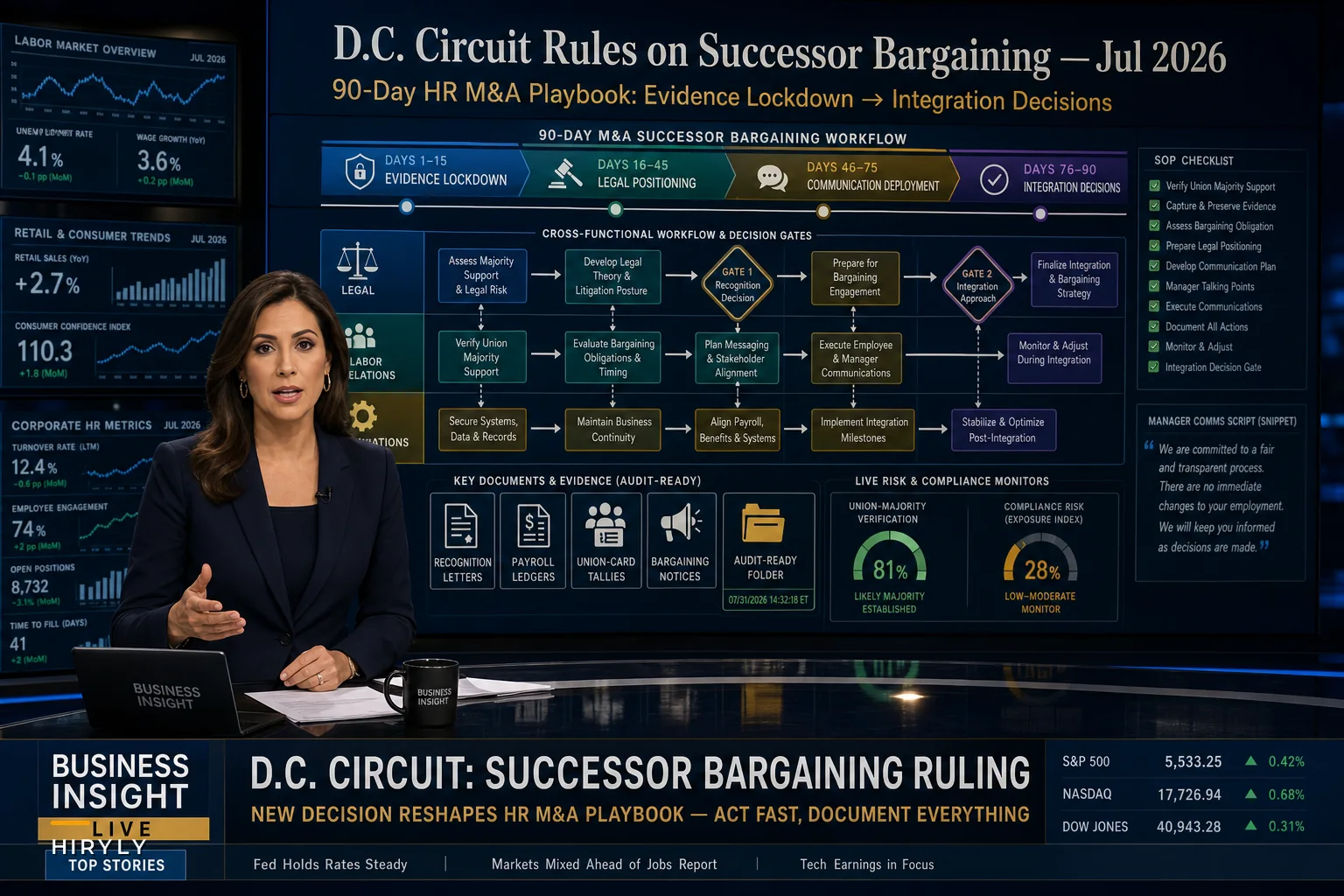

Last week changed a lot for HR teams managing M&A integrations. The D.C. Circuit Court invalidated the NLRB's successor-bar doctrine—a 50-year-old rule that forced companies to recognize and bargain with unions for up to a year after acquiring another business. Reuters reported that this July 21 ruling immediately reshapes how successor employers handle union obligations post-acquisition.
If you're running talent integration for an acquisition or service takeover right now, your playbook from six months ago is obsolete. This ruling doesn't just tweak the rules—it changes when and how you recognize unions, what evidence you need during due diligence, and how fast you can actually move on integration decisions.
What the successor bargaining ruling actually means for your integration timeline
Under the old successor-bar rule, acquiring a unionized workforce meant you were essentially stuck. The NLRB required recognition and bargaining with the existing union for a "reasonable period"—usually somewhere between 6 and 12 months. During that window, employees couldn't file for decertification, and you couldn't challenge the union's majority status even if significant portions of the workforce had turned over since the original certification.
The court threw that entire framework out. Successor employers can now immediately test whether a union actually represents a majority of the current workforce. You're no longer locked into automatic recognition based on old certifications or presumed continuity.
This sounds like freedom. It's actually operational chaos if you're not ready for it. Your integration team now faces compressed timelines, new compliance risks, and very different workforce communication requirements. The companies that fumble this will end up in prolonged legal battles or operational paralysis during the phases that matter most.
The hidden compliance traps that will derail unprepared HR teams
Most HR teams are walking into this without fully understanding what changed. The ruling creates three risk categories that didn't really exist two weeks ago:
Eliminate HR bottlenecks with smart automation.
Hiryly simplifies your HR operations so you can focus on people, not paperwork.
- Centralized candidate tracking
- Automated onboarding workflows
- Performance & compliance dashboards
No credit card required
Evidence collection failures during due diligence Without automatic successor-bar protection, you need solid documentation of union support levels at the exact moment of acquisition. Not last year's certification. Not the seller's word. Actual, verifiable evidence of current majority status among the specific employees you're acquiring.
Premature integration decisions There's a real temptation to move fast now that automatic recognition isn't required. But moving too quickly triggers unfair labor practice charges. You need clear decision gates—verification complete, legal review done, communication deployed. Skip a step and you've handed the union ammunition for board charges.
Communication sequence violations The order in which you communicate with different groups now matters in ways it didn't before. Announce integration plans to managers before completing union status verification? Potentially illegal interference. Tell employees about new benefits before determining bargaining obligations? You've just created evidence of direct dealing.
Your 90-day successor bargaining compliance checklist
Here's the operational framework that keeps you compliant while maximizing integration speed:
Days 1-15: Evidence lockdown phase
-
Employee roster matching against last known union membership
-
Verification of dues check-off authorizations
-
Review of recent union communications and participation rates
-
Analysis of any pending grievances or arbitrations
Create a union status determination file with:
-
Current employee count in the bargaining unit
-
Evidence of union support (or lack thereof)
-
Legal opinion on majority status
-
Decision tree for recognition vs. challenge
Days 16-45: Legal positioning phase
Establish your bargaining posture:
-
If clear majority exists
Develop streamlined recognition and initial bargaining timeline
-
If majority uncertain
Prepare withdrawal of recognition documentation
-
If no majority
Document basis for non-recognition decision
Build your compliance infrastructure:
-
Designate bargaining team members and alternates
-
Create information firewall protocols
-
Establish manager communication guidelines
-
Design employee FAQ response system
Days 46-75: Communication deployment phase
Execute stakeholder engagement in this exact sequence:
-
Legal counsel notification and strategy alignment
-
Senior leadership briefing on obligations and timelines
-
Manager training on permissible vs. prohibited topics
-
Employee communication about process (not outcomes)
-
Union notification per legal requirements
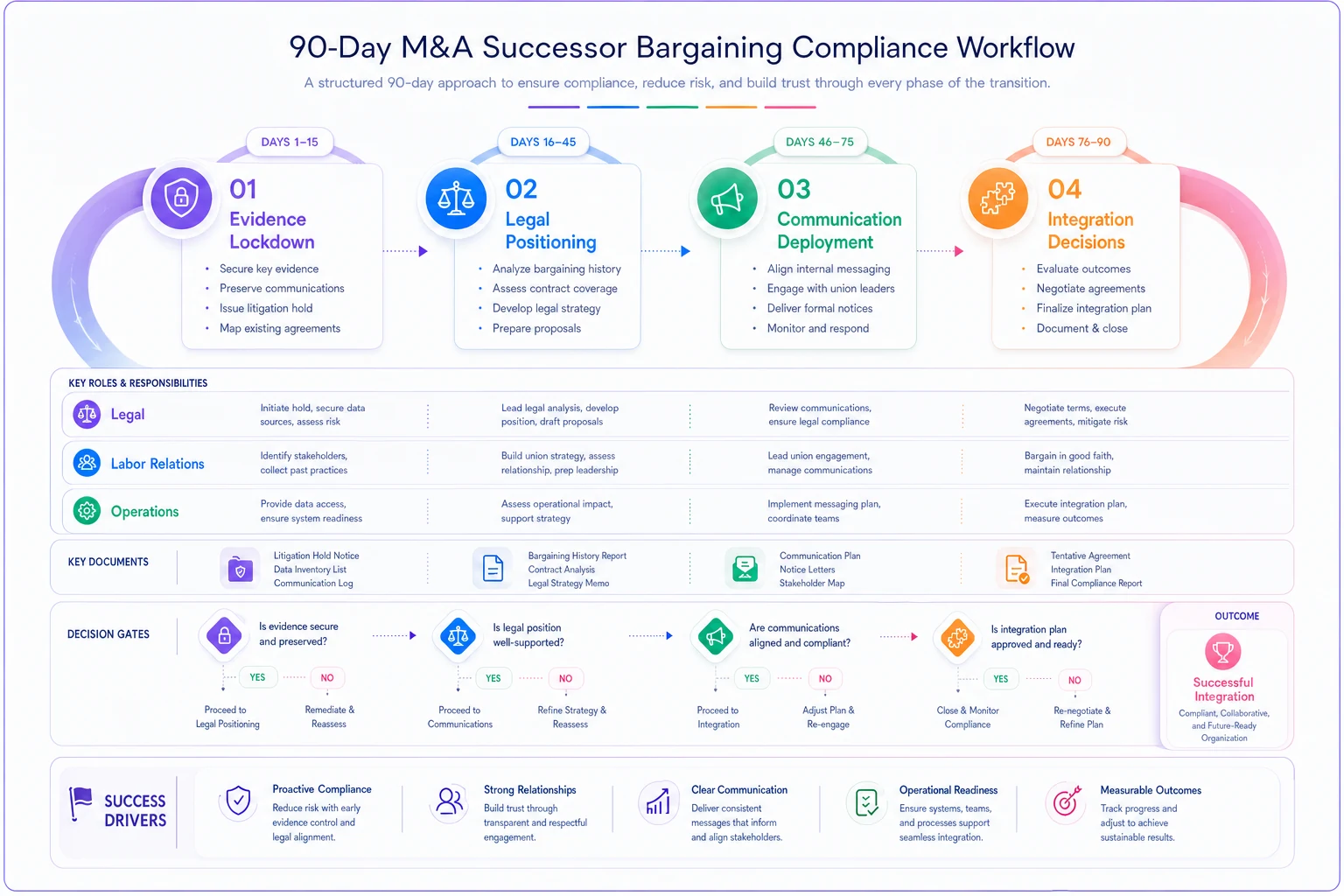
Visual workflow of the 90-day checklist:
Days 76-90: Integration decision phase
-
Benefits harmonization timing
-
Compensation structure changes
-
Reporting relationship modifications
-
System and process integration
-
Cultural integration initiatives
Each decision needs three approvals: Legal for compliance, Labor Relations for bargaining impact, and Operations for business continuity.
The workforce retention crisis nobody's talking about
The ruling creates a retention risk most integration teams haven't thought through. When employees realize their union status is suddenly uncertain, a few things happen pretty fast.
Key union supporters start looking for exits, assuming the company is coming for them. Skilled workers—often the ones with the most bargaining power—start returning recruiter calls. And the rumor mill accelerates into stories far worse than the actual situation.
One retail chain lost close to 40% of their acquired workforce within 60 days of announcing they wouldn't recognize the union under the new framework. Nobody was fired. It was entirely voluntary departures driven by uncertainty.
Your retention strategy needs to kick in immediately:
-
Individual stay bonuses for critical roles (documented outside any bargaining unit)
-
Accelerated integration of benefits where legally permissible
-
Transparent communication about job security regardless of union outcome
-
Manager check-ins with every employee in the first 30 days
Manager check-ins with every employee in the first 30 days
Building your union majority verification system
Proving—not assuming—union support levels is now one of the most critical requirements post-acquisition. This isn't a one-time check; it's an ongoing operational requirement throughout integration.
Start with baseline verification. Review the last 12 months of dues authorizations. Don't just count current check-offs—look at the trend. Rising or falling? Map this against workforce turnover. If 30% of employees joined post-certification, their union support is an unknown.
Track participation indicators:
-
Meeting attendance (union meetings, not company meetings)
-
Grievance filing patterns
-
Union communication engagement rates
-
Steward activity levels
Create ongoing monitoring triggers:
-
Turnover exceeding 20% in any quarter
-
Dues authorization changes of 10% or more
-
Major operational changes affecting the unit
-
Leadership changes in union or management
This isn't about union-busting—it's about legal compliance. The ruling means you need evidence, not assumptions, about representation status.
When challenging union recognition makes sense (and when it's a trap)
The ability to challenge union recognition isn't always an opportunity. Sometimes it's the wrong move entirely. Here's the decision framework:
Challenge when you have:
-
Clear evidence of sub-50% support
-
Strong integration business case requiring flexibility
-
An alternative employee engagement model ready to deploy
-
Management team trained on post-union operations
-
Budget for potential legal proceedings
Accept recognition when you face:
-
Ambiguous support levels around 45-55%
-
Critical operational deadlines requiring stability
-
Multi-site operations where a challenge creates precedent elsewhere
-
Hostile regulatory environment or heavy public scrutiny
-
Weak management infrastructure for direct employee relations
The worst outcome isn't recognizing or not recognizing a union—it's getting stuck in limbo for months while operations stall.
Integration timeline adjustments that reflect new legal reality
Your entire integration roadmap needs recalibration. The old 12-18 month gradual approach assumed forced union recognition and lengthy bargaining. Now you're looking at three possible tracks:
Fast track (no union): 3-6 months
-
Immediate benefits integration
-
Rapid system consolidation
-
Accelerated culture alignment
-
Direct employee communication
Negotiated track (recognized union): 6-12 months
-
Effects bargaining on integration changes
-
Phased benefit harmonization
-
Coordinated system migrations
-
Joint labor-management committees
Contested track (challenged union): 12-24 months
-
Legal proceedings pause most integration
-
Minimal operational changes
-
Separate system maintenance
-
Restricted communication protocols
| Track | Details |
|---|---|
| Fast track (no union): 3-6 months | Immediate benefits integration; Rapid system consolidation; Accelerated culture alignment; Direct employee communication |
| Negotiated track (recognized union): 6-12 months | Effects bargaining on integration changes; Phased benefit harmonization; Coordinated system migrations; Joint labor-management committees |
| Contested track (challenged union): 12-24 months | Legal proceedings pause most integration; Minimal operational changes; Separate system maintenance; Restricted communication protocols |
Most companies haven't modeled all three scenarios. They plan for fast track while hoping to avoid contested track, with no real preparation for either.
The recordkeeping framework that prevents legal disasters
Documentation requirements under the ruling are genuinely demanding. One missing email thread or undocumented conversation can turn a straightforward integration into a multi-year legal fight.
Build this documentation hierarchy:
| Tier | Contents |
|---|---|
| Tier 1: Legal determination records | Every document touching union majority status—employee lists, authorization cards, dues records, participation data. These need litigation-hold level preservation from day one. |
| Tier 2: Decision documentation | Each integration decision needs a paper trail showing: - Who made the decision - What factors were considered - Whether union impact was assessed - What alternatives were evaluated - Why timing was chosen |
| Tier 3: Communication archives | Every employee communication, manager talking point, union correspondence, and public statement. Include drafts, approvals, and distribution lists. |
| Tier 4: Operational impact tracking | Changes to wages, hours, working conditions—even minor ones. Document the business rationale, implementation timeline, and affected populations. |
Start litigation-hold preservation the moment the acquisition is announced.
Companies getting burned are the ones treating this like routine HR documentation. It isn't. It's evidence in a likely legal proceeding.
Proactive union relations that prevent integration disasters
The successor bargaining ruling doesn't eliminate union relationships—it transforms them. Smart HR teams are getting ahead of the adversarial dynamic the ruling tends to create.
While legal determines union status, start information-sharing sessions with union leadership. Not bargaining—just operational transparency about integration goals, timelines, and employee impact. This prevents the information vacuum that breeds resistance.
Create workforce stability commitments that don't require bargaining:
-
Job security pledges for defined periods
-
Training investment guarantees
-
Facility commitment timelines
-
Promotion pathway preservation
Design union-neutral employee feedback systems:
-
Digital pulse surveys accessible to all employees
-
Skip-level meetings with integration leaders
-
Anonymous concern reporting channels
-
Regular town halls with real Q&A
The goal is demonstrating that employee voice exists with or without union representation, which reduces the us-versus-them dynamic that derails integrations.
Technology infrastructure for compliance tracking
Managing successor bargaining compliance across multiple sites or acquisitions requires more than spreadsheets. You need systematic tracking of obligations, deadlines, and decision points.
Essential system capabilities:
Workforce composition tracking: Real-time visibility into bargaining unit definitions, employee classifications, and authorization levels. Most HRIS systems weren't built for this granularity—they treat union status as a simple yes/no flag rather than a complex, time-sensitive legal determination.
Decision audit trails: Every recognition decision, bargaining position, and integration choice needs documented approval workflows. Email chains don't hold up when you're defending decisions two years later.
Compliance calendar integration: Bargaining deadlines, notice requirements, and legal filing dates must flow into operational calendars. Missing a single deadline can invalidate months of integration work.
Document version control: Union agreements, integration plans, and communication materials evolve constantly. You need to track what version was active when specific decisions were made.
This is where AI-powered operational software becomes genuinely useful. Instead of manually tracking dozens of compliance requirements across multiple acquisitions, operational platforms can automate deadline monitoring, flag authorization level changes, and maintain audit-ready documentation. The same hiring governance framework that manages talent operations can be extended to handle union compliance workflows, creating a single source of truth for all workforce decisions.
Measuring integration success in the new legal landscape
The metrics that mattered six months ago don't fully capture success under the ruling anymore. You need KPIs that reflect both operational progress and legal compliance:
Legal risk indicators:
-
Days to union status determination
-
Percentage of decisions with complete documentation
-
Number of unfair labor practice charges filed
-
Time to resolution for any challenges
Integration velocity metrics:
-
Percentage of systems consolidated by day 90
-
Benefits harmonization completion rate
-
Management structure finalization timeline
-
Cultural integration milestone achievement
Workforce stability measures:
-
Voluntary turnover vs. projection
-
Internal fill rate for open positions
-
Employee engagement scores
-
Grievance or complaint volumes
Operational performance markers:
-
Productivity vs. pre-acquisition baseline
-
Quality metrics maintenance
-
Customer satisfaction continuity
-
Cost synergy realization timeline
Track these weekly, not monthly. Compressed timelines under the new ruling mean problems compound quickly if you're not watching.
Preparing for the next phase of labor law uncertainty
The successor bargaining ruling won't be the last disruption to M&A labor practices. Three trends are already complicating integration playbooks further.
Multi-state complexity is growing fast. States are passing their own labor relations rules that may conflict with federal interpretations. An acquisition spanning California, Texas, and New York now means navigating three different regulatory frameworks for the same integration.
Gig economy classifications are bleeding into traditional employment structures. Acquired companies might have complex arrangements—contractors, temps, shared employees—that complicate majority calculations.
AI and automation are changing bargaining unit definitions in ways nobody's fully worked out yet. When half the warehouse jobs you acquired are being automated within 18 months, what exactly is the "continuing" workforce for union recognition purposes?
The HR teams that do well will be those building flexible compliance frameworks rather than rigid playbooks. Ogletree's analysis of the ruling is worth reading for the finer legal details, but operationally the takeaway is consistent: document everything, prepare for multiple scenarios, and keep relationships intact across the labor relations spectrum.
The ruling isn't just a legal change—it's an operational shift for HR teams managing integrations. Companies that build the right infrastructure will close integrations faster and with fewer disruptions. Those that treat it as a simple legal checkbox will find themselves paralyzed by compliance failures and workforce instability.
Every acquisition in your pipeline needs reassessment under this new framework. The playbook you spent years refining became obsolete overnight. Time to build a new one.
Ready to transform your HR processes?
Join thousands of HR teams using Hiryly to hire faster, engage employees better, and stay compliant effortlessly.