

Companies hit somewhere around 50-75 hires per quarter and their recruiting process starts breaking in weird ways. Not because recruiters can't handle the volume – they absolutely can. The breakdown happens because the approval and governance layer wasn't built for that pace.
What usually follows is leadership gets spooked by a bad hire or a compliance flag, then overcorrects with a heavy approval process that grinds everything to a halt. Three months later, they're missing hiring targets and good candidates are dropping because offers take two weeks to clear.
The real challenge with a hiring governance framework isn't adding controls – anyone can slap approval gates onto a process. It's maintaining hiring velocity while ensuring every decision has proper oversight and documentation. That balance only works when you design the governance layer specifically for speed.
Why traditional approval structures collapse under hiring pressure
Most companies inherit their hiring approval structure from when they were smaller. When you're hiring five people a month, having the CEO approve every offer makes sense. Scale that to 50 hires monthly across eight departments and three locations, and you've created an operational mess.
The standard approval chain usually looks like this: hiring manager requests headcount, gets VP approval, posts the role, screens candidates, makes a selection, gets VP approval again, extends the offer, gets finance to sign off on comp. Each handoff takes two to three days minimum. Add them up and you're looking at 15-20 days just in approval time.
What makes this worse is that different roles need completely different approval velocities. An entry-level customer service hire shouldn't require the same governance overhead as a director-level engineering hire. But most companies apply the same process to everything because building role-specific workflows feels too complex to set up.
The compliance layer adds another dimension. You need documented approval trails for SOC 2 audits, consistent exception handling for above-band offers, and clear decision records for candidate selection. Try managing all of that in email threads and Slack messages at any real volume – it becomes unworkable fast.
Building approval matrices that actually scale
A functional hiring governance framework starts with role-based approval matrices, not universal approval chains. The matrix defines who approves what based on role level, compensation band, and exception scenarios.
Eliminate HR bottlenecks with smart automation.
Hiryly simplifies your HR operations so you can focus on people, not paperwork.
- Centralized candidate tracking
- Automated onboarding workflows
- Performance & compliance dashboards
No credit card required
Here's what a working approval matrix actually looks like:
| Role Level | Comp Band | Standard Approval | Above-Band Approval | Location Exception |
|---|---|---|---|---|
| IC 1-3 | $60k-120k | Hiring Manager + Director | + VP | + VP People |
| IC 4-5 | $120k-180k | Director + VP | + CEO | + VP People |
| Manager | $140k-200k | VP + VP People | + CEO | + CEO |
| Director | $180k-280k | VP + CEO | Board Comp Committee | + CEO |
| VP+ | $250k+ | CEO + Board | Board Comp Committee | Board |
The matrix removes ambiguity about who approves what. More importantly, it creates parallel approval paths. While the VP reviews compensation, the director can be checking role requirements. While People Ops validates location compliance, Finance can review budget impact.
Exception handling becomes systematic rather than ad-hoc. Need to hire someone 15% above band to compete with another offer? The matrix already defines that path. Want to hire in a new state where you don't have entity setup? The location exception column shows exactly who needs to sign off.
This approach typically cuts approval time from 15-20 days down to 5-7 days for standard hires. For roles that fit neatly within standard parameters, approvals can turn around in 48-72 hours.
SLA templates that enforce velocity without sacrificing quality
Service Level Agreements for hiring approvals might sound like overkill, but they're really the only way to maintain velocity at scale. Without SLAs, every approval defaults to "when I get to it" and hiring managers have no visibility into timeline.
The SLA structure should match your approval matrix complexity. Here's a template that holds up in practice:
Standard Hire SLA (Role within guidelines)
-
Headcount approval
2 business days
-
Job posting approval
1 business day
-
Candidate selection approval
2 business days
-
Offer approval
1 business day
-
Total cycle
6 business days maximum
Exception Hire SLA (Requires additional approval)
-
Initial exception review
1 business day
-
Exception approval
3 business days
-
Standard approval process
6 business days
-
Total cycle
10 business days maximum
Escalation triggers:
-
No response within SLA
Auto-escalate to next level
-
Second miss
Flag to People Ops leadership
-
Third miss
CEO visibility
The escalation component is what gives SLAs actual teeth. When a VP knows that ignoring an approval request for three days will land on the CEO's dashboard, approvals start happening on time.
SLAs also need escape valves for legitimate delays. If someone's on PTO, the system should automatically route to their designated backup. If additional information is needed, the SLA clock should pause until that information comes through. Without these mechanisms, the SLA either becomes too rigid to follow or just gets ignored.
Decision gates that protect against downstream problems
Most hiring mistakes aren't caught during interviews – they're structural problems that better decision gates would have caught earlier. A solid governance framework builds in checkpoints before issues become expensive.
Pre-Posting Decision Gate:
-
Headcount approved and budgeted
-
Job description matches approved level and band
-
Reporting structure confirmed
-
Interview panel identified and trained
-
Diversity targets defined
-
Success metrics documented
Without this gate, you end up interviewing 15 candidates before realizing the role wasn't actually budgeted, or discovering the hiring manager and their VP have completely different expectations for what they're hiring for.
Offer Decision Gate:
-
Compensation within approved band (or exception documented)
-
Equity grant within guidelines
-
Start date aligns with onboarding capacity
-
Reference checks completed and documented
-
Background check process initiated
-
Competing offers documented if above band
The offer gate prevents compensation surprises:
Post-Hire Gate:
-
Offer letter signed and filed
-
Background check cleared
-
I-9 documentation complete
-
System access requests submitted
-
Manager onboarding plan confirmed
-
30-60-90 day goals documented
The post-hire gate ensures a clean handoff to onboarding:
Each gate should have a clear owner and a checklist. Recruiting owns pre-posting, the compensation committee owns the offer gate, People Ops owns post-hire. This ownership model keeps things from slipping when volume picks up.
Audit requirements that satisfy compliance without creating bureaucracy
The audit trail for hiring decisions needs to satisfy multiple stakeholders: external auditors for SOC 2, legal for compliance, leadership for decision quality, and People Ops for process improvement. Most companies either over-document everything or under-document and scramble when an audit comes up.
A practical audit framework captures just enough to satisfy requirements without creating hours of extra documentation work. Here's what actually needs to be tracked:
Minimum Audit Requirements:
-
Who approved what and when (timestamp and identity)
-
Rationale for exceptions (brief written justification)
-
Candidate evaluation scores (standardized rubric)
-
Reference check outcomes (structured form)
-
Compensation decision factors (market data, internal equity)
-
Rejection reasons for final candidates (legally defensible)
The key is building this capture into the workflow rather than treating it as separate work. When an approver signs off, they select from a dropdown of standard approval reasons or add a brief note. When an exception is requested, the form requires specific fields for the business case.
For SOC 2 specifically, auditors typically want to see:
-
Segregation of duties (requester ≠ approver)
-
Consistent application of policies
-
Documented exceptions with business justification
-
Evidence of periodic review and updates
Most companies try to solve this with spreadsheets and email trails, which becomes unmanageable somewhere around 30 hires per quarter. The audit trail needs to live in a system designed for governance, not scattered across communication tools.
Technology architecture for high-velocity governance
The technology layer is where most hiring governance frameworks actually fall apart. Companies try to piece together their ATS, HRIS, messaging apps, and spreadsheets into something resembling a governance system. It never quite works.
A functional governance architecture needs three core components:
Workflow Engine: Routes approvals based on your matrix, enforces SLAs, handles escalations, and manages exceptions. This can't be email-based – email doesn't have the logic to handle conditional routing and automatic escalations.
Decision Capture: Records who approved what and why in a structured format. This needs to integrate with your ATS so approvals happen in context, not in isolation. The approver should see the candidate profile, interview feedback, and compensation benchmarks in the same view where they're approving.
Audit Dashboard: Provides real-time visibility into approval bottlenecks, SLA compliance, and exception patterns. If certain managers consistently request above-band offers, that pattern should be visible. If approvals consistently bottleneck at the VP level, that needs to surface quickly.
Start with middleware between your ATS and HRIS to keep each system focused on its core purpose and avoid forcing governance into tools that weren't designed for it.
The architecture also needs to handle modern hiring realities: remote approvers in different time zones, mobile approvals for executives who travel frequently, bulk approvals for high-volume roles, and integrations with background check vendors.
What tends to work best is building the governance layer as middleware between your ATS and HRIS. The ATS handles candidate flow, the governance platform handles approvals and compliance, and the HRIS handles the employee record post-hire. This separation lets each system do what it's built for rather than forcing governance capabilities into tools that weren't designed for it.
How hiring approval workflows actually move through the system
To make this concrete, here's a simplified flow of how a standard hire moves through a governance framework from req to offer:
The diagram below shows the standard path and where exception branches occur.
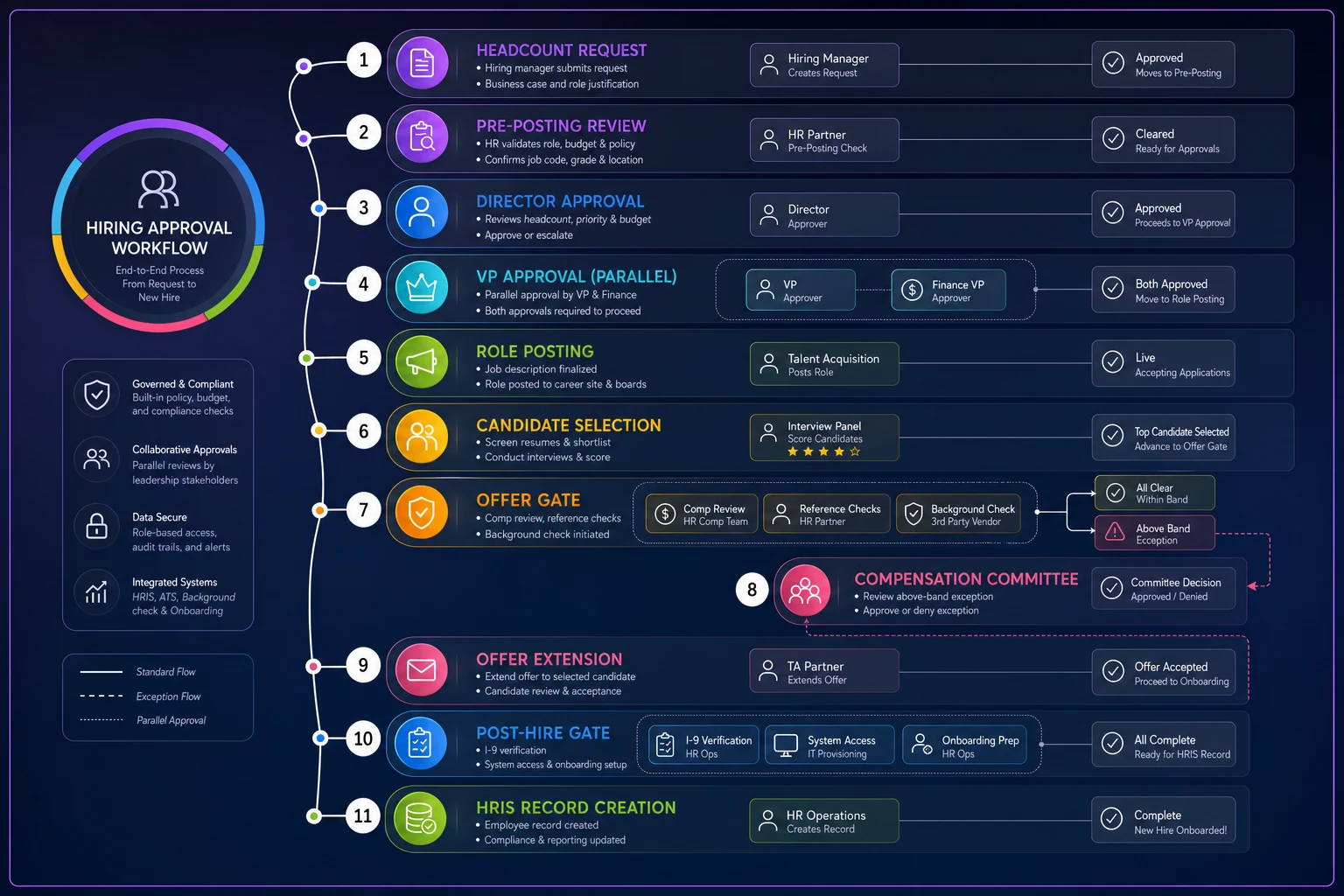
Headcount Request Submitted ↓ Pre-Posting Gate (Recruiting checks budget, JD, panel) ↓ Director Approval → VP Approval (parallel if applicable) ↓ Role Posted ↓ Candidate Selected → Interview Scores Documented ↓ Offer Gate (Comp review, reference checks, background check initiated) ↓ Compensation Committee Sign-off (if above band → exception path) ↓ Offer Extended ↓ Post-Hire Gate (I-9, system access, onboarding plan confirmed) ↓ Employee Record Created in HRIS
Each node in this flow has an owner, a time constraint tied to the SLA, and a documented output. The exception path branches off at the offer gate and loops back in after additional approvals complete. Nothing moves forward without the previous gate clearing – that's what keeps compliance intact even at high volume.
Scaling considerations: what changes from 50 to 500 hires
The governance framework that works at 50 hires per quarter tends to break around 150, then breaks again around 500. Each scale point requires different optimizations.
At 50-150 hires quarterly, the focus is standardization. You're moving from ad-hoc approvals to systematic processes. The approval matrix needs to cover roughly 80% of scenarios, with manual handling for exceptions. SLAs can be relatively generous since volume is still manageable. The audit trail just needs to exist and be searchable.
At 150-300 hires quarterly, parallel processing becomes critical. Sequential approvals can't handle the volume – you need multiple approvals happening simultaneously. The matrix expands to cover closer to 95% of scenarios. SLAs need to tighten to maintain velocity. Automated escalation becomes mandatory. The audit system needs proactive reporting to identify bottlenecks before they impact hiring.
Above 300 hires quarterly, you need automated decision-making for routine approvals. If a hire is within band, within budget, and passes standard checks, the system should auto-approve with human review reserved for exceptions. The governance framework needs regional variations for different employment laws. Audit requirements expand to include analytics around which managers have the highest turnover and which approval patterns correlate with failed hires.
The framework also needs to handle the organizational complexity that comes with scale – different business units with different approval requirements, acquired companies operating under different frameworks during integration, and international entities with country-specific compliance checks.
Common failure patterns and their early warning signs
Even well-designed governance frameworks fail in predictable ways. Recognizing these patterns early lets you adjust before they start affecting hiring outcomes.
The Rubber Stamp Syndrome: Approvers start blindly approving everything because volume is too high to review properly. Early warning sign: approval time drops to under five minutes consistently. That means people aren't reviewing, just clicking through. Solution: implement sampling reviews where random approvals get audited for quality.
The Shadow Process: Teams start working around the official governance framework because it's too slow. Early warning sign: offers going out before official approval, or "provisional" start dates before background checks clear. Solution: either speed up the official process or formally recognize the shadow process with appropriate controls.
The Exception Becoming the Rule: What starts as occasional exceptions becomes standard practice. Early warning sign: more than 30% of hires requiring exception approval. This usually means your standard bands no longer match market reality. Solution: update the standards rather than keep processing everything as an exception.
The Compliance Theater: Teams go through elaborate approval processes that don't actually reduce risk or improve decisions. Early warning sign: no correlation between approval rigor and hire quality or retention. Solution: strip back to essential approvals only and eliminate ceremonial checkpoints.
Measuring governance effectiveness without stifling velocity
The metrics for hiring governance need to balance speed and control. Track only velocity metrics and you'll lose governance. Track only compliance metrics and you'll kill hiring efficiency.
The metrics framework should include:
Velocity Metrics:
-
Time from req approval to offer
target 15-20 days
-
Approval cycle time by level
within SLA 90%+
-
Candidate drop-off due to process delays
under 5%
-
Offers declined due to timing
under 10%
Governance Metrics:
-
Exception rate by category
under 20% overall
-
Audit findings per quarter
zero critical, fewer than 3 minor
-
Approval override rate
under 5%
-
Post-hire issue rate
under 2%
Balance Metrics:
-
Quality of hire scores
stable or improving
-
Hiring manager satisfaction
80%+
-
Candidate experience scores
4+ out of 5
-
Cost per hire
stable relative to market
Review these as a system, not in isolation. If approval velocity improves but quality of hire drops, you've cut too many controls. If compliance is perfect but you're losing candidates to competitors, the process is too heavy. Both directions are failure modes.
The AI automation layer for governance at scale
This is where AI-powered operational software meaningfully changes what's possible with hiring governance. Instead of choosing between speed and control, AI automation lets you have both.
Routine approval decisions – is this hire within budget, within band, within headcount plan – are binary checks that AI can process instantly and accurately. Human approvers can then focus on exceptions and the decisions that actually require judgment.
The audit trail becomes largely self-maintaining. AI can automatically extract approval rationale from messages, document exception patterns, and flag anomalies for review rather than requiring someone to manually compile audit reports.
Pattern recognition surfaces problems before they fully develop. If certain managers consistently hire people who leave within six months, that can get flagged during their next approval request. If compensation exceptions cluster around certain roles, the system can surface a recommendation to revisit the band rather than keep processing exceptions manually.
Over time, the governance framework can also become more self-optimizing. As the system observes patterns between approval decisions and hiring outcomes, it can suggest adjustments to the approval matrix, SLA targets, and exception criteria – getting more efficient without giving up control.
Implementing without disrupting current hiring
The biggest mistake companies make is trying to implement a complete governance framework all at once. This creates chaos, resistance, and usually results in reverting to the old broken system within a few months.
Start with the highest-risk or highest-volume segment. If engineering hiring is your biggest challenge, implement the framework there first. Get it working smoothly before expanding. This contained approach lets you identify gaps without disrupting all hiring across the organization.
Run the new framework in parallel with existing processes initially. For the first month, use both. This reveals gaps in the new framework while maintaining hiring continuity. Once confidence builds, cut over completely.
Build in feedback loops from day one. Weekly check-ins with hiring managers and approvers during the first quarter. Monthly reviews of metrics and bottlenecks. Quarterly assessments of overall framework effectiveness. The framework should evolve based on operational reality, not the original design doc.
Full implementation typically takes three to four months from pilot to full rollout. Rushing that timeline usually creates gaps that cause bigger problems later.
Building a hiring governance framework that maintains velocity while ensuring compliance isn't about adding more controls – it's about designing smarter ones. The companies that get this right treat governance as an enabler of scale, not a barrier to it.
The structure outlined here – role-based approval matrices, velocity-focused SLAs, strategic decision gates, and streamlined audit trails – provides what's needed for high-volume hiring without sacrificing quality or compliance. When enhanced with AI automation, these systems can handle hundreds of hires monthly while actually improving decision quality.
The real test of a governance framework isn't whether it prevents every problem. The test is whether it scales with your hiring needs while catching the problems that actually matter. Get that balance right, and governance becomes a competitive advantage in talent acquisition rather than just a compliance checkbox.
Ready to transform your HR processes?
Join thousands of HR teams using Hiryly to hire faster, engage employees better, and stay compliant effortlessly.