

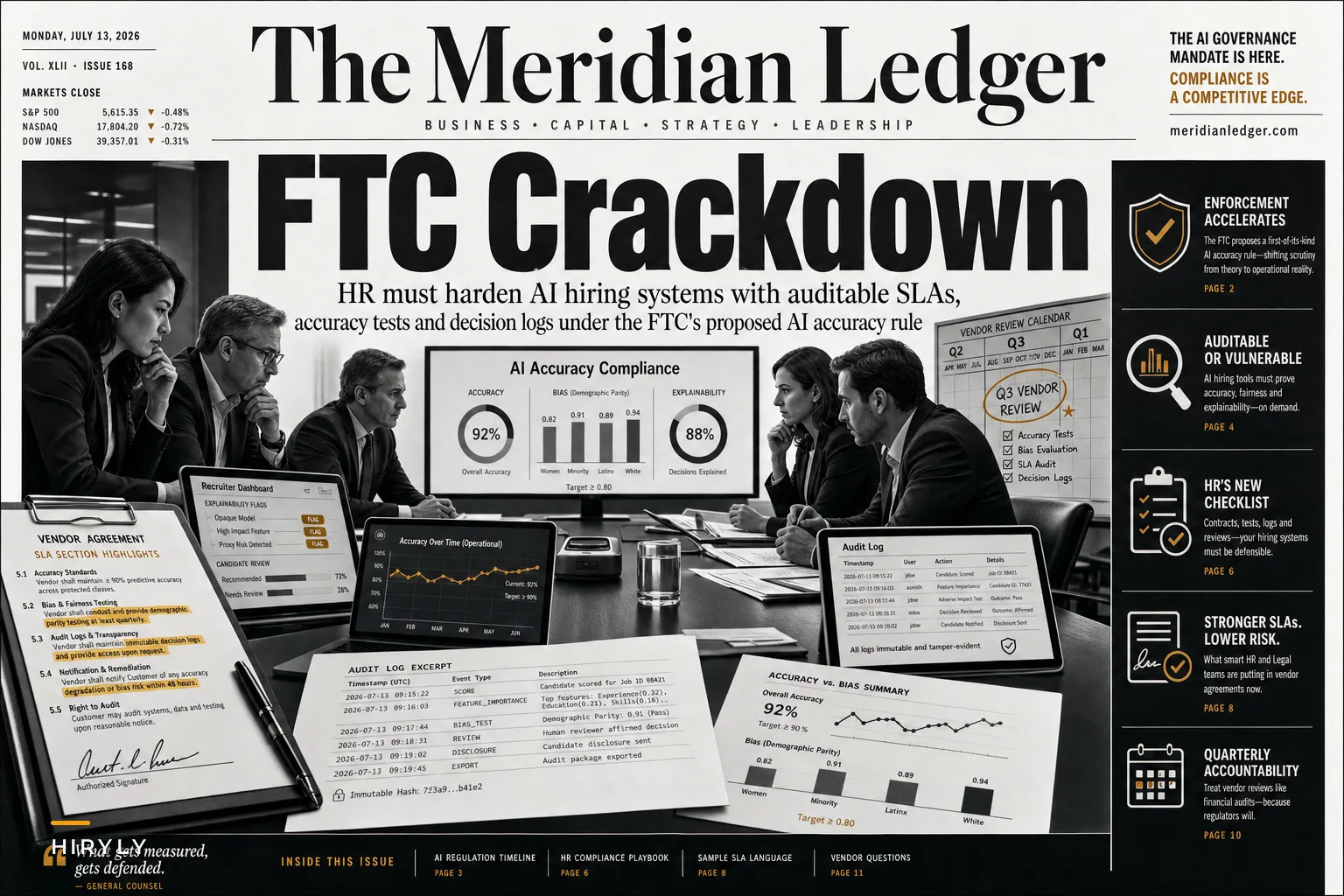

The FTC just dropped something that should have every HR leader auditing their tech stack. Their proposed policy statement on AI accuracy isn't just another regulatory memo — it's essentially saying that tweaking AI outputs to reduce discrimination might itself be a deceptive practice under consumer law.
The part that matters most: if your AI recruiting tools are adjusting outputs to appear less biased, but doing so makes them less accurate about candidate qualifications, you could be looking at FTC enforcement action. Not someday. The comment period runs through July 31, 2026, which means final rules could land before year-end.
This isn't the first time compliance timelines have snuck up on HR teams. GDPR played out the same way. The companies that waited for "final guidance" ended up burning consultant fees on rushed, half-baked programs. The ones that moved early built something that actually held up when regulators came calling.
Your vendor contracts just became compliance liabilities
Pull up your contract with that AI resume screening vendor. Or your video interview platform. Or that predictive hiring tool you bought last quarter.
Search for these terms:
-
Accuracy metrics
-
Error rate reporting
-
Bias mitigation methods
-
Output adjustment documentation
-
Human review requirements
Mostly silence? That's the problem.
Most HR teams signed these contracts when AI compliance meant checking an EEO box. The FTC's focus on "suppression of accuracy" creates an entirely different compliance surface. You need contracts that specify how vendors measure accuracy, what adjustments they make to outputs, and who's liable when their fairness tweaks draw regulatory scrutiny.
The operational reality gets messy quickly. Your resume parser might score candidates on predicted performance, then adjust those scores to ensure demographic balance. Until recently, that looked like responsible AI use. Under the FTC framework, it might be deceptive if those adjustments make the tool worse at predicting actual job performance. That's not a minor distinction — it's the core of what the agency is signaling.
Building your accuracy audit trail before the auditors show up
Compliance teams love to talk about documentation. But documentation without workflow integration is just expensive paper.
Eliminate HR bottlenecks with smart automation.
Hiryly simplifies your HR operations so you can focus on people, not paperwork.
- Centralized candidate tracking
- Automated onboarding workflows
- Performance & compliance dashboards
No credit card required
Here's what an actual FTC AI accuracy compliance program requires on the operational side:
Vendor accuracy baseline
-
For each AI tool in your hiring workflow
-
- What accuracy claims did the vendor make, specifically?
-
- How do they calculate accuracy — precision, recall, F1, something proprietary?
-
- What's the baseline accuracy rate from their testing?
-
- How often do they recalibrate or retrain models?
Your operational accuracy tracking
-
This is where theory meets reality. You need to track
-
- False positive rates (candidates who passed AI screening but failed human review)
-
- False negative audits (rejected candidates who got hired into similar roles elsewhere)
-
- Time-to-failure patterns (how quickly do AI-approved hires leave or underperform?)
-
- Override rates by hiring managers
Decision explainability records
-
Every AI-influenced hiring decision needs a paper trail showing
-
- What the AI recommended
-
- What factors drove that recommendation
-
- Whether a human overrode it
-
- Why
The challenge isn't collecting this data — it's keeping it sustainable. Teams build elaborate tracking systems that recruiters abandon within a few weeks because they add 15 minutes to every decision. That's not a compliance win. That's a compliance illusion.
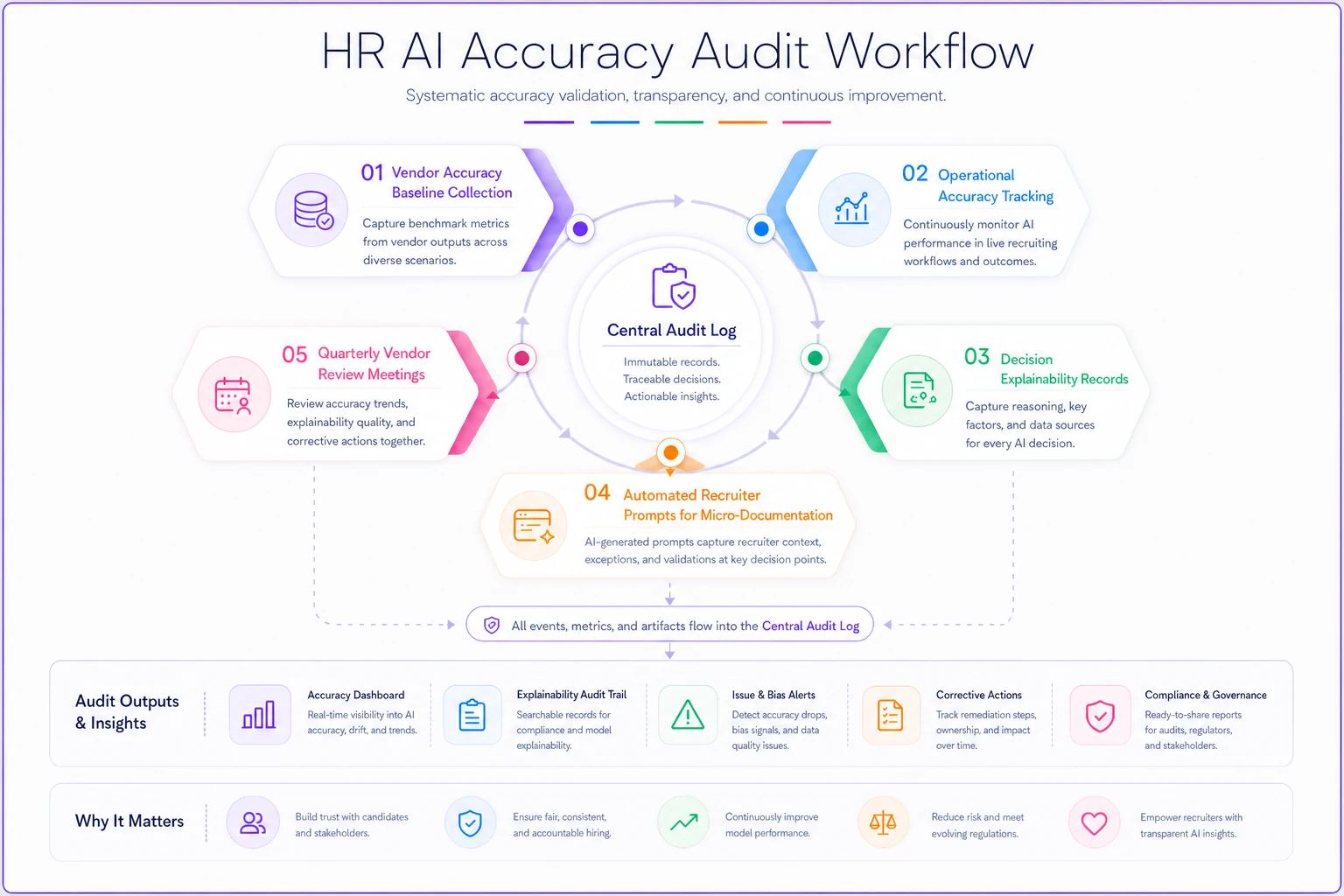
This diagram shows how these pieces connect in practice.
The vendor management piece no one's actually operationalizing
Legal will focus on contract amendments. Compliance will build policies. But someone has to actually operationalize vendor accountability, and that usually falls into HR ops with minimal support.
Start with a vendor AI accuracy inventory — not a spreadsheet listing your tools, but an operational map showing which vendors touch candidate data at which stages, what AI and ML capabilities each vendor actually uses, whether they adjust outputs for fairness and how, and who at the vendor can explain their accuracy methodology clearly.
Then comes the uncomfortable part: testing vendor claims.
Most vendors will hand you a white paper citing 95% accuracy. Accuracy at what, exactly? Predicting interview performance? First-year retention? Long-term success? Measured against whose definition of success, on what dataset?
-
Show us your current accuracy metrics
-
Explain any model updates since last quarter
-
Walk through how you measure false positives and negatives
-
Document any output adjustments made for fairness
-
Provide audit logs for our hiring decisions
Some vendors will push back on proprietary methods. That's exactly when you need escalation paths already baked into your contracts — including the right to terminate if they can't demonstrate FTC-compliant accuracy measurement. If that clause isn't in your current contract, get it in there before the comment period closes.
Creating your hiring decision defense file
Think about your most recent AI-influenced hiring decision. Could you defend it to an FTC investigator?
Not philosophically. Operationally — with documentation showing the AI tool's accuracy rate for similar decisions, how the tool reached this specific recommendation, what human review occurred, why the human agreed or disagreed, and what alternative factors were considered.
This isn't paperwork theater. It's about building systematic data governance that captures decision rationale without destroying recruiter productivity.
The practical approach is automating prompts inside your existing workflow. When a recruiter advances a candidate the AI flagged as marginal, the system should automatically ask for a quick rationale. Not an essay — a dropdown plus optional notes. Same when they reject an AI-recommended candidate. Those micro-documentations build your defense file as decisions happen, without compliance sprints or special meetings.
The accuracy vs. fairness trap buried in your current tools
Here's a scenario worth thinking through: your AI vendor quietly updates their model to improve demographic representation. Sounds good. Except they achieved it by loosening accuracy standards on certain predictions. Now you're running a less accurate tool, and you don't know it because the vendor framed it as a "fairness enhancement."
Under the FTC framework, this could constitute deceptive practice — by the vendor, and potentially by you for deploying it without disclosure.
Protection requires a few operational controls:
Model change notifications
Vendors must notify you before any model updates that could affect accuracy. Not buried in release notes — an explicit notification with accuracy impact analysis attached.
Parallel accuracy tracking
Run your own accuracy measurements independent of vendor claims. Track quality-of-hire for AI-recommended vs. human-discovered candidates. If the AI's recommendations start degrading, you'll catch it before it becomes a liability.
Fairness measurement separation
Measure fairness and accuracy as separate metrics. Optimizing for both is fine, but you need to see when they conflict. A tool that achieves demographic balance by loosening candidate scoring has great fairness numbers and poor accuracy — those are not the same problem and need different fixes.
The table below shows how these two dimensions can diverge, and what each scenario actually signals operationally:
| Scenario | Accuracy | Fairness | Operational Risk |
|---|---|---|---|
| High accuracy, low fairness | Strong | Poor | Legal/DEI exposure |
| Low accuracy, high fairness | Poor | Strong | FTC deceptive practice risk |
| Low accuracy, low fairness | Poor | Poor | Immediate remediation needed |
| High accuracy, high fairness | Strong | Strong | Target state — document and maintain |
The bottom-right box is where you want to be. The bottom-left is where most companies find out they've been operating only after something goes wrong.
Building your 90-day compliance sprint
Forget perfect compliance documentation for now. You need operational readiness by the time final rules land. Here's the priority order:
Days 1–30: Vendor inventory and contract review
Map every AI tool touching your hiring process — not just the obvious ones. Include anything with "smart" or "predictive" features. Your ATS ranking algorithm. Your scheduling tool's availability predictions. Email templates with AI personalization.
For each tool, document current accuracy claims, measurement methodology, fairness adjustments, and contract terms around liability and transparency.
Flag the contracts that need immediate amendment. You want new terms locked in before the FTC rules finalize.
Days 31–60: Accuracy baseline establishment
You can't prove compliance without knowing your starting point. For each AI tool, pull historical accuracy data if it exists, design measurement methodology if it doesn't, establish baseline metrics, and build tracking mechanisms.
Start with your highest-volume tools. The resume screener processing thousands of applications monthly matters more than the executive assessment tool you use a handful of times a year.
Days 61–90: Operational integration
This is where compliance becomes sustainable or becomes theater. Build these into your actual workflows: automated accuracy tracking dashboards, decision documentation prompts, vendor review calendars, escalation procedures, and training materials recruiters will actually use.
Start with the highest-volume tools to get meaningful accuracy signals quickly.
One honest test: can a new recruiter follow your FTC compliance process without specialized training? If not, simplify it until they can.
When accuracy requirements collide with your diversity metrics
Worth addressing directly: what happens when FTC accuracy requirements conflict with your DEI goals?
The FTC's position seems to be that adjusting AI outputs to improve diversity could be deceptive if it reduces accuracy. But most HR leaders have diversity metrics tied to their performance reviews. This isn't a theoretical tension — it's a real operational conflict that's coming, and no one has a clean answer yet.
Abandoning diversity goals isn't the answer. Getting more precise about methodology and measurement is.
Measure accuracy within demographic categories, not just overall. An AI tool might be 90% accurate overall but only 70% accurate for certain groups. That's an accuracy problem, not a fairness problem — and fixing it improves both simultaneously. When you reject an AI recommendation for diversity reasons, document it as human judgment, not AI adjustment. The FTC appears focused on AI systems that obscure internal adjustments — not human reviewers who transparently override AI outputs.
Rather than adjusting AI outputs after the fact, shift focus to better training data that accurately reflects diverse talent pools, multiple models optimized for different hiring contexts, and human review processes specifically designed to catch AI blind spots. That approach is more defensible under the FTC framework and, honestly, produces better hiring outcomes regardless of regulatory pressure.
Your next Monday morning standup agenda
Stop treating FTC AI accuracy compliance as a future legal problem.
It's an operational challenge that needs traction now. Here's what's worth putting on Monday's agenda:
-
Vendor audit assignments
Who owns which contracts, and by when?
-
Accuracy metrics definition
What are we measuring and how?
-
Documentation workflow design
How do we capture decisions without killing productivity?
-
Budget reality check
What will this actually cost in tools and time?
-
Timeline commitment
When do we need to be audit-ready?
The FTC's move signals something bigger than another compliance checkbox. It's recognition that AI in hiring has moved from experiment to critical infrastructure. Reuters reported that the agency specifically flagged concerns about accuracy suppression in the name of fairness — a direct challenge to how many AI hiring tools currently operate.
Making compliance operational, not theoretical
The companies that handle this well won't just be compliant. They'll have better vendor contracts, cleaner accuracy tracking, and decision documentation that protects both the business and candidates. The ones who wait will be scrambling to build all of that under pressure, with the wrong people in the room and not enough runway to do it right.
The comment period closes July 31, 2026. The real competitive advantage in hiring isn't having the most sophisticated AI tool — it's having one you can actually trust, measure, and defend. Starting Monday is the right call.
Starting Monday is the right call.
Ready to transform your HR processes?
Join thousands of HR teams using Hiryly to hire faster, engage employees better, and stay compliant effortlessly.