


Most HCM evaluations go sideways for a boring reason: the shortlist gets built around features nobody will use for two years, while the workflows that actually break every quarter — comp exceptions, promotion approvals, background check reconciliation, off-cycle raises — barely get tested in the demo. Then the platform goes live, and three months later someone in HR is exporting a CSV to a spreadsheet because the promotion workflow can't handle a mid-cycle band change. Sound familiar.
This piece skips the "what is an HCM" throat-clearing. You already know what these platforms do. What you probably don't have is a defensible shortlist mapped to the specific workflows that create audit risk and manager frustration, plus an RFP checklist that surfaces the stuff vendors don't volunteer.
One note before the list: this article is meant to pair with the mid-market total rewards operating blueprint. That blueprint covers the design of role bands, promotion cadence, and comp-exception approvals. This one covers the tooling — which vendors can actually run those workflows, and how to verify it before you sign.
How to read this shortlist (and who it's actually for)
This is scoped for organizations roughly in the 200–2,000 employee range, with in-house HR of maybe 3–15 people, running recruiting, onboarding, performance, and compliance without a dedicated HRIS admin team of ten. If you're at 50 people, most of this is overkill. If you're at 8,000 across 20 countries, you're in Workday/SuccessFactors territory and this list is too small.
The split matters: some teams want a single platform for everything, and some are better off pairing a strong core HR/payroll system with a best-of-breed recruiting or performance layer. Neither is wrong. What tends to happen across mid-market rollouts is that the single-platform choice wins on data consistency and loses on depth in one or two modules, while best-of-breed pairings win on depth and lose weeks to integration maintenance. Pick based on where your pain actually is.
The 5 vendors (plus two pairings)
1. Rippling — single platform, strongest for admin automation
Eliminate HR bottlenecks with smart automation.
Hiryly simplifies your HR operations so you can focus on people, not paperwork.
- Centralized candidate tracking
- Automated onboarding workflows
- Performance & compliance dashboards
No credit card required
Rippling's real differentiator isn't recruiting or performance depth; it's how tightly it ties HR, IT, and finance actions together. When someone gets promoted, the same event can trigger a comp change, a role reassignment, and app-access updates in one flow. For lean HR teams that also touch device and access provisioning, that consolidation removes a genuine coordination headache. The tradeoff: performance management is competent but not deep, and highly custom promotion-approval chains sometimes need workarounds. Good fit for teams whose biggest pain is manual admin sprawl across systems.
2. HiBob (Bob) — single platform, strongest for mid-market performance and culture workflows
Bob tends to win with HR teams that care about the manager experience and want configurable performance cycles, calibration support, and clean org-change handling without a consultant on retainer. Its promotion and comp-review workflows are flexible enough for banded structures, and the UI is one managers actually log into. The gap: payroll is partner-dependent in many regions, and recruiting is lighter than a dedicated ATS. Strong choice when your workflow pain is in performance, promotions, and org changes rather than payroll mechanics.
3. UKG Ready — single platform, strongest for compliance-heavy and hourly workforces
If you've got a meaningful hourly or shift-based population and real compliance exposure — wage-and-hour, scheduling rules, certifications — UKG Ready is built for that reality in a way the "modern SaaS" vendors aren't. Time, attendance, and compliance reporting are genuinely strong. The tradeoff is a heavier, less slick interface and a longer implementation. Not the pick if you're a lean salaried tech team; very much the pick if compliance audits keep you up at night.
4. Paylocity — single platform, strongest balance of payroll depth and usability
Paylocity's sweet spot is teams that want serious payroll and benefits administration without the enterprise weight, plus decent recruiting and performance modules that cover the common cases. It handles off-cycle payroll and comp changes cleanly, which matters for exception workflows. Recruiting and performance won't beat best-of-breed tools, but they're solid enough that many mid-market teams never need to bolt on anything. A pragmatic default for payroll-centric HR functions.
5. Deel — single platform, strongest for distributed and multi-country teams
Deel earned its reputation on global contractor and EOR payments, but its HCM layer has grown into a legitimate option for teams that hire across borders and are tired of stitching together local payroll vendors. If a big share of your workforce sits outside your headquarters country, Deel removes a lot of manual reconciliation. The caveat: for a purely domestic workforce, you're paying for global capability you won't use, and the performance and recruiting depth is still maturing.
Two best-of-breed pairings worth considering
-
Core HR/payroll (Paylocity or UKG) + Greenhouse or Ashby for recruiting. When recruiting volume and hiring-manager workflows are your center of gravity, a dedicated ATS beats every all-in-one recruiting module on structured interviewing, sourcing analytics, and approval routing.
-
Core HR (HiBob) + Lattice or Culture Amp for performance. When calibration, continuous feedback, and development planning are strategic priorities, a specialist performance platform gives you depth the all-in-ones can't match.
The uncomfortable truth about pairings: the integration is never as clean as the sales engineer implies. Budget for someone owning it.
Side-by-side: where each option is strong
The table below is a filter, not a verdict. Use it to get to two or three vendors, then do the real scoring against your own workflows.
| Vendor / Pairing | Best for | Payroll depth | Recruiting depth | Performance/promotion depth | Compliance reporting | Watch-out |
|---|---|---|---|---|---|---|
| Rippling | Admin automation, IT+HR overlap | Good | Medium | Medium | Medium | Custom approval chains |
| HiBob | Performance, org changes | Partner-dependent | Medium | Strong | Medium | Regional payroll gaps |
| UKG Ready | Hourly, compliance-heavy | Strong | Medium | Medium | Strong | UX, longer implementation |
| Paylocity | Payroll-centric balance | Strong | Medium | Medium | Good | Depth ceilings in modules |
| Deel | Multi-country teams | Strong (global) | Light–Medium | Light–Medium | Varies by country | Overkill if domestic |
| Core + Greenhouse/Ashby | Recruiting-heavy | Depends on core | Strong | Depends | Depends | Integration upkeep |
| Core (Bob) + Lattice/Culture Amp | Performance-strategic | Partner | Medium | Strong | Medium | Two contracts, two owners |
The scoring you do against your own workflows matters far more than any generic rating here.
The integrations to verify before you fall in love with a demo
This is where most evaluations get lazy. The demo looks great, everyone nods, and nobody checks whether the platform actually connects to the four or five systems your promotion and exception workflows depend on. Verify these explicitly, in writing, during evaluation:
-
Payroll ↔ HRIS sync for off-cycle and mid-cycle changes. Not just scheduled payroll — can it push a mid-cycle promotion raise without a manual re-run? Ask them to show a mid-period comp change.
-
Background check and screening vendors. Which ones integrate natively vs. via a middleware connector, and does the status write back into the onboarding record automatically?
-
Benefits carriers and 401(k)/pension providers. EDI feed support, and how carrier changes propagate during a promotion that changes benefit eligibility.
-
SSO / identity provider (Okta, Entra/Azure AD, Google). SCIM provisioning specifically — automated deprovisioning is a common audit finding when it's missing.
-
General ledger / finance system. Does comp-cost data map to your GL structure without a spreadsheet in the middle? This is the seam where comp-exception errors hide.
-
ATS ↔ HRIS (if pairing). Candidate-to-employee record transfer without re-keying. Re-keying is where onboarding data errors are born.
-
E-signature and document management for offers, promotion letters, and exception approvals with a retained audit trail.
Ask for each integration's type — native, prebuilt connector, iPaaS (Workato/Merge), or custom API — because that determines who maintains it and what breaks when either side updates.
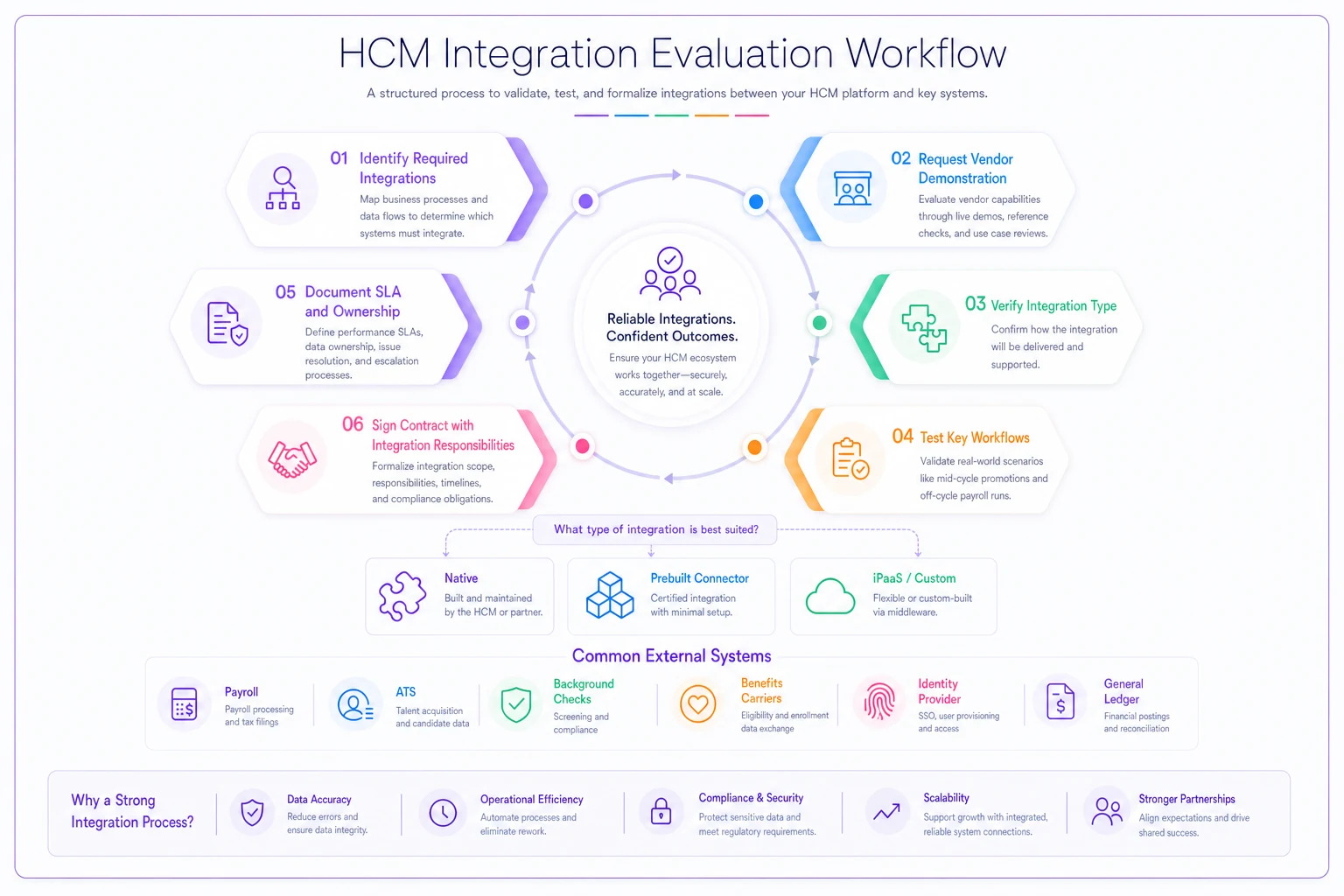
A simple workflow to follow during vendor evaluations.
The RFP checklist that actually surfaces problems
Generic RFPs get generic answers. The questions below are written to expose the specific ways promotion and exception workflows break in real operations.
Sample questions to include
-
Walk us through a mid-cycle promotion that changes an employee's band, base pay, bonus target, and manager — how many manual steps, and where does approval routing live?
-
How do you handle a comp exception that falls outside band? Can approval thresholds route dynamically based on the size of the exception?
-
Show us the audit trail for a comp change
who requested, who approved, timestamp, prior value, new value. Can it be exported for an auditor without engineering help?
-
How does an off-cycle raise flow into the next payroll run? Demonstrate, don't describe.
-
What happens to app access, benefits eligibility, and reporting lines when someone is promoted — automatic, semi-automatic, or manual?
-
How are role bands and pay ranges stored and enforced? Can a manager submit a proposal outside the range, and what does the system do?
-
What's your data retention and deletion capability for PII, and can retention differ by record type and jurisdiction?
-
Describe your standard implementation timeline for an org our size, and name the last three go-live dates you actually hit.
Scoring matrix
Score each vendor 1–5 on the criteria below, weighted to your reality. A workable default weighting for mid-market teams that haven't gone through this before:
| Criterion | Weight | What a 5 looks like |
|---|---|---|
| Promotion/exception workflow fit | 25% | Handles out-of-band exceptions with dynamic routing, no CSV |
| Payroll & off-cycle handling | 20% | Mid-cycle changes flow without manual re-runs |
| Integrations (native depth) | 15% | Native connectors to your actual stack, SCIM included |
| Compliance & audit trail | 15% | Exportable, complete audit logs by non-engineers |
| Usability for managers | 10% | Managers complete tasks without HR hand-holding |
| Implementation credibility | 10% | Verifiable references, realistic timeline |
| Total cost over 3 years | 5% | Transparent, few surprise line items |
The weighting is the honest part. If you weight everything equally, you'll pick a mediocre all-rounder. Weight toward the workflows that break most often for you.
Implementation and data-migration requirements
-
A named implementation lead on the vendor side, not just a rotating support queue.
-
A documented data-migration plan with field-level mapping, sign-off gates, and a defined number of parallel-run cycles before cutover.
-
Data validation checkpoints — record counts, comp history integrity, org-hierarchy accuracy — signed off by your team before go-live.
-
A rollback definition
what happens if migration fails validation, and who eats the cost of the delay.
-
Historical comp and promotion data migration scope explicitly named. "We migrate current state only" is a common surprise that wrecks your audit trail.
Contract red flags
-
Integration fees quoted as "custom scope TBD" with no ceiling.
-
Auto-renewal with a short cancellation window buried in the terms.
-
Per-module pricing that makes the demo bundle look cheap and the full stack expensive.
-
Data export limited to proprietary formats, or export fees at contract end — a lock-in tactic that's more common than it should be.
-
SLA language that covers uptime but says nothing about payroll accuracy or support response for pay-affecting issues.
-
"Roadmap" commitments for features you need but that don't exist yet — if it's not shippable today, price and plan as if it never ships.
Put these in the contract, not the email thread:
A realistic evaluation scenario
A roughly 600-person B2B software company was running core HR on an aging system with recruiting bolted on through a light ATS, and performance managed in spreadsheets. Their recurring failure: every promotion cycle, comp exceptions got approved over email and then manually keyed into payroll, and somewhere between 8 and 12 changes per cycle either landed a pay period late or hit payroll at the wrong number. Finance was reconciling by hand each quarter.
They shortlisted three vendors, weighted the scoring matrix heavily toward promotion and exception handling and off-cycle payroll, and — importantly — made each vendor demonstrate a mid-cycle out-of-band promotion rather than describe it. Two vendors needed a manual export step at exactly the point that was breaking today. The third didn't.
After implementation, exception approvals moved into a routed workflow with a real audit trail, and mid-cycle changes flowed into payroll without re-keying. The manual quarterly reconciliation dropped from a multi-day slog to a spot-check. Nothing dramatic in the marketing sense — but the specific error that had been quietly annoying everyone for years mostly stopped happening. That's the bar to aim for.
When a single platform makes sense — and when it doesn't
Single platform makes sense when: your HR team is small, data consistency across modules matters more than best-in-class depth in any one area, and you don't have anyone to own integrations long-term. Most mid-market teams fit here.
Best-of-breed pairing makes sense when: one function — usually recruiting or performance — is strategically central and the all-in-one modules genuinely can't do the job, and you have someone who will own the integration through vendor updates.
Who should not do this evaluation at all right now: teams mid-way through a different system migration, or teams that haven't yet defined their role bands and promotion cadence. Buying a platform to run workflows you haven't designed just means you'll misconfigure it. Sort the design first — that's exactly what the total rewards operating blueprint is for — then come back and match tooling to it.
Final thought
The best HCM decision isn't the platform with the most features or the slickest demo. It's the one that runs your two or three highest-friction workflows — usually promotions, comp exceptions, and off-cycle changes — without forcing anyone back into a spreadsheet. Build your shortlist from vendors that fit your size and pain, weight your scoring toward the workflows that actually break, and make every finalist prove it on your worst case, not their best one. Do that and you'll avoid the three-months-later CSV problem that catches most teams off guard.
Ready to transform your HR processes?
Join thousands of HR teams using Hiryly to hire faster, engage employees better, and stay compliant effortlessly.