



Mid-market companies hit a weird spot around 200 employees. The compensation structure that worked at 50 people — basically the CEO knowing everyone's salary — starts breaking down. But you're not ready for the enterprise-grade comp platform that costs $80k annually and needs a dedicated analyst to run it.
What happens next is pretty predictable. Finance builds a massive spreadsheet with 47 tabs. HR creates a separate tracker for promotion history. Managers start making side deals because getting approval takes three weeks. Then someone discovers your junior engineers in Austin make more than senior engineers in Chicago, and suddenly you're explaining market differentials to a very confused board.
The problem isn't that you lack a compensation philosophy. Most mid-market companies have one — usually a three-page document about paying at the 50th percentile that nobody actually follows. The real problem is you don't have an operating system to make compensation decisions consistently when your HR team is four people covering everything from benefits to performance reviews.
Why traditional comp frameworks fail at mid-market scale
Enterprise compensation frameworks assume resources that don't exist in mid-market companies. They expect dedicated comp analysts, quarterly market data refreshes, and managers who understand regression analysis. Mid-market reality looks different: your comp lead also runs benefits, your market data is from last year's free survey, and half your managers think a compa-ratio is a type of coffee.
These frameworks also assume stable organizational structures. But mid-market companies reorganize constantly. That job architecture you spent three months building? Already obsolete because you just acquired a 30-person team with completely different titles, or your biggest customer demanded a new service line that doesn't fit any existing job family.
Even worse, traditional frameworks treat exceptions as rare events. In mid-market companies, exceptions ARE the rule. Your top salesperson threatens to leave unless you match an offer that's 30% above band. A critical engineer wants to go part-time but keep their senior title. The new VP you desperately need costs 40% more than anyone else at that level. Traditional frameworks tell you to say no to all of these. Good luck with that strategy when you're competing against companies with twice your resources.
Building role bands that survive organizational chaos
Forget creating 200 unique job descriptions with precise market matches. You need maybe 15–20 role bands that cover 90% of your positions, with enough flexibility to handle the weird situations that come up weekly.
Eliminate HR bottlenecks with smart automation.
Hiryly simplifies your HR operations so you can focus on people, not paperwork.
- Centralized candidate tracking
- Automated onboarding workflows
- Performance & compliance dashboards
No credit card required
Start with operational levels, not titles. Level 1 handles defined tasks with clear instructions. Level 2 works independently on projects. Level 3 leads initiatives or small teams. Level 4 owns major functions or P&L. Level 5 sits on the executive team. Every role in your company fits somewhere in those five levels.
-
Level 1 handles defined tasks with clear instructions.
-
Level 2 works independently on projects.
-
Level 3 leads initiatives or small teams.
-
Level 4 owns major functions or P&L.
-
Level 5 sits on the executive team.
Within each level, create 3–4 job families: technical, operational, commercial, and support. A Level 3 Technical might be a senior engineer or senior data analyst. A Level 3 Commercial could be a senior account executive or marketing manager. The specific title matters less than the level of impact and decision-making authority.
Now here's the part most companies mess up: the salary ranges. Don't try to nail down exact midpoints based on market data you'll never have time to update. Instead, create overlapping ranges with about 40% spread from minimum to maximum. Level 2 might run from $55k to $77k. Level 3 from $70k to $98k. Yes, they overlap significantly — that's intentional. It gives you room to handle market variations, hot skills, and retention situations without constantly seeking exceptions.
For geographic differences, pick three tiers maximum: high-cost (SF, NYC), standard (most major cities), and low-cost (smaller markets). Apply a simple multiplier: 1.2x for high-cost, 1.0x for standard, 0.85x for low-cost. Not perfect, but manageable with limited HR capacity.
The promotion and merit increase decision engine
Most mid-market companies run promotions whenever a manager complains loudly enough or an employee threatens to quit. This creates two problems: unfairness that leads to discrimination risk, and budget chaos when eight promotions hit in the same month.
Instead, run promotions twice per year in defined windows. January for operational roles that align with fiscal planning. July for technical and sales roles that often follow different performance cycles. Outside these windows, only true emergencies get processed — and define emergency narrowly: critical retention risks where you have a written competing offer, or new hires where the role genuinely requires the higher level from day one.
-
Current performance (meets/exceeds/exceptional)
-
Time in role (under 12 months/12–24 months/over 24 months)
-
Business need (nice to have/important/critical)
Scores of 7+ get approved automatically if within budget. Scores of 5–6 go to leadership review. Scores under 5 get denied with clear feedback on what needs to change. Not sophisticated, but it creates consistency when you don't have time for elaborate calibration sessions.
| Group | Increase Range |
|---|---|
| Top 20% | 4–6% |
| Middle 60% | 2–4% |
| Bottom 20% | 0–2% |
Managers will always argue their team deserves more. Don't waste energy fighting individual cases. Give each manager a fixed budget — typically 3% of team payroll — and let them distribute it following the guidelines. They can give one person 8% and another 0%, as long as they document the rationale and stay within budget.
If someone deserves more than 6%, that's a promotion conversation, not a merit increase.
Comp exception approval workflows that actually work
Every compensation framework needs an exception process. The question is whether exceptions take three weeks and six meetings, or three days and one decision.
A quick workflow of the three exception paths:
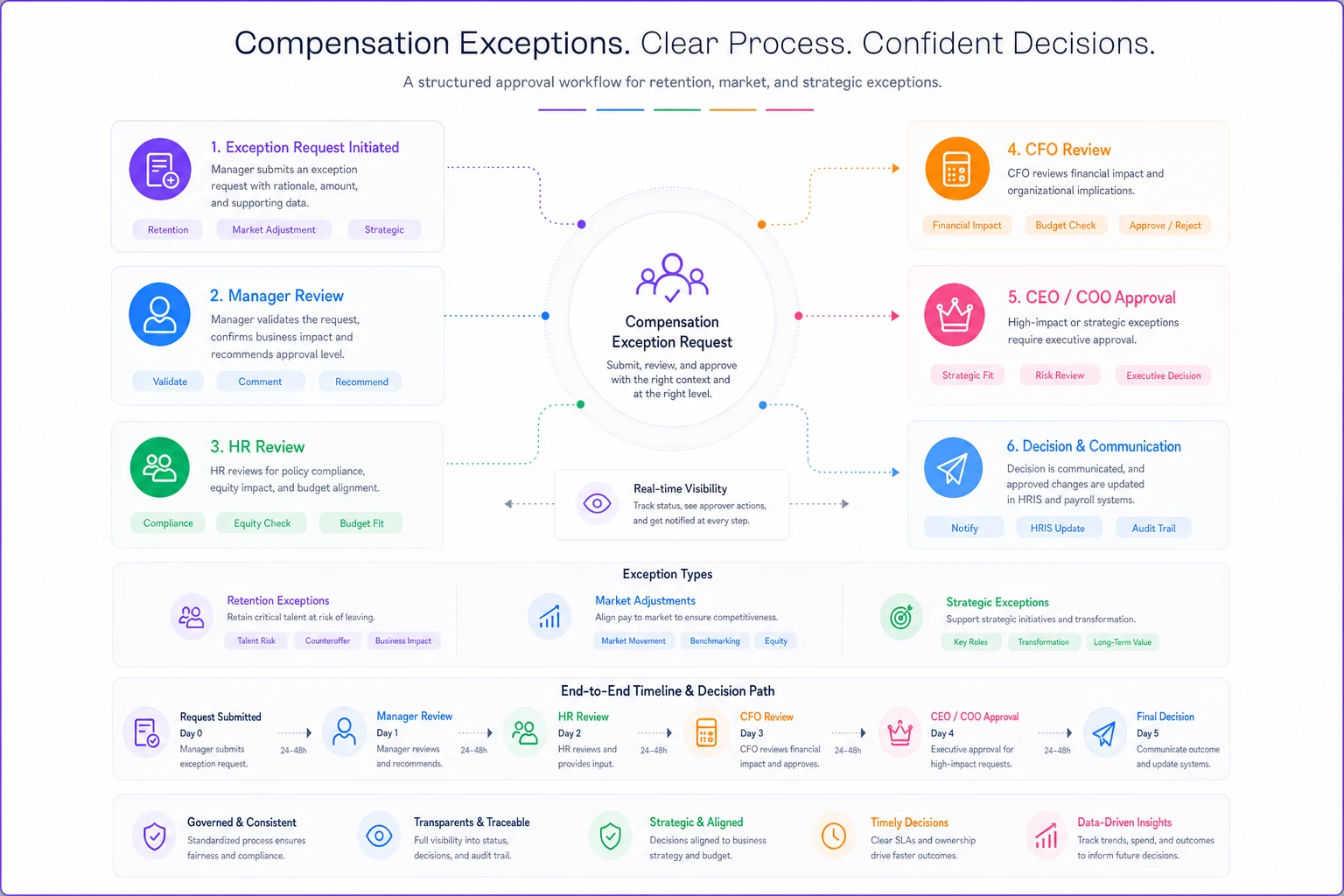
Retention exceptions (competing offer or flight risk): Manager documents the situation, HR validates market data, one-up manager approves if under 15% increase, CFO approves if over 15%. Decision within 72 hours. No committees, no presentations.
Market adjustments (role genuinely pays more than current bands): HR documents market data from at least two sources, CFO and department head approve jointly, adjustment applies to all similar roles. Review quarterly to avoid constant one-offs.
Strategic exceptions (acqui-hires, critical skills, executive positions): CEO or COO approves directly, finance tracks separately from normal comp budget. Limited to 5% of total headcount per year.
Notice what's not here: counteroffers for poor performers, adjustments because someone's been here a long time, or increases because a manager likes someone. Those aren't exceptions — they're failures of your normal process.
Document every exception in a simple tracker: date, employee, amount, type, approver, and outcome six months later (did they stay? did performance improve?). When patterns emerge — like constant retention exceptions in one department — fix the underlying problem instead of processing more exceptions.
The quarterly comp review ritual for lean HR teams
Running compensation well doesn't require constant analysis. It requires consistent check-ins that catch problems before they explode. A quarterly review cycle hits the sweet spot between staying current and not overwhelming your limited HR capacity.
Quarter 1: Budget reconciliation and annual increase planning. Compare actual spend to budget, identify roles growing faster than planned, and set merit/promotion budgets for the year. This takes about two days with finance.
Quarter 2: Promotion cycle one and market check. Run your mid-year promotions, then spot-check 10–15 key roles against current market data. Don't try to review everything — focus on roles where you're struggling to hire or seeing turnover.
Quarter 3: Pay equity review and adjustment planning. Run a basic regression analysis (or have a consultant do it annually) to identify any systematic gaps. Focus on like-for-like roles at the same level. Document everything for potential audit scenarios.
Quarter 4: Promotion cycle two and band adjustment. Run year-end promotions and adjust bands for the following year based on actual market movement. Aim for 2–3% annual band increases unless market data shows something dramatic.
Each review produces a one-page summary for leadership: current comp ratio distribution, exception trends, upcoming risks, and recommended actions. Skip the 40-slide deck — nobody reads it anyway.
Hard trade-offs when HR capacity is limited
You can't do everything with a lean HR team. Here's what to prioritize and what to deliberately ignore:
Do this: Maintain consistent role levels, run defined promotion cycles, track exceptions, and conduct basic pay equity reviews. These prevent lawsuits and mass exodus.
Skip this: Annual market pricing for every role, complex job architectures, individual development plans tied to comp, and elaborate performance calibrations. Nice-to-have luxuries you can't afford yet.
Automate this: Basic comp ratio calculations, approval workflow routing, and exception tracking. A simple operational platform with workflow automation can handle these without constant manual work — the same system that routes exception requests can track approval patterns and flag when certain managers repeatedly request exceptions outside normal cycles.
Outsource this: Annual pay equity audits, executive comp benchmarking, and international comp design. These require specialized expertise you won't have in-house.
Give managers a fixed 3% of team payroll budget and require documented rationale for any deviations to reduce ad-hoc escalation.
The brutal truth about mid-market compensation: you'll never have perfect market data, flawless internal equity, or enough time to handle every situation optimally. Your goal is to be consistent enough to avoid discrimination claims, flexible enough to retain critical talent, and simple enough that managers can actually follow the process.
Building your comp operating system piece by piece
Start with role levels and basic bands. Don't overthink it — you can refine later. Get the five levels defined, create initial ranges based on your current salaries plus 20% headroom, and document which roles fit where. This takes about a week.
Next, implement promotion cycles. Pick your two annual windows, communicate them repeatedly, and stick to them even when it's inconvenient. The first cycle will be chaos. The second will be merely difficult. By the third cycle, managers will start planning ahead. That predictability alone saves dozens of hours of ad-hoc compensation discussions.
Add the exception workflow once promotion cycles are stable. Start strict — approve almost nothing outside the defined categories. After six months, review what got rejected and adjust if you're losing good people over rigid rules. Err on the side of too strict initially; it's easier to loosen than tighten.
Finally, layer in quarterly reviews once the basics are running smoothly. Pick one deep-dive topic per quarter and keep the rest as quick health checks. Use the governance frameworks you've built for other HR processes as templates for structuring these reviews.
The hardest part isn't building this total rewards operating blueprint — it's maintaining it when everything else is on fire. Sales missed their quarter and wants emergency commission changes. Engineering is losing people to a hot startup. The CFO wants to freeze all increases to preserve cash.
This is where the operating blueprint actually earns its keep. Instead of making panicked individual decisions, you have a framework for evaluating trade-offs. Emergency commission changes? That's a strategic exception requiring CEO approval and separate budget tracking. Engineering retention crisis? Run an off-cycle market adjustment review for technical roles specifically. Hiring freeze? Pause new positions but continue planned promotions to avoid larger retention issues downstream.
The real test: when your comp framework meets organizational reality
A midwest manufacturing company with around 280 employees implemented this exact blueprint after their compensation "system" — meaning the CFO's spreadsheet — broke when they acquired a 50-person software company with completely different pay scales. The software engineers made 40% more than manufacturing engineers at supposedly the same level. Their HR team was three people, one of whom was brand new.
They started by mapping everyone to the five-level framework, ignoring existing titles entirely. This immediately revealed that some "senior managers" were actually individual contributors (Level 2), while some "analysts" were running critical projects (Level 3). Just that mapping exercise solved about half their internal equity issues without a single pay change.
The promotion cycles initially faced resistance from managers used to promoting people whenever they felt like it. But after the first cycle, most of them realized batch processing actually made their lives easier — they could tell pushy employees exactly when promotions would be considered instead of fielding constant requests.
The exception process surfaced something interesting: roughly 80% of exception requests came from three managers who'd been using compensation increases to avoid difficult performance conversations. Once they limited each manager to one exception per quarter, those same managers suddenly got better at regular performance management.
After four quarters, compensation costs had actually decreased by around 3% while turnover dropped from 22% to 14%. Not because they paid less, but because they eliminated panic increases and retention counteroffers that rarely actually retained anyone long-term. The money saved went into the promotion budget, creating clearer advancement paths that employees trusted.
Making this sustainable without massive HR investment
This blueprint works because it acknowledges mid-market reality: you'll never have enterprise resources, but you still need enterprise-grade consistency to avoid legal problems and talent exodus. Systems that require minimal maintenance beat perfect frameworks that need constant attention.
The role-banding structure only needs annual review. Promotion cycles run themselves once established. Exception workflows get easier as managers learn what gets approved. Quarterly reviews become routine check-ins rather than massive analysis projects.
This blueprint also scales reasonably well. When you hit 500 employees, add another level or two. At 1,000 employees, you might split some job families or add geographic tiers. But the core operational structure — levels, cycles, exceptions, reviews — keeps working without a massive overhaul.
The companies that successfully implement this share one characteristic: they accept that compensation management at mid-market scale requires compromise. You can't make everyone happy, match every market offer, or create perfect internal equity. But you can build a system that makes consistent, defensible decisions without consuming your entire HR capacity. That consistency, more than perfect market alignment, keeps organizations running smoothly through the chaotic mid-market growth phase.
Ready to transform your HR processes?
Join thousands of HR teams using Hiryly to hire faster, engage employees better, and stay compliant effortlessly.