
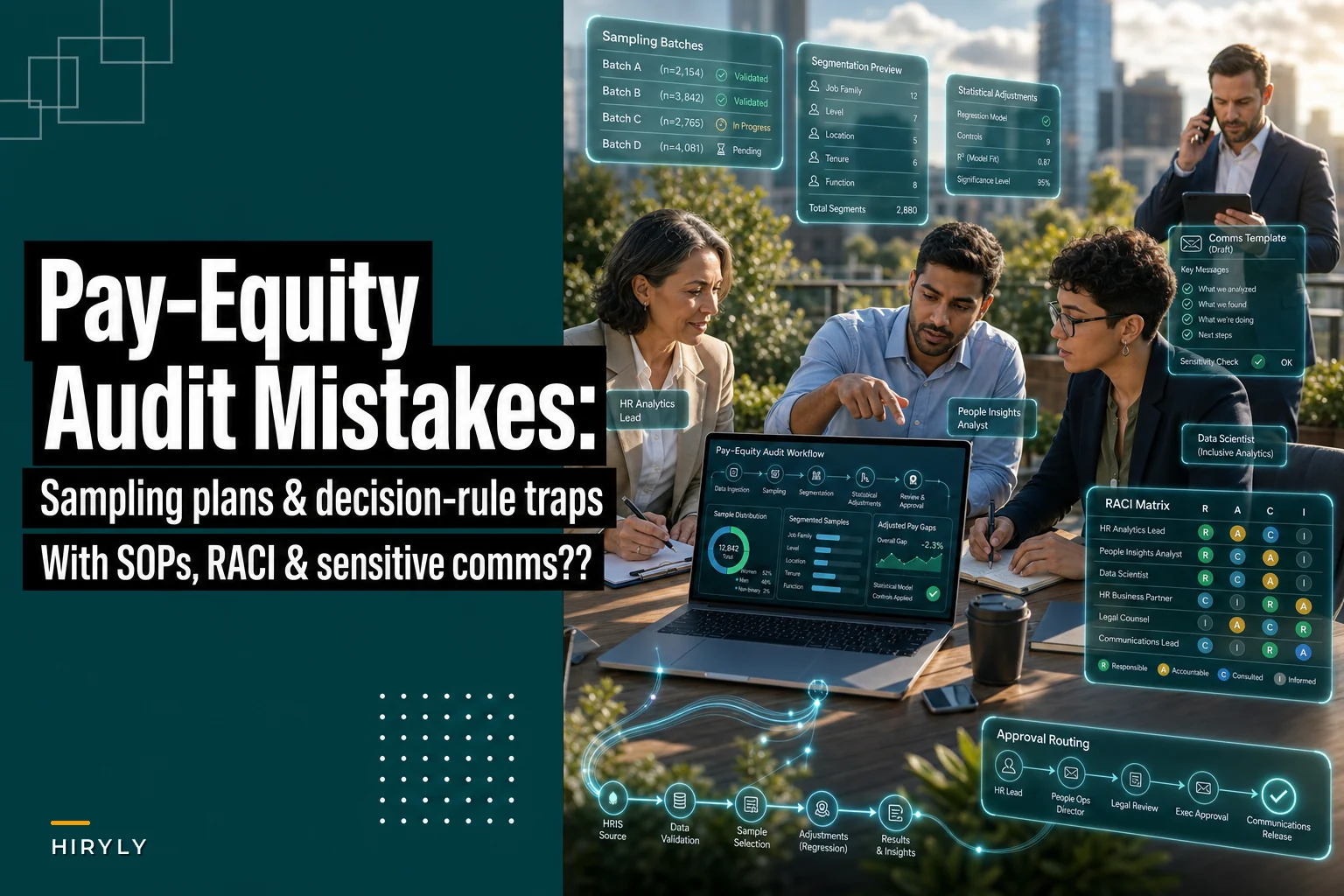

Most HR teams running their first pay equity audit make the same expensive mistakes. They pull compensation data, run some basic statistical tests, and think they're done. Then reality hits—legal challenges questioning methodology, managers who can't explain adjustment decisions, and employees feeling blindsided by changes or the lack of them.
The difference between a defensible audit and a liability nightmare usually comes down to three things most teams underestimate: sampling methodology, explicit adjustment thresholds, and how you communicate throughout the process. Get these wrong and you're not just wasting resources—you're creating real legal exposure.
Why most pay equity audits fail before they even start
Pay equity audits fail for pretty predictable reasons. Teams rush into analysis without establishing defensible methodologies. They make adjustment decisions based on gut feelings rather than documented rules. They communicate changes—or non-changes—in ways that create more problems than they solve.
The sampling mistake usually happens first. HR pulls all employee data into a spreadsheet, runs basic comparisons, and calls it an audit. But without proper statistical sampling methodology, your entire analysis becomes legally questionable. Courts expect specific sampling strategies that account for job families, geographic differences, and tenure bands. "We looked at everyone" isn't a defense—it's an admission that you didn't follow accepted statistical practices.
Then comes the adjustment threshold problem. You find a 7% pay gap between similar roles. Do you adjust? By how much? Who decides? Without explicit decision rules documented before analysis begins, every adjustment becomes subjective. One manager's "material difference" is another's "normal variation." That inconsistency destroys audit credibility and opens discrimination claims.
The communication breakdown seals the failure. Employees hear about adjustments through rumors. Managers can't explain why some gaps triggered changes and others didn't. The CHRO gets blindsided in a town hall with questions nobody prepared answers for. Trust disappears, and what should've been a positive equity initiative becomes an organizational crisis.
The sampling strategy that actually holds up under scrutiny
A defensible sampling strategy starts with segmentation logic, not random selection. You need statistically valid samples within each comparable group—not just overall representation.
Eliminate HR bottlenecks with smart automation.
Hiryly simplifies your HR operations so you can focus on people, not paperwork.
- Centralized candidate tracking
- Automated onboarding workflows
- Performance & compliance dashboards
No credit card required
Here's what that framework looks like in practice:
-
Job family (engineering, sales, operations)
-
Level bands (IC1-IC4, M1-M3, Director+)
-
Geographic markets (using consistent COL indices)
-
Tenure cohorts (0-2, 2-5, 5-10, 10+ years)
Minimum sample requirements per segment:
-
30+ employees for regression analysis
-
10+ for matched-pair comparison
-
5+ for outlier investigation only
Statistical validation checks:
-
Power analysis showing 80%+ detection capability
-
Confidence intervals at 95% significance
-
Documentation of any segments excluded and why
The critical mistake most teams make is treating all employees as one population. A 500-person software company might have 30 distinct analysis segments when properly stratified. Running one regression across all 500 tells you almost nothing useful and won't survive legal review.
When segments are too small for statistical analysis, you need explicit fallback rules. Maybe you aggregate IC1 and IC2 engineers if each group has under 20 people. Or you use market benchmark comparisons instead of internal analysis. Document these decisions before starting—changing methodology mid-audit destroys credibility.
Adjustment decision rules that remove the guesswork
Finding pay gaps is easy. Deciding what to do about them is where audits fall apart. Without explicit thresholds and decision rules, every adjustment becomes a negotiation.
Your adjustment framework needs five documented components:
1. Materiality thresholds Define exactly what gap triggers action. Is it 5%? 7%? Does it vary by level? One tech company uses:
-
5% threshold for IC roles
-
7% for managers
-
10% for directors and above
-
Any gap over $10,000 regardless of percentage
2. Adjustment formulas Specify exactly how corrections work:
-
Full adjustment to median of comparator group?
-
Partial adjustment to lower quartile?
-
Minimum adjustment to threshold level?
3. Budget constraints What happens when adjustments exceed budget? Options include:
-
Phase adjustments over multiple cycles
-
Prioritize largest gaps first
-
Cap individual adjustments at a set percentage
4. Explanatory factors List acceptable reasons for pay differences:
-
Performance rating differences (with specific thresholds)
-
Relevant experience premiums
-
In-demand skill differentials
-
Geographic cost variations
5. Exception approval matrix Who can override rules and under what circumstances:
-
HR Lead
Gaps under 5% or $5,000
-
CHRO
Gaps under 10% or $15,000
-
CEO
Any gap over 10% or $15,000
-
Board Comp Committee
Executive adjustments
These rules must exist before analysis starts. Retrofitting thresholds after seeing the results immediately raises red flags about manipulation.
The RACI matrix that prevents finger-pointing when things go sideways
Pay equity audits touch every part of the organization, but nobody knows who owns what until something goes wrong. A clear RACI established upfront prevents the chaos.
| Activity | Responsible | Accountable | Consulted | Informed |
|---|---|---|---|---|
| Methodology design | Comp team | CHRO | Legal, Finance | CEO, Board |
| Data validation | HRIS team | HR Ops Lead | Comp, Managers | CHRO |
| Statistical analysis | External firm/Comp | CHRO | Legal | CEO, CFO |
| Gap identification | Comp team | CHRO | Legal, Finance | Executive team |
| Adjustment decisions | CHRO | CEO | CFO, Legal | Board, Managers |
| Individual notifications | HR Partners | CHRO | Managers, Legal | Comp team |
| Manager talking points | HR Partners | VP HR | Comp, Comms | All managers |
| Employee communications | Comms + HR | CHRO | Legal, CEO | All employees |
| Legal documentation | Legal | General Counsel | CHRO, Comp | CEO, Board |
| Budget approval | CFO | CEO | CHRO | Board |
The biggest RACI mistake is making managers "responsible" for communications without proper support. They become the face of decisions they didn't make, using talking points they don't fully understand. This creates inconsistent messaging that fuels speculation and erodes trust fast.
Another common error: keeping legal out of early methodology discussions. They get brought in after the analysis is complete, find problems with the approach, and force the team to restart. Legal should be consulted on methodology, involved in threshold setting, and reviewing all communication templates before any analysis begins.
Communication templates that actually work for affected employees
The standard approach—generic email announcement followed by manager conversations—creates more problems than it solves. Employees need specific, personalized information delivered consistently.
Individual adjustment notification template:
Dear [Name],
Following our recent pay equity review, we've identified an adjustment to your compensation to ensure internal equity across similar roles.
Your adjustment details:
-
Current base salary
$[X]
-
New base salary
$[Y]
-
Increase amount
$[Z] ([%])
-
Effective date
[Date]
How we determined this adjustment:
We analyzed compensation across employees in similar roles, considering job level, experience, performance, and geographic location. Your adjustment brings your pay in line with the target range for your role and experience level.
What this means for you:
-
Your new salary will appear in the [Date] paycheck
-
This adjustment doesn't affect your bonus target or equity
-
Your next merit review remains scheduled for [Date]
Your manager [Manager name] is available to discuss any questions. You can also reach out to [HR Partner] for additional context about the review process.
No-adjustment notification for roles analyzed:
Dear [Name],
We recently completed a comprehensive pay equity review that included analysis of your role and compensation.
What we reviewed:
We analyzed your compensation against others in similar roles, accounting for factors including job level, experience, performance ratings, and geographic location.
Our finding:
Your current compensation of $[X] falls within the appropriate range for your role and experience level. No adjustment is needed at this time.
What this means:
-
Your compensation remains competitive and equitable
-
Your regular merit review cycle continues as scheduled
-
Future market adjustments will be considered in annual planning
We conduct these reviews annually to ensure continued fairness. Your next review will occur in [Month, Year].
The element missing from most templates is a specific explanation of methodology. Employees don't trust vague statements about "comprehensive reviews." They want to know what factors were considered and how decisions were actually made.
Manager enablement scripts for difficult conversations
Managers need more than talking points—they need actual conversation frameworks for predictable scenarios. Generic FAQs don't prepare anyone for emotional reactions.
Scenario 1: "Why did [colleague] get a bigger adjustment than me?"
"I understand the frustration. The adjustments were based on individual analysis comparing each person's pay to others in similar roles with similar experience and performance levels. Since everyone started from different points, the adjustment amounts vary. What matters is that everyone in comparable positions is now within the same equity ranges."
Scenario 2: "This proves I've been underpaid for years"
"I can understand why it feels that way. The adjustment reflects our commitment to ensuring fair pay going forward. Market conditions and internal equity standards evolve, and this review brought everyone to current standards. Your contributions have always been valued—this adjustment ensures your compensation properly reflects that in today's market."
Scenario 3: "No adjustment means you think I'm overpaid?"
"Not at all. No adjustment means your pay already falls within the appropriate range for your role, experience, and performance level. You're being paid fairly relative to peers in similar positions. Your compensation remains subject to regular merit increases and market adjustments."
Scenario 4: "How do I know this was really fair?"
"The review used statistical analysis of everyone in similar roles, considering job levels, experience, performance ratings, and location. We worked with [external firm/specialist] to ensure objectivity. The methodology was reviewed by legal counsel and follows EEOC guidelines. While we can't share individual data, the process examined the same factors for everyone."
These scripts work because they acknowledge emotions while providing specific information. Generic responses like "the process was fair" or "we followed best practices" just increase frustration.
The workflow infrastructure that keeps the process consistent
Manual pay equity audit processes create inconsistencies that undermine credibility. Spreadsheets get version-confused. Emails miss stakeholders. Decisions don't get documented properly. This is where proper HR metrics infrastructure matters—you need reliable data pipelines and clear ownership before you start anything.
AI-powered operational software can systematize the entire audit workflow. Instead of juggling spreadsheets and email chains, the platform centralizes data collection, applies statistical models consistently, and tracks every decision through the approval matrix. When legal asks why certain adjustments were made six months later, you have complete audit trails rather than a folder of disconnected emails.
Visualizing the workflow helps teams align on the end-to-end process.
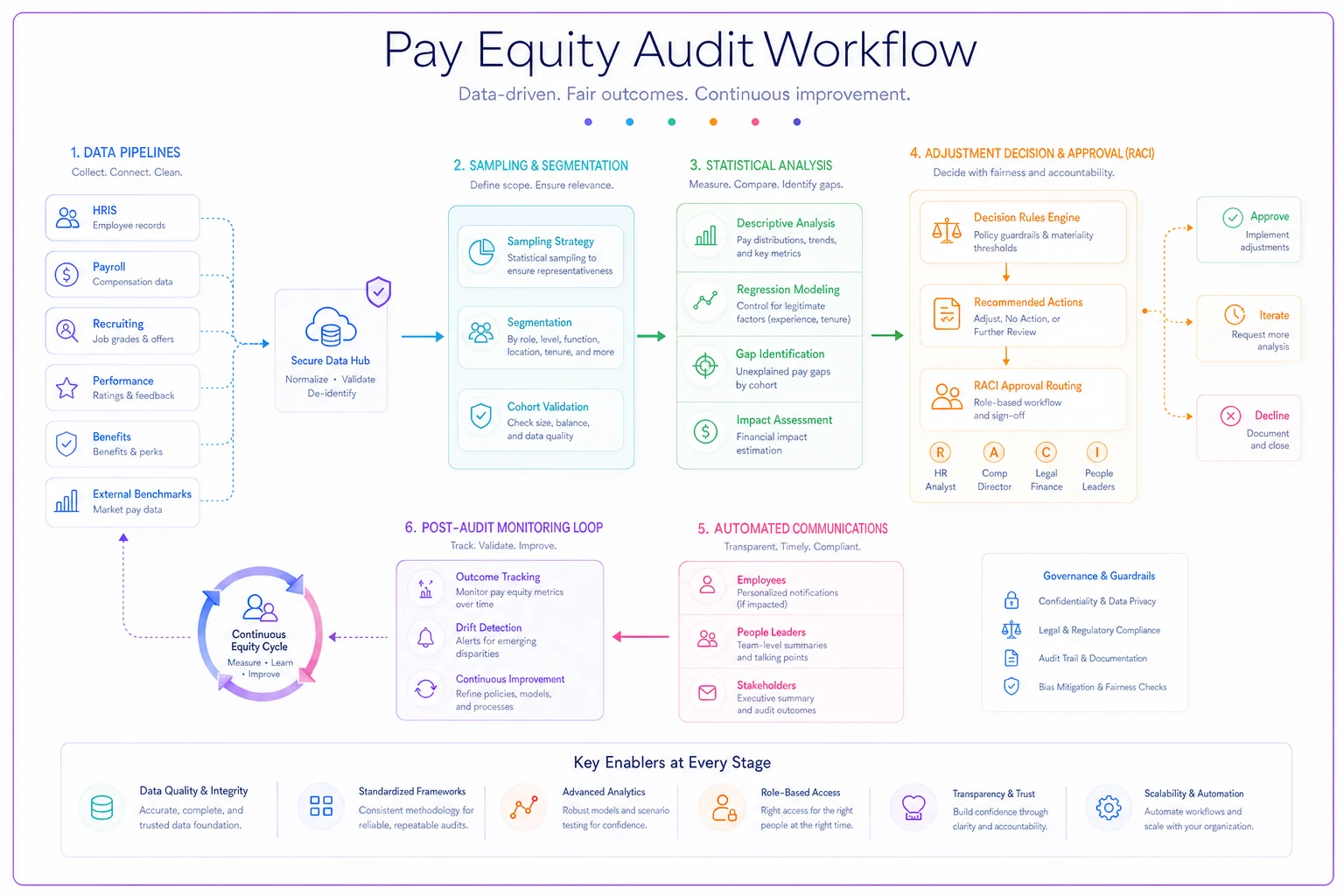
The automation handles the error-prone parts: ensuring sampling rules are applied correctly, applying adjustment thresholds consistently across every case, routing approvals through the right chain, and generating employee communications from verified data. It's not about replacing human judgment—it's about making sure that judgment gets applied consistently and documented properly.
More importantly, these platforms can run continuous equity monitoring rather than annual fire drills. They flag emerging gaps before they become material, track how hiring and promotion decisions affect equity metrics over time, and give managers real-time guidance during compensation conversations. That shift—from reactive audit to proactive management—is where most organizations find the real value.
Avoiding the post-audit reputation damage
The biggest pay equity audit mistake happens after adjustments are made: assuming the work is done. Without proper follow-through, initial corrections get quietly undone through regular compensation cycles.
Post-audit monitoring requires tracking specific degradation patterns. What percentage of adjusted employees are receiving below-median merit increases? How many new hires are coming in above adjusted employees in the same roles? Are promotion rates different between adjusted and non-adjusted groups? These patterns reveal whether your equity commitment is real or just a PR exercise.
The communication strategy has to extend beyond the initial announcement too. Employees watch what happens next. If adjusted employees get smaller merit increases to "balance things out," word spreads fast. If new hires in the same roles come in higher than adjusted salaries, trust disappears. The months following adjustments determine whether your audit builds credibility or destroys it.
This is also where calibration discipline matters most. Performance reviews following equity adjustments face extra scrutiny. Any pattern suggesting retaliation or informal "correction" for adjustments creates legal exposure worse than the original gaps.
Real-world example: How one company learned these lessons the hard way
A 400-person professional services firm decided to conduct their first pay equity audit after several employees raised concerns. They pulled compensation data, ran basic statistical analysis, and identified roughly $300K in adjustments needed across 47 employees.
Without clear thresholds, every adjustment turned into a negotiation between HR, finance, and department heads. Some 8% gaps got adjusted while 6% gaps didn't, based on budget availability and manager pushback. The inconsistency became obvious once employees started comparing notes.
The communication rollout made things worse. Managers got a two-page FAQ sheet about thirty minutes before employee notifications went out. When employees asked specific questions about methodology, managers couldn't answer them. The lack of transparency fueled speculation about favoritism and discrimination.
Three employees filed EEOC complaints challenging the methodology. During investigation, the company couldn't produce documentation showing consistent sampling strategies or adjustment rules. What should have been standard HR practice became a legal liability.
The aftermath: two key HR leaders left. The company hired external counsel to redesign the entire process. The second audit, done properly, cost around $170K in consulting fees plus another $450K in additional adjustments. The reputation damage took years to repair, with "pay equity issues" showing up in Glassdoor reviews for a long time after.
When to bring in external validation
Some audits need external validation from the start. If you're pre-IPO, under a consent decree, or facing active litigation, internal audits won't be enough. But even routine audits benefit from external validation in specific areas.
Statistical methodology should be externally validated if you don't have in-house expertise. Complex regression analyses—particularly those involving multiple variables and interaction effects—need specialist review. External validation typically runs $20-40K, which is minimal compared to defending flawed methodology in court.
Legal privilege considerations also matter. Audits conducted under attorney-client privilege get additional protection from discovery. This doesn't mean hiding problems—it allows candid internal discussion about findings and remediation strategies without everything becoming evidence for plaintiffs.
The external validation decision really comes down to risk tolerance. For companies with simple structures, clear job levels, and no history of complaints, internal audits with solid documentation usually hold up. Add complexity, a history of employee concerns, or heightened regulatory scrutiny, and external validation becomes necessary insurance.
Building a pay equity audit process that actually holds up
Pay equity audits aren't just compliance exercises—they're trust-building opportunities that can strengthen or damage organizational culture depending on how they're run. The difference between success and disaster lies in operational details most teams overlook until it's too late.
Getting the pay equity audit process right means establishing defensible sampling methodologies before analysis begins. It means creating explicit adjustment thresholds that remove subjectivity from decisions. It means building RACI matrices that clarify ownership before problems arise. And it means developing communication templates that actually address employee concerns rather than generating more questions.
The teams that succeed treat pay equity audits as operational challenges requiring systematic approaches, not one-time projects. They build repeatable processes, document clear decision rules, and create feedback loops that prevent equity from slowly eroding after the audit ends.
Finding gaps is the easy part. Managing the human and operational complexity of addressing them is where real expertise matters—and where most teams underinvest until something goes wrong.
Ready to transform your HR processes?
Join thousands of HR teams using Hiryly to hire faster, engage employees better, and stay compliant effortlessly.