

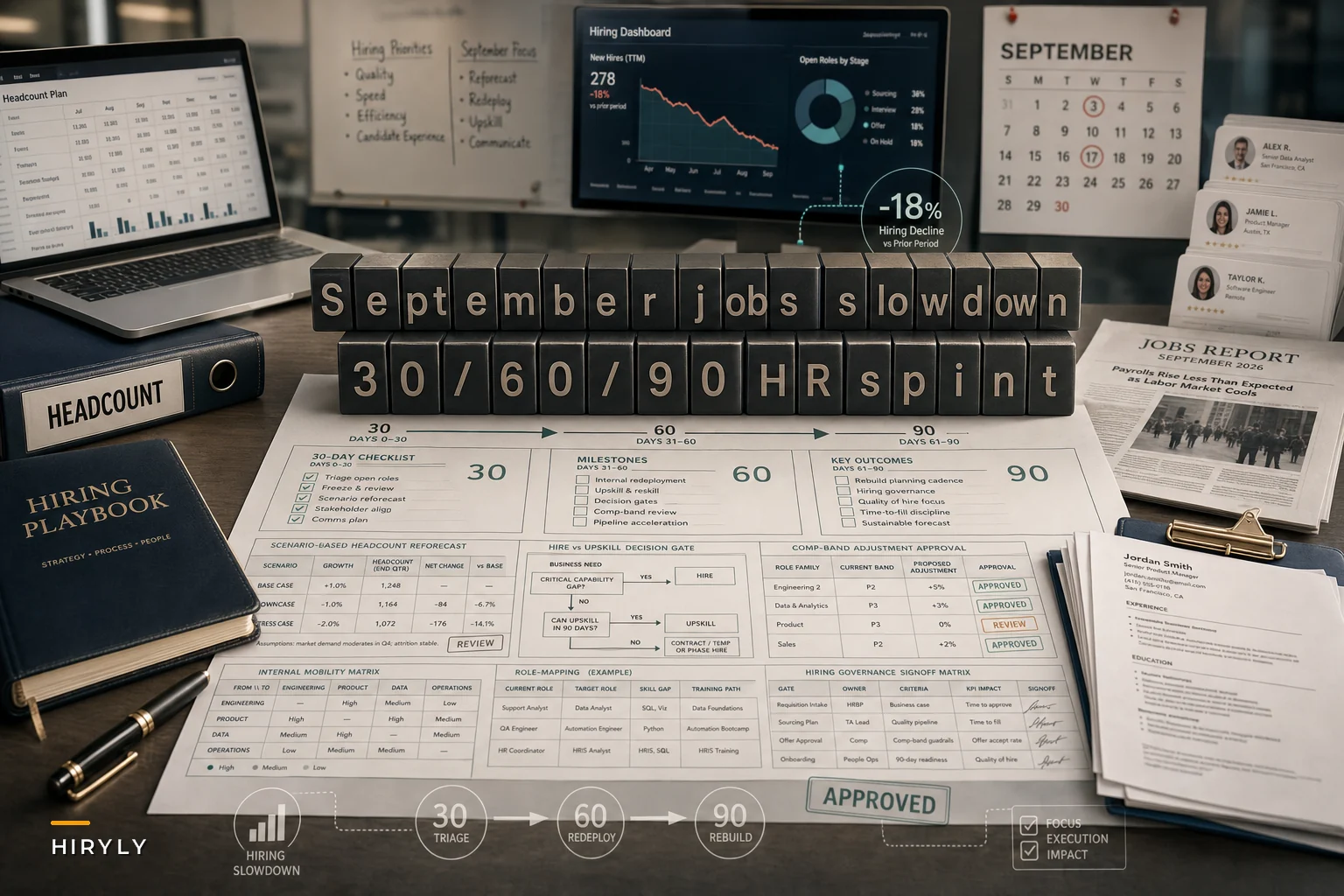

The September numbers landed softer than almost anyone budgeted for. Nonfarm payrolls grew by only around 29,000, unemployment nudged up to 4.2%, and wage growth kept cooling — the kind of combination that quietly rearranges your Q4 plan whether you react to it or not. You can read the full breakdown in the BLS employment situation release, and CNBC's pre-report context is worth skimming to understand how far the actual print missed expectations.
Most HR teams treat a report like this as macro news. Read a few headlines, maybe forward one to the CFO, then go back to running the same requisition pipeline they had the week before. A cooling labor market doesn't announce itself inside your ATS though. It shows up three weeks later as a candidate who suddenly accepts your first offer, or a hiring manager who stops fighting you on budget, or a backfill that no longer feels urgent. By the time those signals reach you organically, you've already made decisions on stale assumptions.
So instead of another macro explainer, this is a sprint. Thirty, sixty, ninety days. What to actually do, in what order, and where the usual mistakes hide.
Why this particular slowdown changes your near-term decisions
A weak jobs month isn't automatically a reason to freeze anything. Plenty of HR teams overcorrect and end up with a hiring gap they spend six months digging out of. What makes this report operationally relevant is the specific mix: slowing job creation plus moderating wages plus a ticking-up unemployment rate.
That combination shifts leverage. When wage growth was hot, you were negotiating against counteroffers and ghosting. In a cooling market, acceptance rates tend to improve, comp bands come under less upward pressure, and internal candidates become more willing to move laterally rather than jump externally. The risk flips from "can we close anyone?" to "are we overpaying and over-hiring against demand that may not materialize?"
The quieter danger is forecast drift. Most annual headcount plans were built months ago on growth assumptions that a 29,000-payroll month doesn't support. If your workforce plan is still running on those numbers, every requisition you approve in Q4 is implicitly betting the slowdown is noise. Maybe it is. But you want that to be a decision, not a default.
The 30/60/90 structure at a glance
Before the detail, here's the shape of the sprint so you can see where each piece fits.
Eliminate HR bottlenecks with smart automation.
Hiryly simplifies your HR operations so you can focus on people, not paperwork.
- Centralized candidate tracking
- Automated onboarding workflows
- Performance & compliance dashboards
No credit card required
| Window | Primary goal | Key outputs | Who owns it |
|---|---|---|---|
| Days 0–30 | Stop the bleeding of bad assumptions | Requisition triage, offer-band sanity check, forecast re-run | HR lead + Finance partner |
| Days 31–60 | Shift from external hiring to internal supply | Redeployment map, upskilling shortlist, comp recalibration | Talent ops + managers |
| Days 61–90 | Rebuild the planning muscle | Scenario-based forecast, governance tightening, Q1 readiness | Workforce planning + HRBPs |
A simple workflow for the 30/60/90 sprint.
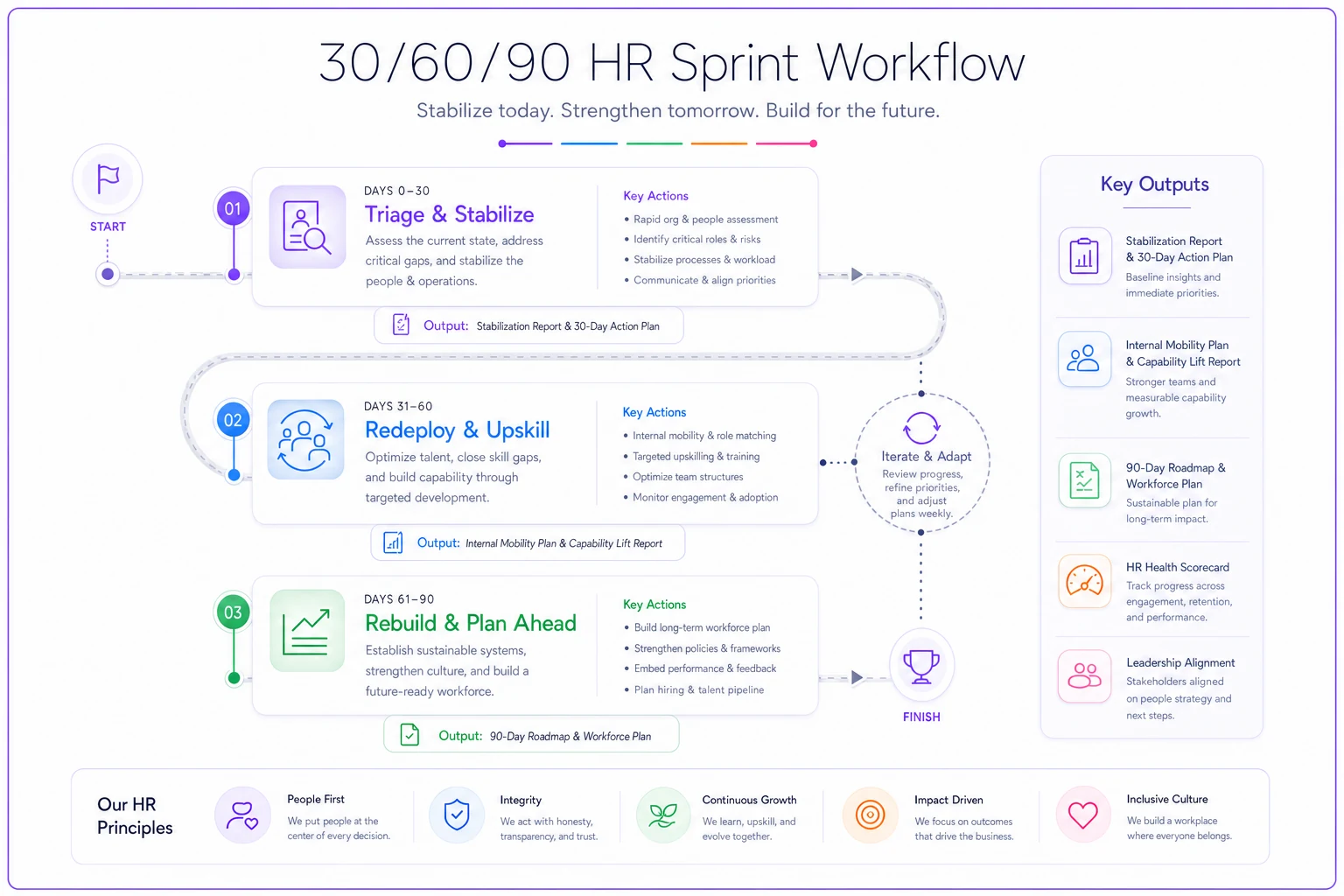
The mistake most teams make is treating these as sequential silos. The 90-day work — rebuilding planning infrastructure — is what prevents you from being caught flat-footed next time, but you start sketching it in week two, not week nine.
Days 0–30: Triage before you plan
The first month isn't about strategy. It's about making sure you're not actively making decisions on a broken model.
Re-run headcount scenarios immediately. Pull every open and approved-but-unfilled requisition. For each one, you're answering a single question: if demand softens 10–15% over the next two quarters, does this role still need to exist in Q4, or can it slip to Q1? In practice, this usually surfaces a surprising amount of slack — roles approved during a more optimistic cycle that nobody ever re-validated against current demand.
Build a freeze/triage rule, not a freeze. A blanket hiring freeze is the lazy response, and it does real damage. It kills critical backfills alongside speculative growth roles and signals panic internally. A tiered triage works better:
Build a freeze/triage rule, not a freeze.
-
Protect revenue-critical, single-point-of-failure, or compliance-mandated roles. These proceed untouched.
-
Review growth roles tied to forecasts that now look shaky. Require a fresh business-case sign-off before proceeding.
-
Pause speculative or "nice to have" headcount. Move to a watchlist, revisit in 60 days.
Sanity-check your offer bands. With wage growth moderating, bands set during a hotter market may now sit 5–8% above where the market is actually clearing. You don't need to slash anything — that creates equity headaches and demoralizes recruiters. But new requisitions should reference current data, and any band last calibrated more than two quarters ago deserves a flag.
A realistic first-month pattern: a mid-market company with around 40 open reqs runs this triage and finds roughly a third fall into "review" or "pause." Not because they're bad roles, but because nobody had re-checked them against demand since spring. The reqs weren't wrong when they were approved — they just never got updated.
Days 31–60: Shift the center of gravity to internal supply
Once you've stopped making decisions on stale assumptions, the second month is about meeting demand without defaulting to external hiring.
This is where most teams leave money on the table. When external hiring slows, the instinct is to wait it out. The better move is to treat the slowdown as cover to do the redeployment and upskilling work that's always urgent-but-never-prioritized.
Map redeployment candidates against open demand. Look at the roles you paused in month one, then look at where you have people whose current scope is shrinking or whose teams are over-resourced. The overlap is your redeployment pool. In a cooling market, internal moves land better — people are less likely to chase external offers, so a lateral or a secondment gets a warmer reception than it would during a hot cycle.
Prioritize upskilling over backfilling. If a paused requisition represented a genuine capability gap, ask whether a current employee can be developed into it over 60–90 days. Almost always cheaper than external hiring once you account for recruiting cost, ramp time, and acceptance risk.
Recalibrate comp deliberately, not reactively. Moderating wage growth doesn't mean you cut pay. It means your budget assumptions for merit and new-hire comp can probably ease. A typical recalibration here looks like trimming planned new-hire comp inflation by a point or two rather than touching existing salaries — a quieter adjustment that protects your budget without triggering internal equity problems.
When this makes sense — and when it doesn't
Redeployment-first is the right call when your demand is genuinely softening and you have internal slack. It's the wrong call when the slowdown is concentrated outside your sector and your own pipeline is still strong — forcing internal moves in a growing business just creates coverage gaps and resentment. Teams that are already thin on bench strength should also be careful: redeploying your few flexible people to cover demand can leave you exposed everywhere at once.
The point isn't to default to internal moves because external hiring feels risky. It's to make a real assessment of where your supply actually lives before you go looking outside.
Days 61–90: Rebuild the muscle that failed you
If a single jobs report can scramble your Q4 plan, the real problem isn't the report. It's that your workforce planning was never built to flex.
Most planning models are static annual exercises. You build a number in budget season, defend it, and spend the year explaining variance. When conditions shift mid-cycle — which they always do — there's no mechanism to re-plan. That's the gap this slowdown is exposing, and it's the same structural issue behind why most workforce planning operating models miss demand. The fix isn't a better forecast; it's a process that re-forecasts on a cadence.
The third month is where you install that. A simple version:
-
Define a quarterly re-forecast trigger. Tie it to a small set of signals — your own pipeline velocity, external labor data, and demand indicators from the business. When two or more move, you re-run the plan.
-
Build two or three scenarios, not one number. A base case, a soft case, and a growth case, each with explicit headcount and comp implications. You pre-decide what you'll do in each, so you're not improvising under pressure.
-
Assign a named owner for each demand assumption. Forecasts rot when nobody owns the inputs. One person should be accountable for each major driver.
-
Set a decision cadence. A standing 45-minute monthly check between HR and Finance to review whether any scenario trigger has fired. Short, boring, and probably the single highest-leverage thing you can add.
Tighten hiring governance while you're at it. A cooling market is the right time to clean up approval SLAs and add a lightweight re-validation gate for any requisition older than 60 days. Not more bureaucracy — just a check that stale reqs don't quietly proceed because they were approved once, months ago.
Your 90-day checklist
-
[ ] Every open requisition triaged into Protect / Review / Pause
-
[ ] Offer bands re-checked against current market data
-
[ ] Redeployment pool mapped against paused demand
-
[ ] Upskilling shortlist built for genuine capability gaps
-
[ ] New-hire comp assumptions recalibrated (without touching existing pay)
-
[ ] Candidate comms and onboarding timelines reviewed for acceptance risk
-
[ ] Quarterly re-forecast trigger and scenarios defined
-
[ ] Monthly HR–Finance decision cadence scheduled
-
[ ] Requisition re-validation gate added for aging reqs
Getting through this list in 90 days is achievable for most teams. The hard part isn't the work — it's resisting the urge to skip the governance pieces once the immediate pressure eases.
A short real scenario
A regional healthcare services company — roughly 600 employees — came into Q4 with about 50 open requisitions and a headcount plan built the previous spring. When the softer labor data hit, instead of freezing, they ran the 30-day triage. Around 18 reqs moved to "review" or "pause."
Over the next 60 days, they filled six of those paused roles internally through redeployment and short upskilling plans, and trimmed planned new-hire comp inflation by about a point and a half. No existing salaries were touched. By the end of the sprint, they'd avoided roughly a quarter of their planned external hires without missing coverage.
The outcome that mattered most wasn't the money saved. It was that they'd installed a monthly re-forecast check — so the next shift in the market wouldn't catch them cold.
What to take away
A soft jobs report is a prompt, not a verdict. Teams that handle it well don't overreact with blanket freezes, and they don't ignore it until the signals show up in their own funnel. They run a disciplined sprint: triage first, shift to internal supply second, rebuild their planning cadence third.
Three months from now, the real test isn't how you responded to this report. It's whether you've built something that flexes on its own — so the next slowdown, or the next surprise upswing, becomes a scheduled decision instead of a fire drill.
A soft jobs report is a prompt, not a verdict. Teams that handle it well don't overreact with blanket freezes, and they don't ignore it until the signals show up in their own funnel. They run a disciplined sprint: triage first, shift to internal supply second, rebuild their planning cadence third.
Three months from now, the real test isn't how you responded to this report. It's whether you've built something that flexes on its own — so the next slowdown, or the next surprise upswing, becomes a scheduled decision instead of a fire drill.
Ready to transform your HR processes?
Join thousands of HR teams using Hiryly to hire faster, engage employees better, and stay compliant effortlessly.