

Most teams don't fail neurodiverse candidates on purpose. They fail them in the small gaps — the 48-hour scheduling turnaround, the surprise "whiteboard this live" moment, the panel interview that rewards fast verbal processing over actual thinking. By the time anyone notices, a strong candidate has already quietly dropped out or scored a 2 out of 5 on "communication" for reasons that had nothing to do with the job.
This is a working checklist, not a philosophy piece. You'll get the specific scheduling adjustments, interviewer scripts, scorecard changes, and — the part most teams skip — a simple experiment design to confirm the changes actually moved candidate outcomes instead of just making everyone feel better.
Start with where the flow breaks, not where the policy lives
A written accommodation policy sitting on your careers page does almost nothing. What matters is the sequence of touchpoints between application and offer, because that's where neurodiverse candidates get filtered out invisibly.
Here's a typical breakdown. A candidate requests extra time to prepare for a technical interview. The recruiter forwards it to the hiring manager. The hiring manager is busy, replies three days later with "sure, that's fine," but never actually changes the interview format. The candidate shows up to the same live-coding round, same time pressure, and the "accommodation" existed only in an email thread.
The failure isn't bad intent. It's that accommodations live in conversations instead of being built into the process itself. If the adjustment isn't in the calendar invite, the interviewer prep doc, and the scorecard, it won't survive contact with a normal busy week.
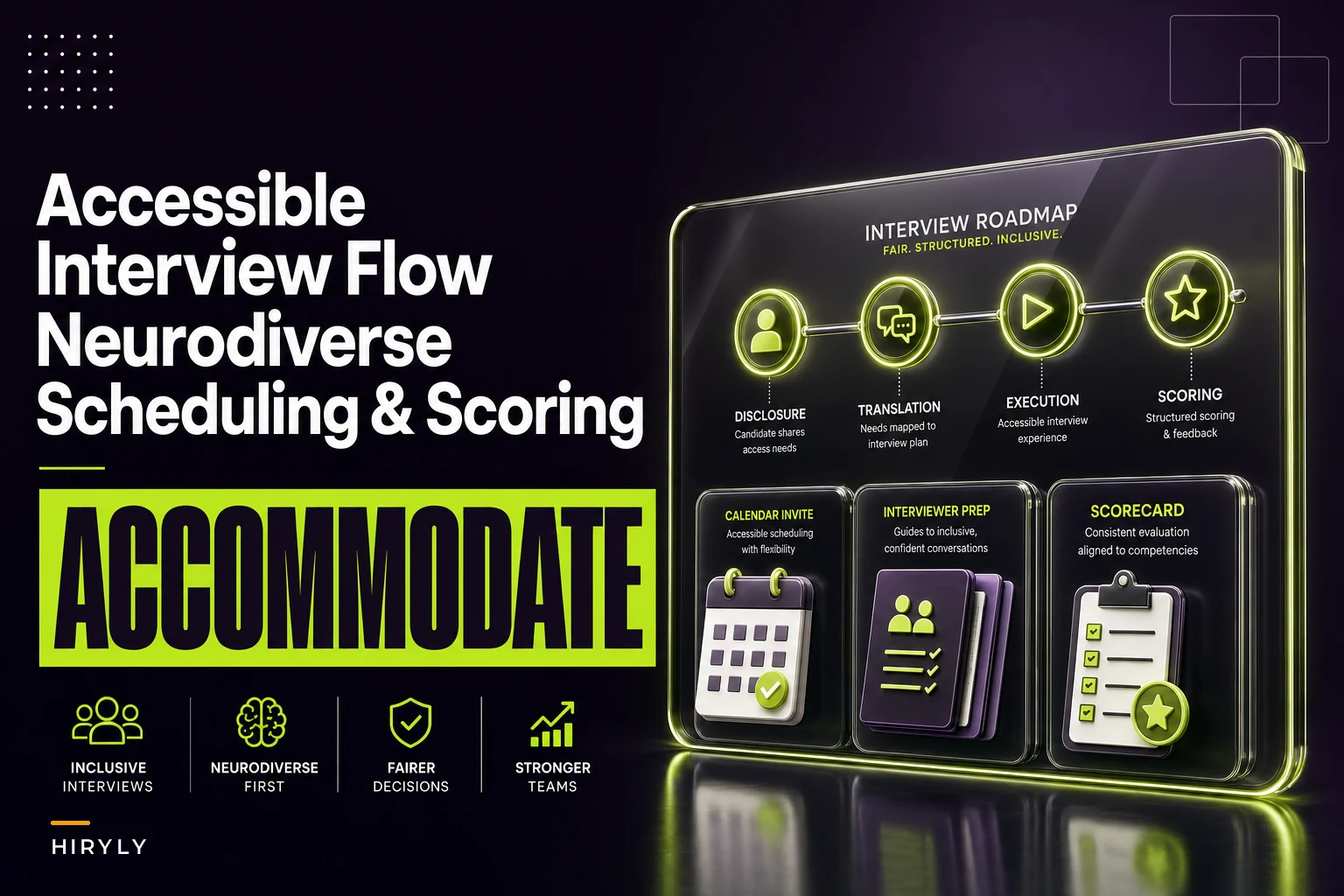
So before touching scorecards or scripts, map your actual flow and mark the four points where things reliably break:
-
Disclosure point — where and how a candidate can request an adjustment without feeling like they're flagging themselves as a problem
-
Translation point — where the request becomes a concrete change to the interview setup
-
Execution point — where the interviewer actually runs the adjusted version
-
Scoring point — where the evaluation accounts for the adjustment instead of silently penalizing it
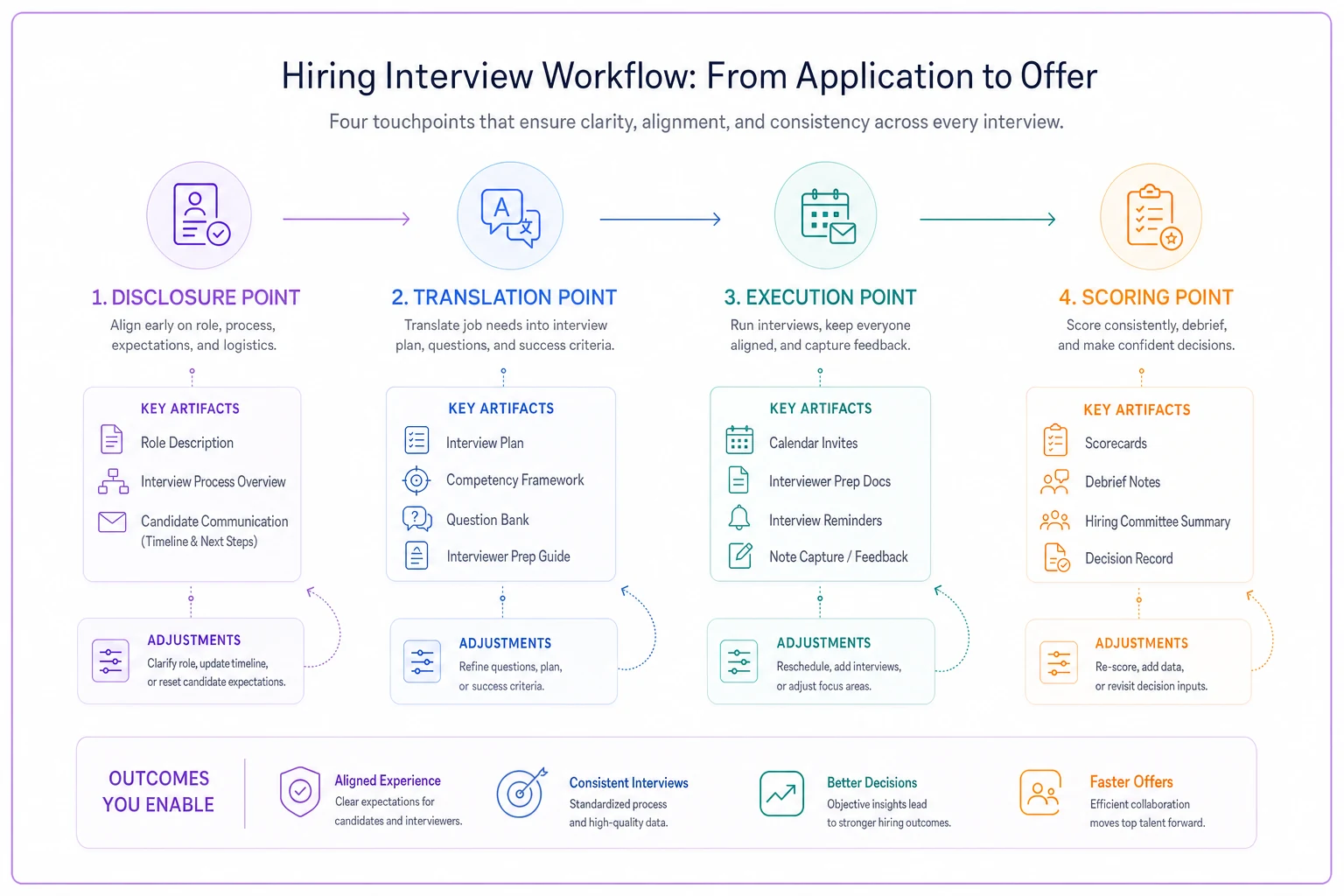
Most teams have a decent disclosure point and nothing after it.
Scheduling adjustments that actually change outcomes
Scheduling is where you can make the biggest difference with the least drama. A lot of what reads as "poor interview performance" for neurodiverse candidates is really the cost of ambiguity and time pressure stacked on top of each other.
Eliminate HR bottlenecks with smart automation.
Hiryly simplifies your HR operations so you can focus on people, not paperwork.
- Centralized candidate tracking
- Automated onboarding workflows
- Performance & compliance dashboards
No credit card required
Put the agenda directly into the calendar invite so candidates don't need to open attachments to know the interview shape.
Here's the set of scheduling changes worth standardizing:
Give the agenda in advance — to everyone. Send the interview structure, format, who's in the room, and the types of questions 2–3 days ahead. Not a cheat sheet, just the shape of the conversation. The common objection is "that's an unfair advantage." It isn't. Knowing you'll be asked about past projects isn't an advantage; being ambushed is a disadvantage. Offering this to every candidate removes the need for anyone to self-identify.
Default to longer slots, not rushed ones. A 45-minute technical screen compressed into back-to-back panels punishes slower verbal processors. Building in a 10–15 minute buffer between rounds costs almost nothing and reduces the "they seemed flustered" noise in your scores.
Offer format flexibility before it's requested. Camera-off options. The ability to answer in writing for one portion. A short break mid-interview. When these are on the menu by default, you stop depending on a candidate's willingness to ask.
Protect against the turnaround trap. If you require a scheduling confirmation within 24 hours, you're filtering for candidates who process logistics quickly — which has nothing to do with the role. Give 3–5 business days.
A practical pattern that works: offer two interview "tracks" any candidate can choose without explanation — a standard track and an extended track with longer slots, written-response options, and questions shared ahead. No disclosure required. You'd be surprised how many non-neurodiverse candidates pick the extended track too, which tells you something about how stressful your default flow actually is.
Interviewer guidance and scripts
Interviewers are usually the weakest link, not because they're biased but because they improvise. An untrained interviewer will fill silence with chatter, interpret a pause as "doesn't know the answer," and read limited eye contact as low confidence. None of that is in the scorecard, but all of it leaks into the rating.
The fix is short, specific guidance plus a few scripted lines they can actually use in the moment.
Give interviewers a one-page brief, not a training course. The brief should cover three things: what to do with silence, how to ask follow-ups, and what behaviors to stop treating as signal.
Scripted lines that reduce the most damage:
-
"Take whatever time you need — I'm happy to sit in silence while you think." (Removes the pressure to fill a pause.)
-
"Would you prefer I give you the question in writing as well?" (Supports candidates who process text better than speech.)
-
"Let me rephrase that in a more concrete way." (Abstract or multi-part questions are a known barrier; give interviewers permission to simplify without penalty.)
-
"There's no trick here — I'm just looking for how you'd approach it." (Reduces the social-decoding load.)
The single biggest interviewer behavior to kill: jumping in to "help" after four seconds of silence. An interviewer who does that is destroying their own data. Tell them explicitly to wait.
One thing worth sitting with: interviewers consistently rate candidates lower on "communication" and "culture fit" when those traits are really proxies for neurotypical social patterns. If your scorecard has a vague culture-fit box, that's where your fairness problem lives. The companion issues around vague, behavior-free criteria are covered in more depth in these interview scorecard design mistakes — worth reading alongside this.
Scorecard adaptations
This is the part that quietly undoes everything else. You can nail scheduling and interviewer behavior, then lose it all because the scorecard rewards the exact traits the accommodations were meant to level out.
Separate substance from delivery. If an answer is correct but delivered haltingly, those are two different observations. A scorecard that blends them into one "communication" rating guarantees that processing style gets scored as competence. Split them, and weight substance higher for roles where polished verbal delivery isn't actually the job.
Replace "culture fit" with "values alignment" tied to behavior. Fit is a trap. It rewards sameness. If you need to assess collaboration, define the specific behavior you're looking for — "built on a teammate's idea," "asked a clarifying question" — instead of a gut read on whether the person felt familiar.
Score against evidence, not impressions. Every rating should point to something the candidate actually said or did. "Seemed nervous" is not evidence. "Could not explain their approach when asked twice" is.
Here's a quick comparison of what changes:
| Scorecard element | Default version | Adapted version |
|---|---|---|
| Communication | Single 1–5 rating | Split: "clarity of reasoning" vs. "delivery style," with delivery weighted low |
| Culture fit | Gut-feel yes/no | Defined behaviors with evidence required |
| Problem-solving | Rated on live speed | Rated on approach quality, time-to-answer excluded |
| Overall | Averaged impression | Evidence-anchored, substance-weighted |
A subtle trap worth calling out: teams add the adapted scorecard but keep the old gut-check overrides in the debrief. If one interviewer can say "I just didn't click with them" and sink the candidate, your scorecard redesign is decorative. Decision rules have to hold in the room.
Where diversity actually leaks — and why neurodiversity hides in the data
Most funnel analytics won't show neurodiverse drop-off, because you're almost never tracking it as a dimension and candidates rarely self-identify. The leak shows up indirectly: higher-than-expected withdrawal after the interview invite stage, or a cluster of 2/5 communication scores concentrated around a specific interview format.
If you already track where candidates fall out of your funnel — the methods for that are laid out in this piece on where diversity leaks in your funnel — add interview format as a variable. Compare pass rates for the same role across your standard and extended tracks. A meaningful gap tells you the default flow is doing the filtering.
The part everyone skips: a small experiment to prove it worked
Rolling out accommodations and assuming they helped is how good intentions turn into unmeasured noise. You need a small, boring experiment to confirm the changes actually improved outcomes — otherwise you can't defend them and you can't improve them.
-
Pick one role family with enough volume to see patterns — a role you interview 40–60 candidates for per quarter works well.
-
Define your outcome metrics upfront. Interview-stage pass rate, offer rate, candidate withdrawal rate, and average "communication" scores. Decide these before you start so you can't rationalize later.
-
Run the adapted flow for one quarter — shared agendas, extended-track option, interviewer briefs, adapted scorecards.
-
Compare against the prior quarter's baseline for the same role. You're not chasing statistical significance; you're looking for direction and size.
-
Add a short candidate microsurvey after the interview, sent to everyone: one or two questions on whether the process felt fair and whether they could show their real ability.
-
Review interviewer score distributions. If the spread of communication scores tightened and substance scores held steady, that's a signal the adaptations removed noise rather than lowering the bar.
A realistic example: a mid-sized software team ran this for a support-engineer role they filled from roughly 50 candidates a quarter. Before the changes, post-interview withdrawal sat around 18%, and communication scores skewed harsh with a wide spread. After one quarter on the adapted flow — shared agendas, extended track, split scorecard — withdrawal dropped to around 10–11%, offer-acceptance held, and debriefs became less about vibes and more about what candidates actually demonstrated. No dramatic headline, just a cleaner process that stopped losing people for the wrong reasons.
The point of the experiment isn't to generate a slide number. It's to make sure you didn't just add friction and call it fairness.
When this makes sense — and when it doesn't
When it's worth the effort: roles you hire for repeatedly, roles where the day-to-day work looks nothing like a high-pressure verbal panel (most engineering, analytical, design, and operations roles), and any team where interviewers improvise heavily.
When to go lighter: genuinely one-off senior hires where you can handle each accommodation individually and well. You don't need a standardized experiment for a role you'll fill once.
Who should NOT do a half-version of this: teams that want to add the "nice" parts — shared agendas, longer slots — but refuse to touch the scorecard or debrief rules. That combination feels progressive and changes nothing, because scoring still penalizes the exact traits you accommodated for. If you can't fix how decisions get made in the room, start there before anything else.
Keeping it from quietly falling apart
The hard part isn't launching this. It's keeping accommodations from decaying back into email threads six months later. The adjustments survive when they're embedded in the artifacts interviewers already use — the calendar invite template, the interviewer prep doc, the scorecard form — rather than depending on anyone remembering to be considerate.
This is where centralizing the flow in whatever applicant tracking or interview-management system you already run pays off. The extended track, the shared-agenda step, and the adapted scorecard become the default options people click, not exceptions they have to request and remember. When the fair version is the path of least resistance, it sticks. When it depends on goodwill and memory, it won't.
Accessibility in hiring isn't a statement you publish. It's a sequence of small, specific choices built into how you schedule, question, and score — and then checked against real candidate outcomes so you actually know it's working.
Ready to transform your HR processes?
Join thousands of HR teams using Hiryly to hire faster, engage employees better, and stay compliant effortlessly.