

Most HR teams don't realize they have a retention problem until someone slides a resignation letter across the table. By then, it's already over. Recruiting fees, onboarding ramp time, knowledge gaps, team morale taking a hit—for critical roles you're realistically looking at 50–200% of annual salary just to get back to baseline.
What's frustrating is that the warning signs were almost always there months earlier. Behavior shifts, disengagement creeping in, someone slowly pulling back from the team. But without a system to catch these signals and route them to managers who can actually do something, they just get missed.
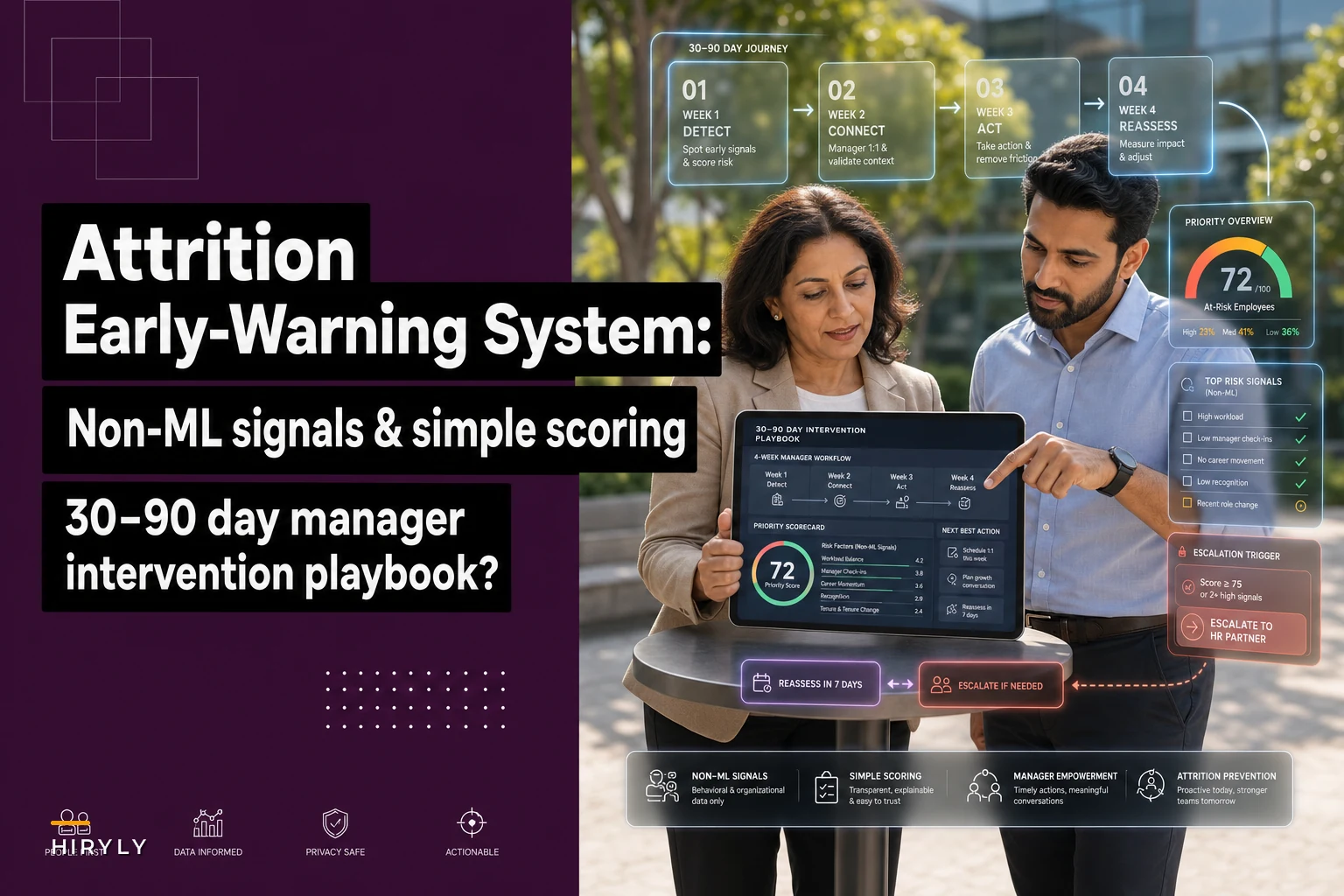
You don't need machine learning or a data science team to fix this. An effective early-warning system can be built from data you're already collecting, scoring logic any manager can follow, and intervention templates that are actually executable. The focus should be on actionable signals, not predictive precision.
Why complex predictive models fail in practice
HR gets excited about predictive analytics, invests in an expensive platform or brings in data scientists, builds a model claiming 85% accuracy—and then nothing changes operationally. Managers don't trust predictions from a black box. The model flags half the workforce as flight risks. Nobody knows what to actually do with any of it.
I've watched this play out at companies ranging from 200-person startups to 5,000-employee organizations. The models look great in presentations but fall apart in real operations. A manager gets an alert saying "Sarah has a 73% probability of leaving" with no explanation of why or what to do next. So they ignore it.
Transparent, rule-based scoring is less sophisticated, but it actually drives action. When a manager sees "Tom hasn't had a one-on-one in six weeks, declined the last two team events, and his project velocity dropped 40%," they understand exactly what's happening and can take specific steps.
Signal catalogue: what actually predicts voluntary turnover
Certain signals consistently show up 60–90 days before resignations. The trick isn't finding one perfect predictor—it's combining multiple weak signals that together tell a clear story.
Eliminate HR bottlenecks with smart automation.
Hiryly simplifies your HR operations so you can focus on people, not paperwork.
- Centralized candidate tracking
- Automated onboarding workflows
- Performance & compliance dashboards
No credit card required
Performance and engagement signals:
-
Sudden performance changes (up or down)
-
Missed deadlines becoming more frequent
-
Quality issues in previously reliable work
-
Declining participation in optional meetings
-
Reduced contribution in team discussions
-
Stopped volunteering for new projects
Communication pattern changes:
-
Delayed email response times
-
Shorter, more transactional messages
-
Avoiding video in remote meetings
-
Missing informal team gatherings
-
Declining manager one-on-one frequency
System usage indicators:
-
Learning platform activity drops to zero
-
Internal job board views increase
-
Benefits portal activity spikes
-
PTO usage patterns change dramatically
-
LinkedIn profile updates
Relationship markers:
-
Key collaborator departures
-
Manager changes
-
Team restructuring impacts
-
Peer promotion reactions
-
Mentor relationship shifts
The power is in tracking combinations. Someone checking benefits information once isn't concerning on its own. Someone checking benefits while their performance has dropped and they've gone quiet in team meetings? That's worth a conversation.
Building your scoring system without ML
A practical scoring system starts with choosing signals you can measure consistently. Stick to 8–10 indicators—enough to detect patterns without making the system impossible to maintain.
Here's a framework that works:
| Signal Category | Indicator | Points | Data Source |
|---|---|---|---|
| Manager Relationship | No 1:1 in 4+ weeks | 3 | Calendar system |
| Manager Relationship | Declined last 2 check-ins | 2 | Calendar system |
| Performance | Performance drop >25% | 3 | Performance system |
| Performance | Missed 2+ recent deadlines | 2 | Project tracker |
| Engagement | Zero learning activity 60 days | 2 | LMS |
| Engagement | Skipped last 3 optional team events | 2 | Calendar/RSVP |
| Communication | Email response time doubled | 1 | Email metrics |
| System Usage | 3+ benefit portal sessions/month | 2 | Benefits system |
| Network | Direct manager changed <90 days | 2 | HRIS |
| Network | 2+ close collaborators left <6 months | 3 | HRIS + surveys |
Score thresholds:
-
0–4 points
Normal variation
-
5–8 points
Yellow flag (monitor closely)
-
9–12 points
Orange flag (manager intervention needed)
-
13+ points
Red flag (urgent intervention + skip-level involvement)
The advantage here is transparency. Managers see exactly why someone is flagged and can address those specific behaviors directly rather than reacting to a probability score they don't understand.
Data collection that doesn't feel like surveillance
The fastest way to destroy trust is making employees feel watched. Companies that installed keystroke loggers and email sentiment analysis tools couldn't figure out why engagement tanked shortly after. Your early-warning system should draw on data that's already being collected for legitimate business purposes, aggregated appropriately, and visible to employees.
Start with what you already have:
-
HRIS for tenure, manager changes, and peer departures
-
Performance management platforms for review scores and goal progress
-
Calendar systems for meeting patterns (accept/decline only, not content)
-
Learning management systems for development activity
-
Benefits platforms for usage spikes
-
Survey tools for engagement scores
A few non-negotiables on privacy:
-
Never monitor personal communications
-
Aggregate email metrics, don't read content
-
Track meeting acceptance, not discussion topics
-
Focus on voluntary system usage, not mandated activities
-
Be transparent with employees about what's tracked and why
Use monthly data pulls and human validation to reduce the surveillance feel while still catching trends early.
Automate collection where you can, but build in human validation before flags go to managers. Monthly data pulls work better than real-time monitoring—it reduces the surveillance feel while still catching trends early enough to act on.
Manager intervention playbook: the 30-day sprint
When someone hits the orange threshold, managers need a real plan—not a vague directive to "check in more often." Specific actions, specific timelines, usable templates.
Week 1: Diagnostic conversations
-
"I've noticed you seem less engaged lately. How are you feeling about work?"
-
"What's been most frustrating in your role recently?"
-
"If you could change three things about your job, what would they be?"
-
"What would make you excited to come to work again?"
Week 2: Quick wins
-
Removing them from a draining committee
-
Adjusting meeting schedules for better focus time
-
Upgrading equipment that's been a persistent annoyance
-
Approving that training request sitting in limbo
-
Fixing a broken process they've complained about
Week 3: Career development reset
-
Review their original career goals
-
Identify skill gaps for their next desired role
-
Build a 90-day development plan with specific milestones
-
Connect them with internal mentors or stretch projects
-
Document and share the plan with them
Week 4: Environment adjustments
-
Adjust project assignments to better match interests
-
Modify team composition for better collaboration
-
Increase or decrease autonomy based on their preferences
-
Create clearer success metrics if ambiguity is the issue
-
Set up skip-level meetings if the manager relationship is strained
Use this workflow as a quick checklist managers can follow during the 30-day sprint.
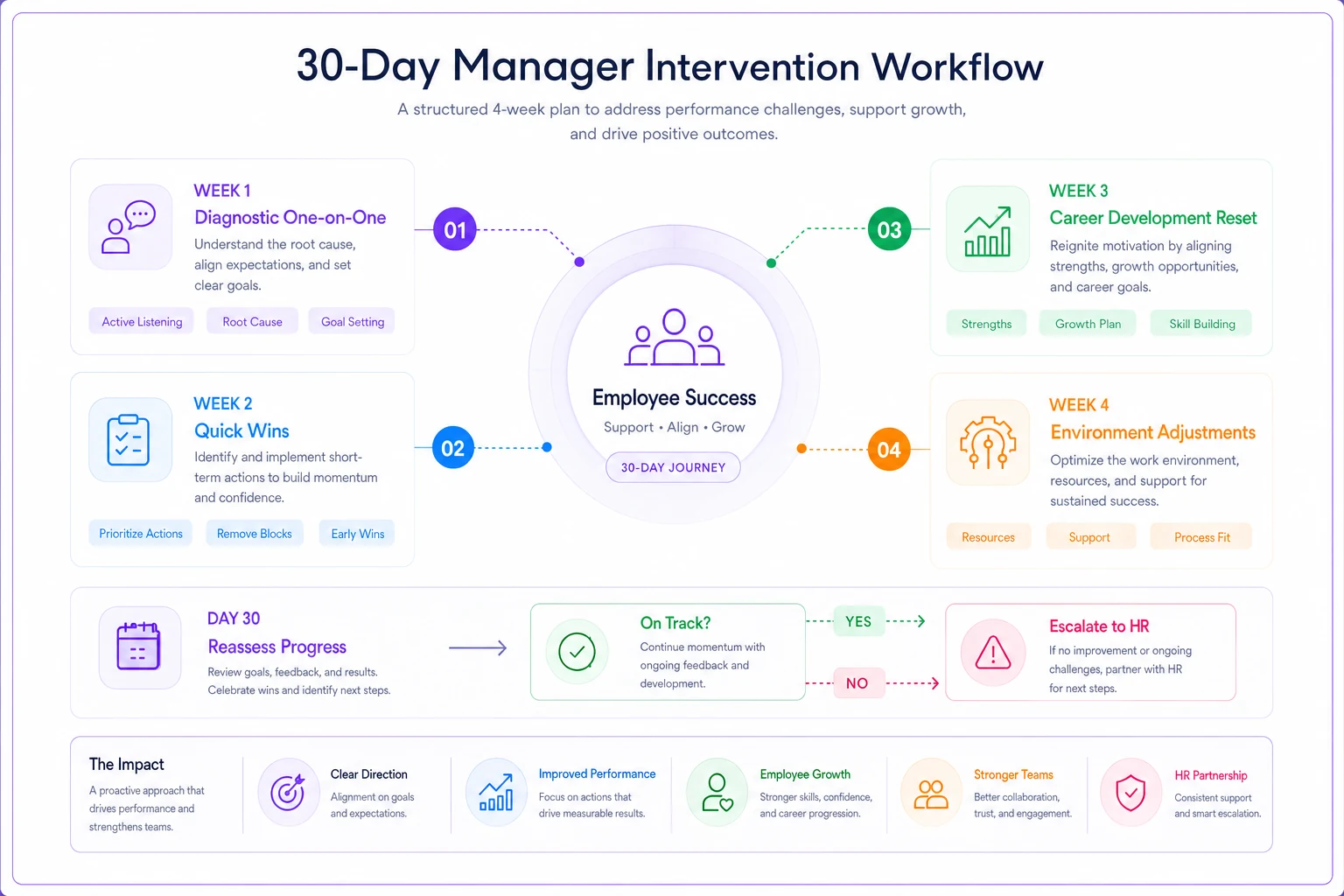
After 30 days, reassess the risk score. If it hasn't moved, escalate to HR for additional support.
The 60-90 day sustained engagement plan
For employees who respond to the initial intervention but still sit at elevated risk, you need something more sustained. This isn't about constant hand-holding—it's about structural changes that address root causes.
Monthly milestone check-ins work best when kept lightweight:
-
Week 1 — Progress review on the development plan
-
Week 2 — Project satisfaction pulse check
-
Week 3 — Peer feedback collection
-
Week 4 — Manager coaching session
Fifteen-minute conversations, not hour-long reviews.
Quarterly retention conversations are worth doing directly:
-
"What would make you leave?"
-
"What keeps you here?"
-
"What one change would most improve your experience?"
Document responses and track how they shift over time. When answers to "what would make you leave" get more specific and immediate, that's a signal risk is rising again.
Project rotation matters more than most HR teams realize. Boredom drives departures, but it rarely shows up explicitly in exit interviews. Build in variety where you can—20% time on cross-functional projects, rotation through different team responsibilities, temporary assignments to high-visibility work, shadowing opportunities in areas they want to grow into.
Track which of these generate renewed engagement and invest more there.
Measuring intervention effectiveness
Without measurement, you're guessing. Track both individual and system-level outcomes.
Individual intervention metrics:
-
Risk score before and after intervention
-
Performance metrics at 30, 60, and 90 days post-intervention
-
Engagement survey scores where available
-
Actual retention at 6 and 12 months
-
Manager assessment of how difficult the intervention was
System-level success metrics:
-
Percentage of flagged employees retained at 6 months
-
Average risk score reduction post-intervention
-
Manager participation rate in interventions
-
Time from flag to intervention start
-
False positive rate
Set realistic targets. A solid early-warning system might catch around 60% of eventual departures and successfully intervene in roughly half of those cases. That's still a meaningful improvement over zero prediction and pure reactive scrambling.
Common implementation pitfalls
Pitfall 1: Over-flagging
Thresholds set too low lead to alert fatigue. Managers start ignoring everything. Start conservative and lower thresholds gradually as confidence builds. Missing some risks early is better than having managers tune the system out entirely.
Pitfall 2: One-size-fits-all interventions
A 22-year-old engineer needs different interventions than a 45-year-old finance director. Build role and level-specific playbooks. Early career employees often need mentorship and skill development. Senior people frequently need more autonomy and strategic input.
Pitfall 3: Manager capability gaps
Not every manager can run a retention conversation effectively. Before rollout, train managers on having difficult conversations, career development planning, reading engagement signals, and knowing when to escalate to HR. Provide scripts and templates, but train them to adapt based on context.
Pitfall 4: Ignoring cultural factors
Flight risk signals vary by culture, geography, and work setup. Remote teams show different patterns than in-office teams. Tech norms differ from manufacturing norms. Calibrate signals and interventions to your specific environment.
Technology and automation considerations
You don't need ML models, but basic automation makes this sustainable at scale. The right HR operations platform can pull data from multiple sources, calculate risk scores automatically, and trigger manager notifications without constant manual overhead.
The key is choosing tools that show their logic transparently. When a manager gets an alert, they should see exactly which signals triggered it and what data drove those signals. That's what builds trust and actually helps managers prepare for conversations.
Modern HR metrics operating systems can integrate your existing data sources, apply scoring rules consistently, and track intervention outcomes automatically—turning a manual monthly process into an always-on retention monitoring system.
Look for platforms that:
-
Connect to your existing HR systems via API
-
Apply configurable scoring rules without requiring coding
-
Generate manager-friendly reports with specific indicators
-
Track intervention outcomes and surface patterns over time
-
Maintain audit trails for compliance and improvement
Technology should enable your process, not define it. Start with manual scoring if you need to, prove the approach works, then automate for scale.
Legal and ethical guidelines
Before launching any employee monitoring system—even one using aggregated data—consult with legal counsel and work through these factors.
Transparency requirements:
-
Inform employees what data is collected and why
-
Explain how it's used in retention efforts
-
Clarify that it's not used for performance evaluation
-
Provide opt-out mechanisms where legally required
Protected class considerations:
-
Ensure signals don't inadvertently discriminate
-
Monitor intervention rates across demographic groups
-
Document decision rationale for legal protection
-
Run regular audits for bias in both signals and interventions
In unionized environments or countries with works councils, you'll need agreement before implementing. Position this as employee support, not surveillance.
On data retention and privacy: define clear retention periods for risk scores, limit access on a need-to-know basis, encrypt sensitive indicators, and follow GDPR or relevant privacy regulations. Similar to calibration meeting documentation, maintaining clear records protects both employees and the organization.
Small-scale pilot approach
Don't roll this out company-wide from day one. Start with a controlled pilot to refine your approach before scaling.
Select pilot groups strategically:
-
One high-turnover department (prove impact)
-
One stable department (test false positive rate)
-
Mix of manager experience levels
-
50–100 employees total
Run for 90 days with clear phases:
-
Days 1–30
Data collection and baseline scoring
-
Days 31–60
Active interventions for flagged employees
-
Days 61–90
Outcome tracking and system refinement
Before scaling, look for:
-
At least 50% of flagged employees showing score improvement
-
Managers reporting interventions are practical and useful
-
No significant privacy concerns raised
-
Clear ROI from prevented turnover
After the pilot, go back through what actually worked. Which signals had the highest prediction value? Which interventions did managers actually use? What additional training do managers need? Where can data collection be simplified? The answers shape a much stronger second iteration.
Turning insights into sustainable practice
An early-warning system only works if it becomes part of regular management practice—not a special project that gets shelved six months after launch.
Embed it in existing rhythms. Add retention risk review to monthly team meetings. Include intervention skills in manager onboarding. Tie retention metrics into manager performance reviews. Create feedback loops between HR and managers—when an intervention works, document what specifically drove the outcome, and when someone leaves despite intervention, understand why. Over time those patterns become institutional knowledge that makes the whole system sharper.
Position this as supporting managers, not adding to their workload. When managers see it preventing the chaos of unexpected departures, they'll treat it as a useful tool rather than an HR mandate.
The goal isn't predicting every departure or saving every at-risk employee. It's moving from reactive scrambling to proactive management. Even preventing 30% of unexpected departures meaningfully changes talent stability—and it sends a clear signal that the organization actually pays attention.
An effective attrition early-warning system doesn't require sophisticated technology or data science expertise. It requires thoughtful signal selection, transparent scoring logic, practical interventions, and consistent follow-through.
Ready to transform your HR processes?
Join thousands of HR teams using Hiryly to hire faster, engage employees better, and stay compliant effortlessly.