

Most contractor problems don't blow up on day one. They surface eight months later, when a controller runs a payment audit and finds a "contractor" who's been invoiced weekly, sits in daily standups, uses a company laptop, reports to a full-time manager, and has no other clients. That person looks exactly like an employee to an auditor — and now you've got back-tax exposure, benefits questions, and a very uncomfortable conversation with Finance about who approved the engagement.
Contingent workforce operations tends to fall apart in the gaps between teams. Recruiting sources the person. A hiring manager wants them yesterday. Procurement sets up the vendor. Finance pays the invoice. Legal is nowhere in the loop. Nobody actually owns the classification decision, so it defaults to "whatever gets them working fastest." This SOP is built to close those gaps — specifically around four failure points: classification checks, onboarding timed to payroll cadence, IP and confidentiality red flags, and the vendor/finance handoff.
This is not a general contractor guide. It's the operational playbook for the four places contingent engagements actually break.
Why classification quietly drifts (and nobody notices)
Classification almost never starts wrong. It drifts.
A contractor gets engaged for a specific project — "build the reporting dashboard, 10 weeks, deliverable-based." Clean. Then the dashboard ships, the manager likes them, and they get rolled onto the next thing. Then the next. Six months in, they're attending team retros, getting assigned ad-hoc tickets, and being told how to do the work instead of just what to deliver. The paperwork still says independent contractor. The reality says employee.
The reason this happens is boring but important: nobody re-checks classification after the initial engagement. It's treated as a one-time gate at the start instead of a condition that has to stay true throughout. The IRS behavioral/financial/relationship tests and most state ABC tests don't care what the contract says — they care what the working relationship actually looks like on a random Tuesday in month seven.
A quick field test to spot drift:
-
Are you telling them when and how to work, or just what outcome you need?
-
Do they have other clients, or are you effectively their full-time income?
-
Are they using your equipment, email, and internal systems like staff?
-
Is there a defined end date, or has it become indefinite?
-
Do they manage anyone, or get managed inside your org chart?
If three or more of those tilt toward "employee," you have a drift problem regardless of what the MSA says.
The classification check that actually holds up
A classification check works when it's a documented decision with an owner, a timestamp, and a re-review trigger — not a vibe from the hiring manager. Companies that avoid misclassification trouble aren't necessarily smarter about labor law. They just refuse to let the engagement start until someone has formally made and recorded the call.
Eliminate HR bottlenecks with smart automation.
Hiryly simplifies your HR operations so you can focus on people, not paperwork.
- Centralized candidate tracking
- Automated onboarding workflows
- Performance & compliance dashboards
No credit card required
Here's the decision structure worth building into your SOP:
| Factor | Leans Contractor | Leans Employee | Who Confirms |
|---|---|---|---|
| Control over how work is done | Contractor decides method | You direct the method | Hiring manager |
| Financial arrangement | Fixed project/deliverable fee | Hourly, ongoing, no end | Finance |
| Exclusivity | Works with other clients | You're their only income | Recruiting/HR |
| Duration | Defined, time-boxed | Open-ended, renewed repeatedly | HR |
| Integration | Operates independently | Embedded in team/org chart | Hiring manager |
| Equipment & tools | Uses their own | Uses yours | IT/Procurement |
The part that actually prevents drift is the re-review trigger. Every contractor engagement should carry an automatic classification re-check at renewal and whenever scope materially changes. A simple rule: no renewal gets approved without a fresh classification confirmation. This single gate catches almost all drift, because drift always shows up at renewal time — you just have to force someone to look.
One more thing that gets missed: document the reasoning, not just the conclusion. "Classified as 1099 because deliverable-based, 12-week fixed scope, uses own equipment, has three other active clients" holds up in an audit. A checkbox marked "contractor" does not.
Onboarding tied to payroll cadence (not the start date)
This is the part almost everyone gets backwards. Teams onboard contingent workers to a start date and then scramble when the first payment cycle doesn't line up. The result is either a worker who's active with no clean path to get paid, or a payment pushed through on an exception that bypasses controls.
The fix is to onboard against your AP cadence, working backward from the first payment.
Say AP runs vendor payments on net-30 with a cutoff on the 25th of each month. A contractor who starts on the 20th but whose vendor record isn't finalized until the 28th just missed the cutoff and won't get paid until the following cycle — nearly six weeks after they started working. Now the contractor is frustrated, the hiring manager is escalating, and someone's pushing for an off-cycle manual payment that skips the normal approval chain. That's exactly how payment chaos starts.
The onboarding sequence that prevents it
-
Confirm classification and get the signed agreement before any system access is granted. No exceptions, no "we'll paper it later."
-
Create the vendor/payee record in parallel with system access — not after. These two tracks should run at the same time.
-
Map the engagement to the next clean payment cycle. If the start date can't make the current cutoff, the worker and manager both get told the real first-payment date up front.
-
Set the invoice schedule to match AP cadence, so the contractor isn't invoicing on a rhythm Finance can't process.
-
Assign a single onboarding owner who holds the checklist across HR, IT, Procurement, and Finance. Shared ownership means no ownership.
A contingent worker's onboarding isn't "done" when they have a laptop and a login.
It's done when there's a confirmed, controls-compliant path to pay them on a known date. If you can't answer "when and how does this person get paid" on day one, onboarding isn't finished.
IP and confidentiality red flags people skip in the rush
Contingent engagements are where IP ownership quietly gets murky. An employee's work product is generally yours by default. A contractor's is not — unless your agreement explicitly assigns it. Skip that language, and the code, designs, content, or models that contractor built may legally belong to them, not you.
Red flags that should stop an engagement until resolved:
-
No IP assignment clause, or a weak one that only covers "work specifically commissioned" without a present assignment of all engagement work product.
-
Contractor reuses prior work or open-source components without disclosing licenses — you can inherit license obligations you never agreed to.
-
The contractor is simultaneously engaged by a competitor in an overlapping domain.
-
Moonlighting employee of another company whose employment contract may assign their work to their employer — meaning what they build for you might not be theirs to assign.
-
No confidentiality/NDA in place before access to sensitive systems or data.
-
Using personal cloud storage, personal repos, or personal AI tools to handle your confidential material.
That last one has gotten sharper lately. A contractor dropping your proprietary data into a personal AI tool or pasting internal code into a public model is a real confidentiality exposure that most onboarding checklists haven't caught up to yet. Spell out tool usage explicitly in the engagement terms.
The operational fix is a gate, not a policy document. No access to confidential systems or data until the NDA and IP assignment are signed and filed. This sounds obvious. It gets violated constantly, because the manager wants them productive on day one and "the paperwork is coming." Once they've seen the data, the exposure already exists.
This connects directly to how you handle contractor PII and access rights more broadly. If you want the deeper structure on who can touch what and how it's logged, the approach in HR data governance for HR teams: access-control matrices, PII minimization checklist, and report lineage templates applies cleanly to contingent workers — arguably more so, since their access should be narrower and shorter-lived than full-time staff by design.
The vendor/finance handoff: where the money actually goes wrong
The handoff from Recruiting/Procurement to Finance is where good engagements turn into payment messes. The symptoms are familiar: duplicate vendor records, invoices that don't match POs, payments approved by people with no visibility into whether the work happened, and no clean trail connecting the contractor to the engagement they were hired for.
What causes it is almost always a missing shared record. Recruiting knows who the person is. Procurement knows the vendor terms. Finance knows the payment. But those three facts live in three systems and never reconcile, so Finance ends up paying on trust.
A handoff template that closes the loop
Build a single engagement record that travels across teams and carries these fields:
-
Engagement ID (ties everything together across systems)
-
Classification decision + date + owner
-
Signed agreement, NDA, and IP assignment (filed, linked)
-
Scope and deliverables (what "done" looks like)
-
Vendor/payee record ID (deduped against existing vendors)
-
PO or spend authorization + cap
-
Invoice cadence matched to AP cycle
-
Approval chain (who confirms work happened before payment releases)
-
Engagement end date + offboarding trigger (revoke access, final payment, IP confirmation)
The field that prevents the most damage is the spend cap tied to the PO. A typical mess looks like this: a contractor engaged for "roughly $18k–$22k" of project work ends up invoicing north of $40k over nine months because scope crept and nobody was tracking cumulative spend against the original authorization. Finance paid each invoice because each one looked reasonable on its own. The cumulative number was the problem, and no one owned the cumulative view.
A hard rule: no invoice gets paid without someone confirming the work occurred against the engagement record, and cumulative spend gets checked against the cap at every payment. When spend approaches the cap, it forces a re-authorization — which conveniently is also the moment you re-run classification.
Visualize the handoff workflow to make sure every team knows what the engagement record must contain and who confirms each field before payment.
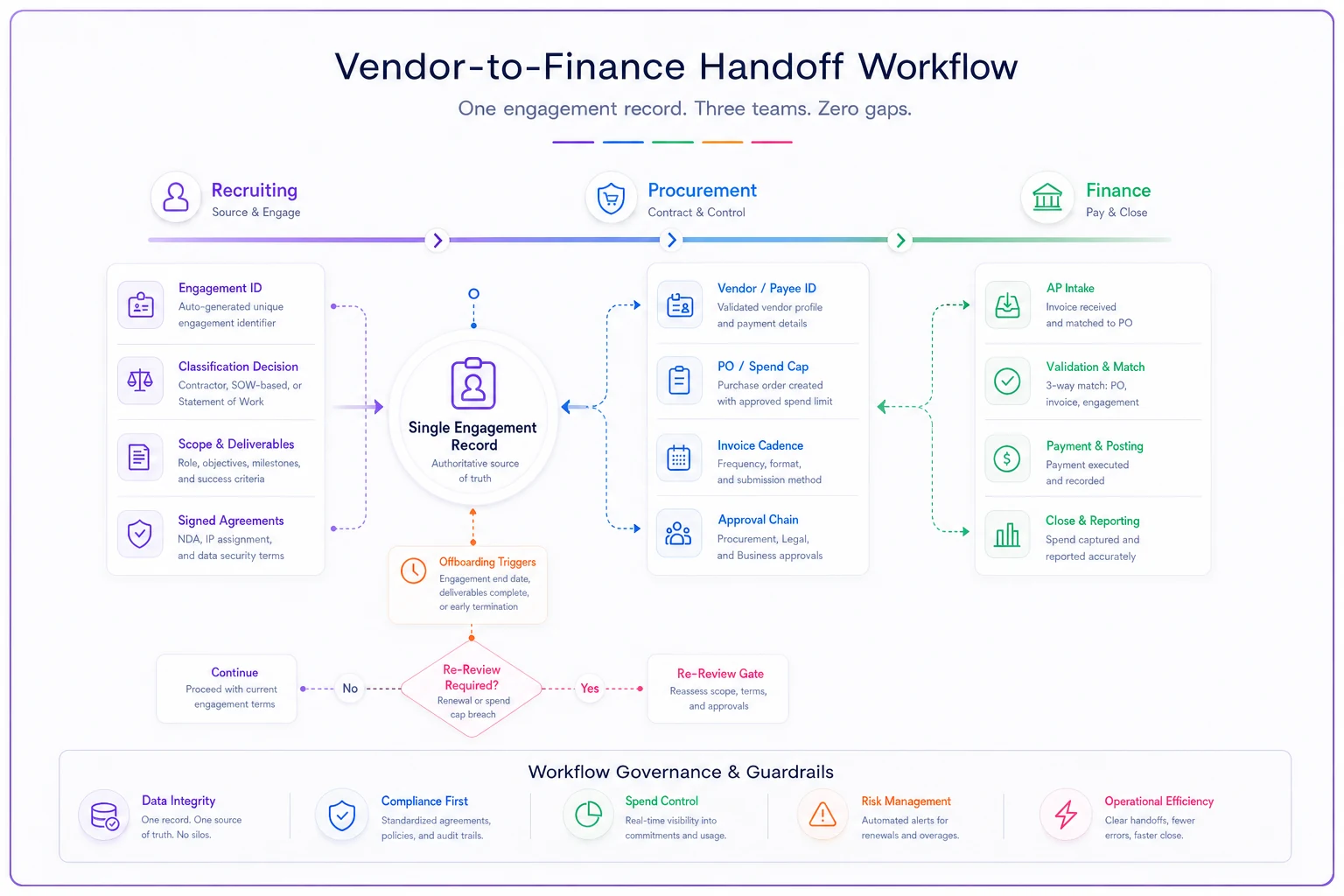
A hard rule: no invoice gets paid without someone confirming the work occurred against the engagement record, and cumulative spend gets checked against the cap at every payment. When spend approaches the cap, it forces a re-authorization — which conveniently is also the moment you re-run classification.
A short real scenario
A roughly 90-person product company was running about a dozen contractors at any given time, all onboarded ad-hoc by individual hiring managers. No central record, classification decided informally, IP assignment inconsistent, Finance paying invoices on manager approval alone.
The problems were exactly what you'd predict. Two contractors had drifted into clearly employee-like arrangements over close to a year. One engagement had no IP assignment at all — and that contractor had built a meaningful internal tool. Cumulative spend on the contingent program was running noticeably higher than Finance expected because nobody held a total view.
They didn't buy new software or hire a procurement team. They built one engagement record every contractor had to pass through, added a hard gate before access could be granted, and tied a re-classification check to every renewal and spend-cap breach. Within a couple quarters, the drifted engagements were either converted to employees or properly re-scoped, the missing IP assignment got papered (uncomfortable, but caught in time), and Finance finally had a cumulative spend view that caught scope creep before it compounded. Nothing dramatic — just fewer surprises and a program that could survive an audit.
When this level of rigor makes sense — and when it doesn't
When it's worth it: You're running more than a handful of contractors at once, engagements renew or extend regularly, contractors touch code, IP, or sensitive data, or Finance has been surprised by contingent spend. At that point, the loose approach is costing you more than the process would.
When it's overkill: You engage one or two contractors a year for short, clearly deliverable-based work with their own tools and no access to sensitive systems. Forcing a nine-field engagement record on a two-week freelance project is just friction. Keep the classification check and the IP assignment; skip the heavy machinery.
Who should not do this halfway: Teams that implement the gates but let managers override them "just this once." A classification gate that gets bypassed under pressure is worse than no gate, because it creates a paper trail showing you knew the rule and ignored it. If you can't enforce it, don't pretend to have it.
Making it stick
The reason contingent workforce operations stays messy isn't that teams don't know the rules. It's that the rules live in four different departments and no single engagement record ties them together. Classification sits with HR, IP with Legal, onboarding with IT, payment with Finance — and the contractor falls through every seam between them.
Everything above collapses into one operating principle: one engagement record, owned by one person, that can't skip a gate. Classification confirmed and reasoned. Onboarding timed to when the person actually gets paid. IP and NDA signed before access. Vendor and finance handoff carrying a spend cap and a work-confirmation step. Re-check classification at every renewal and every cap breach.
If you track the health of your contingent program, do it with real metrics rather than gut feel — percentage of engagements with current classification, average days from start to first clean payment, cumulative spend vs. authorization, and the share of engagements with signed IP before access. Building those into a reliable reporting rhythm follows the same logic laid out in how an HR metrics operating system makes KPIs reliable: taxonomy, cadence, and data ownership.
None of this makes contractors harder to hire. It makes them safe to hire — which is the whole point of running a contingent workforce in the first place.
Ready to transform your HR processes?
Join thousands of HR teams using Hiryly to hire faster, engage employees better, and stay compliant effortlessly.