
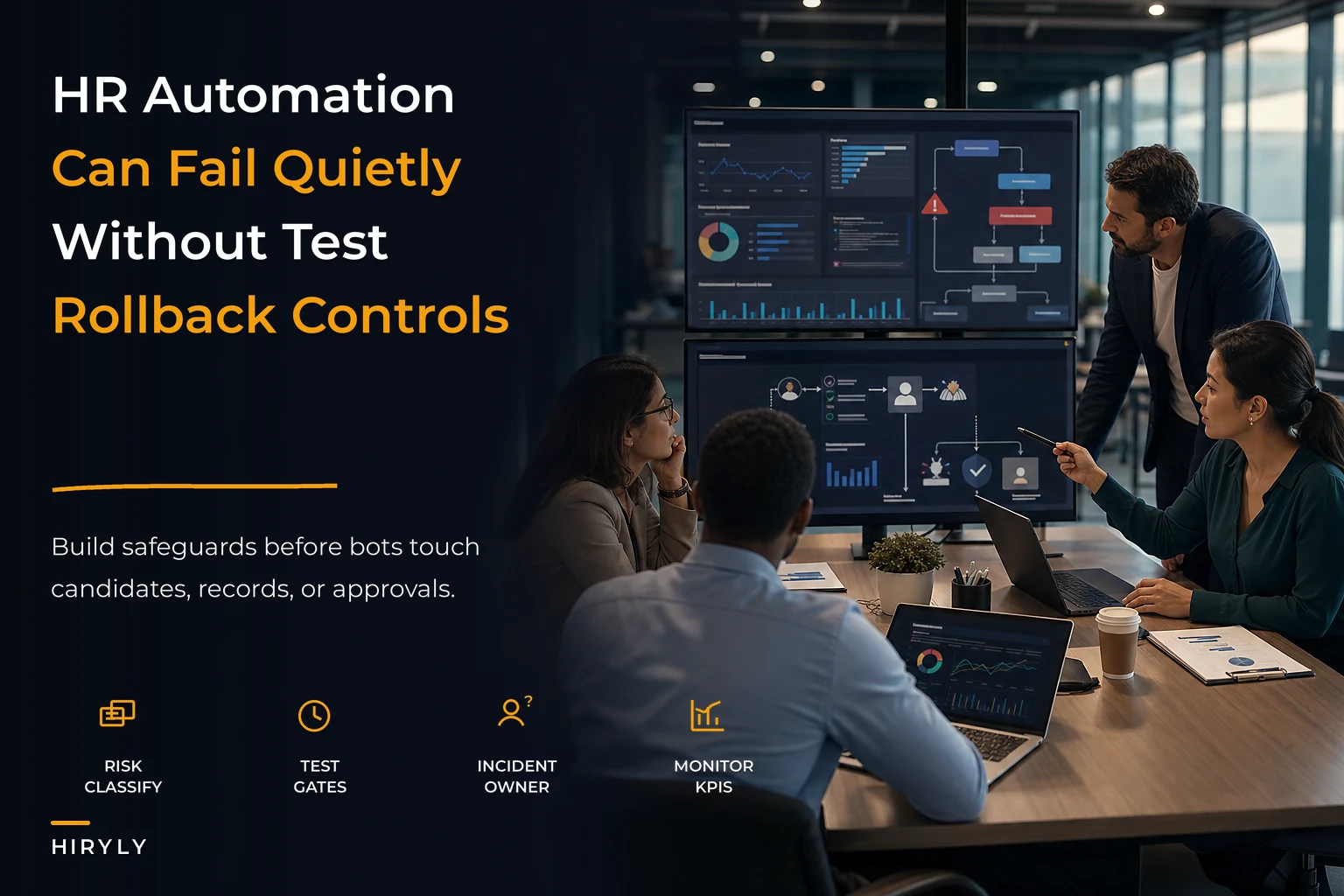

Most HR teams don't roll out AI on purpose. It happens one feature at a time — a resume screener here, a scheduling bot there, an interview note summarizer someone turned on because it saved twenty minutes a day. Six months later you've got a dozen automated flows touching candidate data, and nobody can tell you which ones make decisions, which ones just move data around, and which ones would cause a lawsuit if they drifted sideways.
That's the actual governance problem. Not "AI is dangerous," but "we have automation nobody is accountable for." The mistakes below aren't about the technology being bad. They're about the operational scaffolding that never got built underneath it.
The real failure: governance gets treated as a policy document, not a process
A pattern that keeps coming up: a company writes an "AI use policy." It lives in a shared drive. It says the right things — human oversight, fairness, compliance. And it has zero connection to the actual tools running in production.
Meanwhile the recruiting coordinator has automated interview scheduling and reminder sequences. The sourcing team is using an LLM to rewrite job descriptions and rank inbound applicants. Someone in comp built a spreadsheet macro that flags "outlier" offers. None of these are in the policy. None of them were risk-classified. And two of them are making decisions that affect who gets hired.
Governance isn't a document you approve once. It's a set of process gates a flow has to pass through before it touches a candidate or an employee record, and a set of monitors that keep watching after it goes live. When it's a document, it decays. When it's a process, it holds.
Start with inventory before anything else. You cannot govern what you haven't listed. Most teams are genuinely surprised when they actually write down every automated flow — the number is usually double what leadership assumed, and half of it was built informally by people solving their own bottlenecks.
Step one: classify by decision impact, not by "how much AI is in it"
The most common classification mistake is sorting tools by technical sophistication. Teams get nervous about the flashy generative AI and wave through the "simple" rules-based automation. That's backwards. A dumb if-then rule that auto-rejects anyone with an employment gap can do more legal damage than a sophisticated model that just drafts email copy.
Eliminate HR bottlenecks with smart automation.
Hiryly simplifies your HR operations so you can focus on people, not paperwork.
- Centralized candidate tracking
- Automated onboarding workflows
- Performance & compliance dashboards
No credit card required
| Tier | What the flow does | Example | Governance load |
|---|---|---|---|
| Tier 1 — Decision-making | Screens, ranks, rejects, or scores people | Resume ranking, auto-reject rules, attrition risk scores | Full protocol: testing, human review, bias audit, rollback, logging |
| Tier 2 — Decision-influencing | Shapes what a human sees or how they decide | Candidate summaries, "recommended" shortlists, interview note synthesis | Testing + human sign-off + monitoring; audit the framing, not just the output |
| Tier 3 — Operational / data movement | Moves, formats, or notifies without judging people | Scheduling, reminder sequences, data sync between ATS and HRIS | Lighter: functional testing, monitoring, error alerts |
| Tier 4 — Drafting / assistive | Produces text a human fully reviews before use | Job description drafts, outreach copy | Lightest: usage guidance, spot checks |
The one worth flagging hardest: Tier 2 gets underestimated constantly. A "recommended candidates" panel that reorders your shortlist feels harmless because a human still clicks the button. But if the human clicks the top three 90% of the time — and they will, because that's what busy people do — the tool is effectively deciding. Tier 2 flows need almost as much scrutiny as Tier 1, and most teams give them almost none.
Testing protocols: what actually needs to happen before go-live
"We tested it" usually means someone ran a few resumes through and the output looked reasonable. That's a demo, not a test. Real testing for HR automation has to answer questions a vendor demo will never surface.
-
Golden dataset test. Build a fixed set of 50–200 realistic records where you already know the "right" behavior. Run them every time the tool or its config changes. If a vendor pushes a model update, this is how you catch that it now scores differently.
-
Adverse-impact check. Run the flow across demographic slices and compare selection rates. You're looking for the four-fifths red flag, but honestly you want to see the pattern well before it hits that threshold.
-
Edge-case probing. Feed it the messy stuff
career gaps, non-linear resumes, international education, name variations, formatting chaos. This is where screeners quietly fail.
-
Prompt/config drift test. For generative tools, run the same input a dozen times. If you get materially different rankings or recommendations across runs, that instability is a governance finding.
-
Explainability spot-check. Can a human look at any single output and reconstruct roughly why? If nobody can explain a rejection, you can't defend it.
The overlooked one is number 1. Vendors update models silently. A screener that passed your adverse-impact check in March can behave differently in September with zero notice to you. Without a golden dataset you run every quarter, you'll never know until a candidate complaint forces you to look. This also ties directly into data lineage — if you don't already have clean access-control matrices and PII minimization in place, your testing sits on sand, because you can't even trust the records you're testing against.
When heavy testing actually makes sense — and when it's overkill
Full protocols on a Tier 4 job-description drafter is a waste of everyone's time. Nobody's career is decided by a first-draft JD a recruiter rewrites anyway. Match the testing weight to the tier. Teams that burn out on governance are usually the ones applying Tier 1 rigor to Tier 4 tools, then getting so exhausted they skip testing on the flow that actually matters.
Rollback triggers: decide the kill switch before you need it
Almost nobody defines rollback triggers in advance, and that's how a broken flow limps along for weeks while people argue about whether it's "really" broken. In the middle of an incident, judgment gets political. Someone owns the tool, someone championed it, and suddenly "should we turn it off" becomes a debate instead of a rule.
Set the triggers cold, before launch, in writing. A rollback trigger is a specific measurable condition that, when hit, pulls the flow out of production — no meeting required.
-
Selection rate for any protected group drops below the four-fifths ratio in the weekly monitor
-
Output volume swings more than ~30% week over week with no known cause
-
Error/exception rate on a data-movement flow crosses a set threshold
-
A vendor pushes a model update you weren't notified about
-
More than a small number of candidate complaints about the same automated touchpoint in a short window
-
The golden dataset test fails after any config change
The important design choice: rollback should degrade to the previous safe state, not to chaos. If you kill the auto-scheduler, the fallback is manual scheduling with a named owner — not "candidates stop getting scheduled." Turning something off creates its own bottleneck, and teams forget that. Every rollback plan needs a "what humans do instead" section, and that section needs an owner who knows they're on the hook.
Monitoring KPIs: what to watch after go-live
Testing tells you the flow was fine at launch. Monitoring tells you it's still fine today. These are different questions, and most governance stops at the first one.
-
Selection/pass-through rates by stage and by demographic slice — the earliest signal of drift
-
Human override rate — how often people reverse the tool. Very low (nobody's really reviewing) and very high (the tool's wrong a lot) are both bad. You want a healthy middle.
-
Output stability — is the tool giving consistent results over time on stable inputs?
-
Exception and error volume on operational flows
-
Time-in-stage — a scheduling automation that's silently failing shows up as candidates piling up before it
-
Candidate-side signals — complaints, drop-off spikes right after an automated touchpoint
Override rate is the underrated one. It's the single best gauge of whether "human in the loop" is real or theater. If your reviewers approve 98% of AI recommendations, you don't have oversight — you have a rubber stamp with a person attached. That number belongs in your governance dashboard, reviewed on a set cadence. Building this well overlaps heavily with the discipline of a proper HR metrics operating system with clear taxonomy and data ownership — governance KPIs fall apart for the same reasons ordinary HR KPIs do: nobody owns the number, and nobody agrees on how it's defined.
Audit trails: the part everyone regrets skipping
The audit trail is boring right up until a candidate, a regulator, or a lawyer asks "why was this person rejected?" — and you can't answer. At that point the missing log is the whole story.
Every Tier 1 and Tier 2 flow needs to record, per decision:
-
What input the tool received
-
What version/config of the tool ran it
-
What the output was
-
Which human reviewed it and what they decided
-
Timestamp and the ability to reconstruct the sequence
The mistake here is subtle. Teams log the output but not the input and version. So when a complaint comes in six weeks later, you can see that Candidate X got a score of 0.42, but the model's been updated twice since, and you can't reproduce how that score was reached. The audit trail exists but proves nothing. Version-stamping every automated decision is the detail that separates a defensible process from a scary one.
Incident playbooks: what happens in the first hour
When a flow misbehaves, the damage usually comes from how slowly and messily people respond — not the initial fault. Without a playbook, the first hour is people forwarding emails and asking "who owns this thing?"
-
Who gets paged? A named owner and a backup — not "HR ops" as a team.
-
What's the immediate containment? Usually
hit the rollback, revert to the manual fallback.
-
Who do we notify, and when? Affected candidates, legal, leadership — with rough thresholds for each.
-
How do we reconstruct what happened? This is where your audit trail either saves you or exposes you.
A short real scenario
A mid-sized company — around 400 employees, hiring roughly 15–20 roles a month — had an ATS-integrated ranking tool quietly reweighted after a vendor update. Nobody was notified. Over about three weeks, the tool started sinking candidates from one large state university to the bottom of shortlists, apparently because of how it now read the school-name formatting. Recruiters, trusting the ranking, worked from the top down. Pass-through for that group dropped noticeably before anyone questioned it.
What caught it wasn't a person — it was the demographic pass-through monitor flagging a slice-level shift. Because they'd set a rollback trigger tied to that exact drift, the flow reverted to manual review within the week instead of running unnoticed for a quarter. The audit trail, with input and version stamped, let them reconstruct the roughly 40 affected candidates and re-review them. Messy, but recoverable. Without the monitor and the trail, that pattern runs for months and surfaces only as a legal claim.
The sequence that made recovery possible is worth spelling out, because it's the same sequence any team can build:
-
Demographic pass-through monitor flags a slice-level shift
-
Rollback trigger fires automatically — no meeting, no debate
-
Flow reverts to manual review within days
-
Audit trail with input and version stamps lets the team reconstruct affected decisions
-
Named owner runs re-review of impacted candidates
-
Post-incident review updates the golden dataset and monitor thresholds
None of that happened because someone was unusually diligent. It happened because the triggers and the trail were already wired in before anything went wrong.
This diagram shows the workflow from detection to rollback and re-review in a concise visual.
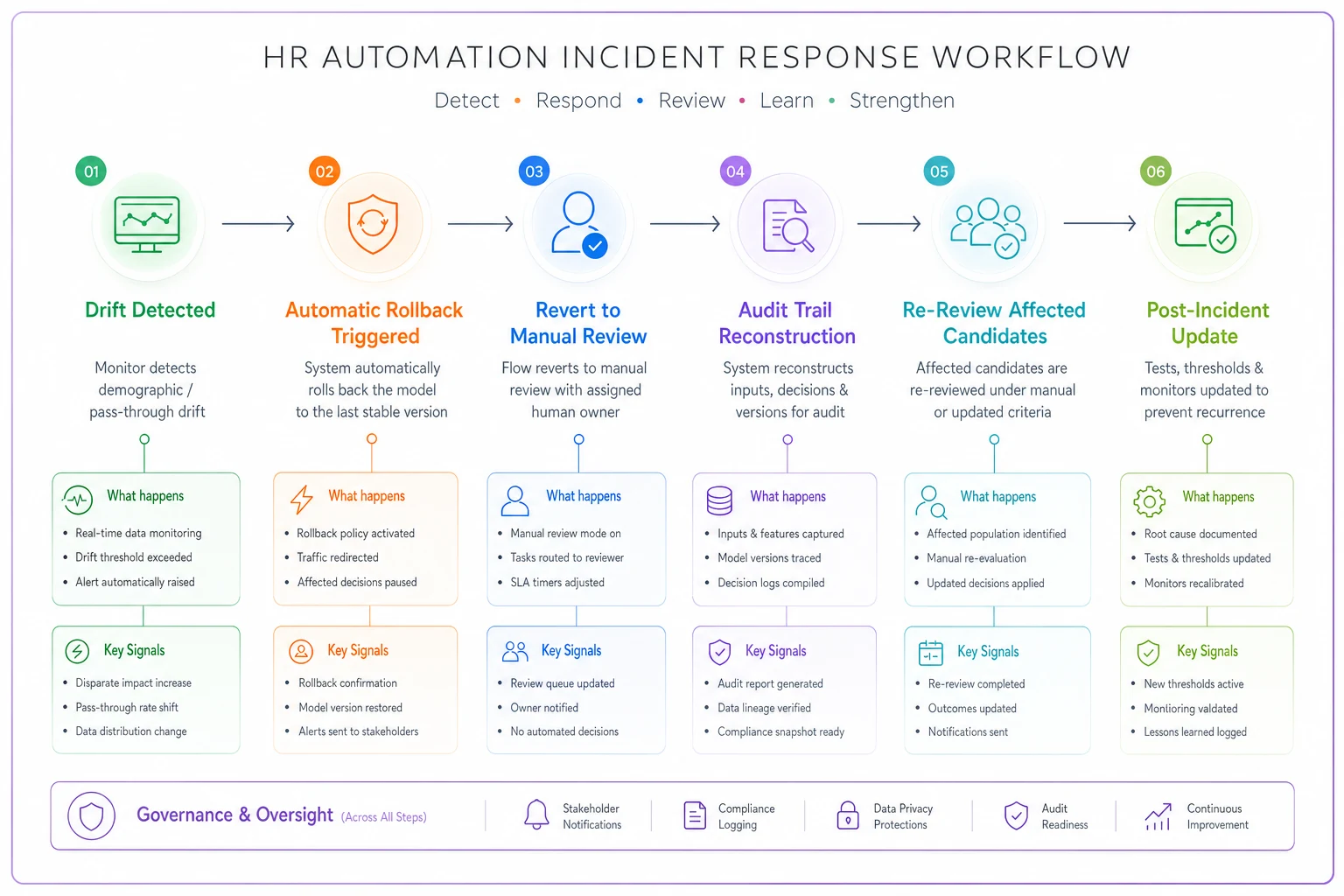
The visual maps detection, automated rollback, manual fallback, and audit-driven re-review as a single recoverable process.
Where the tooling actually helps — and where it doesn't
You can run a lot of this in spreadsheets and calendars when you have three flows. At fifteen flows across sourcing, screening, scheduling, onboarding, and comp, manual governance collapses — not because it's conceptually hard but because the coordination overhead eats the team alive. Nobody remembers to run the quarterly golden-dataset test on tool #9. The override-rate report gets skipped for two months. The rollback trigger fires but the alert goes to someone who left.
That's the honest case for putting governance into your workflow platform rather than running it as a side project. The value isn't AI doing something clever — it's the boring stuff getting done reliably: inventory that stays current, monitors that actually alert, audit logs that capture input and version automatically, rollback triggers wired to real thresholds instead of somebody's memory. AI-assisted operational software earns its place here by making the checks happen on schedule and centralizing the trail, so governance survives contact with a busy quarter. The tools you're governing and the system you govern them with are two different things, and confusing them is how good policies quietly stop being followed.
Who should NOT over-invest in this yet
If you're a small team running two or three low-stakes automations — reminders and JD drafts — building a full incident-playbook apparatus is premature. Inventory what you have, classify it honestly, and put real testing on anything that touches a hiring decision. The heavy machinery is for when the flows multiply and start making calls that affect people's careers, which happens faster than most teams plan for.
The through-line
The governance mistakes that hurt HR teams aren't dramatic. They're quiet: a tool nobody inventoried, a Tier 2 recommender treated as harmless, a vendor update that changed behavior silently, an override rate that turned oversight into a rubber stamp, a missing input log that made a complaint impossible to answer.
None of that gets fixed with a better policy PDF. It gets fixed by wiring governance into the process — classify by decision impact, test against a golden dataset, define rollback triggers before launch, monitor override rates and slice-level pass-through, and version-stamp every decision so the audit trail can actually reconstruct what happened. Do that, and AI stops being a liability you're nervously hoping behaves, and becomes something you can defend, explain, and scale.
The governance mistakes that hurt HR teams aren't dramatic. They're quiet: a tool nobody inventoried, a Tier 2 recommender treated as harmless, a vendor update that changed behavior silently, an override rate that turned oversight into a rubber stamp, a missing input log that made a complaint impossible to answer.
None of that gets fixed with a better policy PDF. It gets fixed by wiring governance into the process — classify by decision impact, test against a golden dataset, define rollback triggers before launch, monitor override rates and slice-level pass-through, and version-stamp every decision so the audit trail can actually reconstruct what happened. Do that, and AI stops being a liability you're nervously hoping behaves, and becomes something you can defend, explain, and scale.
Ready to transform your HR processes?
Join thousands of HR teams using Hiryly to hire faster, engage employees better, and stay compliant effortlessly.