

A board-level search behaves nothing like filling a mid-level role, and most HR teams get burned when they treat it like one. The candidate is often currently employed, frequently senior enough that a rumor could tank their standing, and sometimes replacing someone who doesn't know they're being replaced. Add in sensitive comp conversations, references that need careful handling, and half the hiring committee wanting to "just loop in" a few extra people — and you've got a situation where one careless Slack message or an over-shared calendar invite can cost you the hire entirely.
This playbook is narrow on purpose. It's about keeping an executive search confidential, keeping the evidence clean enough to survive scrutiny later, and making sure the person you fought to hire actually stays past the honeymoon period.
Where confidential searches actually break
The leaks almost never come from the obvious place. People assume the risk is a recruiter blabbing. In practice, the breach usually comes from internal plumbing — a calendar invite titled "Interview: VP Finance (confidential)" that auto-populates on a shared team calendar, an ATS stage visible to twenty people who have no business seeing it, or a well-meaning coordinator who CCs the wrong distribution list.
A typical pattern: the search starts tight, maybe four people in the know. By week three, a hiring manager pulls in a peer for a "gut check," the peer mentions it to someone over coffee, and within days the current CFO you're quietly replacing hears a version of it secondhand. Now you've got a retention problem and a reputation problem, and the external candidate — who specifically asked for discretion — pulls out because word reached their current employer.
The second failure is the paper trail, or the lack of one. Confidential searches generate a lot of informal communication because people are nervous about leaving a record. Decisions get made in hallway conversations and texts, references get taken verbally with no notes, and six months later when someone questions the hire — or there's a dispute — there's nothing clean to point to. You traded auditability for secrecy, and that's a bad trade.
Start with a Stakeholder RACI, and keep it brutally small
The single biggest lever on confidentiality is simply deciding who is allowed to know, and in what capacity. Most leaks are a function of too many people in the circle doing undefined things. A Stakeholder RACI for a confidential search isn't the sprawling matrix you'd use for a normal requisition. It should fit on half a page. The point is to name who decides, who executes, who gets consulted, and who gets told after the fact.
Eliminate HR bottlenecks with smart automation.
Hiryly simplifies your HR operations so you can focus on people, not paperwork.
- Centralized candidate tracking
- Automated onboarding workflows
- Performance & compliance dashboards
No credit card required
Make additions to the circle explicit: any new person needs the Accountable owner's approval in writing.
| Role | Responsible | Accountable | Consulted | Informed |
|---|---|---|---|---|
| Search strategy & shortlist | Lead recruiter | VP Talent | Hiring exec | — |
| Final hire decision | — | Hiring exec + one board member | CFO (comp) | — |
| Reference checks | Lead recruiter | VP Talent | — | — |
| Offer construction | Comp partner | VP Talent | Finance | — |
| Internal comms (post-signature) | HRBP | VP Talent | Legal | Broader team |
Two things matter here. First, the "Informed" column is almost empty until the offer is signed — that's deliberate. Second, nobody gets added to the circle without the Accountable owner approving it. If a hiring exec wants to add a peer for a gut check, that's a decision with a name attached, not a casual favor.
This is a tighter, more restrictive version of the approval logic you'd find in a standard hiring governance framework — same bones, far fewer people, much higher scrutiny on who crosses each gate.
Confidentiality gates: make secrecy a process, not a vibe
Telling people to "be discreet" does nothing. What actually works is building gates into the workflow where information only unlocks when a condition is met — staged disclosure.
Here's a workflow that holds up in practice:
-
Gate 0 — Anonymized intake. The role exists in your system under a code name or generic title. No candidate names, no company names in anything searchable by the broader team. Comp bands are stored separately from the requisition.
-
Gate 1 — Named shortlist, restricted circle. Candidate identities become visible only to the RACI-approved circle. Access is logged. Calendar invites use neutral titles ("External meeting – J.R.") with no agenda attached.
-
Gate 2 — Deep evaluation. References, comp detail, and any sensitive background move here. This is the most restricted layer. Documents live in a separate, access-controlled folder with a named owner.
-
Gate 3 — Offer and signature. Legal and finance join for offer construction only. Still no broad announcement.
-
Gate 4 — Controlled disclosure. Internal comms release on a planned schedule after signature, with messaging prepared in advance for the team, the person being replaced (if applicable), and external stakeholders.
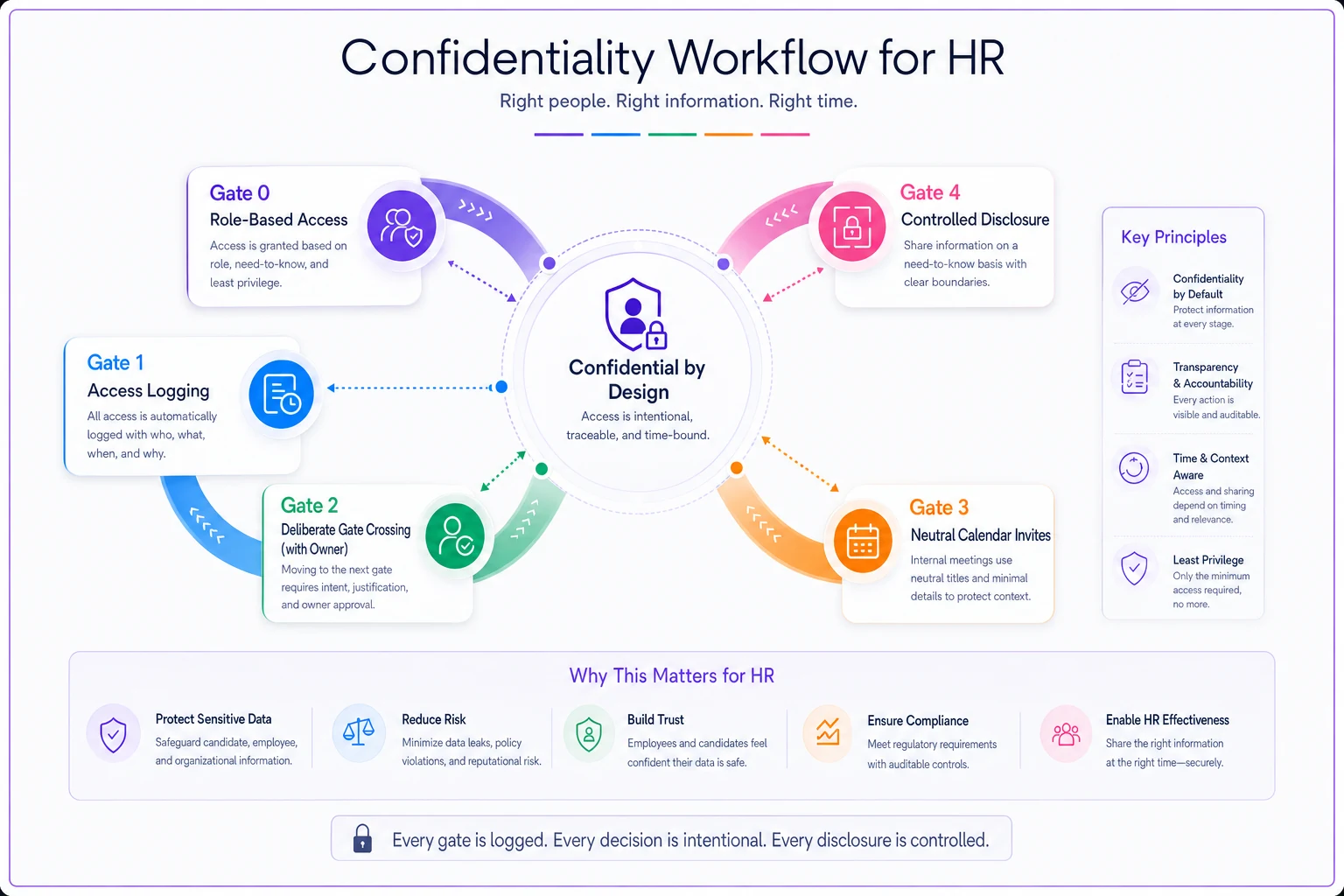
This diagram shows the staged disclosure workflow and who gains access at each gate.
The part most teams miss: confidentiality fails at the transitions between stages, not inside them. When a candidate moves from shortlist to deep evaluation, that's when someone forwards a file to the wrong folder or adds a reviewer who then has standing access forever. Every gate crossing should be a deliberate, logged action with an owner — not an automatic promotion.
This is where operational software quietly earns its place: role-based access that actually enforces the gates instead of relying on people to remember them, and an access log you didn't have to reconstruct from memory. The value isn't flashy. It's that when someone asks "who could see this candidate's name in March," you have an answer in thirty seconds.
Evidence packets: how to stay secret and auditable at the same time
This is where teams get it wrong most often. They assume secrecy and documentation are opposites. They're not — you just have to document in a controlled, structured way rather than leaving a scattered trail of texts and verbal notes.
An evidence packet is a single, access-controlled record per candidate that contains everything a decision rested on. Not a folder of loose files. One structured record.
-
Interview notes tied to the agreed evaluation criteria, not freeform impressions
-
Reference-check summaries with date, who conducted them, and what was asked
-
Comp rationale — why this number, within what band, approved by whom
-
Any risk flags raised and how they were resolved
-
The decision itself, with named decision-makers and date
The discipline is that nothing decision-relevant lives outside the packet. If a hiring exec has a concern, it goes in the packet as a documented note — not a text message that disappears. This feels like extra work in the moment and saves you enormously later, especially if the hire is ever challenged or you need to defend a comp decision, which ties directly into clean HR–Finance governance on compensation.
A good evidence packet is boring, structured, and complete. That's exactly what you want when scrutiny arrives.
Offer and retention bundle templates
Senior offers fall apart when they're constructed ad hoc. Someone verbally promises an accelerated vesting schedule, finance doesn't know about it, and now you're renegotiating after a handshake. The fix is a pre-approved offer/retention bundle — templated components with defined approval thresholds, so the hiring team can move fast without inventing terms mid-conversation.
Structure it as tiers:
-
Base bundle — comp, standard equity, standard benefits. Pre-approved, recruiter can present without escalation.
-
Retention bundle — sign-on, retention bonus tied to a cliff (commonly 12–24 months), accelerated vesting on a defined trigger. Requires VP Talent + Finance sign-off, but the terms are pre-defined so approval is a yes/no, not a negotiation inside your own team.
-
Executive discretion bundle — anything beyond the above. Requires the Accountable owner from the RACI, documented in the evidence packet.
The retention piece matters more than most teams treat it. A lot of executive hires are flight risks precisely because they were lured away themselves — the same forces that got them to say yes to you are operating on them constantly. A retention bundle with a real cliff isn't about trapping someone; it's about aligning the timeline so both sides have skin in the first critical year.
Accelerated reference checks without cutting corners
Confidential searches create a specific reference problem: you often can't talk to the candidate's current employer, and the candidate is nervous about any reference leaking back. So teams either skip references entirely (dangerous) or drag the process out for weeks while the candidate goes cold.
-
Agree the reference list upfront, at shortlist stage, including back-channel contacts the candidate is comfortable with.
-
Run references in parallel, not sequentially — assign two people to split the list and complete within 48–72 hours.
-
Use a fixed question set tied to the role's top three requirements, so every reference is comparable and the summary drops straight into the evidence packet.
-
Handle current-employer references last and conditionally — only after a verbal offer, with the candidate's explicit written sign-off.
Back-channel references, handled respectfully, are often more honest than formal ones — but they're also the highest leak risk. Keep those conversations inside the restricted circle and logged. A hiring exec freelancing a back-channel call that never makes it into the packet is exactly the kind of thing that creates problems later.
Post-hire retention monitoring that isn't creepy
Signing the offer isn't the finish line — it's roughly the halfway point. Executive attrition in the first year is expensive and often preventable, and the warning signs usually show up early if anyone's actually watching.
-
30-day check Is the role matching what was pitched? Early mismatch is the number-one cause of fast executive exits.
-
90-day check Are the key relationships forming? A senior hire who's isolated at 90 days is often gone by month nine.
-
6-month check Is the retention bundle timeline still aligned with how they're feeling? This is the window to address friction before it hardens into a decision.
Keep these qualitative and confidential. You're tracking whether intervention is needed, not building a dossier. Collect what you need to act, nothing more.
A short real scenario
A mid-market company ran a confidential search to replace an underperforming VP of Engineering who didn't yet know. The first attempt leaked within two weeks — a shared calendar invite tipped off the team, the VP found out, and the strongest external candidate withdrew. The search stalled for roughly two months.
On the restart, they tightened the RACI to five people, used code-named requisitions, staged everything through confidentiality gates, and kept a single evidence packet per candidate. References ran in parallel and wrapped in three days instead of two weeks. The hire signed with a retention bundle carrying an 18-month cliff. At the one-year mark, the exec was still in seat and ramped — and the transition out of the old VP happened on the company's terms, not in a panic.
The difference wasn't a better candidate pool. It was process discipline around secrecy and documentation.
When this level of rigor makes sense — and when it doesn't
Use the full playbook when: the hire is board-visible, the candidate is currently employed and senior, you're replacing someone who doesn't know, or the comp is complex enough to invite scrutiny later.
Scale it down when: the role is senior but the search is already public, or the candidate pool is largely internal and known. Running a five-gate confidential process on a non-sensitive hire just adds friction with no upside.
Who should not do this: teams without a single Accountable owner willing to control the circle. If everyone can add people to the search, no process will save you. Confidentiality is ultimately a discipline about saying no to well-meaning requests to "loop someone in."
Confidential executive hiring fails for two reasons that look opposite but share a root cause: too many people in the loop, and too little written down.
Both come from treating secrecy as a feeling instead of a workflow. Define the circle with a tight RACI, enforce staged disclosure through real gates, keep one clean evidence packet per candidate, and keep watching after the signature. Do that, and you protect both the privacy that got the candidate to say yes and the retention that keeps them there once they do.
Ready to transform your HR processes?
Join thousands of HR teams using Hiryly to hire faster, engage employees better, and stay compliant effortlessly.