



Payroll and comp failures almost never look dramatic on the day they happen. They show up as a bonus that got approved in an email thread nobody can find, a merit increase that hit the wrong effective date, a contractor paid on the employee cycle, or a variable-pay calculation that Finance and HR are quietly disagreeing about in two different spreadsheets. The employee sees a wrong number. The board sees a restatement. And somewhere in the middle, HR and Finance are pointing at each other trying to figure out who actually owned the decision.
Most comp errors aren't math errors. They're governance gaps — the seams between the team that decides what someone should be paid (HR) and the team that actually pays it (Finance). When those two functions run on separate calendars, separate approval logic, and separate versions of "the truth," you don't need a bad actor to create a failure. You just need a busy month.
This is a blueprint for closing that seam. Not a philosophy — an actual operating model with approval matrices, evidence packets, cut-off rules, a reconciliation cadence, and escalation gates you can lift and adapt.
Where HR–Finance compensation governance actually breaks
Before designing controls, it helps to be honest about the specific handoffs that fail. In real operations, comp problems cluster around a handful of predictable seams.
The decision-to-record gap. HR approves a raise, promotion, or off-cycle adjustment. Finance records what will actually be paid. Between those two moments, information degrades — an effective date gets rounded to a pay period boundary, a prorated amount gets calculated by hand, an "annualized" figure gets entered as a "per-period" figure. Nobody lied. The handoff just lost resolution.
The exception pipeline. Standard comp changes flow fine. It's the exceptions — retention bonuses, sign-on clawbacks, mid-cycle band moves, one-time spot awards — that skip the normal workflow because they're "urgent." Exceptions are where approval authority gets fuzzy and where audit trails go missing. A company can process 2,000 clean changes a quarter and still get burned by the 30 exceptions that went around the system.
The calendar collision. HR thinks in review cycles and effective dates. Finance thinks in pay cut-offs and GL close. When those two calendars aren't explicitly mapped to each other, you get changes approved after the cut-off that everyone assumed would land in the current run — and then a scramble of off-cycle payments and corrections.
The reconciliation vacuum. Payroll runs, money moves, and then... nothing formally checks that what was approved matches what was paid. Reconciliation gets treated as an accounting task instead of a joint HR–Finance control. Errors don't get caught until an employee complains or an auditor pulls a sample.
What ties all of these together: nobody drew a clean line around who decides, who records, who checks, and who escalates. Governance is just that line, made explicit and repeatable.
What scale does to the problem
At 40 employees, one HR generalist and one finance person can hold the whole comp picture in their heads. Approvals happen in the hallway. Reconciliation happens because the same person who approved the raise also sees the payroll register. Informal coordination works — right up until it doesn't.
Eliminate HR bottlenecks with smart automation.
Hiryly simplifies your HR operations so you can focus on people, not paperwork.
- Centralized candidate tracking
- Automated onboarding workflows
- Performance & compliance dashboards
No credit card required
Here's what actually breaks as headcount climbs:
-
At ~150 people, comp decisions start distributing across multiple managers and locations. The "hallway approval" stops scaling, and undocumented approvals become the norm rather than the exception.
-
At ~300–500 people, you likely have multiple pay groups, maybe multiple entities or countries, and variable pay plans that require real calculation. The manual reconciliation that worked at 80 people now takes days and misses things.
-
Past ~500, you're almost certainly running a shared-services model whether you named it that or not — HR ops, payroll ops, and finance ops as distinct teams. Now the seams between teams are the risk, not any individual's competence.
The pattern is consistent: the failure mode migrates from individual mistakes to coordination failures. Throwing more careful people at it doesn't fix it. You need shared structure. The same logic that makes a hiring governance framework work at scale — role-based approvals, defined SLAs, and audit gates — applies directly to comp: the goal is to make the right path the easy path, so people stop routing around it.
The core building block: an approval matrix that actually holds
Most approval matrices fail because they answer "who can approve?" but not "who can approve what, up to what threshold, with what evidence, by when." A matrix that only names roles will get bypassed the first time something is urgent.
A workable comp approval matrix has five columns, not one:
| Change type | Approval threshold | Required approvers | Evidence required | Cut-off rule |
|---|---|---|---|---|
| Standard merit increase | Within band, ≤ budgeted % | Manager + HRBP | Calibration record, updated comp letter | Must be approved 5 business days before pay cut-off |
| Promotion / band change | Any | Manager + HRBP + Comp lead | Job leveling doc, band placement rationale | 7 business days before cut-off |
| Off-cycle / retention adjustment | Any amount | HRBP + Comp lead + Finance controller | Business case, funding source, effective date | Exception path (see escalation gates) |
| Spot bonus / one-time award | ≤ set threshold | Manager + HRBP | Award justification, GL coding | Standard cut-off |
| Sign-on / clawback provisions | Any | Comp lead + Finance + Legal | Signed offer terms, clawback schedule | At hire; verified at first run |
Two things make this version work where generic matrices don't.
First, the evidence column. An approval without required evidence isn't an approval — it's an opinion. Tying each decision type to a specific artifact means the audit trail is created at the moment of decision, not reconstructed later from someone's inbox.
Second, the cut-off column baked into the matrix itself. Approval authority and timing are the same problem. If the matrix says "7 business days before cut-off" for promotions, then a promotion approved 2 days out automatically becomes an exception — and gets routed through the exception gate instead of silently jamming the payroll run.
Evidence packets: making comp decisions auditable by default
An evidence packet is a small, standardized bundle attached to every non-trivial comp decision. The point isn't bureaucracy — it's that when someone asks "why is this person getting this?" six months later, the answer is one click away instead of a two-day archaeology dig.
A comp decision evidence packet should contain:
-
The decision itself
old value, new value, effective date, change type
-
The rationale
calibration outcome, performance basis, retention risk, market data reference
-
The funding source
which budget line, whether it was within plan
-
The approvals
who approved, in what order, with timestamps
-
Downstream flags
does this trigger a proration, a tax implication, a benefits recalculation, a clawback schedule
This discipline connects directly to how a mid-market total rewards blueprint handles comp exceptions — role-banding and promotion cadence only stay clean if every exception carries its own justification. Without the packet, exceptions quietly become the new baseline, and your carefully designed bands erode one "special case" at a time.
A practical rule worth enforcing: no evidence packet, no payroll processing.
No evidence packet, no payroll processing.
Payroll ops is empowered to reject a change that arrives without its packet. That sounds harsh, but it flips the incentive — now the person requesting the change owns the documentation burden, not the person paying it out.
Payroll cut-off rules that HR and Finance both actually follow
Cut-off rules break for a boring reason: HR treats them as Finance's problem. HR promises an employee an effective date, hands the change to payroll, and assumes it'll "just get processed." Meanwhile the cut-off already passed.
The fix is to make cut-off logic a shared, published artifact — not buried in a payroll SOP that HR never reads. A clean cut-off framework defines:
-
The hard cut-off
the last moment a change can enter the current run with no exceptions.
-
The soft cut-off
an earlier internal deadline (usually 2–3 business days before the hard cut-off) that gives payroll ops time to validate evidence packets and catch errors.
-
The exception window
the narrow band between soft and hard cut-off where changes are still possible but require an escalation approval, because they compress the validation window.
-
The off-cycle path
what happens to a change that misses the hard cut-off entirely — when it gets an off-cycle payment vs. when it simply rolls to next period.
The insight most teams miss: the soft cut-off is where quality lives. If everything arrives at the hard deadline, payroll ops has zero time to validate and every error flows straight through. Publishing a soft cut-off — and holding HR to it — is what buys you the room to catch mistakes before money moves.
Reconciliation cadence: the control that actually catches errors
Approvals prevent unauthorized changes. Reconciliation catches everything else — the entry errors, the proration mistakes, the timing slips, the changes that got approved but never recorded (and the ones recorded but never approved).
Reconciliation should run on a defined cadence with a defined owner, not "whenever someone gets to it."
Every pay run (pre-disbursement):
-
Match approved changes (from the evidence packet log) against the payroll register
-
Flag any register line without a matching approval
-
Flag any approval without a matching register line
-
Verify effective dates and prorations on all off-cycle items
Monthly:
-
Reconcile comp expense to budget by cost center
-
Review all exceptions processed that month against the exception log
-
Confirm terminations properly stopped pay and triggered final-pay rules
Quarterly:
-
Full audit-sample of comp changes against evidence packets
-
Band-drift review
how many "exceptions" actually happened, and are they signaling a broken band?
-
Access review
who has the ability to enter comp changes, and does that still match their role?
Here's a sample pre-disbursement reconciliation checklist you can adapt directly:
-
[ ] Every register change ties to an approved evidence packet
-
[ ] No approved change is missing from the register
-
[ ] All effective dates match the approval
-
[ ] All prorations recalculated and independently verified
-
[ ] Off-cycle payments have documented justification
-
[ ] Terminations stopped correctly; no ghost payments
-
[ ] Variable pay figures match the plan calculation, not a manual override
-
[ ] GL coding matches the funding source in the packet
-
[ ] Exceptions this run were approved through the escalation gate
-
[ ] Total register delta vs. prior run is explainable line-by-line
That last item is the sleeper. A quick variance check against the prior run — "why is this run $180k higher than last?" — catches more real errors than any single line review, because a mistake big enough to matter usually moves the total.
A simple workflow illustrates the reconciliation cadence and handoffs.
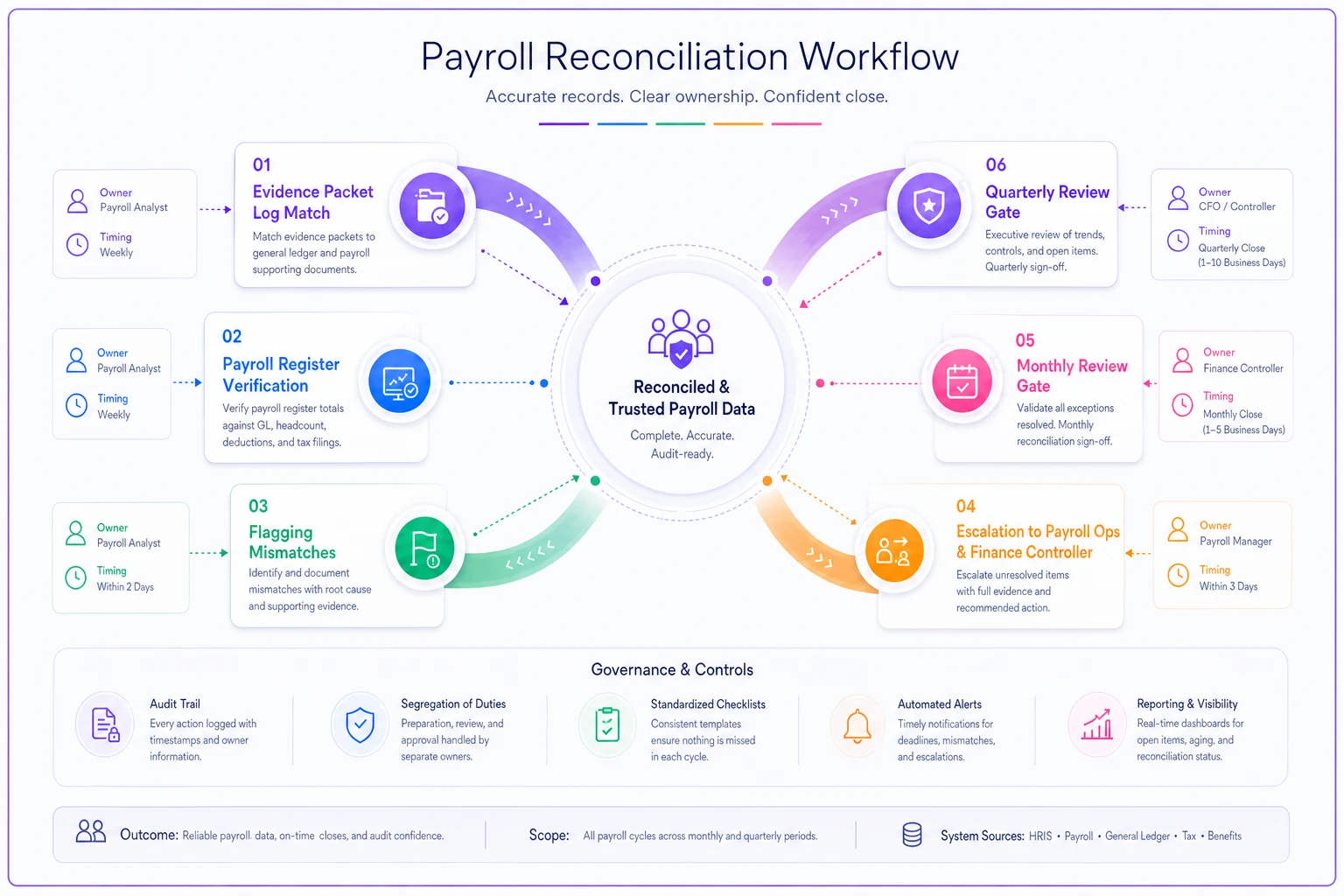
Use the variance check and cadence to catch systemic issues rather than single-run noise.
Escalation gates: what happens when something doesn't fit
Every control system needs a defined path for the stuff that breaks the rules — because otherwise the rules just get ignored under pressure. Escalation gates are pre-agreed decision points that answer: when a change can't follow the standard path, who decides, and how fast?
A three-gate model works well:
Gate 1 — Timing exceptions. A change missed the soft cut-off but not the hard cut-off. Decision owner: payroll ops lead + HRBP. This gate is about capacity ("can we validate this in time?"), not authority.
Gate 2 — Authority exceptions. A change exceeds normal thresholds or lacks a required approver — an urgent retention bonus, a mid-cycle band jump. Decision owner: Comp lead + Finance controller. This gate protects budget and band integrity.
Gate 3 — Control failures. Reconciliation found a real break — a payment with no approval, an approval that was overridden, a repeated pattern of the same error. Decision owner: HR ops director + Finance director. This gate is about fixing the system, not just the single case.
The mistake most organizations make is having only Gate 1 — a way to rush things through — and no Gate 3. So the same control failures repeat every cycle because nobody owns fixing the pattern. Escalation should flow up toward system fixes, not just around toward faster processing.
A RACI that draws the line between HR and Finance
The whole point of a shared-service blueprint is that responsibility is explicit. Here's a working RACI for the comp-to-pay lifecycle:
| Activity | HRBP | Comp Lead | Payroll Ops | Finance Controller | Manager |
|---|---|---|---|---|---|
| Initiate comp change | C | I | I | I | R |
| Validate against band/budget | A | R | I | C | I |
| Approve within matrix | R | A | I | C | C |
| Build evidence packet | R | C | I | I | I |
| Enforce cut-off rules | C | I | A/R | C | I |
| Process payroll | I | I | R | A | I |
| Pre-disbursement reconciliation | C | I | R | A | I |
| Escalation (Gate 2) | C | R | I | A | I |
| Quarterly audit sample | C | R | C | A | I |
The non-obvious design choice: Finance controller is Accountable for reconciliation and payroll, but only Consulted on comp decisions. HR owns the decision; Finance owns the money movement and the check. When those accountabilities blur — when Finance starts making comp calls, or HR starts overriding the register — the control breaks down. Separation isn't friction; it's the entire point.
A real scenario
A ~380-person services company running two entities had comp changes flowing through email approvals and a shared spreadsheet that HR and payroll both edited. Over roughly eight months they'd accumulated a steady stream of small failures: a handful of raises applied a pay period late, two retention bonuses paid at annualized instead of prorated amounts, and about a dozen "spot awards" that no one could tie back to a documented approval. Nothing catastrophic — but Finance flagged that comp expense was running maybe 3–4% over plan with no clear explanation, which is what triggered the cleanup.
They rebuilt around the pieces above: an approval matrix with cut-off timing baked in, evidence packets required before processing, a soft cut-off 3 days ahead of the hard one, and a pre-disbursement reconciliation owned jointly by payroll ops and the controller.
Within two full quarters, the "unexplained" comp variance essentially closed — the overage turned out to be mostly untracked exceptions, not a budgeting problem. Off-cycle corrections dropped noticeably because the soft cut-off caught errors before disbursement instead of after. And the quarterly audit sample went from "reconstruct it from emails" to pulling packets in a few minutes. No dramatic dollar figure — just a lot fewer surprises and a comp process the board stopped asking anxious questions about.
When this level of governance makes sense — and when it doesn't
When it makes sense:
-
You're past ~150 employees with comp decisions distributed across multiple managers
-
You run variable pay, multiple pay groups, or multiple entities/countries
-
Comp expense is drifting from plan with no clear cause
-
An audit, funding round, or M&A process is forcing you to prove controls
When it's overkill:
-
Under ~50 people with a single approver who also sees payroll — informal coordination genuinely works, and heavy process just slows you down
-
Your comp is entirely fixed salary with no exceptions or variable pay to speak of
Who should NOT bolt this on blindly: any organization where HR and Finance report into the same overworked person with no separation of duties. In that case, the first fix isn't a matrix — it's getting a second set of eyes on the reconciliation, even a fractional one. Governance without separation of duties is theater.
If you're building this from scratch, it's worth grounding it in a broader compliance-first operating model with a risk-prioritized roadmap, so comp governance slots into your overall control environment instead of standing alone as a bolt-on.
Where tooling helps — and where it doesn't
None of this requires expensive software. Plenty of mid-sized companies run a solid version of this blueprint on a shared change log, a well-structured approval workflow, and a disciplined reconciliation checklist. The controls are the point; the tooling just enforces them.
The two places where a workflow or business-management platform genuinely earns its keep are (1) making the approval matrix un-bypassable — so a promotion approved 2 days before cut-off is automatically routed to the exception gate instead of quietly slipping into the run — and (2) auto-assembling the evidence packet as approvals happen, so the audit trail builds itself instead of being reconstructed later. Some teams use AI-assisted reconciliation to flag register lines with no matching approval, or to surface the "why is this run higher than last?" variance automatically before disbursement. That's genuinely useful — but only after you've drawn the RACI and defined the gates. Software enforces a good process; it can't invent one.
The real work is organizational: agreeing where HR's authority ends and Finance's begins, publishing cut-off rules both teams actually follow, and treating reconciliation as a shared control rather than an accounting afterthought. Get that line drawn clearly, and most comp failures stop being failures at all — they get caught at the soft cut-off, resolved at an escalation gate, and documented in a packet nobody has to go digging for.
Ready to transform your HR processes?
Join thousands of HR teams using Hiryly to hire faster, engage employees better, and stay compliant effortlessly.