
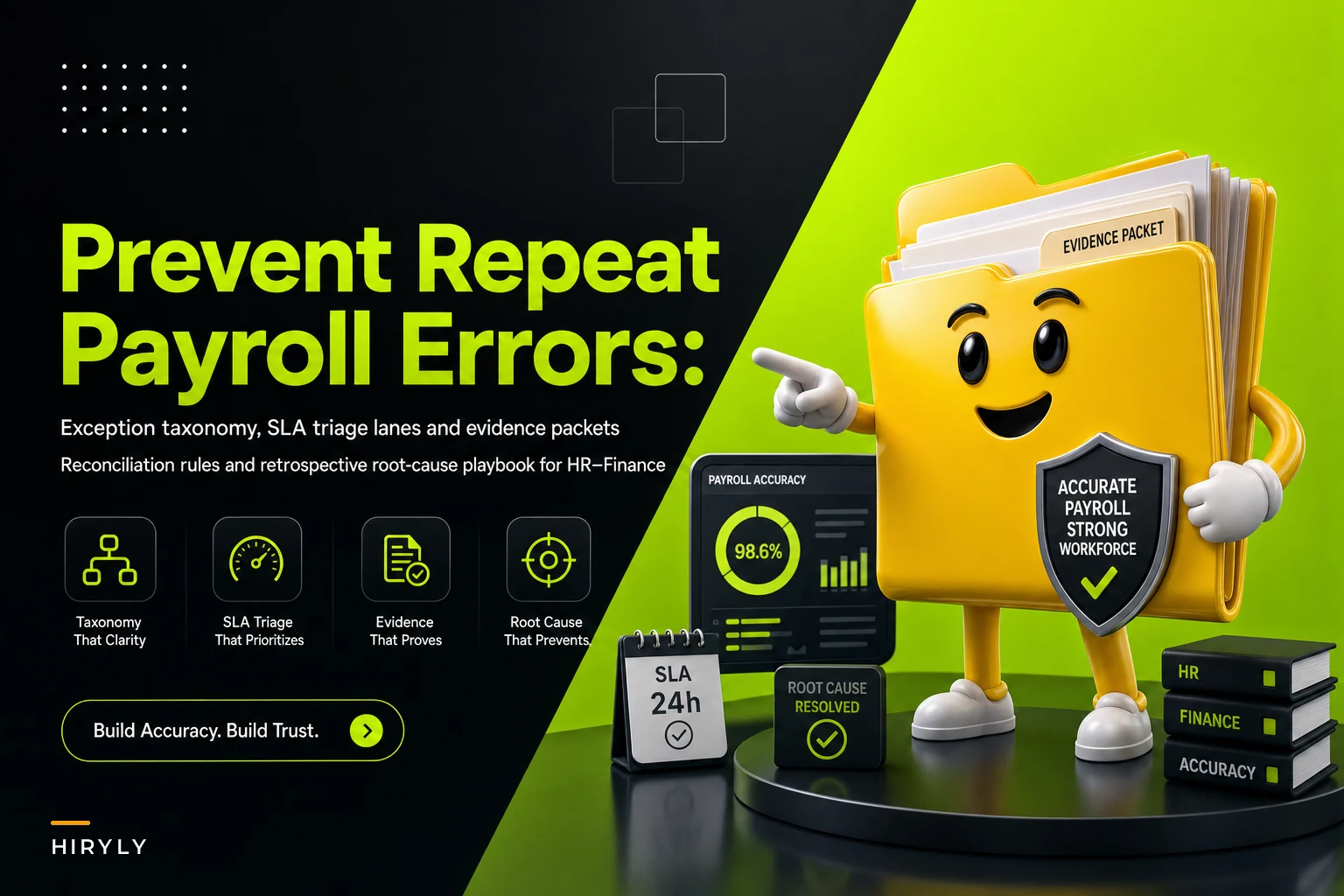

Payroll doesn't usually break in dramatic ways. It breaks quietly — a missed shift differential here, a bonus that hit the wrong pay period there, a terminated employee who somehow got paid for a week they didn't work. And then it happens again next cycle, because nobody wrote down why it happened the first time.
That's the real problem. Not the individual error. The repeat error. Most HR and finance teams are decent at putting out the fire once someone screams about their paycheck. What almost nobody does well is build a payroll exception reconciliation workflow that catches the mistake before payday, packages the correction cleanly, and ties a specific owner to a root cause so the same thing doesn't come back.
This post is about building that. Not governance philosophy — the actual mechanics. Exception taxonomy, triage rules, evidence packets, cut-off discipline, and a retrospective that actually assigns ownership between HR and Finance instead of letting the two teams point at each other.
Start by naming the exceptions — a real taxonomy, not "misc adjustments"
The pattern shows up constantly: a company runs payroll, someone flags a problem, and it gets logged as "correction" or "off-cycle adjustment." That single bucket is where accountability goes to die. If everything is a "correction," you can never see that 40% of your corrections are the same three issues repeating.
A usable taxonomy sorts exceptions by where they originate, because origin tells you who owns the fix. A time-entry error is not the same problem as a comp-config error, even if both show up as "wrong paycheck."
| Exception category | Typical trigger | Likely owner | Detectable before payday? |
|---|---|---|---|
| Time & attendance | Missed punch, unapproved OT, wrong shift differential | HR / Manager | Yes — if timesheets lock early |
| Comp configuration | Wrong pay rate, stale bonus rule, mis-mapped pay code | HR / Comp | Yes — via rate change report |
| Status & lifecycle | Late termination, delayed new-hire start, LOA not processed | HR | Mostly |
| Deductions & benefits | Wrong benefit tier, garnishment error, 401k mismatch | HR / Benefits | Partially |
| Tax & jurisdiction | Wrong work state, local tax not applied, remote worker | Finance / Payroll | Yes — pre-run validation |
| Bank & disbursement | Failed direct deposit, wrong account, reversal | Finance | No — post-run only |
| Data integration | HRIS-to-payroll sync gap, dropped field | HR + Finance | Yes — reconciliation report |
The insight most teams miss: the last column matters more than the owner column. If an exception type is detectable before payday, then every time it slips through to a live paycheck, that's a process failure — not bad luck. Tracking your "preventable exceptions that reached payday" as a distinct metric tells you exactly how leaky your pre-run checks actually are.
One quick note on granularity. Don't build 50 categories. Seven to nine is the sweet spot. When teams create too many sub-codes, people stop coding accurately and you lose the whole point. If you can't remember the category list without looking it up, it's too big.
Triage rules: not every exception deserves the same urgency
Once you're actually catching exceptions, the next trap is treating them all the same. A $12 mileage reimbursement error and a $2,400 missing paycheck are both "exceptions," but spending equal energy on each is a real misallocation every single cycle.
Eliminate HR bottlenecks with smart automation.
Hiryly simplifies your HR operations so you can focus on people, not paperwork.
- Centralized candidate tracking
- Automated onboarding workflows
- Performance & compliance dashboards
No credit card required
Triage needs two dimensions: impact and timing. Impact is straightforward — dollar amount plus employee harm. Timing is the one people forget: can this be fixed in the current run, or does it need an off-cycle payment?
Here's a triage logic that holds up in real operations:
-
Critical — fix before run closes. Anything that leaves an employee unpaid or significantly underpaid (missing paycheck, major hours gap, failed pay for a full period). These jump the queue and go straight to the payroll owner regardless of cut-off pressure.
-
High — off-cycle if past cut-off. Underpayments above a materiality threshold (roughly $150–$200 depending on your workforce) that missed the current run. These get an off-cycle correction, not "we'll catch it next period."
-
Standard — next-cycle correction. Small underpayments and most overpayments where the employee isn't harmed by waiting one period. Batch these.
-
Low — log and monitor. Sub-threshold rounding, minor deduction timing that self-corrects. Track for patterns but don't burn live cycles on them.
The mistake we see consistently: teams push overpayments into the low-priority bucket because "the employee got paid, so no one's mad." That's a finance liability sitting on the books. Overpayments need their own recovery path with clear communication, because clawing back money weeks later after an employee has spent it is a far worse conversation than a same-week correction.
One more triage rule that saves genuine pain — set a materiality threshold in writing and get Finance to sign off on it. Without it, every exception feels urgent to whoever is handling it, and your team burns off-cycle runs (which cost real money in most payroll platforms) on $30 fixes.
The standard evidence packet: stop reinventing corrections
This is the part almost nobody standardizes, and it's where corrections quietly rot. When an exception gets escalated, the person fixing it often has to go hunting — was this approved? By whom? What's the correct number? Where's the timesheet? That back-and-forth is where a two-hour fix becomes a two-day fix.
A standard evidence packet is a fixed set of fields that must accompany any correction before it's actioned. No packet, no correction. It sounds bureaucratic until you realize it's what makes corrections auditable and repeatable.
-
Employee ID and pay period affected (not just the name — names create duplicate-employee errors)
-
Exception category from your taxonomy
-
What the system paid vs. what it should have paid — the actual delta, in dollars and hours
-
Source of truth — the timesheet, the approved rate change, the signed offer, the termination form
-
Approval reference — who authorized the correction and when
-
Root-cause code (even a provisional one — you refine it in the retro)
-
Correction method — current run, off-cycle, or next-cycle adjustment
The difference between a mature payroll team and a chaotic one is not fewer errors. It's that mature teams can reconstruct why any given correction happened, months later, in about 90 seconds. When an auditor or an employee's lawyer asks "why was this person paid this amount," you either have the packet or you have a Slack thread and a bad afternoon.
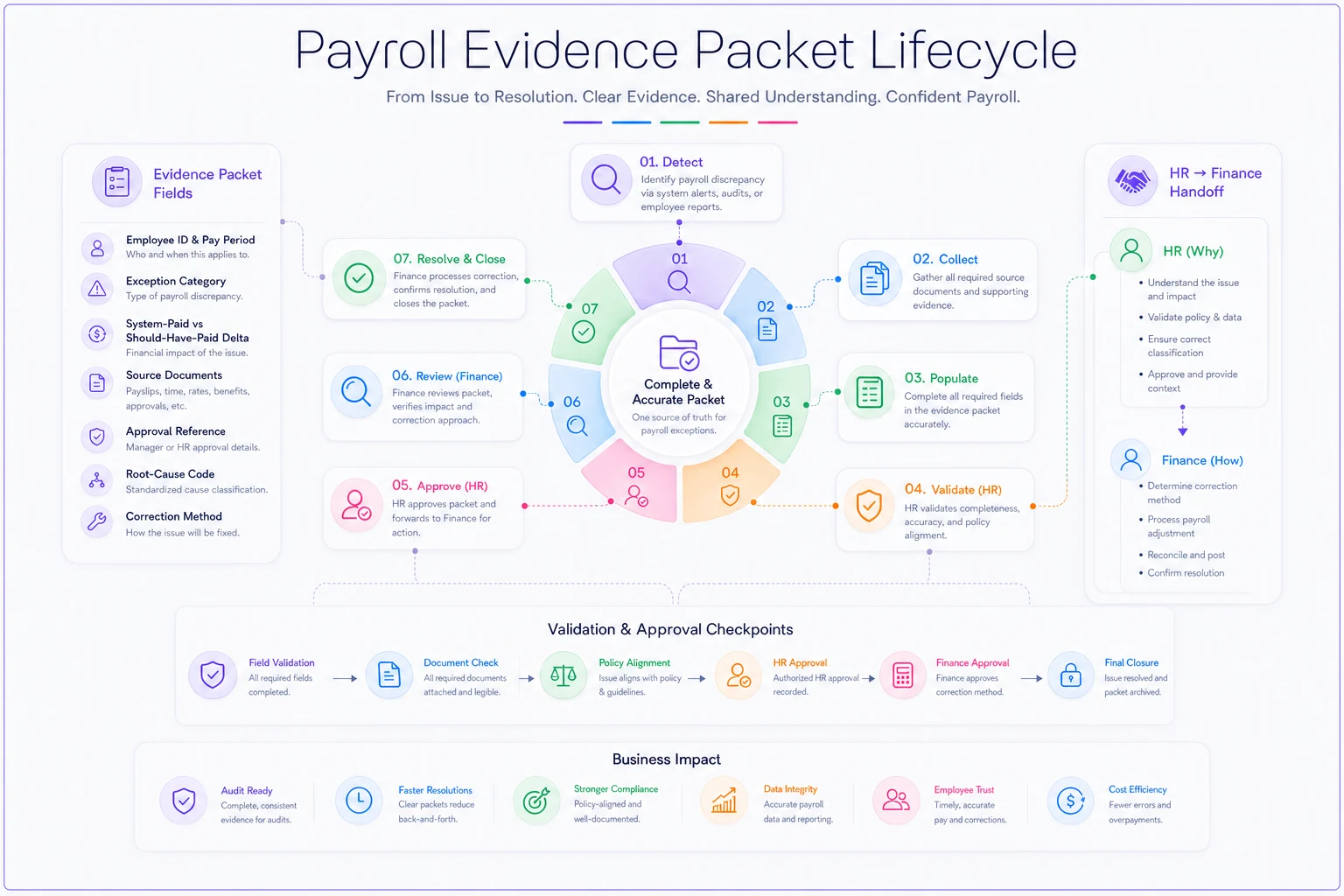
Evidence packets also make the handoff between HR and Finance survivable. HR usually holds the "why" (the status change, the approval) and Finance holds the "how" (the disbursement mechanics). A shared packet format means neither side has to interrogate the other. This kind of cross-functional discipline is the same instinct behind a broader compliance-first HR operating model for SMBs — you're building a paper trail that protects everyone before you actually need it.
Cut-off rules: the boring discipline that prevents most exceptions
If you fix nothing else, fix your cut-off calendar. A huge share of payroll exceptions aren't really payroll problems — they're timing problems. A manager approves a raise two days after the pay period locks, HR enters it, and now there's a retro adjustment that could have been avoided entirely if the change had a hard deadline.
Real operations tend to be sloppy here because cut-offs feel negotiable. A manager pushes, HR bends "just this once," and the exception rate creeps up cycle after cycle. Teams that keep exception rates low treat cut-offs as immovable, with one narrow, documented exception path for genuine emergencies.
-
Data-entry cut-off — the last moment for rate changes, new hires, terminations, and status changes to enter the system. Usually 2–3 business days before the pay run.
-
Timesheet lock — the last moment for time approval. Anything unapproved defaults to a documented rule (prior-period hours, or zero with an alert), never a guess.
-
Pre-run reconciliation window — the gap between timesheet lock and run submission where you actually look at the register before it's live. This is where preventable exceptions get caught.
Most companies have the first two and skip the third. That pre-run window is the single highest-leverage habit in the entire workflow. Even 30–45 minutes comparing this run's register against last run's — flagging anyone whose pay changed by more than, say, 15% without a documented reason — catches the majority of errors that would otherwise become corrections.
Even 30–45 minutes comparing this run's register against last run's — flagging anyone whose pay changed by more than, say, 15% without a documented reason — catches the majority of errors.
This connects to how approvals flow generally. If your rate changes and status updates run through a clear approval chain with real deadlines, most cut-off violations disappear on their own — the same logic behind a solid hiring governance framework with role-based approvals and SLA templates. Payroll cut-offs are just approval governance applied to money that's already earned.
The retrospective: where HR and Finance stop blaming each other
Catching and fixing exceptions is defense. The retrospective is where you actually reduce the volume. And this is where most workflows fall apart, because the retro either doesn't happen or turns into a blame session between two teams who each think the other caused it.
The fix is structural: every recurring exception category gets a named owner from each side and a monthly review that looks at patterns, not individual tickets. You're not re-litigating a single wrong paycheck. You're asking: this category showed up 14 times this quarter — what's the systemic cause?
-
Pull the exception log by category for the period. Sort by frequency, then by dollar impact.
-
Pick the top 2–3 recurring categories. Ignore the one-offs; chase the repeats.
-
Trace each to a root cause using the "5 whys" but stop when you hit a process cause, not a person. "Manager approved late" isn't the root cause — "there's no enforced approval deadline in the manager's workflow" is.
-
Assign one HR owner and one Finance owner to the fix, with a date.
-
Add a preventive check — a report, a validation rule, a cut-off enforcement — that would have caught it earlier.
-
Verify next cycle that the fix actually reduced the category's frequency. If it didn't, the root cause was wrong.
Zero exceptions is a fantasy that leads teams to hide problems instead of logging them. The real goal is a shrinking preventable-exception rate and a stable, well-understood set of unavoidable ones (a garnishment order arriving mid-cycle will always create work — that's fine).
Retros also surface something worth naming: sometimes the "payroll problem" is actually an upstream HR data problem. A stale pay rate isn't a payroll error, it's a comp-change process that didn't propagate. Fixing it in payroll every cycle is treating the symptom forever. The retro is what forces that conversation into the open.
A real scenario: a 90-person services firm drowning in off-cycle runs
Consider a professional services company with around 90 employees — a mix of salaried consultants and hourly support staff. Payroll was technically "working" in the sense that everyone got paid, but they were running roughly 6–8 off-cycle corrections a month, and their HR coordinator was spending close to a full day each pay period just chasing approvals and fixing entries.
When they finally logged exceptions by category for two months, the picture was ugly but clear: over half their corrections came from just two sources — shift differentials for weekend support coverage entered incorrectly, and rate changes approved after the data-entry cut-off. Everything else was noise.
The fix wasn't complicated. They locked the data-entry cut-off hard (with one emergency exception path requiring a manager's written sign-off), built a pre-run report flagging any pay change over 15% without a note, and assigned the shift-differential issue to a named HR owner who standardized how weekend hours got coded.
Within about three cycles, off-cycle corrections dropped to one or two a month, mostly genuine edge cases. The coordinator's payroll-week workload fell from roughly a full day to a couple of hours. No new software required — just a taxonomy, a cut-off with teeth, and a monthly retro that actually assigned owners.
When this workflow makes sense — and when it's overkill
When it makes sense: You're running payroll for more than roughly 40 people, you have both hourly and salaried staff, or you've hit the point where corrections feel like a recurring tax on your team's time. Complexity — multiple states, shift differentials, variable comp — is the real trigger, more than headcount alone.
When it's overkill: A 12-person team on straight salary with no variable pay doesn't need a seven-category taxonomy and a monthly retro. A simple pre-run glance and a shared checklist covers you. Don't build governance heavier than the problem.
Who should NOT do this yet: If your HR and payroll data don't reconcile at all — if you can't reliably pull an exception log — start there. This workflow assumes you have a system of record you can trust enough to compare against. Build the clean data foundation first, then layer the exception discipline on top.
Where tooling quietly helps
None of this requires expensive software. But the tedious parts — comparing registers across runs, flagging pay changes above a threshold, keeping evidence packets attached to each correction, routing approvals against a cut-off deadline — are exactly the kind of repetitive checking that eats a coordinator's week and where humans miss things when they're rushed.
A workflow platform with built-in automation earns its place here: not making the payroll decisions, but running the pre-run comparison automatically, nudging approvers before the cut-off, and keeping every correction's evidence in one auditable place instead of scattered across email threads. The judgment stays with your HR and Finance owners. The rote reconciliation and the paper trail get handled quietly in the background, which is precisely where that work belongs.
Recurring payroll errors persist for one reason: nobody closes the loop between the correction and its cause. You fix the paycheck, the employee stops complaining, and the underlying process stays broken until it breaks again. A real payroll exception reconciliation workflow breaks that cycle by making exceptions visible (taxonomy), triaged by actual impact, packaged so corrections are fast and auditable, prevented at the cut-off, and permanently reduced through a retro that assigns ownership across HR and Finance. Do that consistently, and the same three problems stop showing up every cycle — which is the whole game.
Ready to transform your HR processes?
Join thousands of HR teams using Hiryly to hire faster, engage employees better, and stay compliant effortlessly.