

Your ATS shows 47 candidates entered the pipeline last Monday. By Friday, 31 have gone radio silent. No response to the interview invite. No decline. Just gone.
The recruiting team blames the market. Hiring managers blame the recruiters. Meanwhile, that senior engineer you desperately needed just accepted somewhere else — a company that responded to their application in 4 hours while yours took 6 days.
Most companies track time-to-fill and cost-per-hire religiously, but they're measuring the wrong end of the problem. By the time a candidate drops out, you've already lost. The real question is: where exactly in your process did they decide you weren't worth their time?
Why traditional candidate surveys fail at the operational level
Standard post-interview surveys get maybe 12% response rates. Even when candidates do respond, they give polite, sanitized feedback three weeks after the actual problem occurred. "The process was fine, just went with another opportunity."
That tells you nothing.
Candidates hit specific friction points at specific stages. The engineering manager who takes 9 days to review a technical assessment. The coordinator who schedules interviews without checking availability first. The 45-minute "culture fit" call that's really just an unstructured chat about hobbies.
Each friction point compounds. A candidate who rates their application experience 7/10 might push through. Drop that to 6/10 after a slow response, then 5/10 after a disorganized phone screen, and they're gone before the on-site.
The measurement problem isn't getting feedback — it's getting it at the exact moment things go sideways, from enough candidates to spot patterns, with enough specificity to actually fix what's broken.
Stage-by-stage cNPS architecture
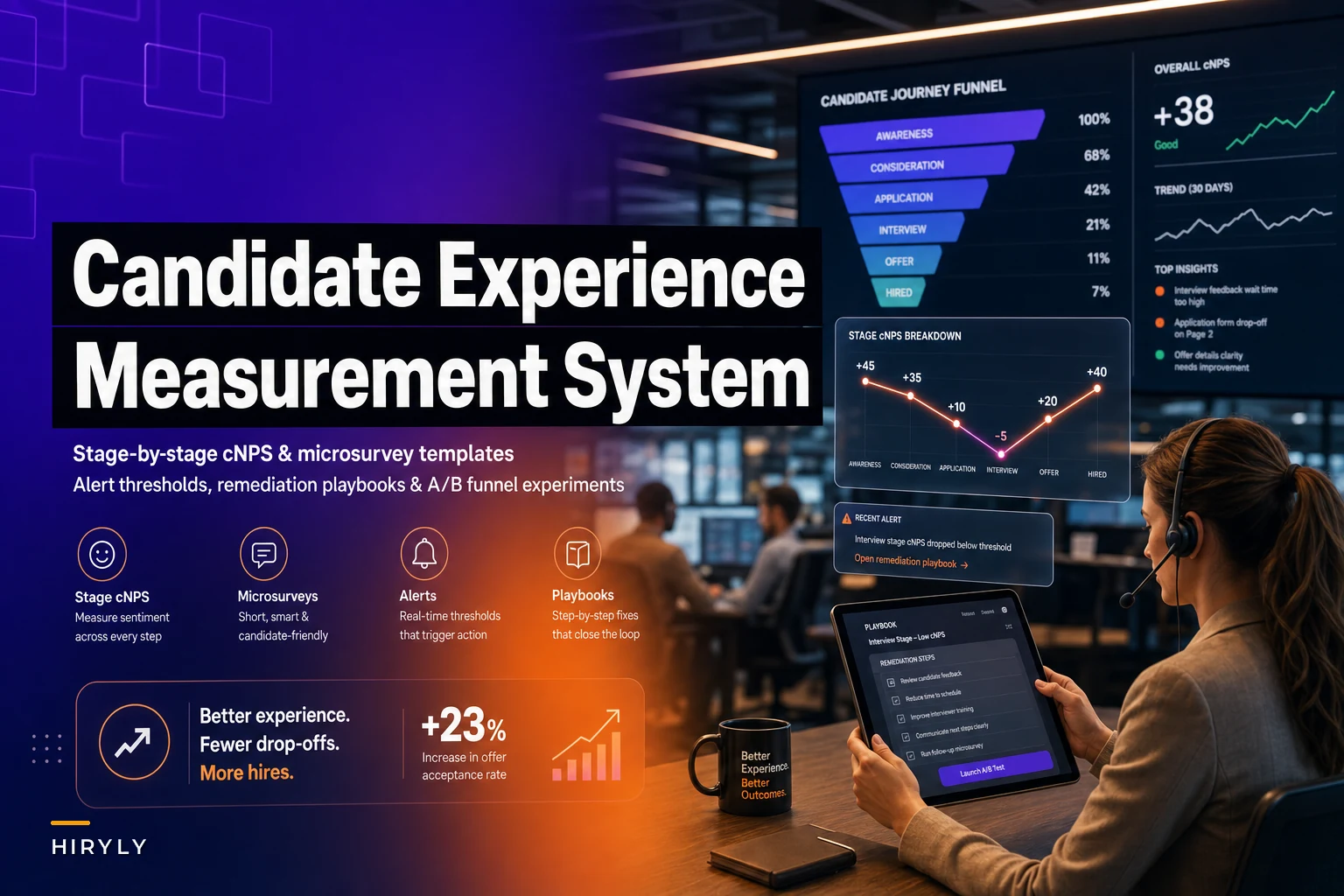
The framework that works: measure candidate sentiment immediately after each interaction, not just at the end.
Eliminate HR bottlenecks with smart automation.
Hiryly simplifies your HR operations so you can focus on people, not paperwork.
- Centralized candidate tracking
- Automated onboarding workflows
- Performance & compliance dashboards
No credit card required
Stage 1: Application Acknowledgment Send a 1-question microsurvey 30 minutes after submission. "How easy was our application process? (0-10)"
-
Individual score <6
Flag for manual follow-up within 2 hours
-
Daily average <7
Trigger process review
-
Weekly average <7.5
Escalate to TA leadership
You're not measuring whether they liked your careers page design. You're measuring whether the form actually submitted properly, whether the required fields made sense, whether the whole thing worked.
Stage 2: Initial Screen Scheduling Microsurvey fires 1 hour after scheduling confirmation. "How would you rate the scheduling experience? (0-10)"
This catches problems before they spiral. Coordinator sent three conflicting times? Timezone confusion? Calendar link didn't work? You'll know immediately, not three weeks later when the candidate ghosts the on-site.
Stage 3: Post-Phone Screen Two questions, sent 2 hours after the call ends:
-
"How likely are you to recommend our interview process to other professionals? (0-10)"
-
"What could we improve about this conversation?"
Watch the open-text responses for patterns. When multiple candidates mention "interviewer seemed unprepared" or "couldn't answer basic questions about the role," you've got a training issue, not a candidate issue.
Stage 4: Technical Assessment For roles with assessments, measure both directions:
-
After delivery
"How clear were the assessment instructions? (0-10)"
-
After submission
"How relevant was this assessment to the actual role? (0-10)"
Companies lose strong engineers because their take-home requires 15 hours of work for a $110k role. The candidates who complete it are often the ones with nothing else going on. The ones you actually want have two or three other offers that didn't require building a full-stack app from scratch.
Stage 5: On-site/Virtual Panel This needs granular measurement. Send one survey 30 minutes after the interview day ends:
-
Overall NPS (0-10)
-
Logistics rating (0-10)
-
"Which interviewer provided the most valuable conversation?"
-
"Any part of today that didn't meet expectations?"
Then track interviewer-specific patterns. When the same name keeps showing up in question 3, you've found your recruiting champion. When someone never appears — or worse, consistently shows up in low-scoring panels — you need to intervene.
Microsurvey templates that actually get responses
Forget 15-question surveys. Forget "on a scale of strongly disagree to strongly agree." Keep it simple, fast, and mobile-first.
The 48-Hour Rule Template Subject: Quick question about your [Company] interview experience Body: "Hi [Name], You spoke with our team 2 days ago. One quick question: How was your experience? (Reply with a number 0-10)" No links. No forms. Just reply to the email. Response rates jump from around 12% to somewhere in the 65-70% range because there's zero friction involved.
The Specific Friction Finder After any score below 7: "Thanks for the feedback. What one thing should we fix first?" Don't ask for comprehensive thoughts. Don't over-apologize. Just get the specific issue so you can fix it.
The Dropout Diagnostic When someone withdraws or goes silent: "No worries about the timing — would love to learn for future candidates: What made you decide to pause the process with us?" Send this within 4 hours of the withdrawal. After 24 hours, response rates drop sharply because they've mentally moved on.
Alert thresholds and escalation paths
Raw scores mean nothing without action triggers. Here's the operational framework:
-
Score 0-3 (Detractor Crisis)
- Immediate notification to recruiter (within 15 minutes) - Mandatory follow-up call attempt within 2 hours - If technical interview stage: notify hiring manager same day - Log specific issue in ATS for pattern tracking
-
Score 4-6 (Passive Risk)
- Automated check-in email from recruiter within 24 hours - Review interview notes for missing elements - If multiple stages show 4-6: escalate to recruiting manager
-
Score 7-8 (Passive Positive)
- No immediate action - Include in weekly pattern analysis - If drops from 8 to 7 between stages: flag for attention
-
Score 9-10 (Promoter)
- Fast-track indicator for offer stage - Capture specific positives for recruitment marketing - If doesn't convert to offer acceptance: mandatory debrief
Aggregate Pattern Thresholds
-
Weekly Team Averages
- <6.0: Emergency TA leadership meeting within 24 hours - 6.0-6.9: Process audit triggered, results due in 5 days - 7.0-7.9: Standard operations, monitor trends - 8.0+: Document and replicate what's working
The granularity matters. A team averaging 6.8 might shrug it off as "basically at 7" — but that 0.2 difference represents dozens of lost candidates over a quarter.
Remediation experiments tied to specific breakpoints
Once you identify a consistent problem, you need pre-designed experiments ready to deploy — not lengthy committee meetings about potential solutions.
Problem: Phone screen scores consistently below 6
Experiment A — Structured interview guide:
-
Week 1-2
Deploy a basic question template to half of interviewers
-
Week 3-4
Add a scoring rubric to the template
-
Measure
cNPS delta between control and test groups
-
Success criteria
>1.5 point improvement
Experiment B — Pre-call candidate prep:
-
Send a "what to expect" email 24 hours before the call, including interviewer bio, role specifics, and question themes
-
Measure
both cNPS and show rate
-
Success criteria
>1.0 point cNPS improvement AND <5% show rate decrease
Problem: Technical assessment abandonment over 40%
Experiment A — Time-boxed alternatives:
-
Offer a choice
4-hour take-home OR 90-minute live coding session
-
Track
completion rates and quality scores for each format
-
Success criteria
<25% abandonment without quality decrease
Experiment B — Progressive complexity:
-
Break assessment into 3 stages
Stage 1 is a 30-minute basic skills screen everyone completes; Stage 2 is a 2-hour intermediate challenge for the top 50%; Stage 3 is a complex problem for the top 25%
-
Measure
total pipeline velocity and offer acceptance rate
-
Success criteria
improved close rates without sacrificing bar
Problem: Coordinator scheduling generates friction
Experiment A — Self-service scheduling:
-
Deploy a calendar link system for initial screens while maintaining manual coordination for on-sites
-
Measure
schedule-to-interview conversion and cNPS
-
Success criteria
>20% faster scheduling, cNPS neutral or better
Experiment B — Availability-first outreach:
-
Collect candidate availability windows in the initial outreach, then schedule within those windows with no back-and-forth
-
Measure
emails-to-scheduled ratio and candidate satisfaction
-
Success criteria
<3 emails average, >8.0 scheduling cNPS
When experiments are pre-designed like this, you can run small, fast tests and iterate based on measured results rather than opinions.
Connecting cNPS to actual business metrics
The measurement only matters if it predicts real outcomes. Track these correlations:
cNPS to Offer Acceptance Map every offer decision back to the candidate's stage-by-stage scores. What you'll typically find: candidates with any stage below 6 accept offers at under 30%. Candidates with all stages above 7 accept at over 75%.
cNPS to Quality of Hire Track 90-day performance ratings against interview process scores. A somewhat counter-intuitive pattern across multiple organizations: candidates who rate the process 9-10 often perform better in role, likely because they got accurate expectations and genuine engagement during the interviews themselves.
cNPS to Referral Generation Candidates who score 9-10 at any stage are significantly more likely to refer others, even when they don't get an offer. The detail that matters: you have to actually ask them within 14 days, not 6 months later during some generic alumni outreach.
Time-in-Stage vs cNPS Degradation Map how scores decline based on waiting time:
| Days Waiting | Average cNPS |
|---|---|
| Day 1-2 | 8.2 |
| Day 3-5 | 7.4 |
| Day 6-10 | 6.1 |
| Day 11+ | 4.8 |
Every additional day of waiting costs roughly 0.3-0.4 cNPS points. That means your hiring manager delays aren't just slowing the process — they're actively degrading candidate experience in ways you can now actually measure.
Building the operational infrastructure
Setting this up requires more than survey tools. You need the full operational stack:
-
ATS integration for trigger events
-
Survey platform (even Google Forms works to start)
-
Response aggregation system
-
Real-time alerting mechanism
Analysis Framework
-
Stage-by-stage scoring dashboard
-
Interviewer-specific tracking
-
Cohort comparison tools
-
Pattern detection queries
Action Protocol Documentation Create specific playbooks:
-
Score <4
[Specific recruiter action required]
-
Score 4-6
[Check-in protocol]
-
Score 7-8
[Monitor and track]
-
Score 9-10
[Leverage for referrals]
Reporting Cadence
-
Daily
Individual alerts to recruiters
-
Weekly
Team averages to TA leadership
-
Monthly
Full funnel analysis with recommended experiments
-
Quarterly
Correlation analysis with business metrics
The metrics governance structure determines whether this becomes a real operational tool or just another dashboard nobody checks.
Here's a visual of how the pieces fit together.
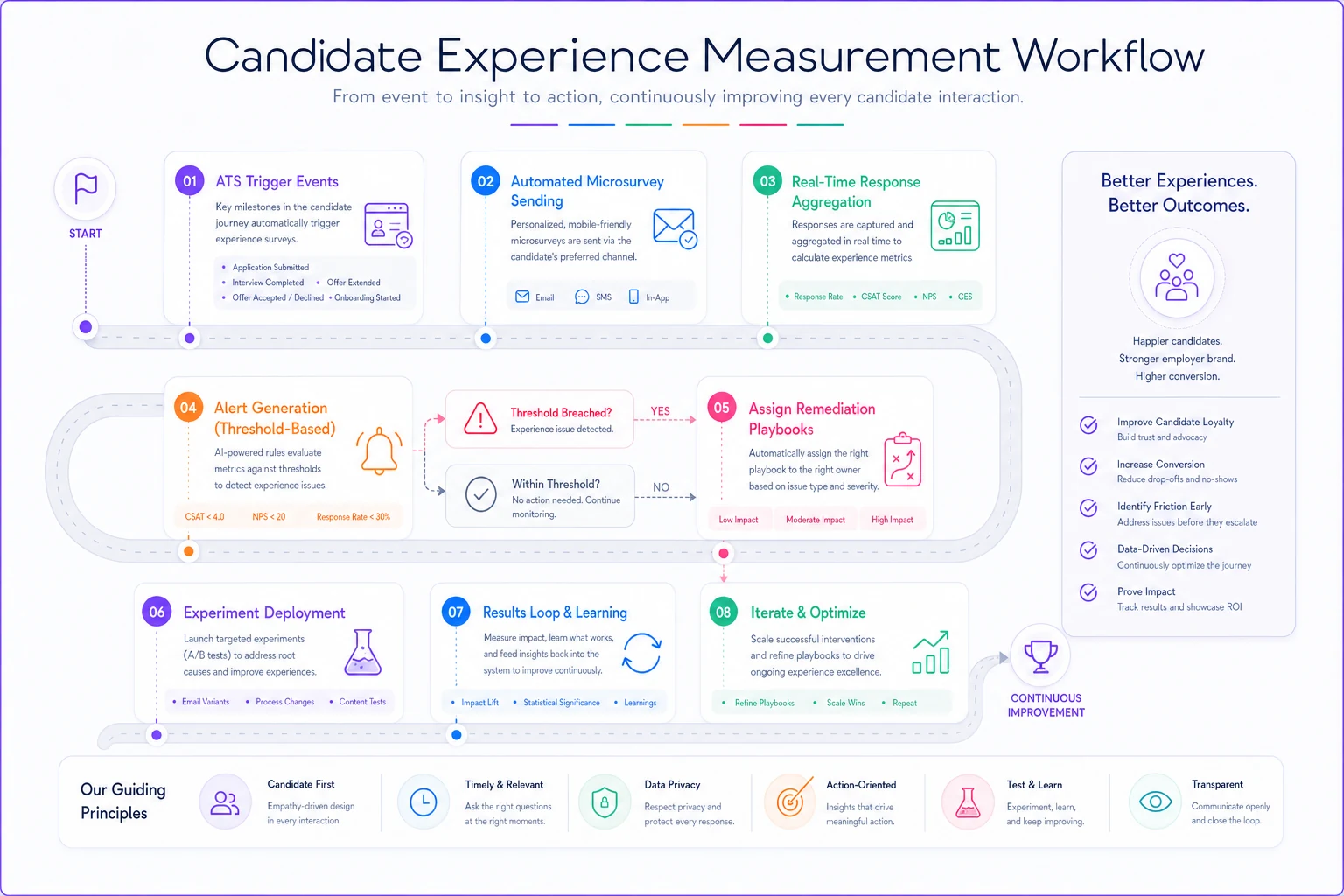
This workflow shows triggers, measurement, and the feedback loop from remediation experiments back into the process.
What separates measurement from actual candidate experience improvement
Most companies measure candidate experience like they're checking a compliance box. Send survey, generate report, file away, repeat quarterly. That's not measurement — that's theater.
Real improvement requires three things most organizations won't actually commit to.
First, acting on negative feedback within hours, not weeks. When a candidate rates their phone screen 4/10, someone needs to call them that day — not to convince them to continue, but to understand exactly what broke so it doesn't happen to the next 50 people.
Second, being willing to pull underperforming interviewers out of the process. When the data consistently shows that every candidate who interviews with a specific engineering manager rates the experience below 6, that person needs training or removal from interview panels. Politics be damned.
Third, connecting measurement to actual recruiter and coordinator workflows. Alerts can't go to some centralized "candidate experience inbox" that gets checked occasionally. They need to flow directly into the tools recruiters already use, triggering specific actions with specific deadlines.
The formula isn't complicated: measure immediately, at every stage, with automatic alerts and pre-built remediation experiments. The implementation is where most organizations fail — usually because they try to perfect the measurement before starting, rather than starting simple and learning as they go.
Making this operational with automation
Running this manually means constant monitoring, survey sending, response tracking, and alert generation. For a team processing 50+ candidates through the pipeline, that's somewhere around 15-20 hours per week of administrative overhead just to keep the system running.
AI-powered recruitment operations platforms can automate most of it — triggering surveys based on ATS stage changes, aggregating responses in real-time, generating alerts when thresholds are breached, and flagging which experiment to run based on detected patterns.
The interesting part isn't the automation itself. It's what it frees up. When you remove the manual work of survey administration, your recruiting team can focus on actually talking to candidates who had poor experiences, running experiments to fix broken processes, and building better interviewer training programs.
Instead of spending Tuesday morning compiling last week's cNPS report, they're calling the three candidates who rated yesterday's experience below 6 and preventing this week's dropoffs.
Over time, the measurement system becomes self-improving. Bad scores trigger immediate interventions. Successful experiments get documented and replicated. Underperforming interviewers get trained or replaced. The baseline cNPS moves up month over month, and suddenly you're closing offers that would have ghosted you six months ago.
That's not because you measured better. It's because you built an operational system that turns measurement into action — consistently, at scale, without requiring heroic manual effort from your team.
Start with tomorrow's interviews
Pick three interviews scheduled for tomorrow. Send a 1-question email 2 hours after each one ends: "How was your interview experience today? (0-10)."
No complex infrastructure. No steering committee. No vendor evaluation.
Just start measuring, start learning, and start fixing the specific things that make candidates disappear. The system builds from there — one stage at a time, one improvement at a time — until you've got a measurement framework that actually prevents problems instead of just documenting them after the fact.
Candidates aren't disappearing randomly. They're leaving at specific moments for specific reasons. Stage-by-stage cNPS measurement just makes those moments visible so you can do something about them.
Your competition is responding faster and running smoother processes. The question isn't whether to measure candidate experience — it's whether you'll start measuring it in time to matter.
Ready to transform your HR processes?
Join thousands of HR teams using Hiryly to hire faster, engage employees better, and stay compliant effortlessly.