


Most deals don't fail on the spreadsheet. They fail in the weeks after close, when two payroll systems won't reconcile, when the acquired company's top performers start quietly taking recruiter calls, and when nobody can say with confidence who owns what decision. The financial model assumed a clean handoff. Reality handed HR a mess of duplicate records, conflicting policies, and a workforce that's genuinely nervous about its future.
The integration phase is where value either survives or evaporates. And the HR side of it — retention, data, policy harmonization, governance — is usually the least planned. Legal gets a war room. Finance gets a cutover date. HR gets told to "handle the people stuff" with a two-week heads-up.
This is a playbook for running that work as an actual system — structured enough to be auditable, flexible enough to survive the chaos every integration produces.
Why integrations break the people side specifically
The pattern is remarkably consistent. The deal team spends months on diligence, modeling synergies down to headcount. Then close happens, and the people who built the model move on to the next transaction. HR inherits the execution with none of the context and a compressed timeline.
A few things break almost immediately.
Data is the first. The acquired company has its own HRIS, its own job architecture, its own way of coding departments and cost centers. On paper, merging two employee lists sounds trivial. In practice, you discover one company stores manager relationships in free-text fields, the other has three overlapping definitions of "full-time," and nobody can agree whether a contractor who's been embedded for four years counts as headcount.
Retention is the second. The best people at the acquired company are, almost by definition, the ones with options. They read the acquisition as uncertainty. If the first few weeks are silence — no clarity on their role, their comp, their manager — they start taking those recruiter calls. By the time HR gets around to formal retention conversations, some of them have already decided.
Policy is the third, and it's sneaky because it doesn't blow up on day one. Two PTO structures, two bonus plans, two remote-work policies. For a while, people just keep running under their old rules. Then someone from the acquired side notices the acquiring company gets an extra week of vacation, and now you have a fairness problem that quietly poisons morale for months.
What makes this worse at scale is coordination. In a small tuck-in — absorbing a 30-person team, say — one competent HR lead can hold most of it in their head. In a merger of two 800-person organizations, the number of moving parts exceeds any individual's working memory. Decisions get made in parallel by different people who don't know what the others decided. That's where the real damage happens.
The pre-flight phase: what has to be true before close
Everything gets easier if the work starts before the deal closes. Not the execution — the preparation. Pre-flight is about building the scaffolding so that day one isn't improvisation.
Eliminate HR bottlenecks with smart automation.
Hiryly simplifies your HR operations so you can focus on people, not paperwork.
- Centralized candidate tracking
- Automated onboarding workflows
- Performance & compliance dashboards
No credit card required
-
Which HRIS survives, or do you run parallel? This single call cascades into data, access, reporting, and payroll. Decide it early.
-
Who are the named retention targets, and what's the budget? Not a vague "we'll keep the good people." A list, with names, risk ratings, and dollar figures attached.
-
What's the policy harmonization timeline? Are you aligning on day one, at 90 days, or at the next plan year? Different answers, different comms.
-
Who holds decision authority during the interim? Before close, there are two orgs with two leadership structures. After close, there's ambiguity. Resolve it in advance.
A mistake that comes up repeatedly: companies treat pre-flight as a data-gathering exercise and skip the actual decision-making. They collect everything and decide nothing, so day one arrives and the same debates happen live, under pressure, with employees watching. Pre-flight should end with decisions written down — not just folders full of census files.
A lot of the systems preparation here overlaps with the discipline you'd apply during any major platform change. The sequencing logic in a migration playbook built to minimize cutover disruption applies directly — you're moving people, records, and active processes from one system of record to another, and the goal is zero dropped balls during the switch.
A compact flow to follow visually:
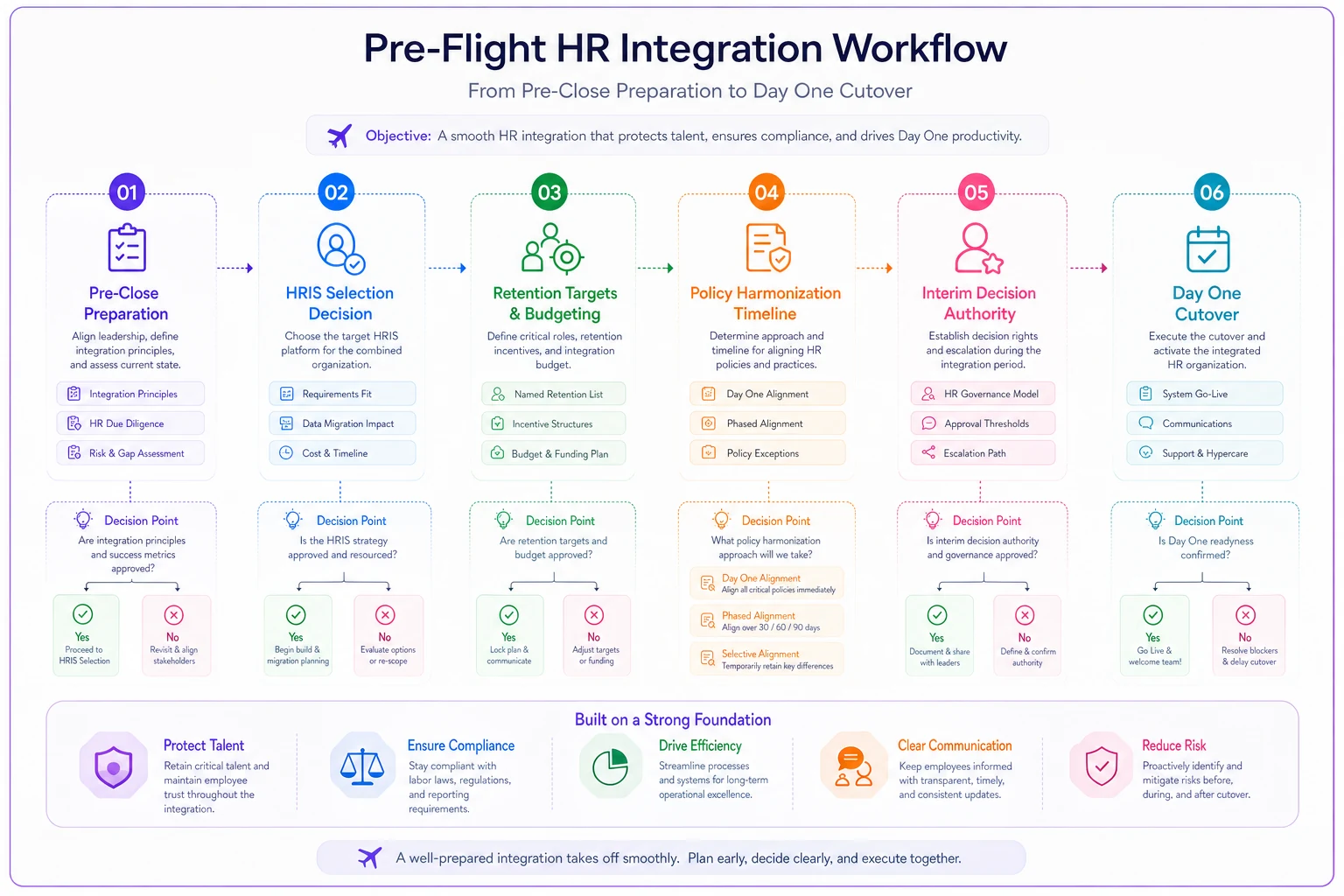
The visual shows how early decisions cascade into data, payroll, access, and communications, helping the team avoid day-one improvisation.
Talent retention bundles: making the keep-the-good-people plan concrete
"Retention" as a line item in the synergy model is useless. What actually works is a structured bundle approach — segment the acquired workforce by risk and value, then attach a specific intervention to each segment.
| Segment | Who they are | Typical risk | Intervention bundle |
|---|---|---|---|
| Critical-keep | Key technical leads, relationship owners, institutional knowledge holders | High — they have options and visibility | Retention bonus (tied to 12–24 month stay), clear role commitment within 2 weeks, direct exec conversation |
| Important-stabilize | Strong performers in roles you're keeping | Medium — watching how it's handled | Role clarity, manager continuity where possible, early comp-parity signal |
| Transition-dependent | People whose roles overlap with the acquirer's | High anxiety, mixed value | Honest timeline, outplacement if redundant, redeployment path if not |
| Standard | Everyone else | Low near-term | Clear general comms, consistent policy rollout |
The bundles matter because they force prioritization. You can't give every employee a white-glove experience in the first month — there isn't enough leadership bandwidth. So you decide deliberately where the concentrated effort goes.
A realistic example. A mid-market software company acquired a 90-person analytics firm. Diligence flagged that roughly 12 engineers held most of the knowledge about the core product being acquired. The retention budget was about $600k. Instead of spreading it thin, they put around $450k into retention agreements for those 12, with payouts at 12 and 24 months, and used the remainder for smaller stabilization gestures across the next tier. Two of the twelve still left within a year — not a perfect outcome — but the core product team held together through the critical integration window, which was the actual goal.
The mistake that wrecks retention bundles is secrecy that lasts too long. Leadership wants to "wait until we have the full plan" before talking to anyone. Meanwhile the uncertainty does the damage. The faster fix is a tiered communication cadence: general reassurance to everyone within days, specific role conversations with the critical-keep segment within two weeks, detailed packages shortly after. Silence reads as bad news even when the news is good.
Data consolidation rules: the part everyone underestimates
Merging two sets of employee data is where integrations quietly hemorrhage time. The failure mode isn't dramatic — it's a thousand small discrepancies that each take an email thread to resolve.
-
Designate a single source of truth per field. For each data element — employee ID, hire date, manager, department, comp — decide which system wins when the two disagree. Write it down.
-
Define the canonical taxonomy first. Pick one job architecture, one department structure, one employment-type definition. Map both companies into it before you merge records, not after.
-
Set a reconciliation threshold. Decide what level of mismatch triggers manual review versus automatic rules-based resolution. You can't hand-review every record.
-
Freeze the data at a known point. Agree on a snapshot date for both systems. Trying to merge two moving targets is how you get records that never reconcile.
-
Log every transformation. Every time a record is remapped or a conflict resolved, it should be traceable. That's what makes the whole thing auditable later.
Document and timestamp every transformation as you apply it so audits and rollbacks are quick and reliable.
A typical discovery that derails timelines: the two companies define tenure differently. One counts from original hire date, the other resets on rehires and internal transfers. Suddenly your tenure-based PTO accruals and vesting calculations are wrong for a chunk of the acquired population, and you don't notice until someone's first merged paycheck is off. The consolidation rules exist precisely to surface these definitional conflicts before they hit payroll.
The auditability piece isn't bureaucratic overhead. When something reconciles wrong six months later — and something always does — you need to reconstruct how a record got to its current state. If you logged the transformations, that's a ten-minute lookup. If you didn't, it's a forensic investigation.
Harmonized policies: aligning rules without triggering a fairness revolt
Two companies, two policy sets, one workforce. Harmonization is unavoidable, but how you sequence it determines whether it builds trust or erodes it.
-
Day one Keep both policy sets running. Communicate that harmonization is coming, with a date. Certainty about the timeline reduces anxiety even before the answer is known.
-
Near-term (30–60 days) Align the low-stakes, high-visibility items first — holidays, expense policies, communication norms. These build the sense that the merger is actually moving.
-
Plan-year boundary Align the expensive, emotional items — benefits, PTO, bonus structures — at the natural reset point. Grandfather existing accruals so nobody loses what they've already earned.
The grandfather clause is the detail that saves you. People can accept a less generous future policy far more easily than they can accept losing something they've already banked. "Your existing PTO balance is protected; the new accrual rate starts next year" lands completely differently than "the policy is now X."
This is also where broader change discipline matters. Policy harmonization is organizational change, and it fails for the same reasons change programs generally fail — leaders announce the new rules and assume adoption follows. The reality of why most HR change programs fail applies directly: without a system for communication, feedback, and managed rollout, harmonized policies exist on paper while people quietly operate under the old rules until a conflict forces the issue.
Interim governance: who decides what, during the ambiguous middle
The window between close and full integration is a governance vacuum. Old decision structures are dissolving, new ones aren't fully in place, and dozens of decisions need to happen anyway. This is where parallel, uncoordinated choices cause lasting damage.
-
An integration steering group that meets weekly and owns decisions with lasting consequences — HRIS selection, policy timeline, major retention spend.
-
Workstream leads with explicit authority over their domain — one for data, one for policy, one for retention, one for comms — who can decide within their lane without escalating everything.
-
Decision checkpoints at fixed intervals — typically day 30, 60, and 90 — where the steering group reviews what's been decided, what's slipping, and what needs adjustment.
The checkpoints are what prevent the slow drift where everyone's busy but nobody can say whether the integration is actually on track. At each one, you're checking: did the retention conversations happen, is the data reconciling, are policies tracking to timeline, are there new flight risks that have emerged.
A pattern worth watching for: the integration that has lots of activity but no clear decisions. Meetings happen, documents get produced, everyone's occupied — and three months in, the fundamental questions are still open because nobody had the authority to close them. Interim governance exists so decisions actually get made and recorded, not just discussed.
Post-close reconciliation: proving it actually worked
The integration isn't done when the systems are merged and the policies are aligned. It's done when you can prove, with documentation, that everything reconciles. This is the part that gets skipped because by the time you reach it, everyone is exhausted and moving to the next priority.
-
Headcount reconciliation Does the final merged employee count match the diligence number, with every variance explained? New hires, departures, and corrections all accounted for.
-
Payroll reconciliation Did the first few merged pay runs process correctly? Compare against the pre-merge baseline and investigate every exception.
-
Retention reconciliation Did the named retention targets actually stay? What did it cost against budget? Who left anyway, and why?
-
Policy reconciliation Are both populations actually operating under the harmonized rules, or are there pockets still running old policies?
-
Data integrity check Spot-check records against the source systems. Are the transformations correct? Did anything get mangled in the merge?
The reconciliation templates matter because they turn "I think it worked" into "here's the evidence it worked." If an auditor, a regulator, or next year's leadership asks what happened during the integration, you have answers instead of recollections.
A scenario that shows why this matters. A regional services business absorbed a competitor of about 140 employees. Everything seemed fine until the post-close payroll reconciliation turned up roughly 20 employees whose overtime eligibility had been coded wrong during the merge — the two companies classified a borderline role group differently, and the consolidation defaulted to the wrong classification. Because they ran the reconciliation at day 45 instead of waiting for a complaint, they corrected it with back-pay adjustments totaling a few thousand dollars, rather than discovering it a year later as a wage-and-hour liability across dozens of pay periods. The reconciliation pass paid for itself in avoided exposure alone.
When this full playbook makes sense — and when it's overkill
Not every deal needs the whole apparatus. Matching the rigor to the deal is part of running this well.
When the full playbook makes sense: Mergers of comparable-size organizations, acquisitions where the acquired company's talent is the asset, deals with union or works-council considerations, and any integration where two full HRIS platforms have to be reconciled. The coordination complexity justifies the structure.
When a lighter version works: Small tuck-ins where you're absorbing a team into existing systems and policies. You still want retention clarity and clean data, but you don't need a formal steering group for a 15-person acquisition. The decisions fit in one person's scope.
Who should not run a bare-bones version: Anyone acquiring a company whose value depends on retaining specific people, and anyone operating in jurisdictions with strong employee-protection requirements. Under-investing in integration governance there isn't a time-saver — it's a liability you'll pay for later, often during an audit or a dispute.
The honest trap sits in the middle. Deals big enough to need structure but run like tuck-ins because leadership is focused on the financial close. That's where the retention leaks, the policy fairness complaints, and the payroll surprises all cluster. The integration got treated as an afterthought, and the people side absorbed the cost.
Pulling it together
The through-line across all of this is that integration is a coordination problem before it's anything else. The individual pieces — retention, data, policy, governance, reconciliation — aren't especially hard in isolation. What makes them hard is running them all at once, across two organizations, on a compressed timeline, while the people involved are anxious about their jobs and the context lives in the heads of a deal team that's already moved on.
This playbook works because it replaces improvisation with sequence. Decide the hard things in pre-flight. Segment retention so concentrated effort lands where it matters. Set data rules before merging so conflicts resolve by policy. Harmonize policies in stages with grandfathering so fairness survives. Hold interim governance so decisions actually get made. Reconcile at the end so you can prove it worked.
Do those things with enough structure to be auditable, and the integration stops being the phase where deal value quietly leaks away. It becomes the phase where you protect the people and systems the deal was supposed to acquire in the first place.
Ready to transform your HR processes?
Join thousands of HR teams using Hiryly to hire faster, engage employees better, and stay compliant effortlessly.