

Most interviewer training dies the same way. HR books a half-day session, everyone shows up, there's a slide about halo effect and affinity bias, people nod, maybe do one role-play, and then go back to their desks and interview exactly like they did before. Three weeks later the scorecards look identical to the pre-training ones. No measurable change. No shift in how people rate candidates. Just a calendar invite that got marked "complete."
The problem isn't that interviewers don't care. Behavior change doesn't happen in one sitting. You can't fix a scoring habit someone's had for eight years with a 90-minute lecture. What actually moves the needle is small, repeated practice — short enough that nobody resents it, frequent enough that it starts rewiring how people make calls.
That's what interviewer training micro-modules are built around. Not more content. Less content, delivered more often, tied to real scoring behavior you can measure before and after.
The core issue: training that can't be measured can't be fixed
Nobody checks if it worked.
A company runs the annual session, logs attendance, and that's the end of the loop. No before-and-after on how tightly interviewers agree with each other. No read on whether anything changed about how candidates get rated. The whole thing gets treated as a compliance checkbox rather than an operational intervention with an actual outcome.
When you don't measure, you can't tell the difference between two interviewers who sound confident and two interviewers who actually score the same candidate the same way. Confidence and reliability aren't the same thing. Some of the most assured interviewers are also the most inconsistent — they just don't know it because nobody's ever shown them their own scatter.
The shift that matters: treat interviewer skill like any other operational capability. Baseline it, train in small doses, re-measure. If reliability improves, the training worked. If it doesn't, change the training. Simple in theory, but almost nobody actually runs it this way.
What a micro-module actually looks like
A micro-module is not a chopped-up version of your old slide deck. It's a single, narrow rep focused on one behavior.
Eliminate HR bottlenecks with smart automation.
Hiryly simplifies your HR operations so you can focus on people, not paperwork.
- Centralized candidate tracking
- Automated onboarding workflows
- Performance & compliance dashboards
No credit card required
-
One behavior per week. Not "unconscious bias." Something concrete like "stop scoring on confidence when the role doesn't need it" or "anchor your rating to the evidence, not the first answer."
-
Five to eight minutes, max. Short enough to do before a batch of interviews, not something that needs a calendar block.
-
A short video script that sets up the behavior and shows a wrong-way/right-way example.
-
A calibration exercise tied to the same behavior — usually scoring a recorded or written response, then comparing against the group.
-
A short scorecard practice session where interviewers rate a sample and see how far off they were from the calibrated score.
The reason this works where workshops fail is repetition under realistic conditions. You're not asking someone to remember a concept. You're asking them to do the actual thing — rate a candidate — over and over, with feedback each time.
Sample weekly sequence
-
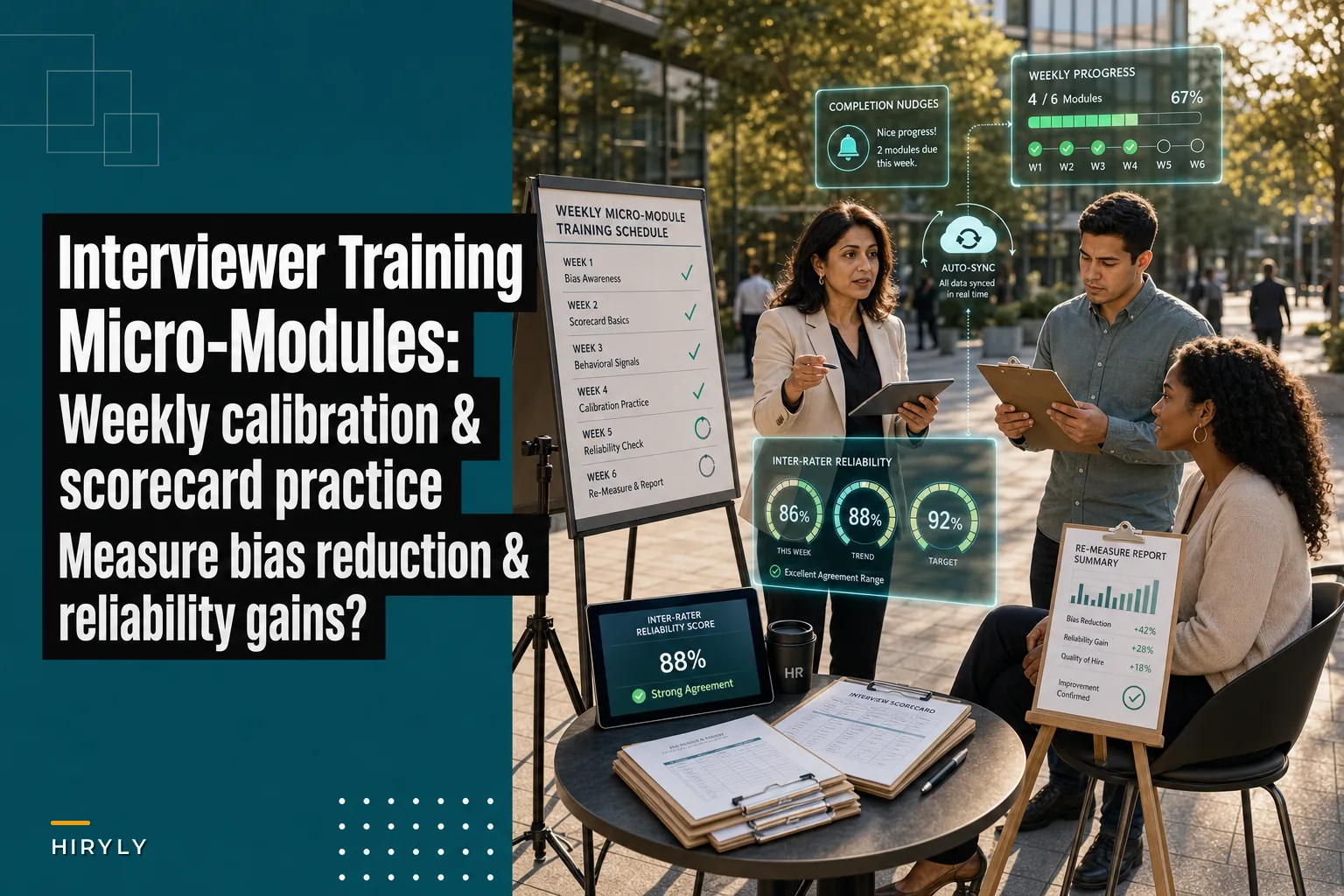
Week 1 — Evidence vs. impression. Rate what the candidate did, not how they made you feel.
-
Week 2 — The first-answer anchor. Catching yourself locking in a rating within the first two minutes.
-
Week 3 — Confidence bias. Separating communication polish from actual competence.
-
Week 4 — Scale drift. Why your "3" and a colleague's "3" aren't the same thing.
-
Week 5 — Similarity bias. "They remind me of me" is not a data point.
-
Week 6 — Note quality. Scores without evidence notes are guesses.
-
Week 7 — Follow-up discipline. Probing weak answers instead of moving on.
-
Week 8 — Full-loop calibration. Everyone scores the same candidate, gaps get discussed.
After week eight, re-measure against the baseline you took before week one. Then repeat the modules where reliability is still weak.
Role-based calibration, because a recruiter and a VP don't score the same way
One mistake that quietly sinks these programs: treating every interviewer like they're doing the same job. A recruiter screening for basics has a different scoring task than a hiring manager assessing depth, which is different again from an exec checking for leadership signals.
If you calibrate all three groups against the same exercise, you get artificial agreement that falls apart in real interviews. The calibration has to match the actual decision each role is making.
| Role | Primary scoring job | Calibration focus | Common failure |
|---|---|---|---|
| Recruiter / screener | Minimum bar, dealbreakers | Consistent pass/fail on basics | Over-screening on gut feel |
| Hiring manager | Depth, technical/role fit | Evidence-based competency ratings | Scoring to fill the seat fast |
| Panel interviewer | Specific assigned competency | Staying in their lane, not re-rating everything | Halo bleeding across dimensions |
| Senior/exec | Leadership, trajectory | Separating polish from substance | Charisma-driven over-rating |
When calibration exercises are built per role, the practice feels relevant and people actually engage. A hiring manager doesn't want to practice a recruiter's screening call, and forcing it makes the whole program feel like busywork.
This connects directly to how your scorecards are built in the first place. If the underlying template is vague, no amount of calibration will save it — which is why it's worth getting the scorecard design right before you start drilling people on how to use it.
Measuring reliability: the before/after that proves it worked
This is what separates a real program from a nice-sounding one. You need numbers on scoring reliability, taken before training starts and again after a full cycle.
You don't need fancy psychometrics. A few practical measures get you most of the way:
-
Inter-rater agreement. When two or more people score the same candidate, how close are their ratings? Track the average gap.
-
Score distribution. Is one interviewer clustering everyone at "4" while another uses the whole scale? That spread tells you about scale drift.
-
Evidence-to-score ratio. What percentage of ratings have an actual note behind them versus a bare number?
-
Reversal rate. How often does a score change meaningfully during calibration discussion? High reversals early, dropping over time, is a good sign.
The point of baselining is making the invisible visible. Most interviewers genuinely believe they're consistent. Showing someone that their ratings sit a full point above the panel average, every single time, lands harder than any slide about bias ever could.
A realistic example
A mid-sized company — around 40 active interviewers across engineering and ops — baselined their panels before rolling out weekly micro-modules. On their standard five-point competency scale, the average gap between two interviewers scoring the same candidate was roughly 1.3 points. On a five-point scale, that's significant — it means one person's "strong hire" is another's "maybe."
They ran eight weeks of five-minute modules plus role-based calibration every other week. No big workshop. No day off-site. Just short reps.
By the re-measure, the average inter-rater gap had dropped to around 0.7. Not perfect, but close to half the disagreement gone. The evidence-to-score ratio shifted from "most scores had no note" to the large majority carrying at least a one-line justification. Debrief meetings got noticeably shorter because people weren't arguing over ratings that were miles apart to begin with.
The more interesting part wasn't the headline number. The two interviewers who'd been rating everyone high self-corrected once they saw their own distribution next to the group's. Nobody had to confront them. The data did it quietly.
The short video script is doing more work than you think
People underrate the video piece because it sounds like filler. It isn't. The script is where you show the wrong behavior clearly enough that people recognize themselves in it.
A good micro-module video isn't a talking head explaining a concept. It's a 60–90 second clip structured like this:
-
Set the scene — "Candidate gives a confident, polished answer that's actually pretty thin."
-
Show the trap — interviewer rates it a 4 because it sounded good.
-
Show the correction — replay, this time the interviewer probes, finds the answer was surface-level, scores a 2 with a note explaining why.
-
The one takeaway — "Polish isn't evidence. Probe before you rate."
One behavior. One before. One after. One line to remember. The reason this works better than a paragraph of explanation is that people need to see the mistake in context to catch themselves making it. Abstract warnings about "confidence bias" don't transfer. A clip of someone rating a smooth-but-empty answer too high does.
Keep a small library of these — one per behavior — and reuse them as refreshers. New interviewers can run the whole set in under an hour as part of onboarding.
Scorecard practice sessions: the rep that actually builds the habit
Watching a video is passive. The scorecard practice is where the learning sticks, because the interviewer has to make a call and then face how far off they were.
A simple practice loop:
-
Give everyone the same recorded response or written answer sample.
-
Each person scores it independently, with a required evidence note.
-
Reveal the calibrated reference score and the reasoning behind it.
-
Each interviewer sees their own gap from the reference.
-
Short discussion on the cases where the spread was widest.
Most of the useful conversation happens around answers where reasonable people disagreed — that's where you find out that half the panel thinks "mentioned the right framework" counts as competence while the other half wants to see it applied. Surfacing that disagreement and resolving it is the actual training.
Keep these short. Twenty minutes, one or two sample answers, done. The temptation is to let them stretch into long debate sessions, which kills the frequency that makes the whole thing work. A quick rep every week does more than one deep session per quarter.
If you're already running calibration sessions for performance reviews, a lot of the same facilitation discipline applies — and it's worth avoiding the common calibration meeting mistakes that quietly undermine fairness in those rooms too.
Where this makes sense — and where it doesn't
Micro-module training isn't the right move for everyone.
When it makes sense:
-
You run enough interviews that reliability actually matters — dozens of loops a month, multiple interviewers per candidate.
-
You've had debates where two interviewers rated the same person completely differently and nobody could explain why.
-
Your scorecards exist but people use them inconsistently.
-
You want to measure improvement, not just assert it.
When it's a bad idea:
-
You hire a handful of people a year. The overhead of baselining and weekly reps won't pay off. Just do a solid single calibration before each loop.
-
Your scorecard itself is broken. Fix the template first — practicing against a bad rubric trains bad habits.
-
Leadership won't look at the reliability data. If no one acts on the before/after numbers, the measurement layer is theater.
Who should not run this: teams that treat interviewer training as a compliance item. If the goal is "we did the training," this is overkill. If the goal is "our hiring decisions are more consistent and defensible," it's exactly right.
Keeping the whole thing running without it becoming a job
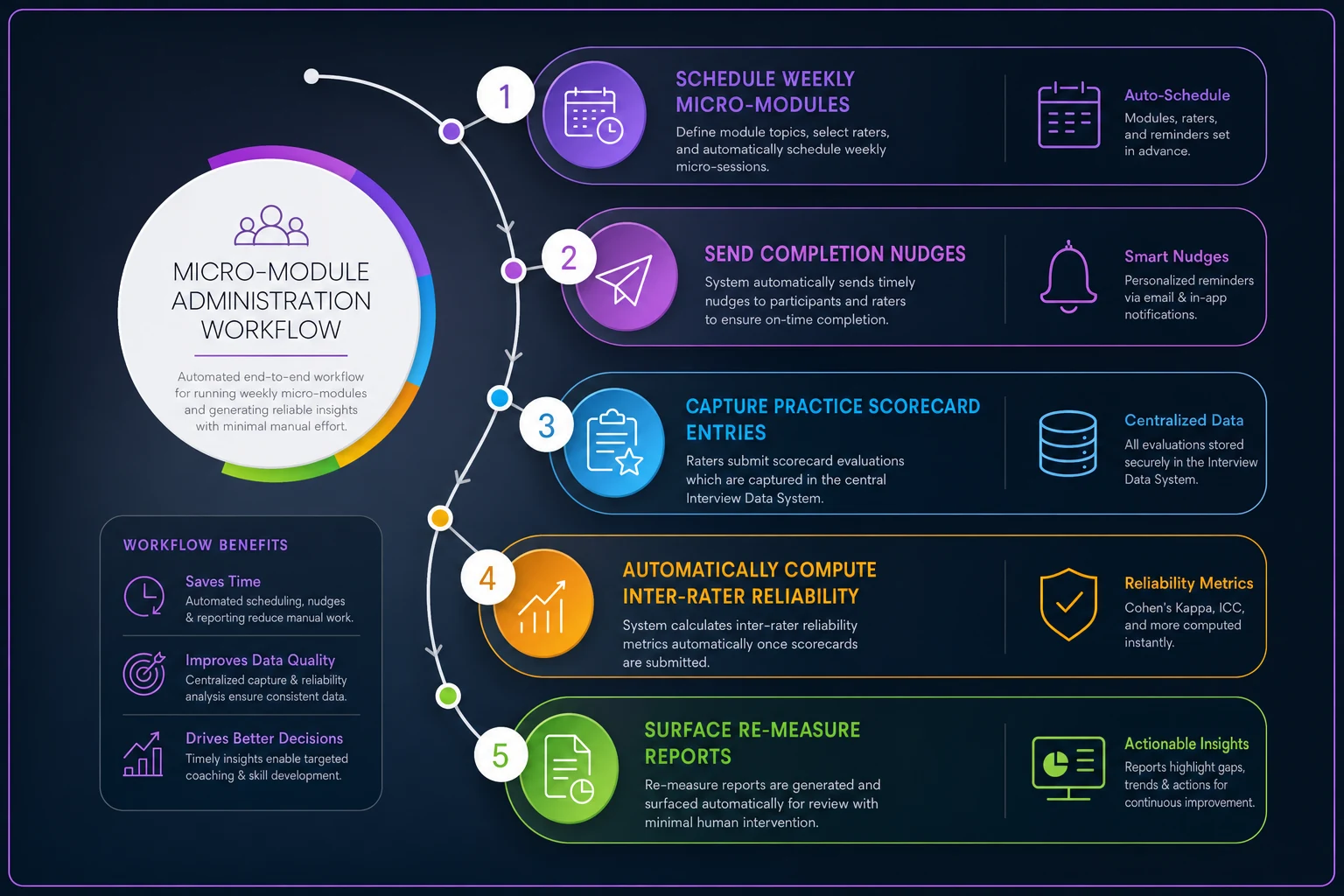
The honest risk with micro-modules is administrative drag. Someone has to assign the weekly module, track who did it, collect the practice scores, calculate the gaps, and pull the before/after comparison. Done in spreadsheets, that quietly becomes a part-time job nobody signed up for — and the program dies from maintenance fatigue rather than bad design.
This is where workflow tooling earns its keep: scheduling the weekly rep, nudging people who haven't completed it, capturing scores in the same place your interview data already lives, rolling up reliability metrics automatically instead of someone rebuilding a pivot table every month. The value isn't the automation itself. It's that the program survives past week three because nobody has to babysit it.
Whatever tooling you use, the principle holds: if measuring reliability is harder than running the interviews, people will stop measuring. Keep the admin near-zero and the program keeps running.
The quiet payoff
The thing that surprises most teams isn't the reliability number going up. It's how much calmer hiring decisions get.
When interviewers are calibrated, debrief meetings stop being arguments and start being quick confirmations. Candidates get rated on what they actually did. And when someone challenges a hiring decision — a manager, a candidate, a legal review — you have evidence notes and consistent scores to point to instead of a shrug.
Small reps, done often, measured honestly. That's the whole model. It's unglamorous, which is probably why so few teams actually stick with it — but it's the difference between training that lives on a slide deck and training that shows up in how people score on a Tuesday afternoon.
Small reps, done often, measured honestly. That's the whole model. It's unglamorous, which is probably why so few teams actually stick with it — but it's the difference between training that lives on a slide deck and training that shows up in how people score on a Tuesday afternoon.
Ready to transform your HR processes?
Join thousands of HR teams using Hiryly to hire faster, engage employees better, and stay compliant effortlessly.