
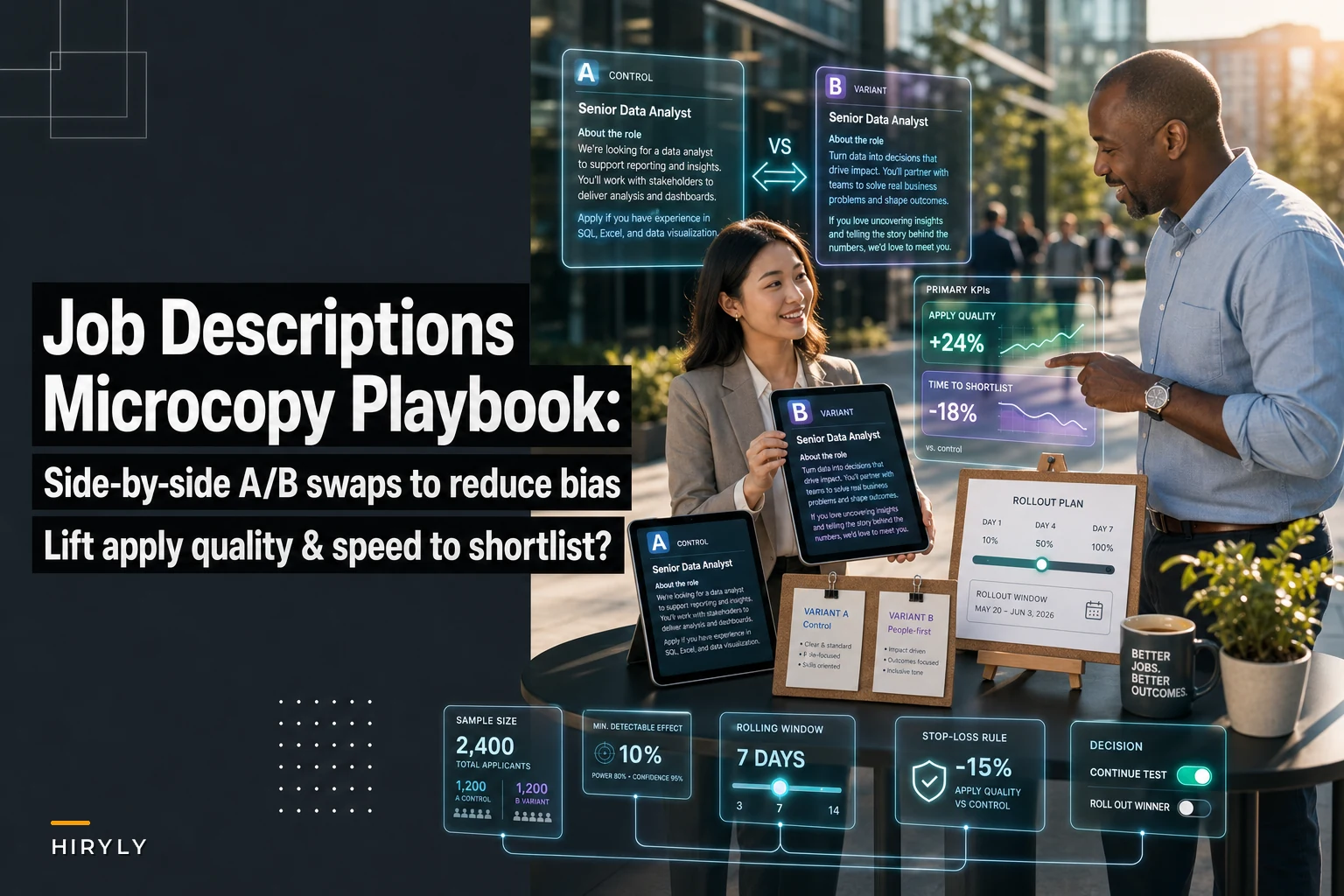

Most teams rewrite job descriptions the same way: a recruiter and a hiring manager argue over a Google Doc, change twelve things at once, post it, and then have no idea which change did anything. Three weeks later the applications look slightly different and nobody can say why. That's not testing. That's redecorating.
The frustrating part is that job description microcopy — the small, specific phrases inside a posting — moves apply behavior more than the big structural stuff people obsess over. A single line about "years required" or a benefits sentence tucked under responsibilities can quietly filter out half your qualified pipeline. And because the effect is invisible unless you isolate it, teams keep guessing.
This playbook is narrow on purpose. It's about running clean, one-variable swaps on JD microcopy, measuring apply quality and time-to-shortlist (not raw application volume), and knowing when to call a result. No statistics degree required.
Why single-variable discipline matters more here than anywhere else
Recruiting experiments fail for a boring reason: people change too many things and run them too short.
A posting gets a new title, a reworded requirements block, a salary band added, and a "we encourage applicants from all backgrounds" line — all in one edit. Applications go up 18%. Everyone claps. But you've learned nothing reusable, because you can't attribute the lift to any single change. Next req, you repeat the whole bundle and it does nothing. The bundle "worked" once by accident.
The pattern that shows up constantly: the salary line did all the work and the diversity statement did nothing, but the team now believes the diversity statement is magic and keeps pasting it everywhere while ignoring the actual lever.
Microcopy A/B testing only fixes this if you hold the line on one change at a time. One swap. One hypothesis. One metric that matters. It feels slow. It's actually the fastest way to build a reusable library of phrases that work for your roles and your market — which is the whole point.
If you want the broader experimental mindset behind this, the approach pairs well with low-effort HR experiments to lift quality-of-hire in 60 days. This article is the microcopy-specific slice of that.
The two metrics that actually matter (and the one everyone chases by mistake)
Raw application count is the vanity metric of recruiting. Easy to inflate, tells you almost nothing. A posting that pulls 200 applications where 190 are unqualified is worse than one that pulls 40 where 25 can do the job.
Eliminate HR bottlenecks with smart automation.
Hiryly simplifies your HR operations so you can focus on people, not paperwork.
- Centralized candidate tracking
- Automated onboarding workflows
- Performance & compliance dashboards
No credit card required
Track these instead:
Apply-quality rate. Of the people who applied, what percent cleared your first real screen — a recruiter call or basic knockout filter? This is your signal for whether the microcopy attracted the right people, not just more people.
Time-to-shortlist. From posting live to having a usable shortlist (usually 3–5 screened candidates a hiring manager agrees to interview). Good microcopy doesn't just lift quality — it compresses this number because recruiters spend less time wading through noise.
The trap worth naming: a variant can win on volume and lose on both metrics that actually matter. A "no experience required, apply today!" line will flood your inbox. Apply-quality rate craters and time-to-shortlist balloons because now a recruiter is screening 150 people instead of 50. That variant "won" by every surface-level measure and made everything worse.
| Metric | What it tells you | Watch out for |
|---|---|---|
| Raw applications | Reach / attractiveness of posting | Easy to inflate with low-quality traffic |
| Apply-quality rate | Did you attract the right people | Needs a consistent screen definition |
| Time-to-shortlist | Operational efficiency of the pipeline | Affected by recruiter load, not just JD |
| Shortlist diversity mix | Whether language is narrowing the funnel | Small samples swing hard; use ranges |
A reasonable baseline: if your apply-quality rate sits around 20–30% on a role and a microcopy variant pushes it into the mid-30s while holding volume steady, that's a real, bankable win.
Rollout windows: how long to run and when to stop
The most common mistake after "too many variables" is stopping too early. A recruiter sees Variant B leading on day two, declares victory, and rolls it out everywhere. Day two is noise.
A few rules that hold up:
-
Minimum window
one full posting cycle for the role.
For high-volume roles (support, sales, warehouse) that's often 7–10 days. For niche roles (senior engineering, specialized clinical) you may need 3–4 weeks just to accumulate enough applies to say anything. -
Minimum volume beats minimum time. Don't call a test until each variant has at least 40–60 applications and enough screened candidates to compute a quality rate. For slow roles, this is why single-variable JD testing is genuinely hard — you may need to run the same microcopy swap across several similar reqs and pool the results.
-
Split by posting, not by applicant, when you can't randomize cleanly. Most ATS setups can't randomly serve two JD versions to applicants. Run Variant A on one req and Variant B on a comparable req, or alternate by week. Imperfect, but workable if the roles are genuinely similar.
-
Stop-loss trigger. If a variant is clearly dragging apply-quality down after 40+ applies, kill it. No prize for finishing a bad test.
One thing people consistently skip: freeze everything else during the window. If the sourcing channel mix shifts mid-test — say someone turns on a LinkedIn promoted post for only one variant — your result is garbage and you won't even know it.
A simple rollout workflow looks like this.
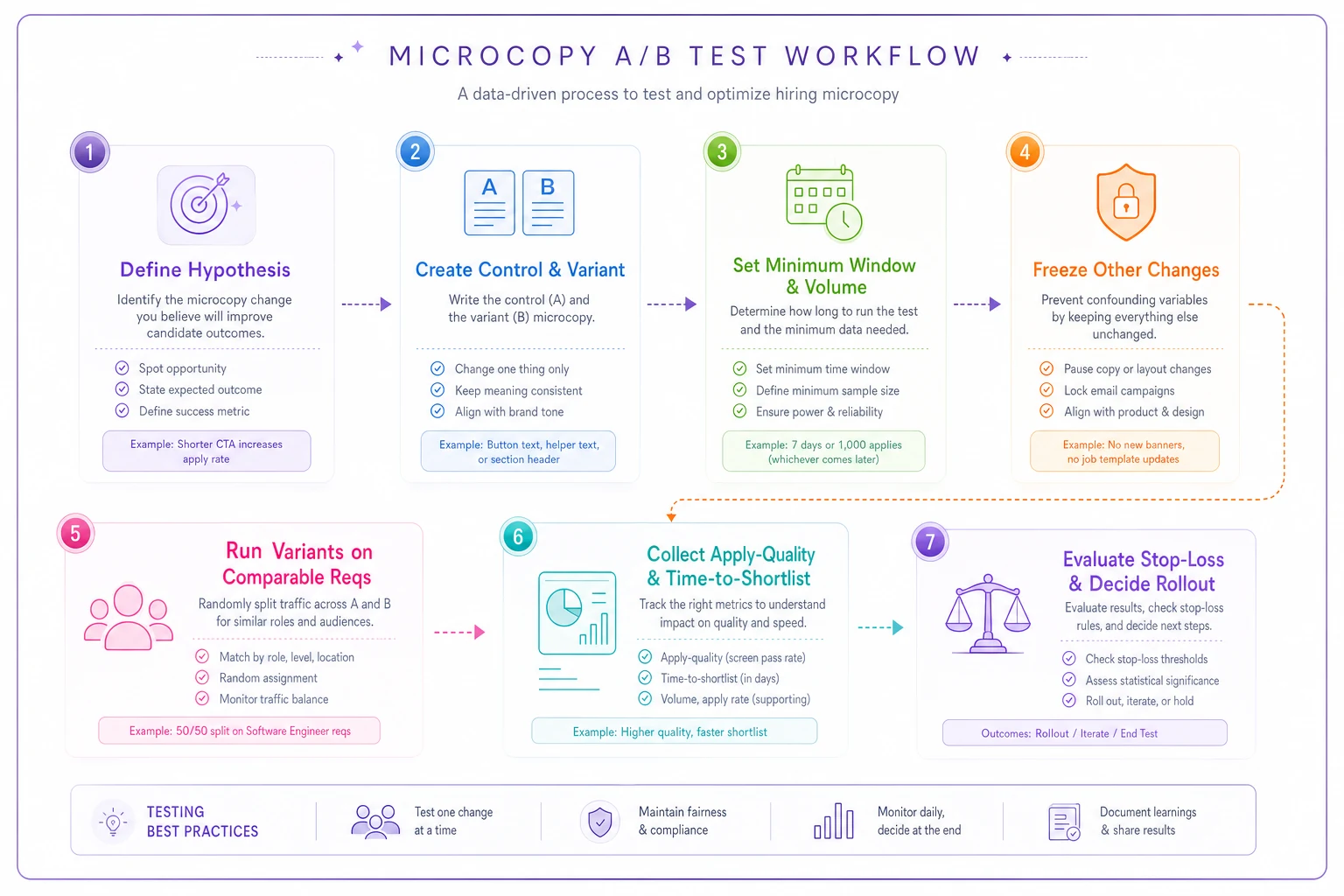
Freeze other posting changes during the test to avoid contaminating results.
If the sourcing channel mix shifts mid-test — say someone turns on a LinkedIn promoted post for only one variant — your result is garbage and you won't even know it.
The swaps worth testing first
Not all microcopy is worth your limited test slots. Some of it moves nothing.
-
Requirements framing — "must have 5+ years" vs. "comfortable owning X; most people get there in a few years." The hard-years line is the single biggest quiet filter, especially on gender-diverse pipelines.
-
Title specificity — "Rockstar Ninja Developer" vs. "Backend Engineer (Python)." Clever titles tank search discoverability and applicant quality.
-
First two sentences of the JD — team/impact framing vs. company-boilerplate framing. People decide whether to keep reading right here.
-
Benefits placement — buried at the bottom vs. a short line near the top.
-
Inclusivity language — but test it honestly; some phrasings help, some read as boilerplate and do nothing. (The funnel-attribution thinking in where diversity leaks in your funnel is useful for reading these results without fooling yourself.)
Low-leverage swaps not worth early slots: comma style, "we" vs. "our," reordering standard perks, logo placement. Teams love debating these because they're safe. They move nothing.
Sample experiment templates
Keep each test on one page.
If it doesn't fit on a page, you're probably testing too much.
Template 1 — Requirements framing
-
Hypothesis
Replacing "5+ years required" with capability-based language lifts apply-quality rate without dropping qualified volume.
-
Control (A)
"5+ years of experience in paid acquisition required."
-
Variant (B)
"You've run paid acquisition campaigns and can own channel budgets. Most strong candidates have a few years of hands-on experience."
-
Primary metric
apply-quality rate
-
Secondary
shortlist diversity mix, time-to-shortlist
-
Window
10 days or 50 applies per version
-
Stop-loss
kill B if quality rate drops more than 8 points by 40 applies
Template 2 — Title discoverability
-
Hypothesis
A plain, searchable title increases qualified applies vs. a branded title.
-
Control (A)
"Customer Happiness Hero"
-
Variant (B)
"Customer Support Specialist (SaaS)"
-
Primary metric
apply-quality rate
-
Secondary
raw applies (expect B higher from search)
-
Window
one posting cycle
Template 3 — Benefits placement
-
Hypothesis
Surfacing a comp/benefits line in the first third lifts application completion vs. burying it at the bottom.
-
Control (A)
benefits at bottom
-
Variant (B)
one-line salary range + "remote, 4 weeks PTO" after the opening paragraph
-
Primary metric
application start-to-complete rate, then apply-quality
-
Window
7–10 days
Keep each test on one page. If it doesn't fit on a page, you're probably testing too much.
Copy-and-run microcopy variants
Steal these, swap your specifics, run them.
Requirements
-
Instead of
"Bachelor's degree required."
-
Try
"Degree optional if you can show the work."
-
Instead of
"10+ years of management experience."
-
Try
"You've led teams through real tradeoffs; title and tenure matter less than judgment."
Opening line
-
Instead of
"Founded in 2012, we are a leading provider of…"
-
Try
"You'll own [specific outcome] for [specific team] from week one."
Inclusivity (test, don't assume)
-
Instead of
"We are an equal opportunity employer." (legal, but inert)
-
Try
"If you're on the fence about applying because you don't tick every box — apply anyway. We'd rather read your application than miss you."
Benefits
-
Instead of
a perks wall at the bottom
-
Try, near the top
"Salary: $95k–$115k. Remote-first. We cover health in full."
Call to action
-
Instead of
"Submit your resume and cover letter."
-
Try
"Send a resume. Skip the cover letter — a two-line note on why this role is enough."
The CTA swap alone frequently lifts completion rates. Cover-letter requirements quietly filter out strong, busy candidates more than weak ones — which is probably the opposite of what you want.
A real scenario
A mid-market logistics company was hiring dispatch coordinators across three regional branches. Each branch posted its own JD with "3–5 years dispatch experience required" and a "Dispatch Guru" title one branch had copied years earlier and nobody had ever questioned.
They ran two clean swaps across comparable reqs over about three weeks. First swap: plain title ("Dispatch Coordinator — Night Shift") against the "Guru" version. Second swap: capability-based requirements against the hard-years line.
Before: apply-quality rate hovering around 22%, time-to-shortlist close to 12 days, recruiters complaining most applicants had never touched a TMS. After the two winning variants made it into the standard template: apply-quality climbed into the low-to-mid 30s, time-to-shortlist dropped to around 8 days, and the qualified-applicant mix broadened — more women applied for night-shift dispatch, which the hard-years line had apparently been suppressing.
No new sourcing spend. No new tooling. Two phrases.
When this makes sense — and when it doesn't
Run microcopy tests when: you post the same or similar roles repeatedly (so you can build a reusable phrase library), you have at least moderate application volume, and you have a consistent screen definition to compute quality against.
-
you post the same or similar roles repeatedly (so you can build a reusable phrase library)
-
you have at least moderate application volume
-
you have a consistent screen definition to compute quality against
Skip or delay when: you hire one unique senior role per quarter — you'll never reach meaningful volume, and your energy is better spent on sourcing and the screening process itself. Also skip if your intake and screen criteria aren't stable. You can't measure quality against a moving target.
-
you hire one unique senior role per quarter — you'll never reach meaningful volume
-
your intake and screen criteria aren't stable
Who should not do this yet: teams without a clean handoff between posting, screening, and shortlist. If candidates fall through cracks between stages, your time-to-shortlist numbers reflect broken handoffs, not microcopy. Fix the pipeline mechanics first — the end-to-end hiring process framework covers that groundwork. Testing on top of a clean process is where the signal actually gets trustworthy.
Keeping the results usable over time
The last mile most teams drop: logging what won. A variant wins, gets pasted into a couple of postings, and then quietly disappears when the next recruiter starts from a stale template. Six months later you're re-testing the same "years required" swap you already proved out.
Keep a one-tab record per role family: the swap, the window, the volume, the quality delta, and whether it made it into the standard template. Boring, but it's the difference between a test program and a series of forgotten experiments. Applicant-tracking systems and JD tooling can help with version control and tagging postings so you can pull quality-by-variant later instead of reconstructing it from memory — but the record matters more than the tool. A shared sheet that people actually update beats a fancy system nobody touches.
Microcopy testing isn't glamorous and it won't fix a broken pipeline. What it does, reliably, is strip out the quiet filters in your language that were costing you qualified people — one honest, single-variable swap at a time.
Microcopy testing isn't glamorous and it won't fix a broken pipeline. What it does, reliably, is strip out the quiet filters in your language that were costing you qualified people — one honest, single-variable swap at a time.
Ready to transform your HR processes?
Join thousands of HR teams using Hiryly to hire faster, engage employees better, and stay compliant effortlessly.