
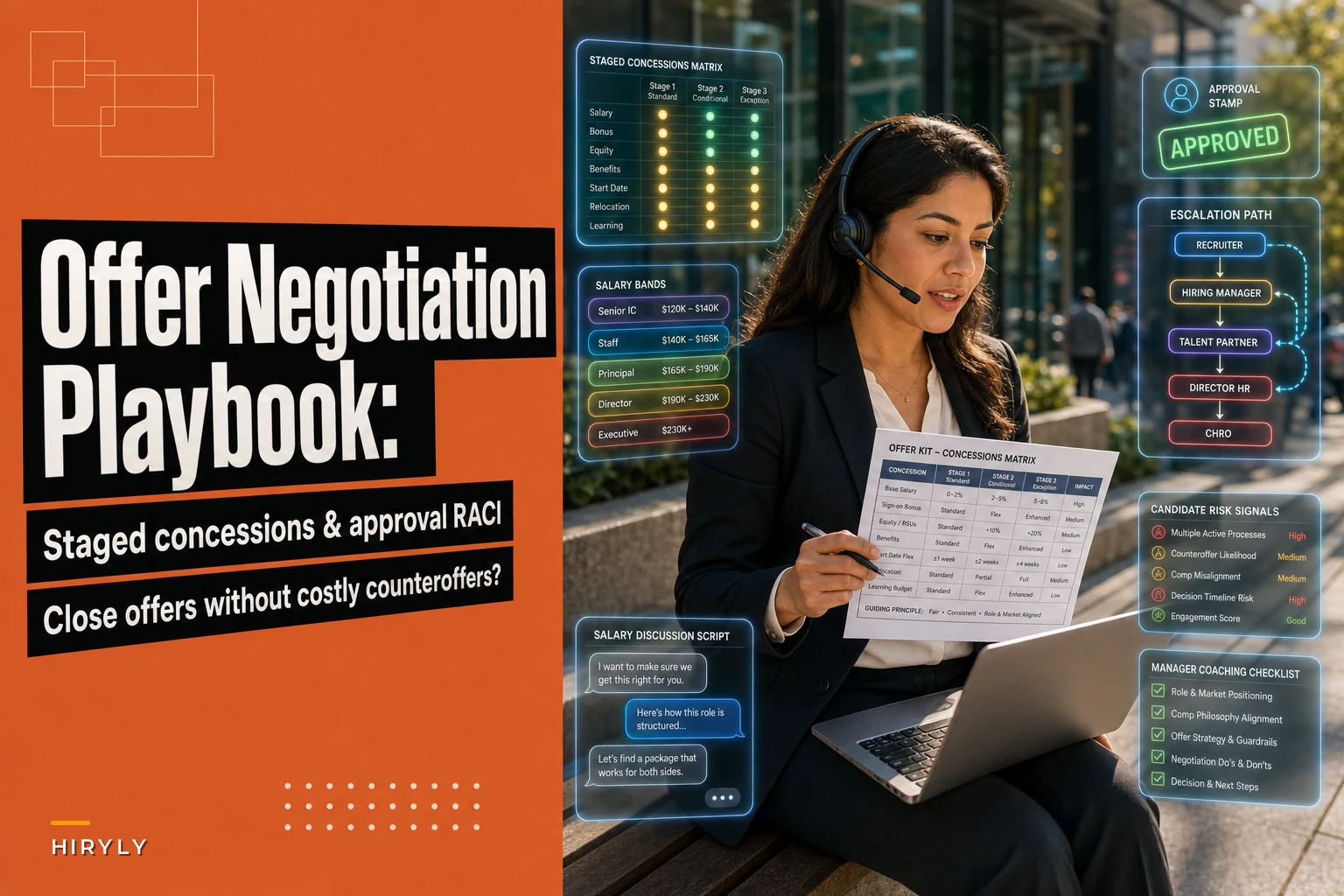

Most offer losses don't happen because the number was too low. They happen because the recruiter negotiated reactively — matching whatever the candidate asked for, one panicked Slack message at a time, until the whole thing either blew the band or collapsed on a counteroffer nobody saw coming.
The candidates who walk are rarely unreachable. They're the ones the recruiter could have closed if the offer conversation had been run with a plan instead of improvised across three days of "let me check with the hiring manager."
This is a tightly scoped playbook for that exact window — from verbal offer to signed. Not sourcing, not employer branding, not comp philosophy. Just the mechanics of getting a strong candidate to yes without swinging the offer number around like it's a live auction.
Where offers actually fall apart
The failure pattern is pretty consistent. A recruiter extends a verbal at, say, $118k. The candidate says "I was hoping for closer to $130." The recruiter, not wanting to lose momentum, says "let me see what I can do." They go to the hiring manager, who says "yeah fine, offer $128 if that closes it." Recruiter goes back, offers $128, candidate now senses there's room and says "and I'd need the sign-on bumped too."
Now you've taught the candidate that pushing works, burned two days, and left a manager annoyed the number moved $10k in one afternoon. Worse, when the candidate's current employer counters, there's no story left — you already showed all your cards.
A mid-market SaaS company we looked at was losing roughly 1 in 4 offers at the final stage, and their exit reason codes were almost all "accepted counteroffer" or "comp gap." When someone actually mapped the negotiations, the real issue wasn't comp. Recruiters had no defined room to move, no script, and no idea what the manager would actually approve. Every negotiation started from zero.
The offer stage is where all your earlier work either pays off or evaporates. If you've already tightened the process — there's a solid breakdown of that in the piece on closing the offer-to-onboard gap — the negotiation becomes the last high-risk handoff. This playbook is about making that handoff boring and predictable.
The staged concessions matrix
The single biggest fix is deciding before the call what you're willing to move, in what order, and what each move costs. Recruiters lose offers because they treat every candidate ask as a live decision. It shouldn't be. By the time you're on the offer call, the concessions should already be sequenced.
Eliminate HR bottlenecks with smart automation.
Hiryly simplifies your HR operations so you can focus on people, not paperwork.
- Centralized candidate tracking
- Automated onboarding workflows
- Performance & compliance dashboards
No credit card required
For each role, define three tiers of levers and pre-approve the range on each.
| Concession lever | Tier 1 (recruiter can offer freely) | Tier 2 (needs manager sign-off) | Tier 3 (needs comp/finance escalation) |
|---|---|---|---|
| Base salary | Up to midpoint of band | Midpoint to 90% of band | Above 90% or band exception |
| Sign-on bonus | Up to ~$5k | $5k–$15k | Above $15k |
| Start date flexibility | Within 4 weeks | 4–8 weeks | Beyond 8 weeks |
| Equity / RSU | Standard grant | +10–15% grant | Custom grant structure |
| Title | Pre-approved title only | Adjacent title within level | Level change |
| Remote / hybrid terms | Within posted policy | One-off exception | Policy-level exception |
The exact numbers are yours to set per band. The point is that the recruiter walks into every offer conversation knowing what they can say yes to on the spot, what needs a quick approval, and what genuinely can't move without escalating.
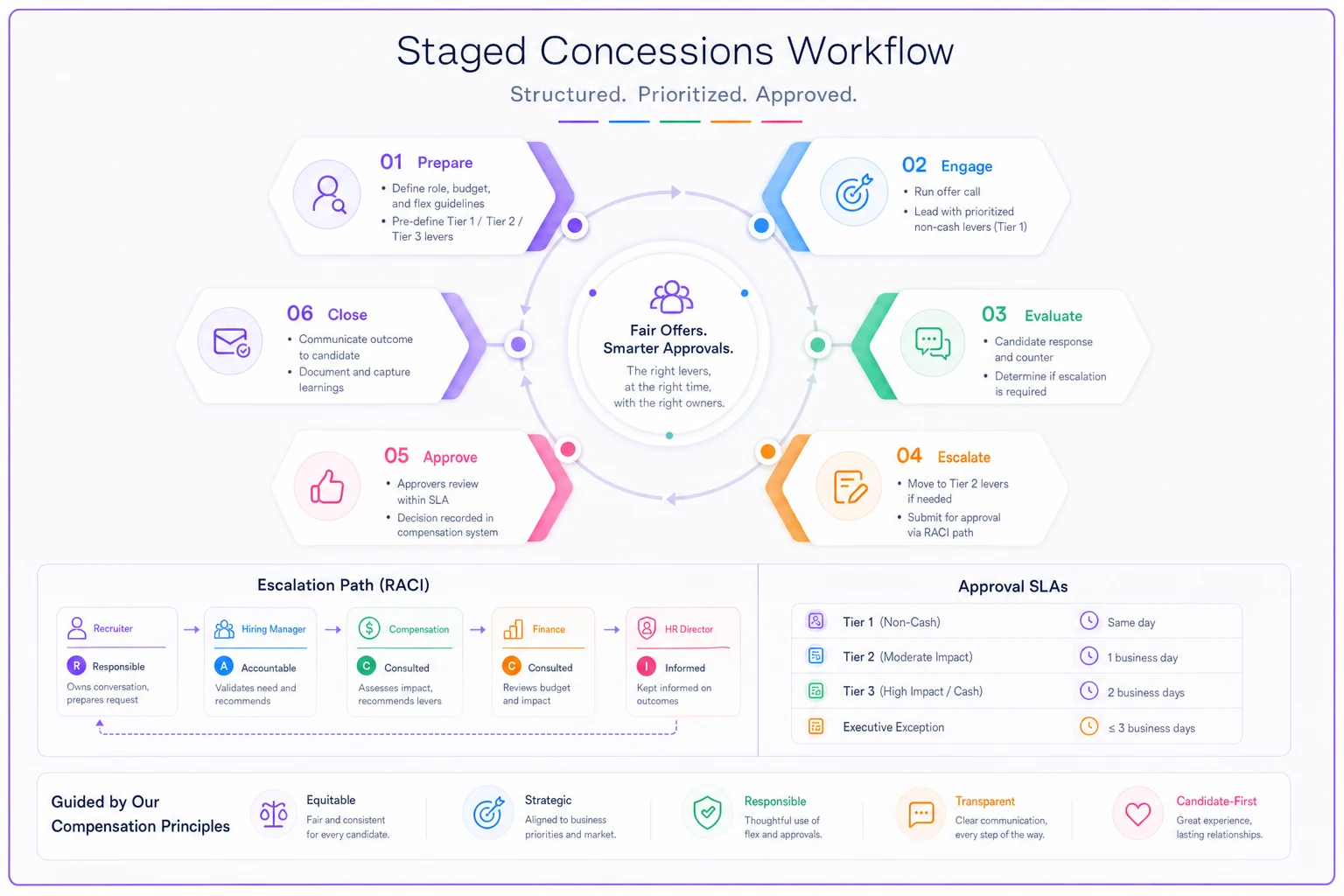
A subtle thing most people miss: stage your concessions on non-cash levers first. A candidate hung up on base is often actually anxious about something cheaper to solve — start date, remote days, a slightly better title. Lead with a small non-cash concession and you'll frequently close without touching the number at all. Recruiters who lead with base every time train candidates to think base is where the give is.
When building tiers, document example scenarios per role so recruiters can respond instantly without asking for manager time.
The exact numbers and the tier labels are less important than the discipline: you must sequence concessions and keep the sequence consistent across recruiters and hiring managers.
Approval RACI for escalations
The second thing that kills offers is ambiguity about who decides. When a candidate asks for something above Tier 1, the recruiter shouldn't be guessing who to ping or how long it'll take. Every hour of "waiting to hear back" is an hour the candidate's current employer — or a competing offer — is working on them.
-
Responsible Recruiter (runs the negotiation, drafts the counter, communicates with candidate)
-
Accountable Hiring manager (owns the hire and the budget line; final yes/no on Tier 2)
-
Consulted Comp/Total Rewards (Tier 3 band exceptions, equity adjustments)
-
Informed Finance / HRBP (notified after approval for anything above midpoint)
Then attach a response SLA to each tier. Tier 2 approvals should come back within 4 business hours. Tier 3 within one business day. If you can't hit those, you don't have an approval process — you have a bottleneck the candidate is going to feel.
This is where offer negotiation connects to the broader operating model. If approvals routinely stall, the problem probably isn't the offer stage — it's governance. The hiring governance framework for scaling talent operations covers how to set role-based approvals and audit gates so exceptions don't turn into free-for-alls. An offer RACI is basically that framework applied to the final 48 hours.
The pattern that keeps showing up: companies have a comp band and a "get approval" rule, but no named owner and no SLA. Approval speed ends up depending entirely on whether the hiring manager is near their laptop. That's not a process.
Salary-band talking scripts
Recruiters lose credibility the moment they sound unsure about the number. The candidate hears hesitation and reads it as there's room. Scripts fix this — not because you read them robotically, but because rehearsing the framing keeps you from improvising your way into a bad spot.
When the candidate anchors high right away: > "Appreciate you being direct on the number. This role sits in a defined band, and where we've landed for you at $118k reflects the level and your experience. I want to walk you through the full package, because base is only one piece — and if there's flexibility, it's usually in the parts that matter most to you."
When they push after the initial offer: > "Here's how I'd think about it. We're at the top of what makes sense for this level right now on base. What I can look at is [sign-on / start date / equity]. Which of those actually changes the decision for you?" You're asking them to prioritize, which surfaces what they truly care about and stops the everything-at-once negotiation.
When they name a competing offer: > "That's useful to know. Can I ask — if the comp were identical, which of these roles do you actually want? Because I don't want to win this on a number and lose you in six months to whatever made you keep looking." That reframes away from a bidding war and toward fit, which is where you usually have the edge.
One mistake worth calling out: scripting only for the number. Half the real negotiation is about reassurance — the candidate is nervous about the manager, the team, the ramp. A script that acknowledges that closes more offers than one that just defends the band.
Candidate-side risk signals
You can read whether an offer is at risk long before the candidate says no. The signals are behavioral, and catching them early gets you an extra day or two to intervene instead of reacting to a decline.
-
Sudden vagueness on start date. A candidate excited about the role gives you a date. One weighing a counteroffer says "I need to sort a few things out first."
-
Loops in a new stakeholder late. "Let me talk to my partner / mentor" this late often means they're building a case to stay or negotiate harder.
-
Response time doubles. Someone who replied in an hour now takes a day. Silence at the offer stage is rarely neutral.
-
Asks about the exit / notice process in detail. Sometimes genuine, sometimes rehearsing the resignation conversation they're dreading — which is exactly when their employer counters.
-
Reopens something already settled. If remote policy was fine two weeks ago and now it's suddenly a sticking point, something changed.
-
Goes quiet on logistics but stays warm on relationship. They like you, they like the team, and they're stalling. Classic counteroffer-in-progress.
When you see two or more of these, don't wait. That's the moment for a direct, low-pressure check-in — not another email, an actual call.
The counteroffer conversation (before it happens)
The best counteroffer defense is planting the seed before the candidate ever resigns. Most recruiters skip this because it feels awkward. It isn't — done right, it's one of the more respected things you can do.
-
Name it directly. "There's a real chance your current company counters when you resign. I want to talk about that now, while it's calm, not when you're in the room feeling guilty."
-
Reframe the counter. "A counter usually means they didn't value you until you had one foot out the door. And statistically, most people who accept one are gone within a year anyway."
-
Anchor to their 'why.' "You told me you were leaving because [growth stalled / no path / burnout]. Will more money actually fix that?"
-
Rehearse the resignation. "When you resign, keep it short
you've accepted a role that's right for your growth, and you're grateful. Don't negotiate. Don't hand them a number to beat."
-
Set the check-in. "Text me the day you resign. I'm around if it gets weird."
This whole sequence takes ten minutes and it cuts counteroffer losses significantly, because the candidate has already emotionally rehearsed saying no. You're not fighting the counter in the moment — you inoculated against it days earlier.
Manager coaching checklist
Recruiters can only control their side. A lot of offer swings come from hiring managers who overpromise, undercut the band, or panic and throw money at a wobbly candidate. A quick pre-offer alignment prevents most of it.
-
[ ] Manager knows the exact band and the approved offer number
-
[ ] Manager has agreed on the concession tiers before the candidate asks
-
[ ] Manager will route Tier 2/3 asks through the RACI, not freelance a promise
-
[ ] Manager understands they don't respond to candidate comp asks directly — everything routes through the recruiter
-
[ ] Manager is briefed on the candidate's likely motivators (growth, flexibility, title)
-
[ ] Manager is available within the approval SLA window
-
[ ] Manager has a short "why this team" pitch ready for a closing call if needed
The single most common manager mistake: freelancing a concession in a casual chat with the candidate. The candidate mentions comp, the manager says "I'm sure we can work something out," and suddenly the recruiter's carefully staged negotiation is blown. One rule fixes most of it — managers don't discuss numbers, ever. That routes through the recruiter.
When this level of structure makes sense — and when it doesn't
This playbook is built for teams making enough offers that inconsistency actually costs you. If you're extending 15+ offers a quarter and losing a meaningful chunk to counteroffers or comp swings, the matrix and RACI pay for themselves quickly.
When it's overkill: if you make a handful of offers a year, you don't need a formal concessions matrix — you need the hiring manager and recruiter aligned in a 20-minute conversation before each offer. Formalizing it just adds friction. Who should not adopt this rigidly: senior executive hires. Exec offers are bespoke — the tiers, the equity, the terms all get individually negotiated, often with legal and the board involved. Forcing a fixed concessions matrix onto a VP hire will make you look inflexible with exactly the people who negotiate hardest. Use the principles (know your levers, sequence your gives, agree internally first) but drop the rigid tiers.
A real scenario
A regional healthcare staffing company was extending around 40 offers a quarter and losing close to 30% at the final stage — mostly to counteroffers and last-minute comp asks that spiraled. Recruiters had a band but no defined room to move, and every ask triggered a scramble to the hiring manager.
They put in three things: a staged concessions matrix per role family, a RACI with a 4-hour approval SLA on Tier 2, and the pre-emptive counteroffer conversation baked into every verbal acceptance. Within about two quarters, their final-stage loss rate dropped to somewhere in the low-to-mid teens. The quieter win: average base offered actually came down slightly, because recruiters stopped reflexively leading with money to save deals. They were closing on start dates, title tweaks, and a rehearsed resignation script instead of blowing the band. The comp savings alone more than covered the effort of building the matrix.
The through-line
Offers get lost in the gap between "we want you" and "I accept" — and nearly every loss in that gap traces back to improvisation. No pre-agreed room to move, no clear approver, no script, and no plan for the counteroffer everyone knows is coming.
Fix the mechanics and the emotional swings mostly disappear. The candidate feels a recruiter who's calm and prepared. The manager stops freelancing promises. And the negotiation that used to eat three panicked days becomes a short, confident conversation you've basically already had in your head before the phone rings.
Fix the mechanics and the emotional swings mostly disappear. The candidate feels a recruiter who's calm and prepared. The manager stops freelancing promises. And the negotiation that used to eat three panicked days becomes a short, confident conversation you've basically already had in your head before the phone rings.
Ready to transform your HR processes?
Join thousands of HR teams using Hiryly to hire faster, engage employees better, and stay compliant effortlessly.