

Most sponsorship delays don't happen because a government office is slow. They happen because nobody owned the gap between "offer accepted" and "immigration vendor engaged." The candidate sits waiting. The hiring manager assumes something is moving. The recruiter thinks the mobility team has it. And three weeks disappear before anyone realizes the intake form was never submitted.
That dead air is the single most expensive thing in global hiring, and it's almost entirely self-inflicted.
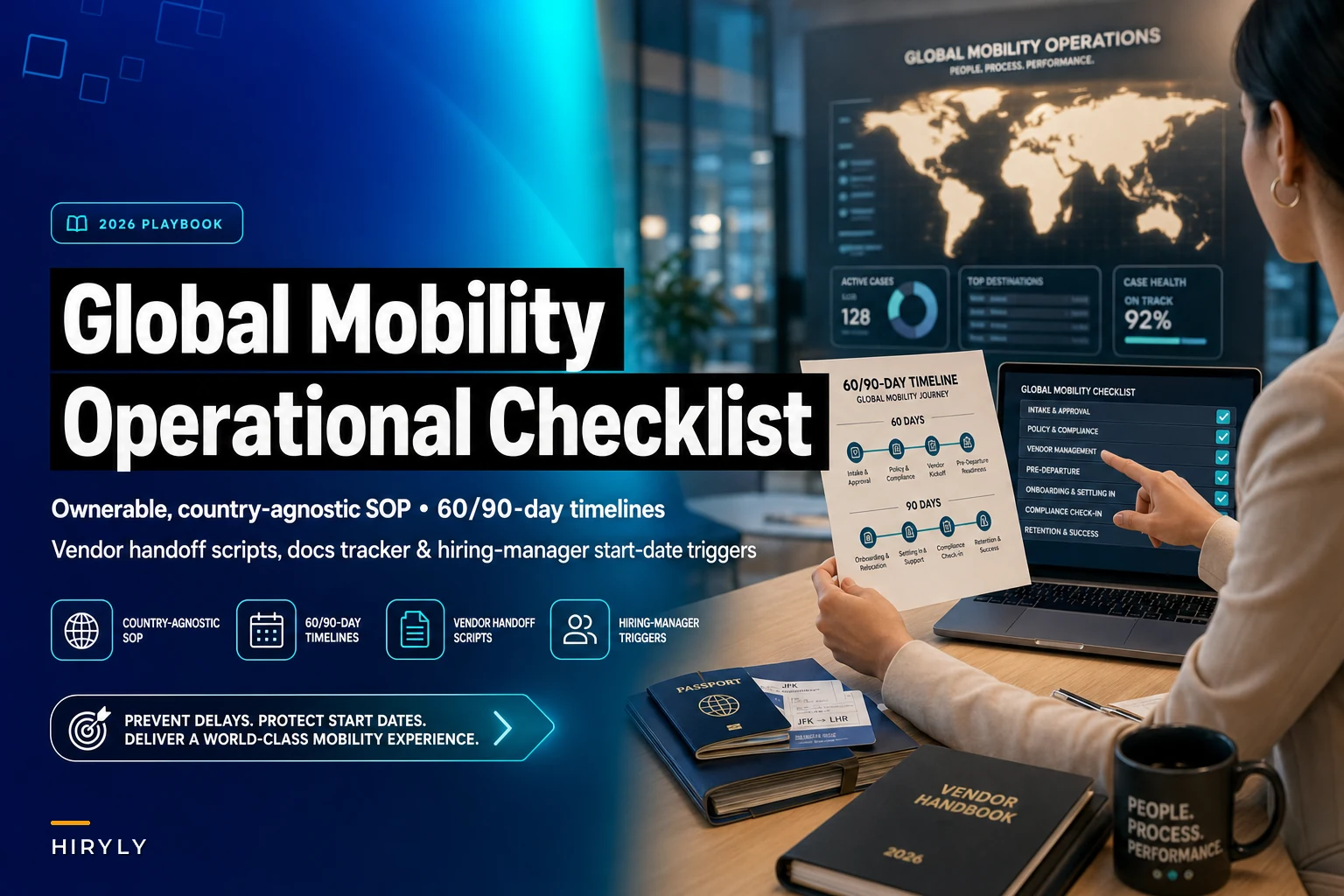
This checklist is built to remove it. It's deliberately country-agnostic — not because immigration rules are the same everywhere, but because the operational failures are nearly identical regardless of where you sponsor. The failure modes repeat: unclear handoffs, documents collected too late, start dates promised before anyone checked feasibility, vendor emails sitting in one person's inbox.
We'll work backward from the start date, map the 60- and 90-day timelines, script the vendor handoffs, and give you a documentation tracker plus a set of risk triggers a hiring manager can actually act on.
Why global-hire delays are almost never about the government
The visa authority is rarely your bottleneck. Your internal coordination is.
In practice, a sponsorship timeline breaks in three predictable places:
-
The gap between offer and vendor engagement. Nobody explicitly owns "trigger the immigration process." So it triggers late.
-
Document collection. Passports expire, marriage certificates need apostilles, prior visa stamps are missing, degree certificates are in a language nobody thought to translate. These take weeks to source, and they always get requested last.
-
The start-date promise. A hiring manager tells the candidate "you can start in six weeks" without ever checking whether six weeks is physically possible for that country and visa type.
That third one is the quiet killer. Once a start date is spoken out loud to a candidate, it becomes emotional truth. Walking it back damages trust — sometimes enough that the candidate re-opens their job search. So the delay isn't just administrative, it feeds directly into offer drop-off. There's a full offer-to-onboard SOP worth reading if candidate fade is a recurring issue for you.
A typical scenario: a mid-size software company extends an offer to a candidate needing sponsorship, the hiring manager casually says "let's target the first of next month," and it takes eleven days before anyone opens a case with the immigration vendor. By then that date was never realistic — but the candidate has already given notice at their current job. Now you're managing a stressed candidate and a compressed timeline. Both were avoidable.
The one habit that fixes most of this: work backward from feasibility, not forward from optimism
Before a start date is ever mentioned to a candidate, someone needs to answer one question: what's the earliest defensible start date for this specific country and visa route?
Eliminate HR bottlenecks with smart automation.
Hiryly simplifies your HR operations so you can focus on people, not paperwork.
- Centralized candidate tracking
- Automated onboarding workflows
- Performance & compliance dashboards
No credit card required
Not the fastest theoretically possible. The defensible one — the date you'd actually bet on and communicate.
This means the hiring manager doesn't get to promise a date. The mobility owner sets a feasible window, and the recruiter communicates it. That reordering alone eliminates a significant share of delays, because it kills the optimistic promise before it exists.
The rule worth enforcing: no start date leaves the building until the mobility owner has confirmed a feasibility window. It sounds bureaucratic. It saves weeks.
The 60-day and 90-day timeline templates
Two templates, because sponsorship timelines cluster into roughly two buckets: routes that can realistically close in about two months, and routes that need three or more. You'll adapt the exact days to your country and visa type, but the sequence holds up almost everywhere.
Certain tasks must start on day one regardless of route length. Document collection is the obvious one — it's the longest lead-time item and the most commonly delayed.
60-day timeline (faster routes)
| Day range | Owner | Action |
|---|---|---|
| Day 0 | Recruiter + Mobility | Offer accepted; mobility owner confirms feasibility window before start date is communicated |
| Day 0–2 | Mobility | Open case with immigration vendor; send intake form to candidate |
| Day 2–5 | Candidate | Return intake + begin document sourcing (passport, prior visas, credentials) |
| Day 5–10 | Mobility + Vendor | Confirm required document list per candidate profile; flag any apostille/translation needs |
| Day 10–25 | Candidate + Mobility | Collect and verify all documents; chase gaps weekly |
| Day 20–30 | Vendor | Prepare and submit petition/application |
| Day 30–50 | Vendor | Government processing window; mobility monitors status |
| Day 45–55 | HR + Manager | Confirm relocation logistics, payroll setup, equipment |
| Day 55–60 | Mobility | Approval received; lock start date and confirm with candidate |
90-day timeline (slower or document-heavy routes)
| Day range | Owner | Action |
|---|---|---|
| Day 0 | Recruiter + Mobility | Offer accepted; feasibility window confirmed and communicated |
| Day 0–3 | Mobility | Vendor case opened; intake sent; kickoff call scheduled |
| Day 3–7 | Vendor | Country-specific document list issued (this list is bigger — plan for it) |
| Day 7–35 | Candidate + Mobility | Extended document collection: apostilles, sworn translations, employment references, credential evaluations |
| Day 20–40 | Mobility + Legal | Employer-side documents prepared (sponsorship letters, labor market tests if required) |
| Day 40–55 | Vendor | Application submission |
| Day 55–80 | Vendor + Mobility | Government processing; respond to any requests for evidence within 48 hours |
| Day 75–85 | HR + Manager | Relocation, housing support, dependent visas, payroll and onboarding prep |
| Day 85–90 | Mobility | Approval; finalize travel and confirmed start date |
The biggest difference between the two isn't the government processing block — it's the document collection window. On slower routes, documentation eats a month or more. Treating it as a day-one task instead of a mid-process task will routinely help you beat your own timeline.
Vendor handoff scripts (so nothing lives in one inbox)
The most fragile point in the whole process is the handoff between your team and the immigration vendor. Information gets scattered across emails, half of it never reaches the vendor, and the vendor's clarifying questions sit unanswered for days.
A handoff script fixes this by making the first contact complete rather than the start of a back-and-forth. Here's a structured kickoff message you can adapt.
Here's a quick visual of the handoff workflow.
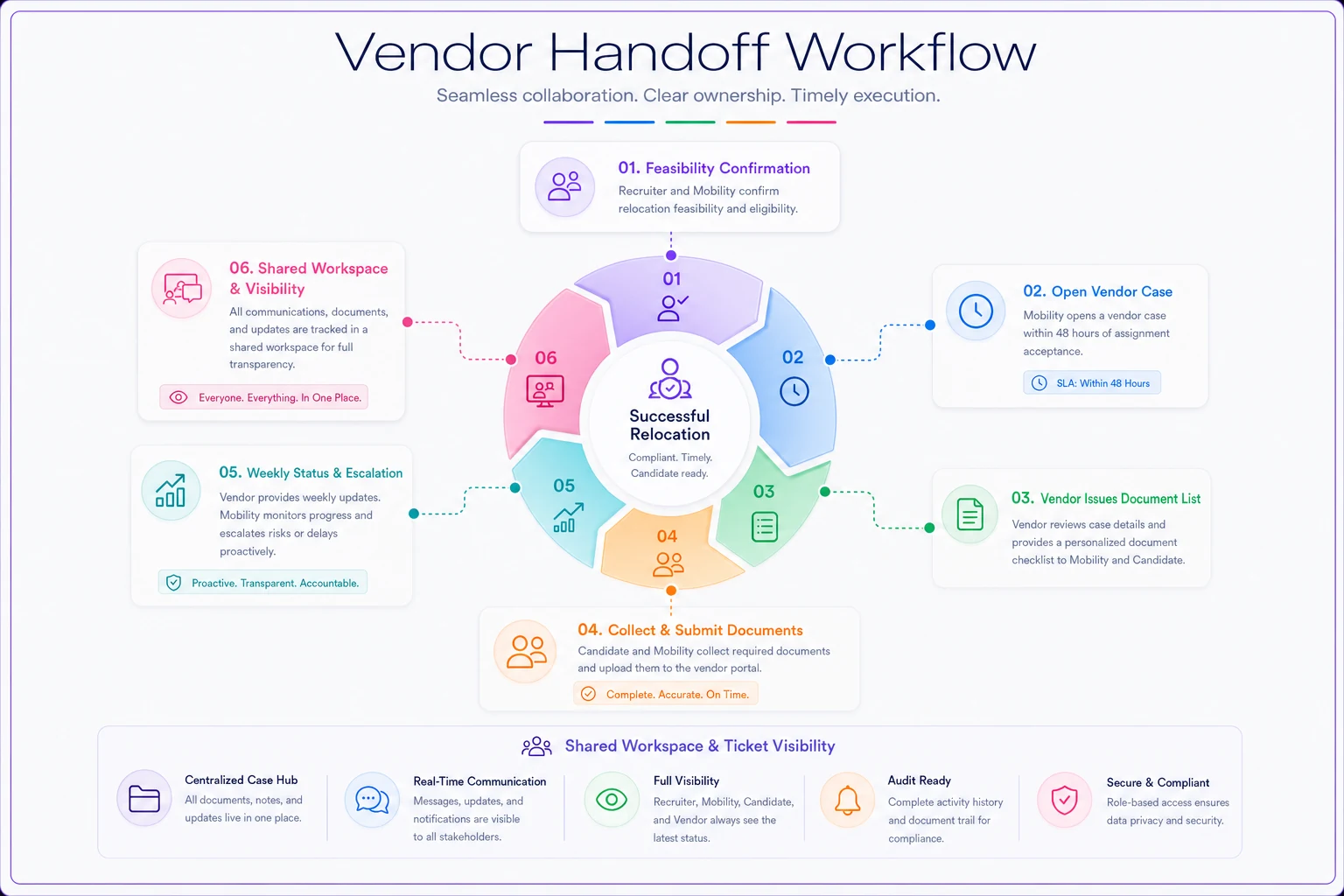
Case-open script (Mobility → Vendor):
> Subject: New sponsorship case — [Candidate Name], [Country], target window [X] > Opening a new case. Details below so we can move without back-and-forth:
-
- Candidate [name, nationality, current location]
-
- Role [title, work location, salary]
-
- Visa route [if known — otherwise please advise on best route]
-
- Feasibility window we've communicated to candidate [date range]
-
- Dependents to include [yes/no, details]
-
- Known complications [e.g., prior visa refusals, gaps in employment, credential in non-English]
Please confirm within 2 business days: (1) recommended route, (2) full document list specific to this candidate, (3) realistic processing estimate, (4) any employer-side documents you need from us.
Status-check script (Mobility → Vendor, weekly):
> Weekly check on [Candidate]. Please confirm: current stage, any outstanding items on our side, any outstanding items on candidate's side, and whether the [date range] window still holds. If anything threatens that window, flag it now.
The second script matters more than it looks. Asking "does the window still hold?" every week forces early warning. Most delays get discovered too late simply because nobody asked the vendor the direct question soon enough.
One operational note: route these vendor communications through a shared workspace or ticket, not a personal inbox. When the mobility owner is on vacation and the vendor sends a request for evidence with a 5-day deadline, that email cannot be sitting unread in one person's mail. This is exactly the kind of ownership and approval clarity that a proper hiring governance framework is meant to enforce.
The documentation tracker
Document collection is where timelines quietly die, so it deserves its own living tracker rather than a buried email thread. For each candidate, track every document with a status, an owner, and a lead-time note.
A working tracker has these columns:
-
- Document (passport, degree certificate, prior visa stamps, marriage certificate, etc.)
-
- Required? (yes / conditional / no — depends on route and profile)
-
- Status (not started / requested / received / verified / needs translation / needs apostille)
-
- Owner (candidate or employer)
-
- Lead time (how long this realistically takes to source — the column most people skip and most need)
-
- Blocker notes (e.g., "candidate's original degree is with prior employer")
The lead-time column is the one that actually changes behavior. An apostille from certain countries can take three to four weeks. A sworn translation adds one to two more. A credential evaluation can take close to a month. When you can see those lead times against your timeline, you stop requesting documents on day 30 that needed to be requested on day 3.
Update this tracker on a fixed weekly cadence and review it during the same weekly vendor check. Documents sitting at "requested" for two weeks are your earliest and most reliable delay signal.
Hiring-manager risk triggers mapped to start-date planning
Hiring managers don't need to understand immigration law. They need a short list of warning signs that tell them a start date is at risk, so they stop making promises the process can't keep.
Give them these triggers, mapped to what they should do:
-
Trigger
Candidate needs sponsorship at all.
→ Do not commit a start date. Ask mobility for a feasibility window first. -
Trigger
Candidate has a prior visa refusal or complex history.
→ Assume the longer (90-day+) timeline. Communicate a range, never a single date. -
Trigger
Route requires a labor market test or advertising period.
→ Add weeks before the case even starts. Flag to recruiting. -
Trigger
Candidate is bringing dependents.
→ Separate visa tracks may run in parallel; confirm timing before promising a family move date. -
Trigger
Any document sits at "requested" for 10+ days.
→ Escalate. This is the number-one cause of missed windows. -
Trigger
Vendor's weekly status check goes unanswered.
→ Escalate immediately; a silent vendor is a slipping timeline.
Worth stressing: hiring managers cause more delays through optimistic communication than through anything they fail to do operationally. They mean well — they want to keep the candidate warm. But an overpromised date that slips does far more damage than an honest range given up front.
A real scenario: the 40-day slip that became a 4-day fix
A growing fintech firm — around 300 employees, expanding into two new countries — kept losing sponsored candidates late in the process. Two hires in the same quarter had start dates slip by five to six weeks each, and one candidate walked entirely and took a competing offer.
When they traced it back, government processing wasn't the problem at all. In both cases, the vendor case was opened roughly 11–14 days after offer acceptance, and document collection didn't start in earnest until the vendor chased. Passports needed renewing. One candidate's degree needed an apostille that took nearly three weeks. All of it was discovered late.
They changed three things, none of them complicated. First, no start date could be communicated until the mobility owner signed off on a feasibility window. Second, the vendor case had to be opened within 48 hours of offer acceptance, using the kickoff script above. Third, a shared documentation tracker replaced the email thread, reviewed every Friday.
The next batch of sponsored hires came in roughly on their communicated windows — a couple actually landed a few days early. The "how long until we can commit a date" question that used to take a week to answer now got resolved in about four days, because the feasibility check happened immediately instead of after the candidate had already been promised something. No more emergency walk-backs.
When a tight 60-day target makes sense — and when it doesn't
Not every hire should be pushed onto the fast timeline. Being honest about this up front is what prevents the overpromising cycle.
A 60-day target makes sense when:
-
The route is well-understood and you've run it before in that country
-
The candidate's documents are clean and already in hand
-
No dependents, no prior refusals, no credential complications
-
The vendor confirms the window on the kickoff call
Push to 90 days (or wider) when:
-
It's a new country for you, or a route your vendor flags as variable
-
The candidate has any documentation complexity — translations, apostilles, credential evaluations
-
Dependents are involved
-
There's any prior immigration history that could trigger extra scrutiny
Who should not commit to a firm single date at all: anyone hiring in a country where processing times are publicly volatile or backlogged. In those cases, communicate a range and update it weekly. A candidate can plan around a range. A broken promise is much harder to recover from.
Bringing the pieces together
The whole system rests on a small reordering of who does what and when. The mobility owner sets feasibility before anyone speaks a date. The vendor case opens within two days, using a complete handoff so there's no back-and-forth. Documents get tracked with real lead times from day one. Hiring managers get a handful of triggers that tell them when to hold their promises.
Keeping all of this in one shared, owned place — rather than scattered across inboxes and a hiring manager's memory — is what separates a global mobility checklist that lives on paper from one that actually protects your start dates. When the tracker, the vendor thread, the feasibility sign-off, and the risk triggers all sit somewhere the whole team can see, the dead air between offer and start has nowhere to hide.
You won't control the government's timeline. You can absolutely control everything that happens before it — and that's where almost all of your recovered weeks come from.
Ready to transform your HR processes?
Join thousands of HR teams using Hiryly to hire faster, engage employees better, and stay compliant effortlessly.