

HR ends up owning more vendors than almost anyone realizes. Background check providers, ATS platforms, assessment tools, benefits brokers, payroll add-ons, LMS platforms, recruiting agencies, immigration counsel, engagement survey tools. A mid-market HR team can easily be sitting on 15 to 25 active vendor relationships, and almost none of them get managed with the same rigor procurement applies to a manufacturing supplier.
The result is predictable. Contracts auto-renew before anyone reviews performance. A vendor underdelivers for eight months and nobody has documentation to push back. Then when you finally want to switch, you discover the exit is a nightmare because nobody ever specified what data you'd get back or in what format.
This is a specific operational gap, and it's fixable with a real SOP — not a policy document that sits in SharePoint, but an actual set of artifacts and cadences that live inside your vendor workflow. Below is the HR vendor management SOP we'd hand to any HR ops lead who's tired of getting surprised.
The five artifacts that actually prevent surprises
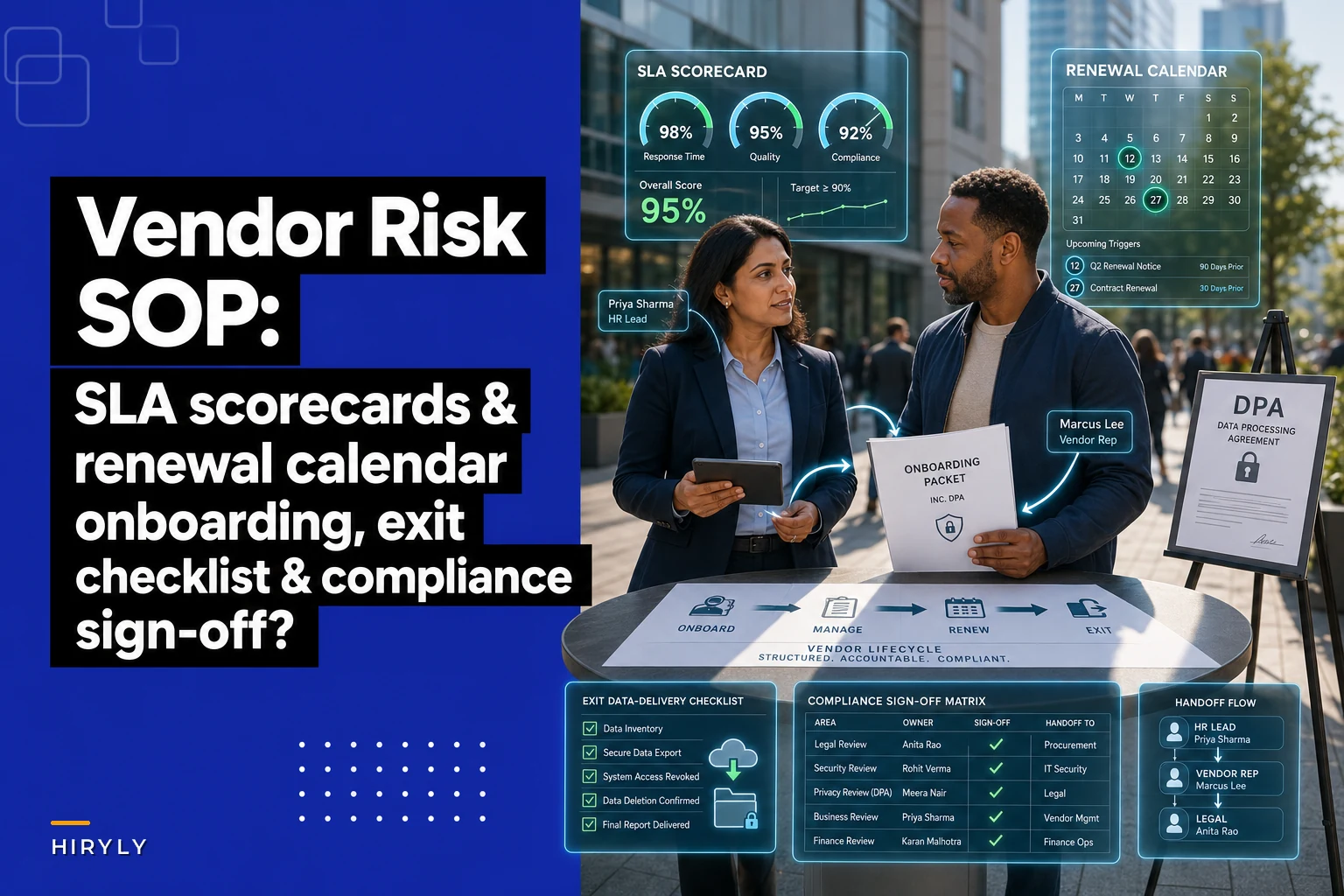
A working vendor lifecycle for HR needs five documents, and each one exists to prevent a specific failure. Skip any of them and you'll feel the gap eventually.
| Artifact | Prevents | When it gets used |
|---|---|---|
| Onboarding packet | Vague scope, unclear owners, missing data agreements | At contract signing |
| SLA scorecard | Silent underperformance with no evidence | Monthly / quarterly |
| Renewal calendar | Auto-renewals and last-minute negotiation panic | 90–120 days before renewal |
| Exit data-delivery template | Being held hostage by your own data | At notice of termination |
| Compliance sign-off matrix | PII exposure, missing DPAs, audit gaps | Onboarding + annual review |
Most teams have maybe one and a half of these. Usually a signed contract and a vague memory of what was promised in the sales call. That's not a system. So let's build each piece.
The onboarding packet: get the boring stuff on paper before the honeymoon ends
The onboarding packet is the single highest-leverage document in the whole SOP, because it's the only one created while the vendor is still eager to please. Once the ink dries, your negotiating leverage drops significantly. Capture everything now.
Eliminate HR bottlenecks with smart automation.
Hiryly simplifies your HR operations so you can focus on people, not paperwork.
- Centralized candidate tracking
- Automated onboarding workflows
- Performance & compliance dashboards
No credit card required
-
Scope statement in plain language — not the legal SOW, a one-page description of what this vendor actually does for you and what they don't
-
Named contacts on both sides — your internal owner, their account manager, and the escalation path with actual names, not "support@"
-
Data flow map — what candidate/employee data goes to them, how it's transmitted, where it's stored, and who on their side can see it
-
Signed DPA and any sub-processor list — this matters enormously and gets skipped constantly
-
Integration inventory — which systems this vendor touches (ATS, HRIS, SSO) and who owns each connection
-
Agreed SLAs with actual numbers — turnaround times, uptime, response windows
-
Exit terms — data return format, deletion certification, notice periods, transition support obligations
That last one is the trick almost everyone misses. The best time to negotiate your exit is when you're signing on. When you're actually leaving, the vendor has no incentive to be helpful.
One thing worth noting: teams that build a solid data flow map during onboarding also make their broader HR data governance work far easier, because they already know exactly where employee PII is flowing outside the org.
The SLA scorecard: turn "they've been kind of slow lately" into evidence
Vendor performance decay is never a cliff. A background check vendor that promised 3-day average turnaround creeps to 4 days, then 5, then you're regularly waiting 6 or 7 days on a chunk of your checks. Nobody logs it. The recruiter grumbles and works around it. Eight months later you're annoyed but you have zero documentation, so any pushback becomes a "he said, she said" conversation with the account manager.
-
Average turnaround time vs. the contracted target
-
% of checks exceeding SLA (this is the one that catches decay early)
-
Error/re-run rate — how often results come back needing correction
-
Responsiveness — hours to resolve an escalation
-
Billing accuracy — invoices matching contracted rates
Score each red / amber / green, add a one-line note, and file it. The whole thing takes maybe 15 minutes a month per vendor. The value isn't the score itself — it's that when renewal comes, you walk in with six months of amber flags and say "we need to talk about turnaround before we renew." That's actual leverage.
A realistic example of what this catches: a 60-person company using an assessment vendor priced around $18k/year noticed their scorecard showing an amber "candidate completion rate" for four straight months. Turned out the vendor had changed their test interface and candidates were dropping off mid-assessment. Without the scorecard, they'd have blamed their own pipeline. With it, they had a concrete conversation, got the interface issue fixed, and pulled a partial credit.
The renewal calendar: the cheapest risk reduction you'll ever implement
Auto-renewal clauses are where HR budgets quietly bleed. A tool renews at a 7% uplift nobody approved. A recruiting agency retainer rolls over for another year even though you barely used them last quarter. The contract had a 60-day cancellation window and you found out 30 days after it closed.
The renewal calendar is embarrassingly simple and enormously effective. For every vendor, you log:
-
Contract end date
-
Auto-renewal yes/no
-
Notice window required (30/60/90 days)
-
The decision trigger date — end date minus notice window minus your own review buffer
That decision trigger date is the one that matters. If a contract ends December 31 with a 60-day notice requirement, and you want 30 days to review the scorecard and decide, your trigger date is roughly October 1. That's when a task fires to the vendor owner: pull the scorecard, decide renew/renegotiate/exit.
When this matters most: vendors with steep auto-renewal uplifts, multi-year commitments, or high switching costs. A $2k/year survey tool renewing quietly isn't worth losing sleep over. A $90k ATS auto-renewing before you've evaluated a competitor absolutely is.
Teams that get this right usually stop treating renewals as calendar reminders in someone's Outlook and start treating them as workflow steps with owners and gates — the same discipline you'd apply in a real hiring governance framework with SLA templates and audit gates. A renewal is just another approval gate; treat it like one.
The exit data-delivery template: don't get held hostage by your own records
This is the artifact that saves you when things go wrong, and it's the one people only understand after a painful exit.
Picture switching away from an ATS you've used for four years. You give notice. Then you ask for your data. The vendor sends a CSV export that's missing all interview feedback, has candidate stages mislabeled, strips out resume attachments, and provides no clean mapping to your new system's fields. Migrating becomes a manual archaeology project that eats weeks.
The exit data-delivery template, agreed at onboarding, specifies:
-
What data you get back — records, attachments, notes, audit logs, everything, itemized
-
Format — structured export with a documented schema, not a random dump
-
Timeline — data delivered within X days of termination
-
Deletion certification — written confirmation they've purged your data and instructed sub-processors to do the same
-
Transition support — how many hours of vendor assistance are included during cutover
A quick checklist to pressure-test any vendor before you sign:
-
[ ] Can they export all data types you'll need, including attachments and free-text notes?
-
[ ] Do they provide a field-level schema with the export?
-
[ ] Is there a contractual delivery timeline for exit data?
-
[ ] Will they certify deletion in writing?
-
[ ] Are transition-support hours specified, not "best effort"?
-
[ ] Who owns the migration on both sides?
If a vendor hesitates on the deletion certification or won't commit to an export timeline, that's information. It tells you what leaving will feel like — before you're stuck.
The compliance sign-off matrix: one grid that keeps you audit-ready
HR vendors touch the most sensitive data in the company, which means every one of them is a potential audit finding waiting to happen. The compliance sign-off matrix is a single grid that maps each vendor against the compliance requirements that apply to them, with a sign-off owner and a review date.
-
Signed DPA on file
-
Sub-processor list reviewed
-
Data residency confirmed (matters for global hiring vendors)
-
Security attestation (SOC 2 / ISO) current
-
Access review completed (who at the vendor can see your data)
-
Retention/deletion terms documented
-
Next review date
The key insight here: vendor compliance isn't a one-time signing event, it's a recurring review. A SOC 2 report expires. A vendor adds a new sub-processor you never approved. Their security posture drifts. The matrix forces an annual re-check with a named owner, so you're never scrambling to prove vendor compliance when legal or a customer's security team comes asking.
Where this whole SOP tends to break down
Building the artifacts is the easy part. The failure mode is almost always ownership and cadence. Documents get created during a burst of enthusiasm, nobody's job becomes updating the scorecard or watching the renewal trigger dates, and six months later the system is stale.
-
No single vendor owner. If "HR" owns a vendor, nobody owns it. Assign a named person per vendor.
-
Scorecards without a cadence. A scorecard filled out once is worse than none — it creates false confidence.
-
Renewal dates living in someone's head. The moment that person leaves or gets slammed, the auto-renewals start winning.
-
Exit terms negotiated at exit. Always too late.
This is exactly the kind of recurring, multi-step, easy-to-forget workflow that benefits from being managed inside an operational platform rather than a spreadsheet graveyard. When renewal trigger dates, scorecard reminders, and compliance review dates fire automatically to the right owner — instead of relying on someone remembering — the SOP actually survives contact with a busy quarter.
Assign a named vendor owner in your HRIS or task system so responsibility doesn't evaporate when someone leaves.
That's the real value of putting vendor lifecycle steps into a system with AI-assisted reminders and status tracking: not automation for its own sake, but the fact that nothing quietly slips.
Here's a simple workflow visualization:
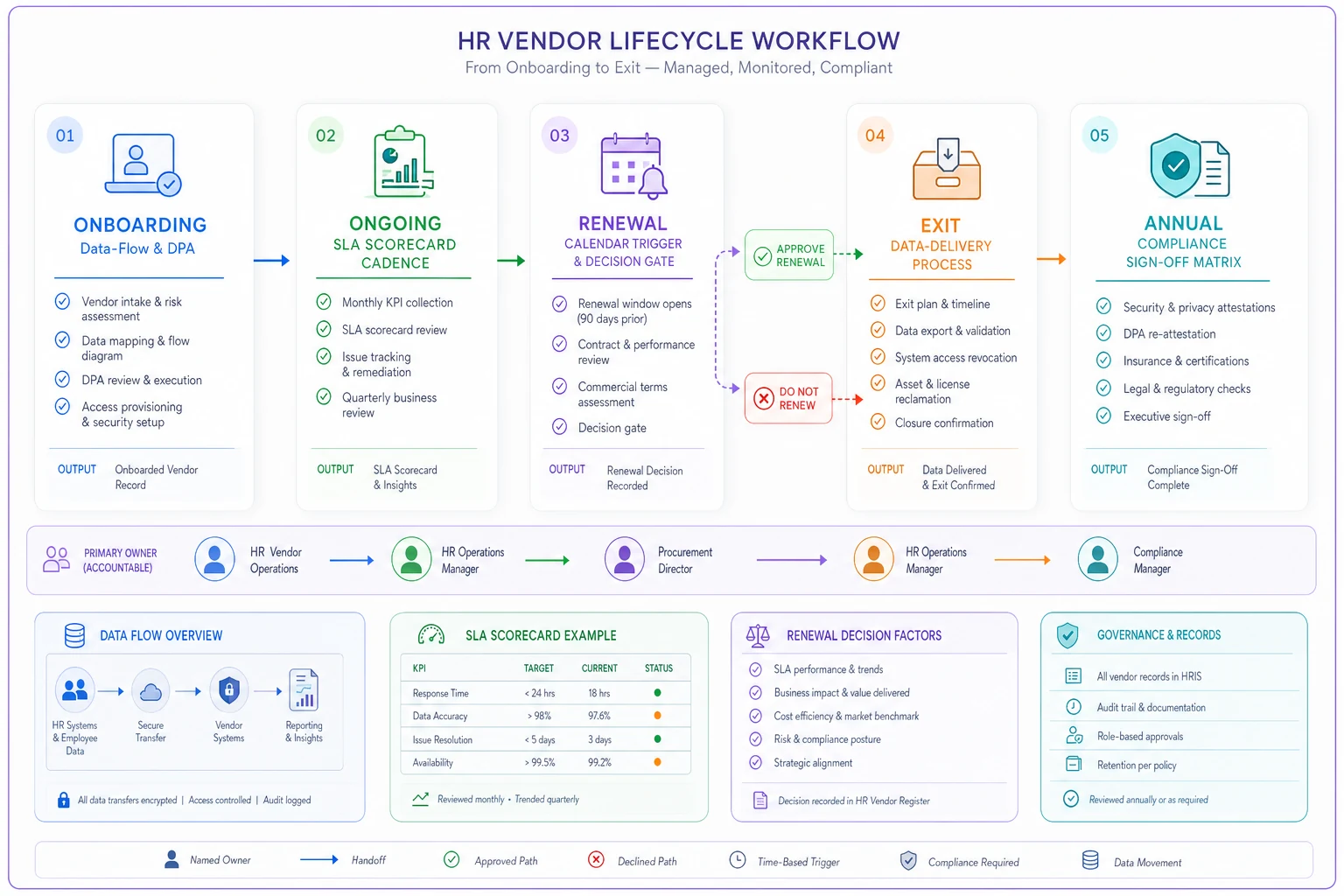
When renewal trigger dates, scorecard reminders, and compliance review dates fire automatically to the right owner, the SOP survives a busy quarter.
A realistic before-and-after
A regional services company with about 40 monthly hires was running roughly 18 HR-related vendors with no central management. Two things kept biting them: a recruiting-tools subscription auto-renewed at a 9% increase they'd have declined, and switching background check providers took nearly six weeks because the old vendor's export was a mess.
They spent about two weeks standing up the five artifacts — onboarding packets for new vendors, scorecards for the top eight by spend, a renewal calendar with trigger dates, exit templates baked into new contracts, and a compliance matrix.
The change over the following year wasn't dramatic-sounding but it was real. They caught two auto-renewals early and renegotiated both, saving somewhere in the low five figures. The scorecard surfaced a consistently underperforming assessment vendor they eventually replaced. And because new contracts now included exit data terms, their next vendor switch took about a week instead of six. No heroics — just the boring documents doing their job.
When you actually need this level of rigor
Not every vendor needs the full treatment. Three low-cost tools and a stable set of relationships might only need a lightweight renewal calendar.
-
You manage more than ten HR vendors
-
Vendors handle candidate or employee PII (which is most of them)
-
You have contracts with auto-renewals and meaningful switching costs
-
You've been burned by a bad exit or a surprise uplift before
-
You're subject to audits or customer security reviews
Who should probably not overbuild this: a very small team with two or three vendors and simple month-to-month terms. Building a five-artifact matrix there is process for its own sake. Start with the renewal calendar and the exit checklist, add the rest as you grow.
The point
Vendor risk in HR is rarely a single dramatic failure. It's the slow accumulation of unwatched performance, unreviewed renewals, and unspecified exits — small gaps that only become visible at the worst possible moment.
The five artifacts here exist to make those gaps visible early, while you still have leverage to do something about them. Build them once, assign real owners, and put them on a cadence that survives a busy quarter. That's the whole SOP.
Vendor risk in HR is rarely a single dramatic failure. It's the slow accumulation of unwatched performance, unreviewed renewals, and unspecified exits — small gaps that only become visible at the worst possible moment.
Ready to transform your HR processes?
Join thousands of HR teams using Hiryly to hire faster, engage employees better, and stay compliant effortlessly.