

Most reference checks are theater. The recruiter calls two names the candidate handed over, both of whom are friends or a favorable ex-manager, hears "great person, would hire again," writes a one-line note, and the offer sails through. Nobody scores anything. Nobody defines what a red flag actually is. And when a hire blows up three months later, there's no paper trail showing what the reference check found — because it didn't find anything, it just confirmed what everyone already wanted to believe.
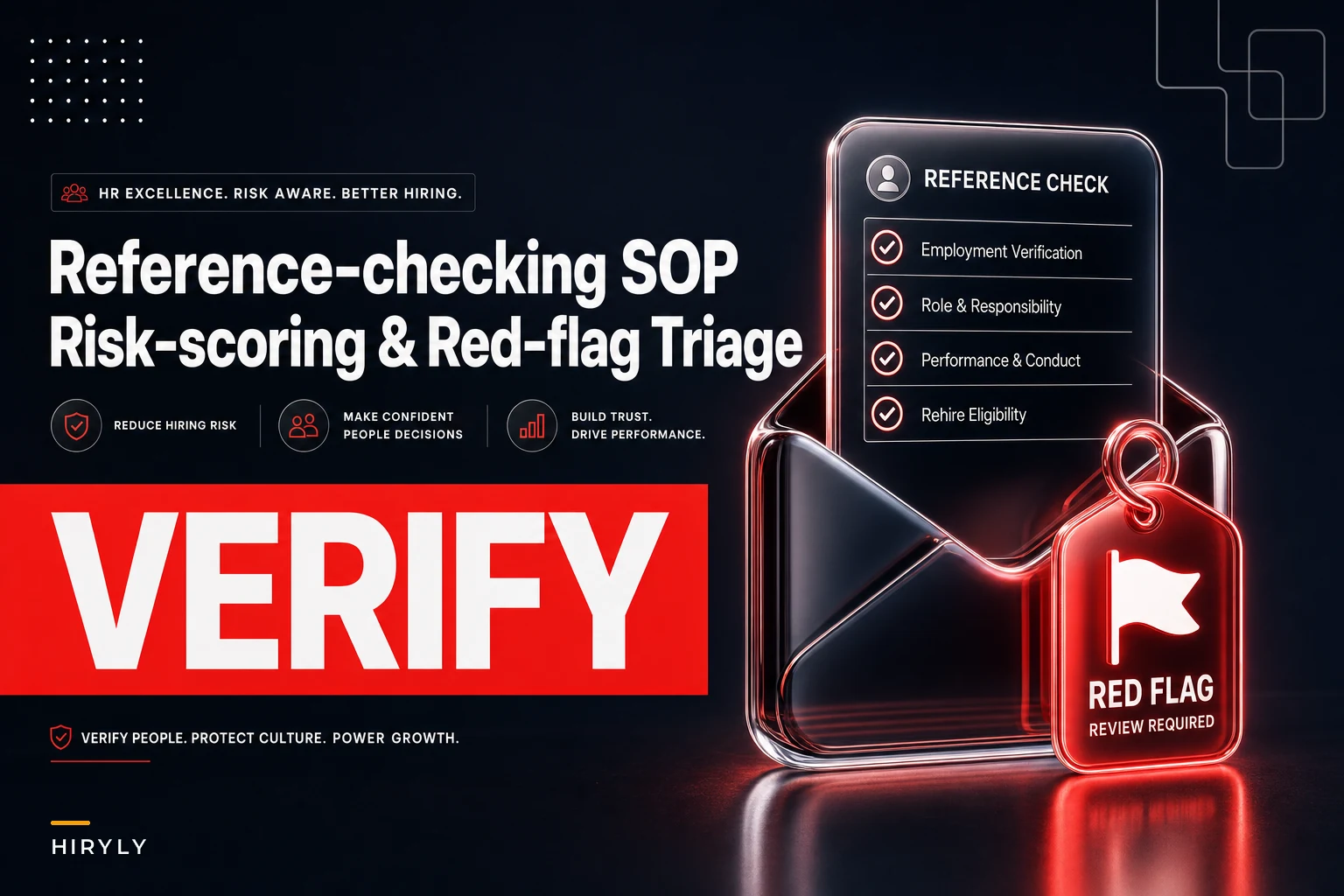
That's the core failure. Reference checking sits at the exact point where a hiring decision becomes expensive to reverse, and yet it's usually the least standardized step in the whole pipeline. This piece is about fixing that specific gap: building a reference checking SOP with a standard questionnaire, a red-flag triage system, a risk-scoring rubric, and clear rules for when you handle it in-house versus hand it to a vendor.
Why reference checks fail as a gate
The step exists to catch things the interview can't — patterns of behavior, how someone actually performs under pressure, whether the story they told about "why I left" matches reality. But three things quietly break it.
First, candidate-selected references are self-selecting. Nobody hands you a name expecting a bad review. So the raw signal is skewed positive before you even dial. If your SOP doesn't account for that bias, you're essentially scoring noise.
Second, there's no rubric, so every recruiter interprets answers differently. One recruiter hears "he can be a bit intense in meetings" and flags it. Another hears the same thing and writes "passionate." Same input, opposite outcome. When interpretation lives in someone's head, the gate isn't really a gate — it's a mood.
Third, the timing is wrong. References often get run after the verbal offer, which means the decision is emotionally made and the reference check becomes a formality people rush through to avoid re-opening a closed loop. A red flag that surfaces at that point rarely stops anything.
A typical example looks like this: a mid-size company extends a verbal to a sales lead, references come back with one former manager who's vague and slightly cold — "I'd say she's better in a very structured environment." Nobody knows what to do with that. It's not a "no." It's not a "yes." So it gets ignored, and six months later she's struggling in exactly the loosely-structured role she was warned about. The signal was there. The system to act on it wasn't.
The standard questionnaire — same questions, every time
The fastest quality improvement is boring: ask the same questions in the same order for every candidate at the same level. Variation in questions creates variation in answers, and variation in answers makes scoring meaningless.
Eliminate HR bottlenecks with smart automation.
Hiryly simplifies your HR operations so you can focus on people, not paperwork.
- Centralized candidate tracking
- Automated onboarding workflows
- Performance & compliance dashboards
No credit card required
Build the questionnaire around behavior you can verify, not opinion you can't. Skip "was she a good employee?" That invites a useless yes. Ask things that force specifics:
-
"What were the two or three things she was clearly responsible for, and how do you know they got done?"
-
"Walk me through a time a deadline slipped. What happened and what was her part in it?"
-
"If you were staffing a team again, what kind of role would you not put her in?"
-
"How would you describe the way she handles being told she's wrong?"
-
"Is there anything about her performance you'd want a future manager to know going in?"
That last one is the workhorse. It gives a hesitant reference permission to volunteer a concern without feeling like they're torpedoing someone. The strongest negative signals almost never come from a direct question — they come from a pause, a reframe, or a carefully diplomatic sentence after you've made it safe to say something real. Keep the set tight. Eight to ten questions, tiered slightly by role seniority. You want consistency, not a 40-minute interrogation that references start declining to give.
The red-flag triage rubric
This is the piece almost nobody documents, and it's the piece that makes the SOP defensible. A red flag isn't just "something bad." It's a defined signal with a defined severity and a defined response. Without that, "red flag" means whatever the recruiter felt that afternoon.
Split flags into three tiers:
| Tier | What it looks like | Response |
|---|---|---|
| Tier 1 — Hard stop | Refusal to confirm employment dates or title, discovered fabrication (e.g. claimed "director," reference says "senior analyst"), reference reports termination for integrity/safety issues | Pause offer. Escalate to hiring manager + recruiting lead. Requires documented resolution before proceeding. |
| Tier 2 — Investigate | Consistent theme of a real weakness across references, reluctance to re-hire without a clear reason, mismatch between candidate's stated role and reference's account of scope | Don't kill the offer, but run one additional reference and a targeted follow-up. Document the reconciliation. |
| Tier 3 — Note and proceed | Minor stylistic concerns, single mildly cool reference among positive ones, normal human imperfection ("occasionally overcommits") | Record it, share with hiring manager, no gating action. Useful for onboarding context, not for blocking. |
The value of tiering is that it forces the "what now" conversation to happen before the flag appears — when everyone's calm and objective — instead of after, when there's an offer on the table and pressure to just move forward.
One pattern worth calling out: the single cold reference among three warm ones is where most gating mistakes happen. Recruiters either overweight it (kill a good candidate over one grumpy ex-manager) or dismiss it entirely (ignore the one person who actually saw the problem). The tiering forces a middle path — you investigate rather than react.
A simple risk-scoring rubric
You don't need a machine-learning model here. You need a score that's consistent and explainable. Score each completed reference on a few dimensions, sum it, and set thresholds.
-
Verifiability — did they confirm dates, title, and scope cleanly? (Vagueness scores low.)
-
Re-hire willingness — would they hire this person again, and did they say it without hesitation?
-
Consistency — does their account match the candidate's story and the other references?
-
Concern density — how many substantive concerns surfaced, weighted by severity?
-
Reference quality — is this an actual former manager, or a peer the candidate picked to look good?
Add them up per reference, average across references, and map to a band:
-
High confidence (avg 4.0+) proceed, no gating condition.
-
Moderate (3.0–3.9) proceed, but attach any Tier 2/3 notes to onboarding and manager brief.
-
Low (2.0–2.9) hold. Run an additional independent reference before the gate opens.
-
Fail (below 2.0 or any Tier 1 flag) offer paused pending escalation.
The point isn't the exact math. It's that two different recruiters checking the same candidate should land within a point of each other. That's the real test of whether your rubric reduces subjectivity — run a few checks in parallel early on and see if scores converge. If they don't, your questions or your dimensions are still too fuzzy.
Where references fit in the offer gate
Timing decides whether any of this matters. If you run references after the emotional commitment is made, you've built a beautiful rubric that nobody will act on.
The workflow that actually holds:
-
Interviews complete and the hiring manager signals intent to hire.
-
Reference check runs as a formal gate condition — before the verbal offer, or with the verbal explicitly framed as "contingent on references."
-
References scored against the rubric within a defined SLA (3–4 business days so it doesn't stall momentum).
-
Score and any flags reviewed against the tier response table.
-
Gate decision recorded
pass / hold / escalate — with the reasoning attached.
-
Only a "pass" releases the formal written offer.
Here's a visual of that workflow.
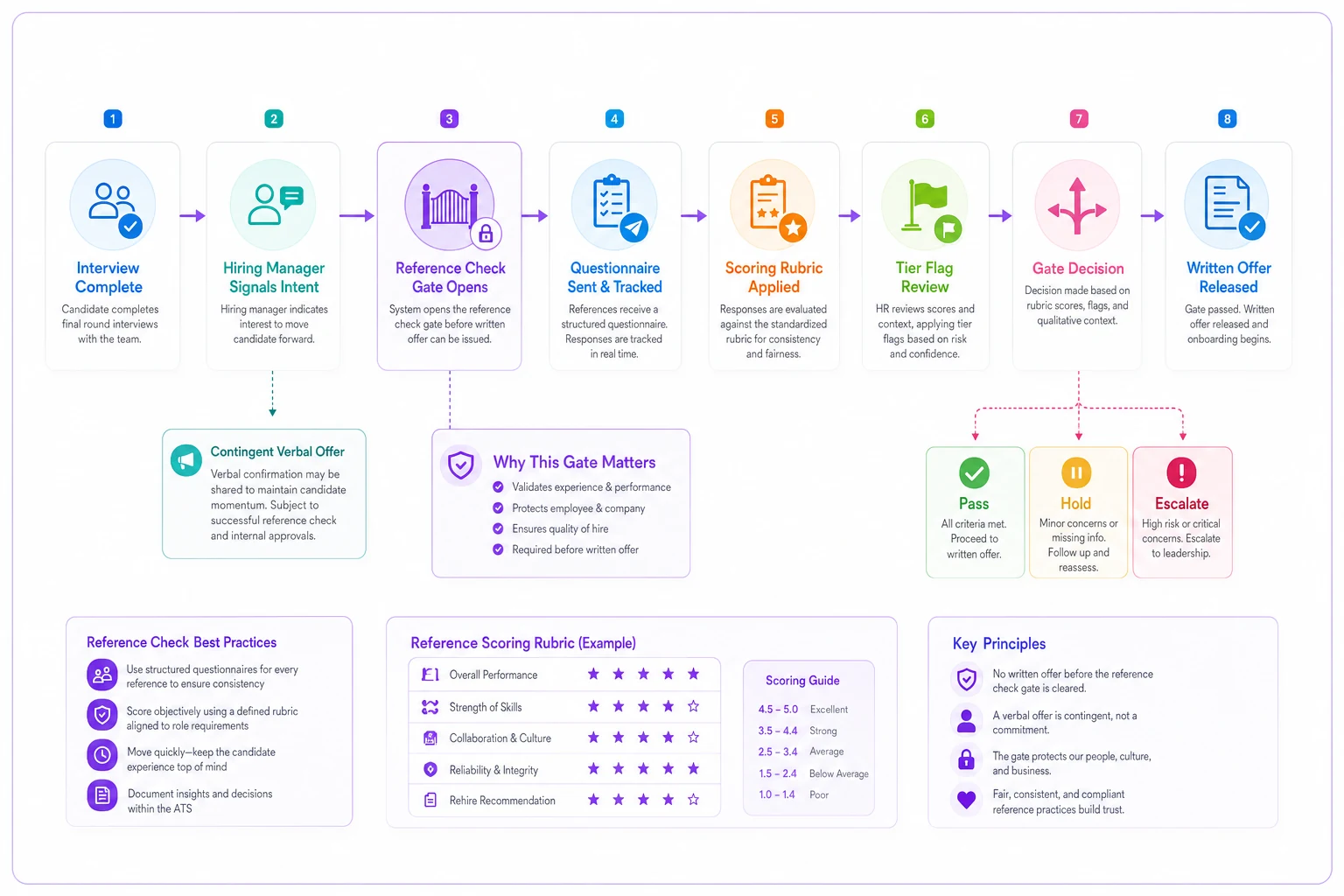
Framing the verbal as contingent is the small move that saves you. It keeps the door open to act on a Tier 1 or 2 finding without the candidate feeling like you reneged. This also connects directly to the tail end of the process — a clean gate here feeds a cleaner handoff into onboarding, which matters a lot when you're trying to keep momentum and avoid the drop-offs covered in closing the offer-to-onboard gap. And because a slow, opaque reference stage is itself a candidate-experience problem, it's worth watching how it lands against your stage-level signals from a proper candidate experience measurement system.
Vendor vs. manual: the trade-off that actually matters
The reflex is either "we've always done references ourselves" or "let's just outsource everything." Both are wrong for most teams. The real answer is volume- and risk-dependent.
| Factor | In-house manual | Vendor / outsourced |
|---|---|---|
| Best at | Nuanced senior roles, reading between the lines, follow-up probing | Volume, employment/date verification, consistency at scale |
| Speed | Slower per check, faster to start | Faster at volume, setup overhead |
| Cost | Recruiter time (often hidden) | Per-check fee, predictable |
| Signal depth | High if recruiter is skilled | Standardized, sometimes shallow on soft signals |
| Compliance/documentation | Depends on discipline | Usually strong, built-in audit trail |
A useful split: verification tasks go to a vendor or automated intake; judgment tasks stay human. Employment dates, title confirmation, and reference-response collection are mechanical — let a vendor or an automated questionnaire tool handle the chasing and logging. But the moment a Tier 1 or Tier 2 signal appears, a skilled human runs the follow-up call. Machines are bad at hearing the hesitation before "well…". People are bad at consistently chasing four references over five days without dropping something.
A useful split: verification tasks go to a vendor or automated intake; judgment tasks stay human.
This is also where light automation earns its place inside the SOP — not as a decision-maker, but as the thing that sends the standardized questionnaire, tracks who's responded, applies the scoring math consistently, and routes anything below threshold to a human for review. The gate logic stays owned by your team; the busywork and the interpretation drift get handled quietly in the background. That's the sensible version of automation here: it removes the manual drag without pretending software should decide who gets hired.
When outsourcing references is a bad idea
If your hires are mostly senior, low-volume, and high-stakes, outsourcing the judgment is a mistake. A vendor reading from a script won't catch the diplomatic non-answer that tells you everything. Keep those in-house and invest in recruiter training instead.
When manual-only is a bad idea
If you're running high volume — say 30+ hires a month — and still doing every reference by hand with no scoring rubric, you're guaranteed inconsistency and you're eating recruiter hours you can't account for. That's the profile where structured intake plus a vendor for verification pays off fast.
A short real scenario
A regional healthcare staffing firm was hiring roughly 25–30 clinical support staff a month. References were done ad hoc — whoever had time called whoever the candidate listed. No rubric, no tiering. Over about a year they'd had a handful of early terminations tied to issues a reference had actually hinted at but that never got escalated.
They put in a standard questionnaire, the three-tier flag system, and the 1–5 scoring rubric, and moved reference checks to a contingent gate before the written offer. Verification — dates, license, prior employer confirmation — went to a vendor. Anything that scored in the "hold" band or threw a Tier 2 flag got a human follow-up call.
The change wasn't dramatic on the surface. Total time-to-offer moved by maybe a day or two. But the number of checks that got a documented, defensible outcome went from basically none to nearly all of them, and over the next couple of quarters early terminations tied to reference-visible issues dropped noticeably. The bigger win was quieter: when a hire did go sideways, they finally had a record showing what the check found and why the gate opened anyway — which changed how hiring managers made the call the next time around.
The one thing to get right
Decide what a red flag means, and what you'll do about it, before you make the call — not after. The questionnaire, the rubric, the vendor split, the automation — all of it exists to move the judgment upstream of the emotional commitment.
Reference checking only works as a gate when the answers are collected the same way every time, scored against a rubric two people would agree on, and tied to actions you defined while nobody was under pressure to say yes.
Everything else is just theater with a phone.
Ready to transform your HR processes?
Join thousands of HR teams using Hiryly to hire faster, engage employees better, and stay compliant effortlessly.