

Last month a tech company lost their top product manager to a competitor. The kicker? They had an open product leadership role that same manager would've been perfect for. Nobody connected the dots because she worked in a different division, used different terminology for her skills, and her current boss had no visibility into other teams' openings.
This happens constantly. Companies hemorrhage talent while simultaneously struggling to fill roles, because their internal mobility operating model either doesn't exist or runs on hope and spreadsheets.
The hidden cost of a broken internal mobility system
Most HR teams obsess over external hiring metrics — time to fill, cost per hire, quality of hire. Meanwhile, existing employees are scrolling LinkedIn during lunch, applying to roles that look suspiciously similar to positions open three departments over.
The numbers are frustrating. Companies with functioning internal mobility fill roles 2-3 weeks faster and save roughly $18,000 per placement compared to external hires. Internal moves also show 40-60% higher two-year retention. Yet most organizations treat internal mobility as an afterthought — something that happens organically through manager relationships and who-you-know.
Without a proper system, talent hoarding becomes the norm. Managers sit on high performers because there's no incentive to develop and release them. Employees feel trapped, especially when they watch external candidates land stretch roles while they're told to "wait for the right opportunity." The ambitious ones — usually your top 20% — leave first.
Skills taxonomy: the foundation nobody wants to build
Most companies have job descriptions that might as well be written in different languages across departments. Marketing calls it "stakeholder management," Sales calls it "client relations," Customer Success calls it "account ownership." Same skill, three names, zero connectivity.
Eliminate HR bottlenecks with smart automation.
Hiryly simplifies your HR operations so you can focus on people, not paperwork.
- Centralized candidate tracking
- Automated onboarding workflows
- Performance & compliance dashboards
No credit card required
Core skill categories (5-7 max)
-
Technical/Functional
-
Leadership/People Management
-
Business Operations
-
Client/External Relations
-
Strategic Planning
-
Communication/Influence
-
Domain Expertise
Skill definitions (15-20 words each) Keep these behavior-based, not philosophy-based. "Manages project budgets between $100k-$1M including vendor contracts and resource allocation" beats "Demonstrates fiscal responsibility and strategic resource management."
Proficiency indicators (observable, not subjective)
-
Has done it with guidance
-
Has done it independently
-
Has taught others to do it
-
Has redesigned how it's done
The mistake everyone makes is trying to map every possible skill before launching. Start with roles that have the highest turnover or longest fill times. Get 20 roles mapped properly rather than 200 roles mapped poorly.
Start with roles that have the highest turnover or longest fill times.
Here's a quick visual of the skills taxonomy building process.
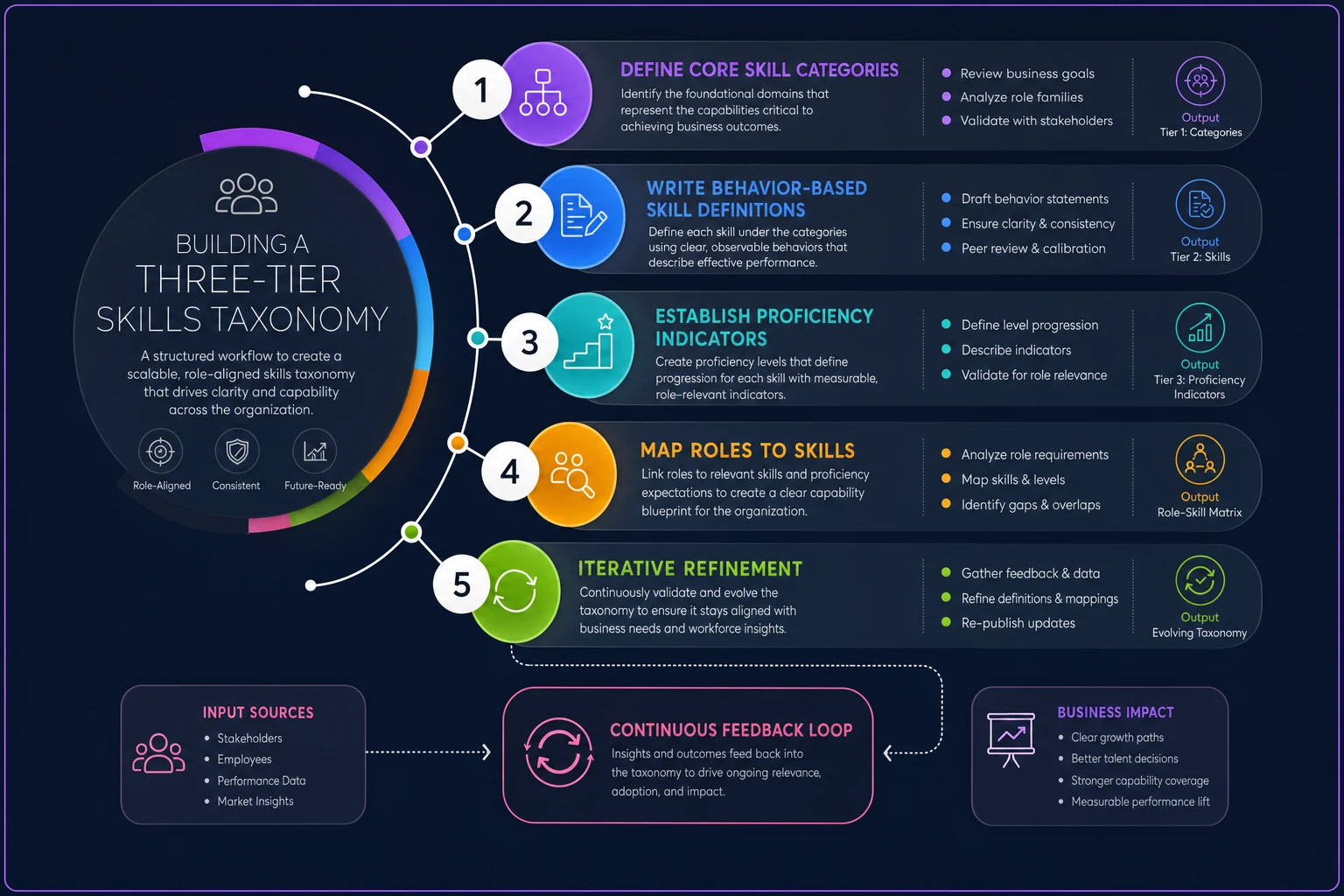
The mistake everyone makes is trying to map every possible skill before launching. Start with roles that have the highest turnover or longest fill times. Get 20 roles mapped properly rather than 200 roles mapped poorly.
Shortlisting rules that prevent manager gaming
Without clear rules, internal mobility becomes political. The sales director's golf buddy gets first dibs on the strategic projects role. The quiet high performer in finance never hears about it.
Your shortlisting system needs hard rules that trigger automatically:
Mandatory consideration triggers:
-
Any employee with 3+ matching core skills gets notified
-
Current role tenure of 12+ months (exceptions require VP approval)
-
Performance rating of "meets" or above in last cycle
-
No active PIPs or investigations
Priority scoring (simple math, not ML):
-
Matching skills
10 points each
-
Adjacent skills
5 points each
-
Previous experience in target department
15 points
-
Manager endorsement
20 points
-
Completion of relevant L&D programs
10 points
Auto-rejection criteria:
-
Less than 9 months in current role (unless restructuring)
-
Active performance improvement plan
-
Declined similar role in past 6 months
This might seem harsh, but unclear rules create more problems than strict ones. Employees can work toward clear criteria. They can't work toward "whoever the hiring manager likes."
The secondment approval matrix nobody thinks about until it's too late
Secondments and rotational assignments could solve half your mobility problems, but most companies treat them like exotic exceptions rather than standard tools. The result? Managers refuse to release people because there's no clear return path or backfill process.
A functioning secondment matrix addresses three questions upfront:
Who approves what duration?
-
0-3 months
Direct manager only
-
3-6 months
Direct manager + receiving manager
-
6-12 months
Department heads both sides
-
12+ months
Treat as permanent transfer
What gets backfilled?
-
Under 3 months
Redistribute within team
-
3-6 months
Contractor or internal stretch assignment
-
Over 6 months
Formal backfill process
What's the return guarantee?
-
Original role held for assignments under 6 months
-
Comparable role guaranteed for 6-12 months
-
No return guarantee beyond 12 months
The legal and compensation complexity here gets messy fast. Who pays for the employee during secondment? What happens to their bonus target? Who conducts performance reviews? These aren't philosophical questions — they're operational requirements that need answers before someone's first day in the temporary role.
Manager-to-manager handoff scripts that actually get used
The biggest friction point in internal mobility isn't policy or process — it's the awkward conversation between losing and gaining managers. Nobody teaches managers how to hand off employees professionally, so they either fight over talent or dump problems on each other.
The handoff needs structured talking points that both managers follow:
Week 1 conversation (losing manager leads): "Here's what Sarah excels at: [specific examples]. She struggles with [specific areas]. Her working style is [actual behaviors]. She's motivated by [observed patterns]."
Not: "Sarah's great, you'll love her" or "Good luck with that one."
Week 2 documentation transfer:
-
Last 2 performance reviews (full text)
-
Active development plan with progress notes
-
Current project list with handoff status
-
Stakeholder relationship map
-
Communication preferences and triggers
Week 4 check-in (gaining manager leads): "I'm seeing [specific behaviors]. Does that match your experience? Any advice on [specific situation]?"
Week 12 retrospective (both managers): "What worked in this transfer? What should we document for next time?"
Most handoffs fail because managers treat them like transactions instead of transitions. The losing manager feels robbed, the gaining manager feels unprepared, and the employee feels like cargo. Structure fixes this.
Measuring what matters: redeploy time and retention lift
Internal mobility metrics usually focus on volume — number of moves, percentage of roles filled internally, satisfaction scores. These tell you what happened, not whether it worked.
Redeploy time measures the real efficiency of your system:
-
Job posting to internal candidate identified
-
Internal candidate identified to interview scheduled
-
Interview complete to decision made
-
Decision made to start date
-
Start date to full productivity
Track each segment separately. Most companies discover their "fast" internal mobility process takes 8-12 weeks total — barely faster than external hiring. The breakdown usually shows 3-4 weeks lost to manager negotiations and approval chains that don't apply to external candidates.
| Metric | Internal Moves | External Hires | Gap |
|---|---|---|---|
| 6-month retention | 94% | 87% | +7% |
| 12-month retention | 88% | 76% | +12% |
| 24-month retention | 71% | 52% | +19% |
| Promoted within 2 years | 34% | 18% | +16% |
If your internal moves aren't showing at least 10% better retention at 12 months, your selection or support process has problems. Usually it's because internal candidates get less onboarding support — a strange thing to do to someone who already knows the company.
The uncomfortable truth about talent hoarding
Every organization claims they want managers to develop and release talent. Then they measure managers on team stability, penalize them for turnover, and make backfilling a nightmare. Of course managers hoard talent.
Breaking that cycle means changing the incentive structure:
Stop penalizing turnover blindly
-
Regrettable external turnover
Full penalty
-
Regrettable internal turnover
No penalty
-
Promoted team member leaving
Bonus points
Make talent development visible
Track how many employees each manager has successfully placed internally. Public scoreboard. Quarterly recognition. The manager who's placed zero people in two years has some explaining to do.
Guarantee backfill priority
-
Managers who release talent for internal moves get first priority on backfills.
-
Their positions get posted within 48 hours, not 4 weeks.
-
They get recruiter support immediately, not after external requisitions are cleared.
Create talent marketplace days Quarterly events where employees can openly explore internal opportunities without manager approval. Think internal career fair. Managers can't block attendance. HR tracks who shows up, who connects, and what happens next.
Breaking that cycle means changing the incentive structure:
When geography and compliance kill good intentions
Remote work made internal mobility simultaneously easier and harder. Easier because talent can move between locations without relocating. Harder because employment law, tax implications, and benefits administration become a mess.
A software engineer in Texas can't just slide into a role tagged for California without triggering state registration requirements, tax withholding changes, and benefits adjustments. Your 3-week internal mobility process just became a 12-week compliance exercise.
This requires pre-work:
Location flexibility matrix Define which roles can be performed from which locations before posting them. Not after someone applies. Include visa requirements, tax implications, and benefits eligibility upfront.
Compliance checkpoint automation Build triggers into your mobility system that flag moves requiring legal review. International transfers, state changes, contractor-to-employee conversions — these need automatic routing to legal and tax, not manual catching after the offer is made.
Cost burden transparency If moving someone from Ohio to California increases total compensation cost by 40%, everyone needs to know that before interviews start. The gaining manager might not have budget for California wages. The employee might not realize their purchasing power is about to drop.
This requires pre-work:
The skills database that doesn't become shelfware
Most companies build elaborate skills databases that employees ignore and managers distrust. Six months later, it's another dead HR system people mock in the break room.
Working skills databases share three things:
Continuous passive updating Skills update through project assignments, training completions, and peer endorsements — not annual self-assessments. When someone completes a Tableau training, their profile updates automatically. When they lead a project using Python, that gets logged. No manual entry required.
Visible value to employees Employees can see which skills gap them from target roles. Not vague competencies — specific skills with clear development paths. "You need Advanced Excel and Budget Management for that Senior Analyst role. Here's how to get them."
Manager verification requirements Managers verify team skills quarterly, but the process takes 15 minutes, not 3 hours. Simple interface: "Has Sarah demonstrated Python programming in the last quarter? Yes/No/Not Observed." That's it.
The biggest mistake is making skills tracking feel like performance management. The moment employees think skills data will be used against them, they'll game it or ignore it. Keep skills tracking separate from performance ratings, and say so explicitly and repeatedly.
Building momentum when nobody believes it will work
What typically happens: HR launches internal mobility with fanfare, a few brave employees apply for internal roles, they get rejected for vague reasons or ghosted entirely, word spreads that it's theater, participation collapses.
Starting small and proving value works better than big launches:
-
Pilot with eager departments first Find 2-3 department heads who genuinely want to share talent. Run mobility between their teams only. Iron out the problems with willing participants before forcing it on skeptics.
-
Publicize every single success When someone moves internally, make it visible. Email announcement, transition story, 90-day update showing they're thriving. You're fighting the underground narrative that internal moves are career suicide.
-
Track and share competitive losses When a high performer leaves for a role you had internally, document it. "We lost a senior analyst to a competitor for a role nearly identical to our open position in Division B." Make the cost visible.
-
Create mobility champions Identify employees who've moved internally before, even without a formal system. Make them visible advocates. Their stories carry more weight than any HR presentation.
Starting small and proving value works better than big launches:
The technology stack that makes it manageable
Manual internal mobility works for companies under 500 people. Beyond that, you need systems. Most companies try to force their ATS to handle internal mobility, which works about as well as using Excel for CRM.
Your mobility tech stack needs four components:
Skills intelligence platform Maps skills from various sources — HRIS, learning systems, project management tools — into a unified taxonomy. AI-powered platforms can infer skills from project descriptions and peer feedback, reducing manual entry significantly.
Opportunity marketplace Internal job board with intelligent matching, but more importantly, project and stretch assignment postings. Most growth happens through projects, not role changes. Employees need visibility into both.
Workflow automation Approval chains, notifications, and handoff tasks need to run automatically. When someone expresses interest in a role, their manager gets notified within 24 hours, not whenever HR remembers to send an email.
Analytics dashboard Real-time visibility into mobility metrics, pipeline health, and bottlenecks. Which departments are talent exporters versus importers? Where do internal candidates stall? What skills are you consistently buying instead of building?
Integration requirements here get complex quickly. Your skills platform needs to connect to your HRIS, LMS, ATS, and potentially your project management system. Most companies underestimate this effort by a factor of three.
Making the business case when finance pushes back
Finance will question the ROI of internal mobility infrastructure. They'll point to the cost of new systems, dedicated headcount, and manager time. The economic argument that actually lands:
Quantifiable savings per internal placement:
-
Avoided external recruiting fees
$15,000-$30,000
-
Reduced time-to-productivity
4-6 weeks faster
-
Lower failure rate
20-30% reduction in 12-month turnover
-
Knowledge retention value
6-12 months of institutional knowledge
For a 5,000-person company making 500 annual hires, shifting just 20% to internal mobility saves roughly $2-3 million annually in direct costs. That's before counting productivity gains and retention improvements.
The risk mitigation argument: Every competitor poaching your talent knows something you don't — which of your employees are ready for the next level. They're essentially getting your talent assessment for free. A functioning early warning system for attrition paired with internal mobility can flip this dynamic.
The strategic flexibility argument: When markets shift, companies with strong internal mobility can reorganize faster. Instead of layoffs and rehiring, you redeploy. The tech company that can shift engineers from consumer to enterprise products without losing half the team has a real competitive edge.
Common failure patterns and how to prevent them
After watching dozens of internal mobility programs launch and fail, the patterns become predictable:
The "Special Cases" death spiral It starts with one executive getting an exception to the tenure requirement. Then a rainmaker's favorite analyst gets fast-tracked. Soon the rules mean nothing and trust evaporates. Prevention: Document every exception with business justification. Publish exception rates quarterly. When exceptions exceed 10%, the system needs redesign.
The "Not Ready Yet" trap Managers perpetually claim their high performers aren't ready for the next level, while hiring external candidates with less experience for similar roles. Prevention: Create objective readiness criteria. If someone meets 70% of requirements, they're ready with support.
The "Mobility Theater" problem Companies go through the motions — posting jobs internally first, interviewing internal candidates — but hiring decisions are predetermined. Prevention: Track offer rates for internal versus external candidates by role level. If internal candidates never win senior roles, you have theater, not mobility.
The "Abandoned Champion" syndrome HR owns the program but has no power to enforce participation. Managers ignore it, employees lose faith, and it becomes another dead initiative. Prevention: CEO sponsorship isn't optional. Mobility metrics need to show up in executive dashboards. Department heads need mobility KPIs.
After watching dozens of internal mobility programs launch and fail, the patterns become predictable:
Building an operating model that actually operates
Internal mobility isn't a program or initiative — it's an operating model that either functions or doesn't. The difference between companies that retain talent and companies that watch it walk out the door isn't intention, it's infrastructure.
The components outlined here — skills taxonomy, shortlisting rules, secondment approvals, handoff protocols, measurement systems — aren't suggestions. They're operational requirements. Skip any of them and you end up with mobility theater that frustrates employees and wastes resources.
Internal mobility also competes directly with external opportunities. Your internal process needs to be faster, clearer, and more supportive than what employees experience applying elsewhere. That's a high bar, but it's the only one that matters.
The companies getting this right aren't perfect. They've just built enough structure to make internal movement the path of least resistance. Their employees explore internal opportunities first, not last. Their managers develop talent instead of hoarding it. Their onboarding processes work equally well for internal transfers as external hires.
The alternative is watching your best people leave for opportunities that existed down the hall. That's an expensive way to run a business, and an exhausting way to run HR.
The alternative is watching your best people leave for opportunities that existed down the hall. That's an expensive way to run a business, and an exhausting way to run HR.
Ready to transform your HR processes?
Join thousands of HR teams using Hiryly to hire faster, engage employees better, and stay compliant effortlessly.