
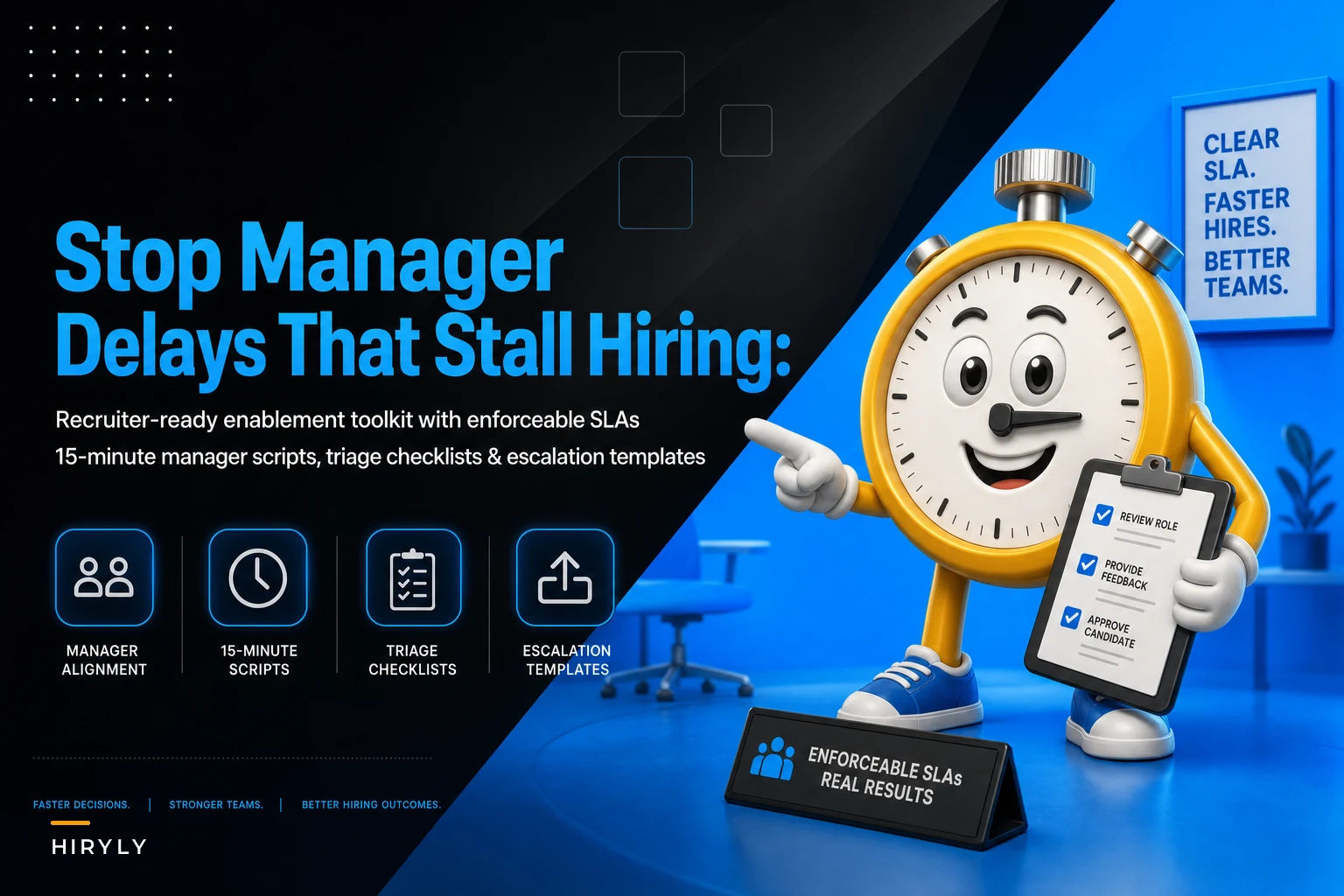

You lose a candidate every 4.7 days of manager delay. That's what happens when hiring managers sit on interview feedback, ghost scheduling requests, or take weeks to review resumes. The average tech recruiter burns around 11 hours a week just chasing down managers for decisions that should take minutes.
The math gets ugly fast. A delayed hire in engineering costs roughly $27,000 in lost productivity over three months—assuming a $140k role running at 65% capacity while vacant. Sales roles are even worse. You're looking at $45,000+ in missed pipeline per quarter.
Most recruiting teams try to fix this with more meetings, more reminders, more Slack messages. But manager delays aren't a reminder problem. They're a structure problem. Managers don't know what you need, when you need it, or why their 3-day delay just killed your top candidate's interest.
Why manager delays actually happen (it's not what HR thinks)
Recruiters assume managers are just busy or don't care. That's only partly true. The real breakdown happens because managers don't have a clear operating model for their role in hiring.
Watch what happens during a typical req. The recruiter posts the job, sources candidates, schedules screens. Then suddenly needs the manager to review 12 resumes by Thursday. But the manager doesn't know this is coming. They're in back-to-back meetings. They finally look at resumes Sunday night, reject 10 with no feedback, approve 2 with "looks good."
The recruiter now has to guess why those 10 got rejected. They schedule the 2 approved candidates. One ghosts because it's been 8 days since they applied. The other interviews next week. The manager takes 5 days to submit feedback because they're "thinking it over." Meanwhile, that candidate just accepted an offer elsewhere.
This pattern repeats on every single req. The recruiter becomes a project manager instead of a talent partner. The manager feels nagged and defensive. Good candidates disappear into faster-moving companies.
What managers typically don't understand about their delays:
The 72-hour rule breakdown: Once a candidate applies, you have 72 hours to make first contact before response rates drop by 60%. Every additional day cuts another 10-15%. By day 7, you're at around 25% response rate.
Interview feedback decay: Managers think taking a few days to "process" their thoughts improves feedback quality. It doesn't. After 48 hours, managers forget roughly 40% of interview details. After a week, they're basically making decisions on vague impressions.
Candidate momentum: Strong candidates are usually running 3-5 parallel processes. When you delay, you're not just losing time—you're losing competitive position. That senior engineer you're mulling over just moved to final rounds with two other companies.
The enforcement problem nobody talks about
Every recruiting team has tried SLAs. They create documents stating managers must review resumes within 2 days, submit interview feedback within 24 hours, make offer decisions within 48 hours. Then nothing changes.
Eliminate HR bottlenecks with smart automation.
Hiryly simplifies your HR operations so you can focus on people, not paperwork.
- Centralized candidate tracking
- Automated onboarding workflows
- Performance & compliance dashboards
No credit card required
SLAs fail because they have no enforcement mechanisms. You can't actually force a VP of Engineering to submit feedback faster. You can't block their calendar if they don't review resumes. Traditional SLAs are suggestions dressed up as rules.
Real enforcement requires three things most teams don't have:
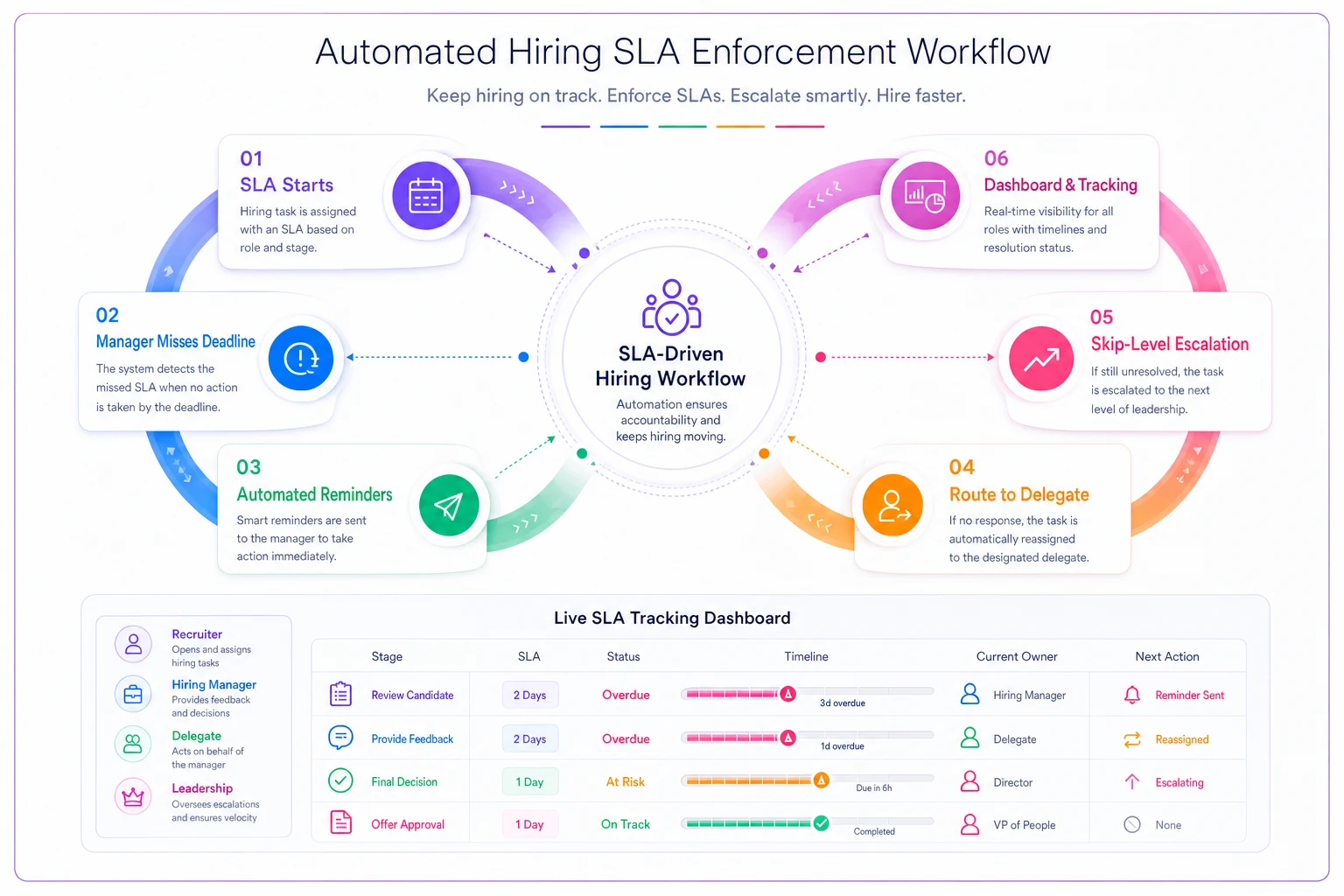
Escalation pathways: If a manager misses an SLA, what happens? Who gets notified? At what point does their boss get involved? Most teams have no answer to any of this.
Visible consequences: Managers need to see the damage their delays cause—not in abstract metrics, but in actual candidates lost, roles staying open, team productivity declining.
Alternative workflows: When a manager can't meet an SLA, you need a backup plan that doesn't involve waiting. Delegation protocols, approval proxies, automatic escalation.
Building your hiring manager enablement SLA toolkit
The solution isn't more rules. It's giving managers tools that make compliance easier than non-compliance. Here's the toolkit that actually works.
The 15-minute onboarding script
Most manager onboarding for hiring is either non-existent or a 90-minute HR presentation everyone forgets by Thursday. Instead, use this focused 15-minute script that covers only what matters:
Minutes 1-3: The cost frame "Every req you open costs the company $X per day unfilled. For your role, that's roughly $1,800 daily in lost productivity. Our average time-to-fill is 47 days, but manager delays add 19 days on average. That's $34,000 in preventable cost per hire."
Minutes 4-8: The three commitments
-
Resume reviews within 48 hours (Tuesday/Thursday batches)
-
Interview feedback within 24 hours (same-day preferred)
-
Offer decisions within 48 hours (with pre-set criteria)
"If you can't meet these, you delegate to [specific person] who has full authority to act on your behalf."
Minutes 9-12: The tools walkthrough
Show them:
-
The resume review interface (2 minutes max per resume)
-
The feedback form (pre-structured, 5 minutes to complete)
-
The decision matrix (binary choices, no essay required)
Minutes 13-15: The escalation preview
-
Hour 1
Automated reminder
-
Hour 24
Your delegate gets access
-
Hour 48
Skip-level notification with impact report
-
Hour 72
Req pauses, productivity loss calculation sent to leadership
This works because it's specific, short, and immediately actionable. Managers leave knowing exactly what's expected and what happens if they don't deliver.
Enforceable SLA templates that actually work
Standard SLAs read like legal documents. Enforceable SLAs read like operating manuals. Here's the structure that gets compliance:
| SLA Type | Commitment | Delegation Trigger | Enforcement After Deadline |
|---|---|---|---|
| Resume Review | 48-hour review, Tue/Thu batches, max 10 resumes | Auto-delegates to backup if unavailable | Recruiter advances top 30% based on pre-agreed criteria |
| Interview Feedback | Submitted same day as interview | 5-minute debrief call if traveling | Interview marked "neutral," process continues |
| Offer Decision | 48-hour decision on all recommendations | CFO authority for offers within approved ranges | Offer proceeds at midpoint of approved range |
All three SLA types include a weekly or monthly tracking report with delays flagged to leadership—resume review weekly, feedback timeliness monthly, offer decision delays quarterly.
Triage checklists for rapid decisions
Managers delay because they overthink. Triage checklists force quick, good-enough decisions:
Resume Triage (2 minutes per candidate):
-
□ Has 70% of must-have skills? → Yes/No
-
□ Salary expectations within range? → Yes/No
-
□ Can start within required timeframe? → Yes/No
-
□ Any obvious red flags? → Yes/No
Score: 3+ Yes = Phone screen, 2 or less = Reject
Interview Assessment (5 minutes post-interview):
-
□ Could they do the job today? → Yes/No
-
□ Would current team accept them? → Yes/No
-
□ Are they better than current pipeline? → Yes/No
-
□ Any concerns that training won't fix? → Yes/No
Score: 4 Yes = Strong hire, 3 Yes = Hire, 2 or less = No hire
Offer Decision (3 minutes):
-
□ Best candidate seen for role? → Yes/No
-
□ Within budget? → Yes/No
-
□ Available when needed? → Yes/No
-
□ References checked out? → Yes/No
Score: 4 Yes = Offer at ask, 3 Yes = Offer at midpoint
These checklists cut through analysis paralysis. Managers can't spend 45 minutes debating whether someone is "technically strong but culturally uncertain." They answer binary questions and move on.
Use the triage checklists immediately after interviews to capture fresh impressions.
Escalation scripts that preserve relationships
24-Hour Reminder (automated): "Hi [Manager], friendly reminder that feedback for [Candidate] is due. If you need help completing it, reply HELP and [Delegate] will handle it. Otherwise, please submit by [time] today."
48-Hour Escalation (from recruiter): "Hi [Manager], we're at risk of losing [Candidate] without your feedback. I'm looping in [Delegate] who can make the decision if you're unavailable. Please confirm by 2pm or we'll proceed with [Delegate]'s assessment."
72-Hour Skip-Level (automated to manager's boss): "[Manager] has missed the hiring SLA for [Role]. Current delay: 72 hours. Estimated cost of delay: $5,400. Candidate pipeline at risk: 3 strong candidates. Recommended action: Immediate delegation to [Delegate] to preserve pipeline."
Weekly Pattern Report (to leadership):
-
On-time responses
67%
-
Average delay
31 hours
-
Candidates lost to delays
2
-
Estimated productivity cost
$12,600
-
Chronic delays
[Manager A - 4 instances], [Manager B - 3 instances]
These scripts keep things professional while actually driving action.
How AI-powered operational software eliminates the enforcement problem
Manually enforcing SLAs burns out recruiting teams. You become the bad cop, constantly chasing and escalating. That's where AI-assisted operational platforms change the dynamic.
Modern recruitment operations software doesn't just track SLAs—it enforces them automatically. When a manager misses a deadline, the system routes the decision to their designated backup without anyone having to send an awkward message. Candidates keep moving.
The AI automation handles the tedious enforcement work: reminders sent at optimal times based on manager response patterns, feedback compiled from multiple interviewers into a single decision brief, candidates flagged for fast-tracking based on competing offer timelines.
These platforms can also predict delays before they happen. By analyzing manager calendar density, historical response times, and current workload, the system spots high-risk situations early and suggests delegation or calendar blocks before anything falls through.
It's not about replacing human judgment. It's about removing the friction that causes delays in the first place. Managers still make hiring decisions, but now those decisions happen inside structured workflows that prevent bottlenecks from building up.
Here's a simple workflow visualization of automated enforcement and delegation.
The better platforms also create transparency without blame. Managers see their own SLA performance alongside peers, understand which specific delays cost which candidates, and get concrete suggestions for improvement. Once candidates accept offers, the handoff to onboarding becomes critical—another area where automated workflows prevent costly drops.
When SLAs actually backfire (and what to do instead)
Not every hiring situation benefits from strict SLAs. Knowing when to flex is just as important as enforcement.
Executive hiring: C-level and VP roles operate on different timelines. A 24-hour feedback SLA for a CFO interview is unrealistic and counterproductive. Use weekly checkpoints and advisory committees to maintain momentum without artificial urgency.
Highly technical roles: When hiring ML researchers or security architects, managers need deeper evaluation time. Replace time-based SLAs with stage-based commitments: "Complete technical assessment within one week of final interview."
Hiring surges: During rapid scaling, strict SLAs can overwhelm managers and actually degrade decision quality. Switch to batch processing with longer cycles but guaranteed throughput: "Review all candidates every Monday and Thursday, regardless of volume."
Small teams: In startups or small departments, the hiring manager might be the only person who can evaluate candidates. Delegation protocols that don't exist can't save you. Use pre-approved rubrics that allow recruiters to advance obvious strong candidates instead.
The key is matching your enforcement model to your operational reality. A 500-person tech company needs different SLAs than a 30-person startup or a 5,000-person enterprise.
The real-world impact: from 67 days to 34 days
A mid-sized SaaS company with around 180 employees was averaging 67 days to fill engineering roles. Their recruiter spent close to 13 hours per week just managing manager communications. Good candidates regularly dropped out citing "slow process" in decline surveys.
After implementing the hiring manager enablement SLA toolkit:
-
Resume review time dropped from 6 days to 1.5 days
-
Interview feedback completion hit 89% same-day (up from 30%)
-
Offer decisions accelerated from 5 days to 2 days
-
Overall time-to-fill
34 days
-
Recruiter coordination time
4 hours per week
-
Candidate drop rate
decreased by 55%
The real win wasn't just speed. Hire quality actually improved because managers were evaluating candidates while their memory was fresh, comparing against recent interviews rather than vague recollections from weeks prior.
The delegation protocols also uncovered something interesting—senior engineers were often better at evaluating technical candidates than engineering managers. Once given formal authority through the SLA structure, they made faster, more accurate decisions. This connects directly to the structured onboarding that follows, where clear ownership and checkpoints continue to drive results.
Implementing your manager enablement system
Start small. Pick one team, one SLA, one manager. Get a single success story before rolling out broadly.
Week 1: Run the 15-minute onboarding with your most cooperative hiring manager. Track their before/after SLA compliance.
Week 2: Add the triage checklists. Measure how much faster decisions happen.
Week 3: Implement one escalation pathway. Document what happens when it's triggered.
Week 4: Review results with leadership. Show the time saved, candidates preserved, and costs avoided.
Then expand gradually. Each successful implementation becomes an internal case study that makes the next rollout easier.
The biggest mistake teams make is trying to implement everything at once. You'll hit massive resistance and probably abandon the whole thing. Build momentum through small wins that prove the model works.
Hiring manager enablement SLAs aren't about control. They're about giving managers tools to make fast, confident decisions while protecting your candidate pipeline. When managers understand that SLAs help them hire better people faster with less personal time investment, they become your biggest advocates.
The companies winning the talent war aren't always the ones with the biggest brands or highest salaries. They're the ones where hiring managers respond quickly, decide confidently, and don't let great candidates disappear due to preventable delays.
Your recruiting team has already identified great candidates. Your managers want to build strong teams. The only thing standing between them is broken handoffs and unclear expectations. Fix the structure, and the speed follows.
Ready to transform your HR processes?
Join thousands of HR teams using Hiryly to hire faster, engage employees better, and stay compliant effortlessly.