
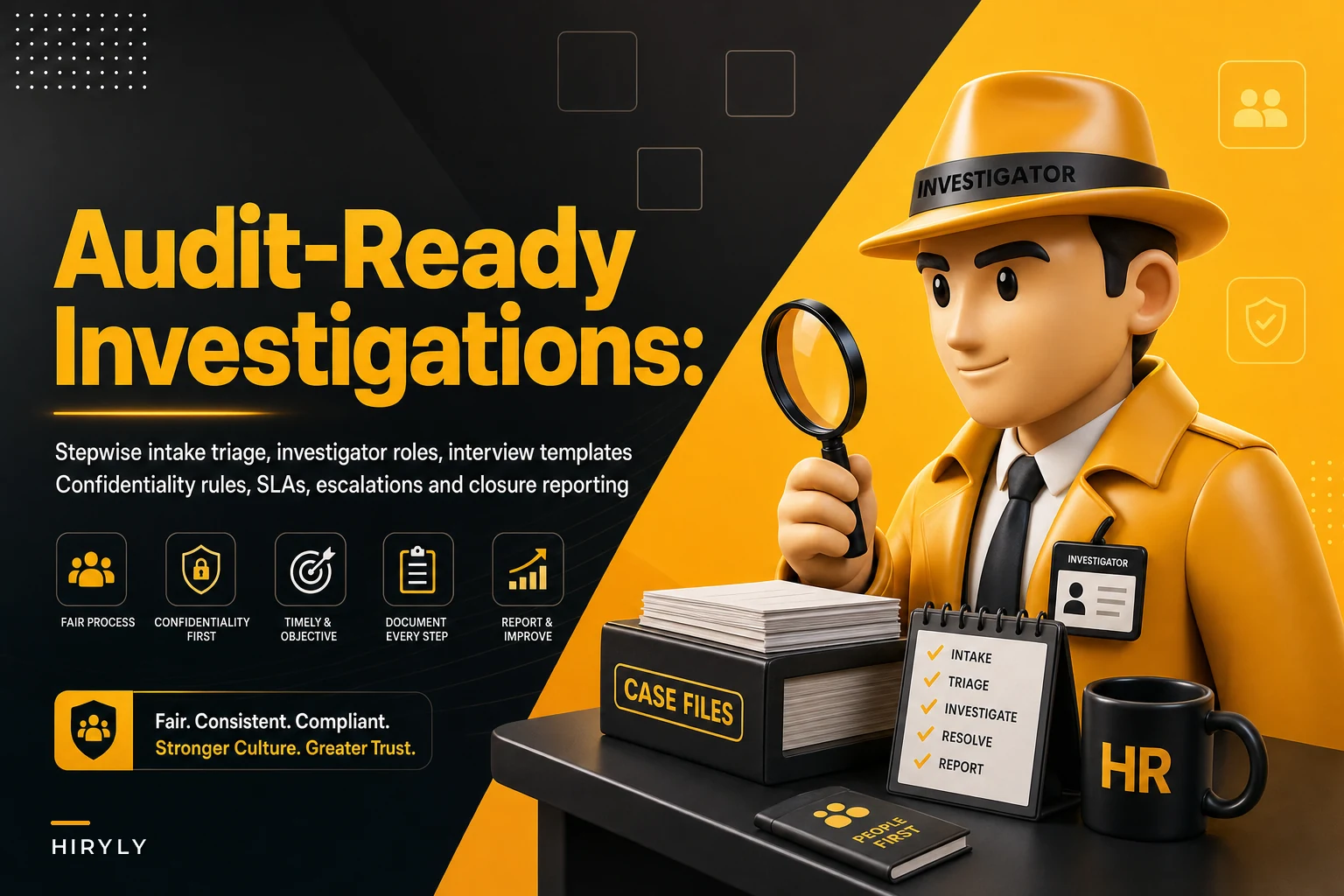

Most workplace investigation workflows break at the same point: the handoff between intake and actual investigation. An employee files a complaint about discrimination. HR logs it somewhere. Three weeks pass. The employee follows up asking about status. HR scrambles to figure out who was supposed to investigate, what documentation exists, and whether anyone interviewed witnesses.
Then the attorney letters start arriving.
The gap between receiving a complaint and producing an auditable investigation file shouldn't exist anymore. Yet HR teams everywhere struggle with the same operational blindspots—no clear triage criteria, undefined investigator responsibilities, missing interview documentation, and closure reports that wouldn't survive basic scrutiny.
Why workplace investigation workflows collapse under pressure
Investigation workflows typically fail for predictable operational reasons. The intake process lacks severity scoring, so every complaint gets treated with the same urgency (or lack thereof). Role assignments happen informally through email chains instead of documented protocols. Interview notes live in individual notebooks rather than centralized case files. Timeline commitments exist as verbal promises rather than tracked SLAs.
When an EEOC inquiry lands six months later requesting documentation, HR discovers they have fragments scattered across drives, incomplete witness lists, and no clear audit trail showing who made which decisions when.
Common investigation workflow failures:
-
Complaints submitted through multiple channels with no central tracking
-
Severity assessment based on gut feeling rather than defined criteria
-
Investigator selection happening through availability rather than qualification
-
Interview documentation varying wildly between cases
-
Confidentiality rules existing as general guidelines rather than specific protocols
-
Timeline commitments made without tracking actual completion rates
-
Closure documentation missing key elements required for legal defensibility
These aren't training problems—they're workflow design problems. The solution requires building repeatable processes that function regardless of who's handling the case.
Building intake triage that sorts critical from routine
Effective intake starts with classification criteria that anyone can apply consistently. Not every complaint requires the same response speed or investigation depth. A harassment allegation involving physical contact demands different handling than a dispute over vacation scheduling.
Eliminate HR bottlenecks with smart automation.
Hiryly simplifies your HR operations so you can focus on people, not paperwork.
- Centralized candidate tracking
- Automated onboarding workflows
- Performance & compliance dashboards
No credit card required
Create severity tiers with specific triggers:
Tier 1 (Immediate Response Required)
-
Physical safety concerns
-
Sexual assault allegations
-
Executive-level involvement
-
Regulatory violation potential
-
Media exposure risk
Tier 2 (48-Hour Response Window)
-
Discrimination complaints
-
Retaliation concerns
-
Hostile work environment claims
-
Policy violation patterns
-
Manager misconduct
Tier 3 (5-Day Response Window)
-
Interpersonal conflicts
-
Performance dispute claims
-
Minor policy violations
-
General workplace concerns
Each tier triggers different protocols. Tier 1 automatically escalates to legal counsel and senior HR leadership. Tier 2 follows standard investigation procedures with weekly status reviews. Tier 3 might resolve through mediation or manager coaching rather than formal investigation.
The triage matrix removes subjective judgment from initial response decisions. An HR coordinator can classify incoming complaints without needing years of investigation experience. The system captures who made the classification decision and when, creating the audit trail from minute one.
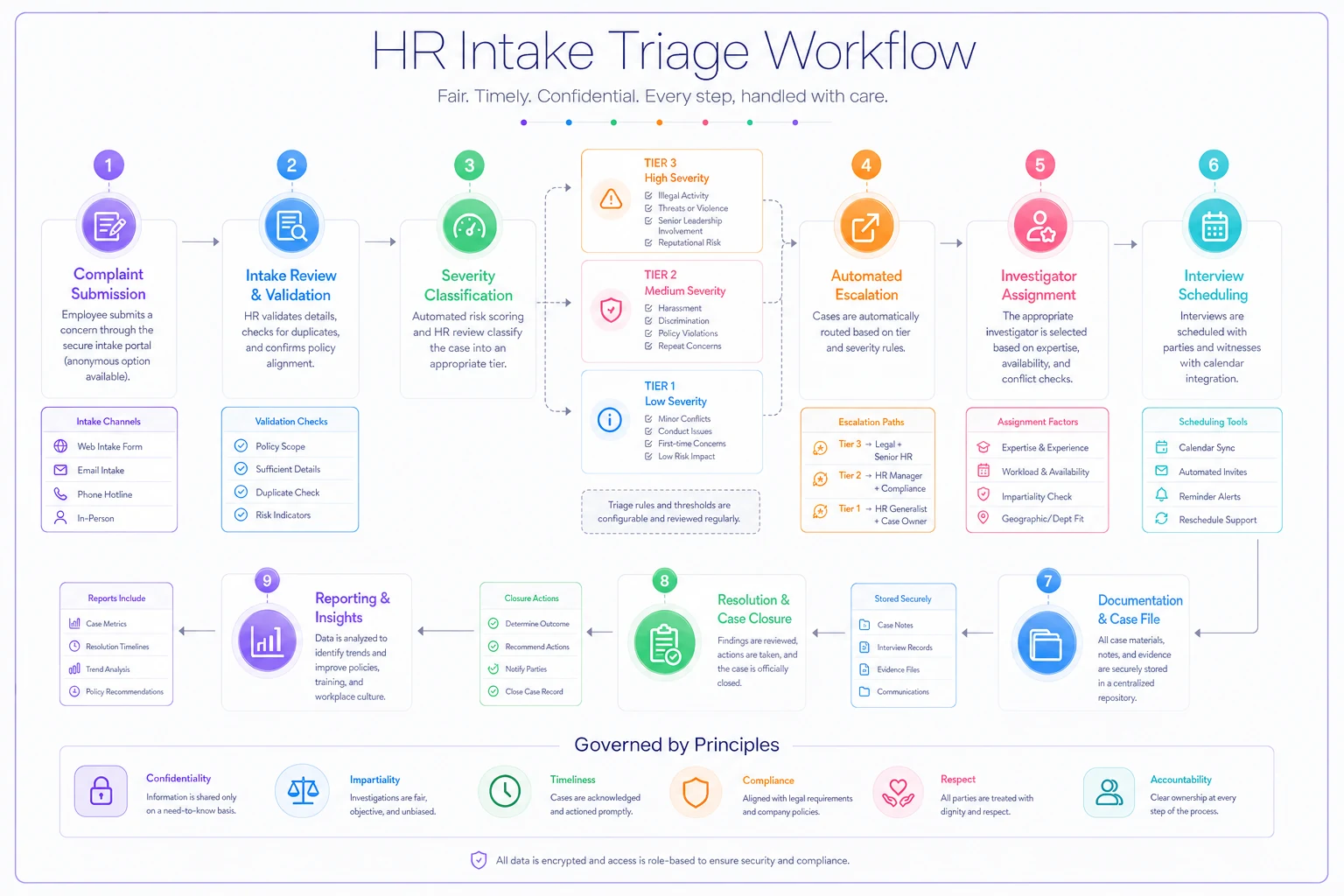
Track classification accuracy over time. If around 30% of Tier 3 complaints end up escalating to Tier 2 during investigation, your criteria need adjustment. The goal is consistent application that reduces both over-reaction and under-response.
Defining investigator roles before assignments happen
Investigation quality depends heavily on who conducts them. Yet most organizations assign investigators based on whoever's available rather than systematic qualification matching. This creates inconsistent outcomes and potential bias claims.
Start by documenting investigator pools with clear qualification thresholds:
Internal Investigator Requirements
-
Completed investigation training within past 24 months
-
No direct reporting relationship to involved parties
-
No participation in disputed decisions
-
Minimum two levels removed from complainant/respondent
-
Available for estimated investigation duration
External Investigator Triggers
-
C-suite involvement
-
Potential criminal conduct
-
Expected litigation
-
Conflict affecting all qualified internal investigators
-
Investigation scope exceeding 40 hours
Create pre-approved investigator rosters for each tier. When a Tier 2 discrimination complaint arrives, the workflow identifies qualified investigators from the roster, checks their availability and conflict status, then assigns based on predetermined criteria like investigation load balancing or specialization areas.
Document why specific investigators get selected. "Assigned to Sarah Chen because she has no reporting relationship to either party, completed advanced investigation training in Q2 2024, and currently has capacity with only one other active investigation" creates defensible assignment rationale.
This approach also surfaces capacity gaps. If your organization repeatedly lacks qualified internal investigators for routine Tier 2 cases, that's a training and development issue to address proactively rather than discovering it mid-crisis.
Interview templates that capture legally required elements
Interview documentation makes or breaks investigation defensibility. Yet most investigators take notes however feels natural to them, creating massive variance in what gets captured and how.
Standardized templates ensure every interview captures required elements while allowing flexibility for case-specific exploration. Build separate templates for complainant, respondent, and witness interviews.
Complainant Interview Framework
-
Incident details (who, what, when, where, how)
-
Impact description (work effects, personal effects)
-
Desired outcomes
-
Previous reporting attempts
-
Documentary evidence identification
-
Witness identification
-
Retaliation concerns
-
Questions for respondent
Respondent Interview Framework
-
Response to specific allegations
-
Alternative explanations
-
Documentary evidence
-
Witness identification
-
Relationship context
-
Previous similar situations
-
Understanding of policies
-
Proposed resolutions
Witness Interview Framework
-
Observations of specific incidents
-
General workplace dynamics
-
Documentary evidence awareness
-
Other potential witnesses
-
Confidentiality understanding
-
Retaliation concerns
Beyond content, templates standardize format. Every interview starts with date, time, location, and attendees. Every interview ends with confidentiality reminders and follow-up process explanation. This consistency helps attorneys and regulators quickly navigate investigation files months or years later.
Include prompts for legally significant elements that often get missed. Did you ask about previous complaints? Did you explore disparate treatment possibilities? Did you document credibility assessments? These prompts prevent investigators from inadvertently creating gaps that undermine the entire investigation.
Confidentiality protocols that actually get followed
Confidentiality breaches destroy investigations and create new liability. Yet many organizations treat confidentiality as a general expectation rather than a documented protocol with specific requirements and consequences.
Build confidentiality rules into every investigation touchpoint:
Pre-Interview Confidentiality Protocol
-
Written acknowledgment required before interview begins
-
Explanation of permissible disclosures (attorney, spouse, therapist)
-
Clarification that confidentiality includes not discussing with coworkers
-
Documentation of who receives confidentiality instructions
During-Investigation Protections
-
Case files restricted to assigned investigator and HR leadership
-
Physical documents secured in locked storage
-
Digital files in access-controlled folders with audit logging
-
Email communications minimized and marked confidential
-
No investigation discussions in public spaces
Post-Investigation Requirements
-
Participants reminded of ongoing confidentiality obligations
-
Documents retained per legal hold requirements
-
Access logs maintained showing who viewed files when
-
Destruction protocols following retention period expiration
Make violations consequential. An employee who discusses an ongoing investigation with uninvolved coworkers faces disciplinary action. A manager who accesses investigation files without authorization gets flagged immediately. These aren't harsh—they're necessary to maintain investigation integrity.
Track confidentiality breaches as investigation metrics. If breaches spike during certain investigation types or keep coming from the same departments, you've identified training needs or cultural issues that need real attention.
Timeline SLAs that create urgency without sacrificing thoroughness
Investigations drag without defined timelines. But arbitrary deadlines force rushed work that misses critical evidence. The solution is tiered SLAs based on investigation complexity with built-in extension protocols.
Standard Timeline Framework
Tier 1 Investigations
-
Initial response
4 hours
-
Investigation plan
24 hours
-
Completion target
10 business days
-
Maximum duration
15 business days
Tier 2 Investigations
-
Initial response
48 hours
-
Investigation plan
3 business days
-
Completion target
20 business days
-
Maximum duration
30 business days
Tier 3 Investigations
-
Initial response
5 business days
-
Investigation plan
7 business days
-
Completion target
30 business days
-
Maximum duration
45 business days
Build checkpoints that prevent timeline drift. Every investigation gets a day-5 status review assessing whether the timeline remains achievable. If witness availability or documentation complexities threaten the deadline, the investigator requests an extension with specific justification.
Track actual completion rates against SLAs. If Tier 2 investigations consistently blow past 20-day targets, either your SLAs are unrealistic or your investigation process has inefficiencies. Both are fixable once identified.
Include escalation triggers for stalled investigations. An investigation approaching its maximum duration without completion automatically escalates to senior HR leadership. This prevents things from quietly languishing while still allowing flexibility for genuinely complex cases.
Closure reporting that survives legal scrutiny
Investigation closure reports often read like rough notes rather than professional documents suitable for legal review. This creates real risk when investigations face external scrutiny months or years later.
Structure closure reports to answer the questions attorneys and regulators will actually ask:
Executive Summary Section
-
Complaint summary (2-3 sentences)
-
Investigation scope
-
Key findings
-
Credibility determinations
-
Recommendations
Investigation Process Documentation
-
Timeline of investigation activities
-
Interviews conducted (names, dates, durations)
-
Documents reviewed
-
Policies considered
-
Investigation obstacles and resolutions
Detailed Findings
-
Each allegation addressed separately
-
Evidence supporting or contradicting
-
Credibility assessment rationale
-
Policy violation determinations
-
Mitigating or aggravating factors
Recommendation Rationale
-
Disciplinary action reasoning
-
Precedent considerations
-
Proportionality analysis
-
Risk mitigation measures
-
Follow-up requirements
Don't bury credibility assessments. If you found the respondent more credible than the complainant, explain why using specific factors: consistency across interviews, documentary support, witness corroboration, demeanor observations. These assessments often determine case outcomes, so they need careful documentation.
Include minority opinions when investigation teams disagree. If the investigator recommends termination but HR leadership opts for suspension, document both positions and the reasoning. This transparency demonstrates thoughtful decision-making rather than arbitrary choices.
Monitoring and continuous improvement
Even well-designed investigation workflows degrade without monitoring. Build measurement systems that identify problems before they become crises.
Key Investigation Metrics
| Metric | Target | Warning Threshold |
|---|---|---|
| Intake to assignment time | <24 hours | >48 hours |
| SLA compliance rate | >90% | <75% |
| Investigation overturn rate | <5% | >10% |
| Confidentiality breaches | 0 per quarter | >1 per quarter |
| Complainant satisfaction | >70% positive | <50% positive |
| Days to closure (median) | <20 days | >30 days |
| External investigator usage | <20% of cases | >35% of cases |
Review patterns quarterly. Are certain managers generating disproportionate complaints? Do investigations in specific departments consistently exceed timelines? Are confidentiality breaches concentrated in particular teams?
Create feedback loops with participants. Send brief surveys 30 days post-investigation asking about process experience, perceived fairness, and improvement suggestions. Low response rates are normal, but the feedback you do receive often identifies blind spots you wouldn't have found otherwise.
Conduct annual audits of closed investigations. Pull a random sample and review for documentation completeness, procedural compliance, and consistency. This isn't about second-guessing outcomes—it's about ensuring the process remains defensible.
How AI-powered operational platforms reduce investigation risks
Manual investigation tracking through spreadsheets and shared drives creates inevitable gaps. Important emails get lost. Timeline commitments slip without notice. Documentation standards vary between investigators. These aren't people problems—they're system problems.
AI-enhanced investigation platforms address these operational gaps by automating workflow elements that typically fail under pressure. When a complaint arrives, the system automatically classifies severity based on keyword analysis and routes to appropriate personnel. Natural language processing can flag high-risk phrases that might warrant immediate escalation even if the complainant didn't explicitly request urgent response.
Automated task generation ensures nothing falls through cracks. The system creates investigation timelines with specific milestones, sends reminder notifications as deadlines approach, and escalates stalled cases according to predetermined rules. This removes the burden of manual tracking while ensuring consistent timeline compliance.
Interview scheduling becomes less painful when AI handles the coordination. The system identifies available time slots across multiple calendars, sends meeting invitations with appropriate confidentiality notices, and maintains activity logs showing all scheduling attempts. That seemingly minor automation prevents the scheduling delays that often stretch investigations beyond SLA targets.
Document assembly features ensure consistency across investigations. Templates populate automatically with case details, reducing preparation time while maintaining documentation standards. AI can even analyze interview notes to flag potential gaps or inconsistencies that warrant follow-up questioning.
The real value shows up in pattern recognition across investigations. AI-powered platforms identify trends that are easy to miss manually—like increased complaints following specific company events, concentration of issues in particular departments, or escalating severity patterns that suggest brewing cultural problems. That kind of analysis transforms investigations from reactive fire-fighting into proactive risk management.
For resource-constrained HR teams, this type of automation means senior professionals spend less time on administrative tasks and more time on actual investigation work. The data governance frameworks ensure sensitive investigation data remains protected while still enabling appropriate access for those who need it. Combined with robust HR metrics systems, organizations can track investigation patterns alongside other workforce indicators to identify systemic issues before they escalate into something much harder to manage.
Making workplace investigation workflows actually work
The difference between defensible and dangerous investigations isn't mysterious—it's operational. Organizations that survive legal scrutiny have clear processes, consistent documentation, and trackable accountability. Those that don't are gambling with every complaint that arrives.
Start with intake triage. If you can't consistently classify complaint severity, nothing downstream will function properly. Build your investigator assignment matrix next, ensuring you can always identify qualified, unconflicted investigators without scrambling. Standardize interview templates and confidentiality protocols before your next investigation starts, not during it.
Set realistic timeline SLAs based on actual capacity, not optimistic projections. Track completion rates and adjust when patterns emerge. Make closure reports comprehensive enough that someone unfamiliar with the case could understand your reasoning two years later.
Treat investigations as an operational system requiring continuous monitoring and improvement. The metrics you track, patterns you identify, and adjustments you make determine whether your investigation process protects the organization or exposes it to preventable risk.
The goal isn't perfection—it's consistency and defensibility. When that EEOC inquiry arrives, you should be able to produce a complete investigation file demonstrating reasonable, documented, timely action. That's not just compliance; it's operational discipline that protects everyone involved.
Ready to transform your HR processes?
Join thousands of HR teams using Hiryly to hire faster, engage employees better, and stay compliant effortlessly.