

Most HR teams don't get into trouble because they bought a biased screening tool. They get into trouble because nobody could explain, six months later, why a candidate got rejected, who signed off on the tool that rejected them, or what was actually checked before it went live. The tool is rarely the whole story. The governance around it is.
That's the gap this article is about. Not "AI is scary" and not "AI is magic." The real problem is that AI now touches resume screening, interview scoring, chatbots, ranking, scheduling, and even reference summaries — and most HR functions are running all of that with the same oversight they used for a single applicant tracking system in 2016. The controls didn't scale with the surface area.
An ethical AI HR operating model isn't a policy PDF. It's a working system: how you classify risk, where a human has to step in, what you monitor weekly, what you do when something breaks, and how you keep records that survive an audit or a lawsuit. This article is about building that system properly.
Why oversight breaks quietly (and usually not where you'd expect)
The failure almost never looks dramatic. There's no moment where a model announces it's discriminating. Instead, small decisions accumulate.
A recruiter turns on a "smart match" feature because it saves time. A vendor pushes an update that changes how scores are calculated. Someone builds a knockout question that quietly correlates with age. A hiring manager starts trusting the ranked list so much they stop reading past the top eight. None of these went through review — they're defaults that nobody governed.
What you tend to see across a lot of HR functions is that tools get adopted at the team level while accountability stays at the program level. So legal thinks talent acquisition owns it. TA thinks the vendor owns it. The vendor's contract says the customer is responsible for outcomes. Everyone is technically covered and nobody is actually watching.
Then there's the scale problem. When you're screening 200 applicants a quarter, a manager can eyeball the rejections. When you're screening 20,000 across 15 requisition types, no human is reviewing anything by feel anymore — you're trusting a system you never stress-tested. The oversight that worked at small volume silently stops working at large volume, and nobody notices because there's no alarm for "we stopped checking."
That's the core insight worth holding onto: bias risk in hiring isn't primarily a modeling problem. It's a coordination and monitoring problem that grows with volume and tool sprawl. So the model has to be built around coordination and monitoring, not around any single algorithm.
Start with risk tiers, not tools
The most useful move is refusing to treat all AI use the same. A chatbot that answers "what's the PTO policy" needs almost no oversight. A tool that ranks and filters candidates before a human sees them needs a lot. Apply the same heavy governance to both and people route around it. Apply the same light governance to both and you get burned on the one that mattered.
Eliminate HR bottlenecks with smart automation.
Hiryly simplifies your HR operations so you can focus on people, not paperwork.
- Centralized candidate tracking
- Automated onboarding workflows
- Performance & compliance dashboards
No credit card required
| Tier | What it covers | Human involvement | Review before launch | Ongoing monitoring |
|---|---|---|---|---|
| Tier 3 – High impact | Screening, ranking, filtering, scoring, anything that removes or reorders candidates | Human makes final call, must be able to override and see reasons | Full bias testing + legal sign-off + documented business justification | Monthly adverse-impact checks, drift monitoring |
| Tier 2 – Assistive | Interview note summarization, JD writing, reference summarization, structured question suggestions | Human reviews and edits output before it's used | Accuracy spot-check + prompt/config review | Quarterly sampling for accuracy and skew |
| Tier 1 – Low impact | FAQ chatbots, scheduling, reminders, internal knowledge lookup | Minimal, no candidate outcome affected | Basic functional test + privacy check | Annual review, complaint-triggered checks |
The classification question that actually matters isn't "is this AI?" It's "can this tool remove, rank, or disadvantage a person before a human evaluates them?" If yes, it's Tier 3, full stop — even if the vendor calls it "just a productivity assistant."
A common mistake: teams tier the tool once and never revisit it. But tools change function through updates. A summarizer that adds a "recommended: yes/no" field just became a scoring tool and jumped tiers. Your tiering needs a re-check trigger tied to any vendor feature change.
Human-review gates: where a person legally and operationally must step in
"Human in the loop" sounds like a control but often means nothing. A human clicking "approve" on a list of 300 without reading it isn't oversight — it's a rubber stamp with a name attached.
Real review gates specify three things: what the human sees, what they can change, and what they have to record.
-
Before screening runs — the requisition owner confirms the tool config (knockout questions, weighting, filters) matches an approved template. No custom filters go live without a second approver.
-
At the ranked-list stage — the recruiter must see the reason a candidate scored low, not just the rank. If the system can't surface a reason, it can't be used to reject.
-
Before any rejection based on score — a human confirms the rejection reason is job-related. Auto-rejection with no human touch is not permitted for Tier 3.
-
At override points — when a recruiter pulls a candidate the model ranked low, that override is logged with a one-line reason. Overrides are gold; they're your early signal that the model and your recruiters disagree.
-
At batch close — a summary of who was screened out, by which rule, gets stored.
The thing most teams miss: track your overrides as a metric, not an exception. If recruiters are constantly rescuing candidates from a certain school tier or a career-gap group, you've found a bias signal before any auditor does. A model that's never overridden isn't necessarily good — it might just mean people stopped looking.
Here's a simple visual of the gating workflow to help teams map where humans must intervene and where logs should be captured.
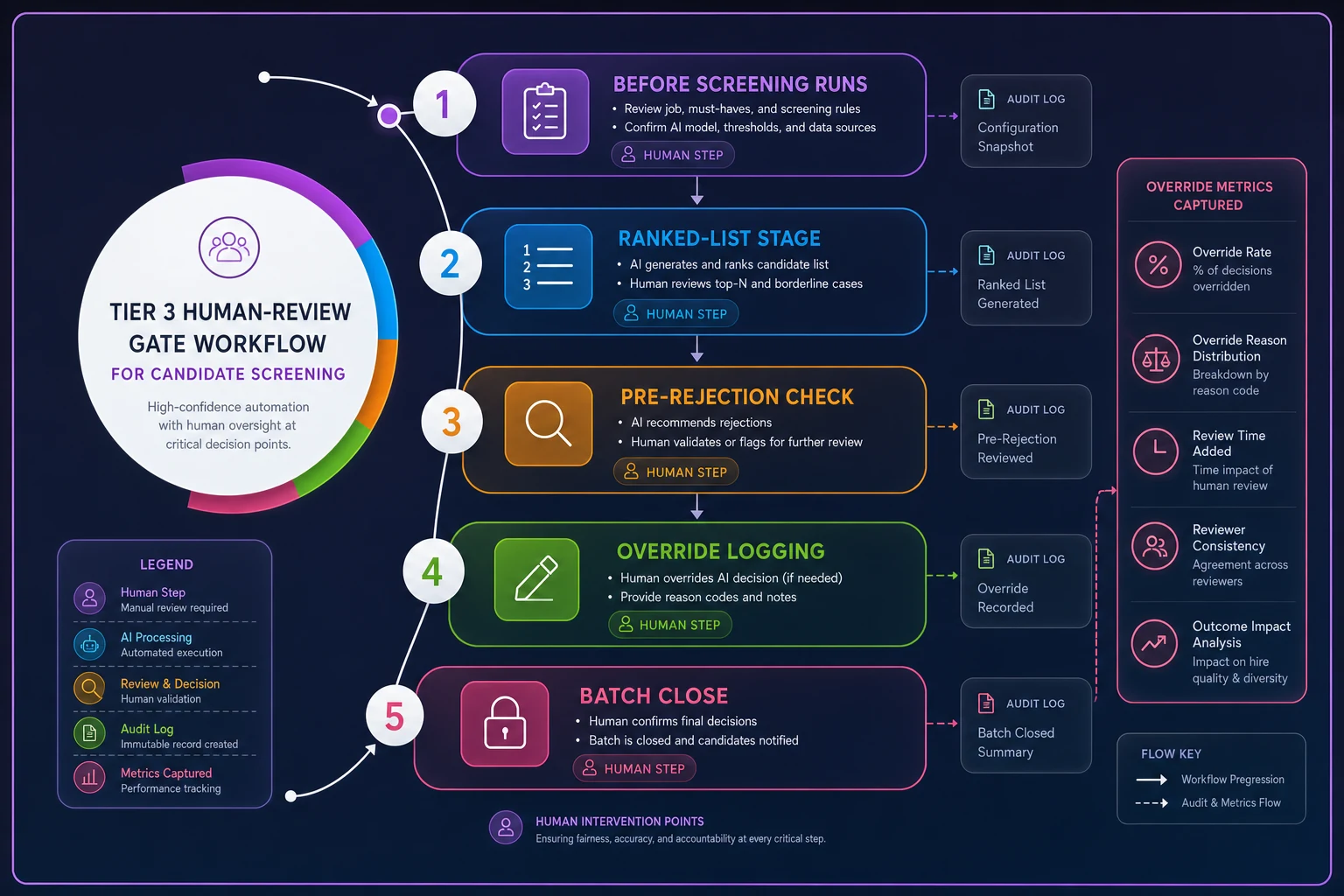
Track your overrides as a metric, not an exception.
If recruiters are constantly rescuing candidates from a certain school tier or a career-gap group, you've found a bias signal before any auditor does.
Monitoring KPIs that actually tell you something
Plenty of dashboards measure whether the tool is running. Far fewer measure whether it's fair. Uptime and time-to-screen tell you the machine works. They tell you nothing about who it's quietly filtering out.
The KPIs worth watching monthly for Tier 3 systems:
-
Selection rate by group at each stage — passthrough rates for protected groups compared against the highest-selected group. The four-fifths rule is a floor, not a finish line, but it's a fast trigger.
-
Stage-level drop-off skew — where in the funnel does representation change most? Bias rarely spreads evenly; it usually concentrates at one gate.
-
Override rate and direction — how often humans reverse the tool, and toward which candidates.
-
Score distribution drift — has the spread of scores shifted month over month without an obvious cause? Drift often precedes a fairness problem.
-
Complaint and re-review volume — candidates or internal recruiters flagging odd outcomes.
-
Time-since-last-bias-test — a boring metric that catches the most common failure: the test everyone assumed someone else was running.
Getting these numbers reliable depends entirely on clean data ownership. If nobody owns the definition of "screened out" or "passthrough," your fairness metrics will quietly contradict each other across teams. This is where the discipline from a proper people analytics operating model with a clear data-owner RACI and taxonomy does the heavy lifting — fairness monitoring is only as trustworthy as the metric definitions underneath it.
One pattern worth naming: teams often monitor at the final hire stage because that's where the EEO data lives. But by then the damage is done and invisible — the biased filtering happened three stages earlier, on people who never became "candidates of record." Monitor the earliest automated gate, not the last human one.
Incident playbooks: what you do when it goes wrong at 2pm on a Tuesday
Every serious oversight model needs a plan for the day something fails, because something will. The teams that handle it well aren't the ones that never have incidents — they're the ones who don't improvise during them.
An AI incident in hiring usually surfaces as one of: a fairness metric crossing a threshold, a candidate complaint alleging discrimination, a vendor disclosing a model change, or someone discovering a config was wrong for the last three weeks.
Your playbook should pre-answer these before you're scrambling:
-
Trigger definitions — what specific reading or event opens an incident. "Selection ratio drops below threshold for two consecutive weeks" is a trigger. "Someone feels uneasy" is not.
-
Immediate containment — can you pause the tool or fall back to manual review today? If pausing takes a two-week vendor ticket, you don't have containment, you have a hope. This is exactly the kind of rollback readiness covered in avoiding HR automation and AI governance mistakes with rollback triggers and testing protocols — decide the kill switch before you need it.
-
Scope assessment — how many decisions were affected, over what window, for which requisitions.
-
Candidate remediation — the uncomfortable part most plans skip. If people were wrongly screened out, what do you actually do? Re-review the batch? Re-open requisitions? Notify them?
-
Notification chain — who tells legal, who tells the affected business unit, who owns external communication if it escalates.
-
Root cause and record — what happened, written down, with the fix documented.
The mistake to avoid: writing an incident playbook that only covers detection and stops before remediation. Discovering you screened out 40 qualified candidates unfairly is only useful if you know what you'll do for those 40 people.
The oversight charter: who actually owns this
Governance dies when ownership is diffuse. A charter fixes that by naming a body — call it an AI oversight group, a review board, whatever fits your org — with real decision rights.
A workable charter defines:
-
Membership — at minimum HR/TA leadership, legal or compliance, someone technical who understands the tools, and a business representative. Keep it small enough to actually meet.
-
Decision rights — who can approve a Tier 3 tool for launch, who can force a pause, who signs off on going back live after an incident.
-
Meeting cadence — monthly for KPI review, ad hoc for incidents. A quarterly-only board can't govern something that changes weekly.
-
What requires escalation — new Tier 3 tools, vendor changes to existing tools, any metric breach, any candidate complaint alleging discrimination.
-
Records the board keeps — approvals, exceptions, incident closures, and testing sign-offs.
The pattern that separates real charters from decorative ones: the charter grants the power to say no and the power to pause. If your oversight board can only make recommendations, it's an advisory committee — and advisory committees don't stop bad launches under deadline pressure.
Testing protocols before anything touches a real candidate
Pre-launch testing is where you catch problems that never make it into a dashboard because they never got the chance. This is the part teams skip most often, usually because the tool "already worked at another company" or the vendor "already tested for bias." Neither of those covers your candidate pool, your job types, or your configuration.
-
Define the job-relatedness case first. Write down what the tool is supposed to predict and why that's tied to the actual job. If you can't articulate this clearly, stop here.
-
Run adverse-impact analysis on representative data across protected groups at each decision point the tool affects.
-
Test configuration, not just the base model. Your knockout questions, weightings, and filters are where a "fair" model becomes an unfair system.
-
Probe proxy variables. Zip code, school, employment gaps, graduation year — features that correlate with protected characteristics without naming them.
-
Run edge cases and manual comparisons. Feed in profiles you know should pass and see if they do. Compare tool decisions against a human panel on a sample.
-
Document the whole thing — inputs, results, who reviewed, what the sign-off decision was, and when the next re-test is scheduled.
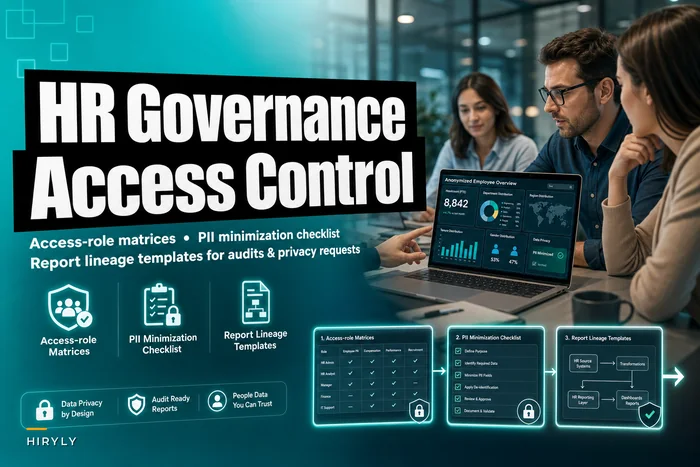
Handling representative candidate data for these tests raises its own obligations. Testing sets often contain exactly the sensitive attributes you're most restricted on, which is why the guardrails from solid HR data governance — access-control matrices and PII minimization matter here too. You don't want your fairness testing to itself become a privacy incident.
Audit logs: the boring part that saves you
If there's one thing that separates HR teams who survive scrutiny from those who don't, it's records. Not because records prevent problems, but because when a candidate, regulator, or plaintiff's attorney asks "why was this person rejected and how do you know the tool was fair," you can answer with documents instead of memory.
An audit log for people decisions should let you reconstruct, for any candidate: what tools touched their application, what config was live at the time, what the tool output, whether a human reviewed it, who that human was, what they decided, and any override reason. And it should be immutable enough that nobody can quietly edit history after the fact.
The failure mode here is subtle. Teams do keep logs — but scattered across the ATS, the vendor platform, a shared drive of testing spreadsheets, and someone's email approvals. When the request comes, reconstructing a single decision takes days and half the trail is missing. The log is only useful if it's centralized and tied to the decision, not spread across five systems.
This is where operational software with proper audit trails earns its keep — not by being clever, but by capturing the who/what/when/why of each people decision in one place automatically, so the record exists whether or not anyone remembered to save it. The value isn't the AI in the tool; it's the traceability around the tool.
A real scenario: mid-size employer, one quiet filter
A regional healthcare staffing company, screening somewhere around 6,000–7,000 applicants a quarter across nursing and admin roles, rolled out a resume-ranking feature bundled into their ATS. No board, no tiering, no pre-launch bias test — it was marketed as a time-saver and treated like one.
About four months in, a recruiter noticed she kept manually rescuing strong candidates the tool had buried, and they skewed heavily toward people with employment gaps — a lot of them returning caregivers. That override pattern was the only reason anyone caught it. Nobody was monitoring for it.
When they finally ran an adverse-impact analysis on the config, the "years of continuous employment" weighting was doing most of the damage. Passthrough for candidates with any gap over six months was running roughly 20–25% below comparable candidates without gaps — for roles where continuous tenure wasn't job-relevant at all.
The fix wasn't complicated. They paused the ranking feature for the affected role family, dropped the continuous-employment weighting, added a human-review gate before any score-based rejection, and re-reviewed the last quarter's screened-out batch. That re-review pulled roughly 30–40 qualified candidates back into active pipelines. What changed most, though, was structural: they tiered every AI feature, stood up a monthly oversight review, and started logging overrides as a KPI. The tool wasn't the problem. The absence of a system around it was.
When this level of oversight makes sense — and when it's overkill
When to build the full model: you're using any tool that ranks, filters, or scores candidates before a human sees them; you're hiring at volume where manual review isn't realistic; you operate in jurisdictions with AI-in-hiring rules; or you've got multiple tools from multiple vendors touching the funnel. Once tool sprawl and volume cross a certain point, informal oversight simply stops functioning.
When it's overkill: if your only AI use is a policy chatbot and a scheduling assistant, you don't need a review board and monthly adverse-impact testing. Tier those honestly as low-impact and move on. Over-governing low-risk tools is how you train your organization to see governance as bureaucracy — and then route around it when it actually matters.
Who should not do this alone: HR teams without access to legal or compliance input shouldn't stand up Tier 3 AI screening until they have that seat at the table. The testing and remediation decisions have legal consequences, and a well-intentioned HR team guessing at adverse-impact thresholds is a real exposure. Get the partnership first, then build the model.
Fair AI hiring isn't achieved by picking a "fair tool." It's produced by a system that classifies risk honestly, forces humans into the decisions that matter, watches the right numbers at the earliest gate, knows what to do when something breaks, and keeps records good enough to prove any of it.
The teams that get this right treat their AI tools less like software purchases and more like ongoing decisions they're accountable for — with owners, checkpoints, and a paper trail. The ones that struggle bought powerful tools and governed them like spreadsheets.
Start where your exposure is highest: find every tool that can remove or reorder a candidate before a human looks, tier it Tier 3, and put a real review gate and monitoring rhythm around it. That single move closes most of the gap. Everything else in the model — the charter, the playbooks, the audit logs — exists to keep that gate honest as your volume grows and your tools multiply.
Ready to transform your HR processes?
Join thousands of HR teams using Hiryly to hire faster, engage employees better, and stay compliant effortlessly.