



Span-of-control problems rarely announce themselves. Nobody walks into a leadership meeting and says "our reporting structure is quietly breaking." Instead you notice the symptoms: a manager who hasn't done a real 1:1 in six weeks, approvals sitting for days because one person is the bottleneck for everything, a new hire reporting to someone with fourteen other direct reports who gets basically no coaching.
By the time HR gets pulled in, the reorg conversation is already emotional. Someone's title is on the line. A director wants to "keep their team together." And the actual question — how many people should report to whom, and under what rules — gets buried under politics.
The fix isn't a prettier org chart. It's an organizational design operating model with explicit decision rules, so span-of-control choices become boring and repeatable instead of political and improvised. This piece walks through role-family definitions, manager-to-individual ratios, approval SLAs, impact assessment, and rollback criteria — with matrices you can adapt.
Why span-of-control quietly breaks
The most common failure isn't "too many direct reports." It's inconsistency. One manager runs 12 people comfortably because the work is repetitive and standardized. Another drowns under 6 because the work is ambiguous and each person needs constant judgment calls. When you set a single company-wide number — "no manager over 8 reports" — you get both under-managed and over-managed teams simultaneously.
The second failure is title inflation used as a compensation workaround. A company can't get budget to raise someone's pay, so they hand out a "Lead" or "Manager" title with one or two direct reports attached. Multiply that across a 200-person org and you end up with a structure that's four layers deep when the work only justifies three. Every extra layer adds approval hops, more meetings, and translation loss between leadership and the front line.
There's also a coordination cost that never shows up on any dashboard. Every reporting relationship is a channel that needs maintenance — feedback, priorities, context. When a manager's span outgrows their actual capacity, they don't fail loudly. They just quietly stop doing the parts of management that aren't urgent. Coaching goes first. Then career conversations. Then, eventually, retention.
Start with role families, not headcount
Before you can set a ratio, you have to know what kind of work you're managing. This is where most org design skips a step — people jump straight to "how many reports per manager" without defining what those reports actually do.
Eliminate HR bottlenecks with smart automation.
Hiryly simplifies your HR operations so you can focus on people, not paperwork.
- Centralized candidate tracking
- Automated onboarding workflows
- Performance & compliance dashboards
No credit card required
Group roles into role families based on how much management attention each one realistically consumes. A useful cut looks like this:
| Role family | Work characteristics | Management load per report | Sensible span range |
|---|---|---|---|
| Execution / standardized | Repeatable tasks, clear SOPs, measurable output | Low | 10–15 |
| Skilled / semi-autonomous | Judgment within known frameworks, some ambiguity | Medium | 6–9 |
| Complex / high-judgment | Novel problems, cross-functional, high stakes | High | 3–5 |
| Emerging / early-tenure | Ramping, needs coaching regardless of role | High (temporary) | 3–5 |
| People-managing managers | Managing other managers, not ICs | Medium-high | 4–7 |
The point isn't the exact numbers — adjust them to your reality. The point is that a single manager might sit across two or three families at once, and their effective span is a weighted blend, not a raw headcount.
When a manager spans multiple families, calculate effective span as a weighted blend of load units rather than raw headcount.
Here's a quick visual of the role-family to weighted-load workflow.
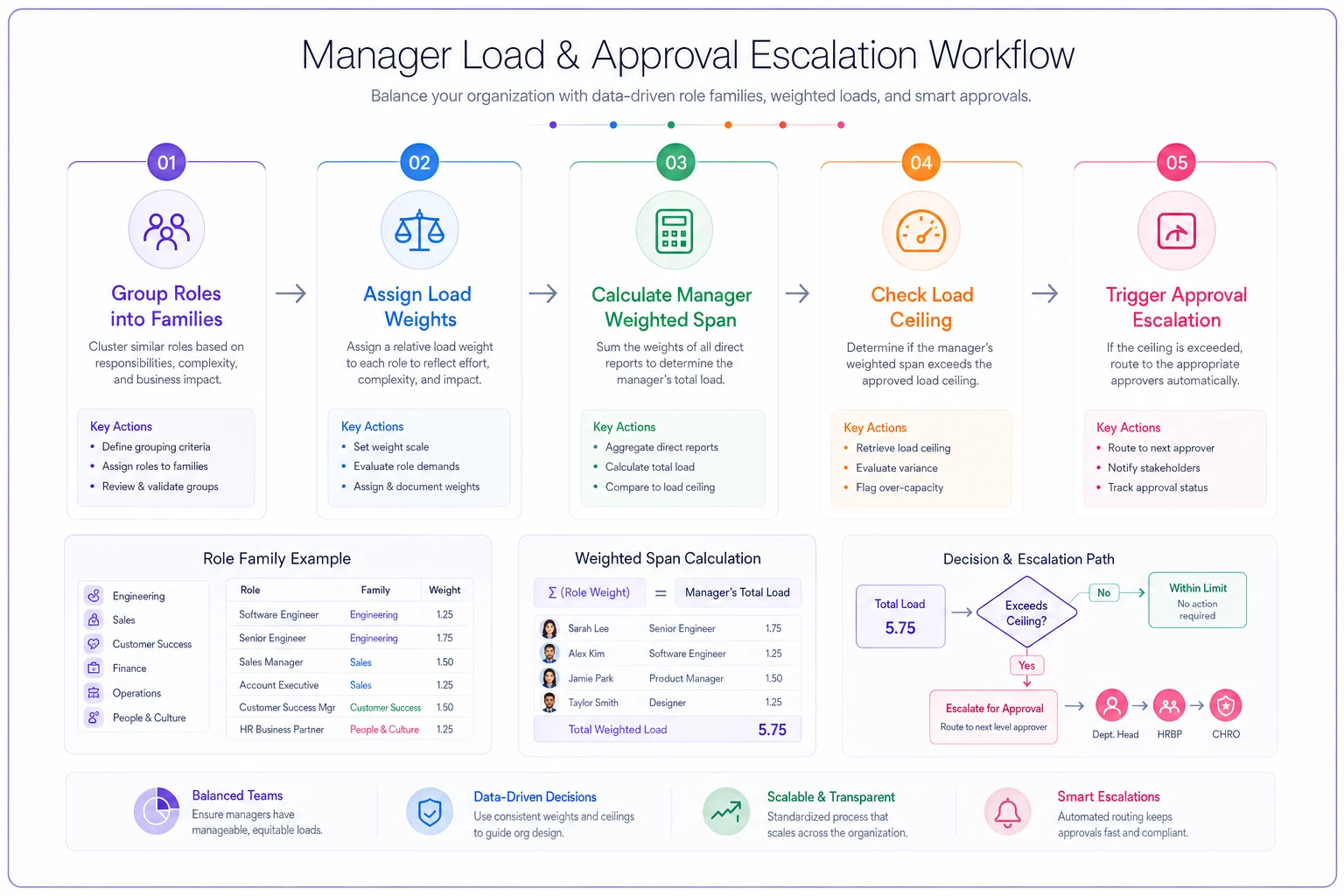
A team of 10 execution-family reports is not the same load as 5 complex-family reports plus 3 early-tenure hires. On paper the second manager has fewer people. In practice they have far more actual management to do. If your operating model can't see that difference, it'll make the wrong staffing calls repeatedly.
This also connects directly to how you band and promote people. If your role definitions and comp structure don't agree with each other, spans drift. A well-built role-banding and promotion cadence gives your org design real guardrails instead of vague titles.
The manager-to-individual ratio decision rule
Instead of one company-wide number, assign each role a load weight, then cap managers by total weighted load rather than raw headcount.
-
Execution report = 1.0 load unit
-
Skilled report = 1.5 load units
-
Complex report = 2.5 load units
-
Early-tenure report (first 6 months) = +1.0 on top of their family weight
-
Direct report who is also a manager = 2.0 load units
Then set a target ceiling — roughly 12–14 load units before you consider splitting the team or adding a layer.
Quick example. A team lead with:
-
3 execution reports (3.0)
-
2 skilled reports (3.0)
-
1 complex report (2.5)
-
2 early-tenure hires, both skilled (2 × 1.5 = 3.0, plus 2 × 1.0 ramp = 2.0)
That's 13.5 weighted load units across 8 people. Looks manageable on the org chart. In reality they're right at the edge, and the two ramping hires are the reason. Six months later, once those hires are up to speed, the same team drops to about 9.5 load units — and suddenly you're over-structured for the actual work.
That last point is the one people consistently miss. Spans aren't static. They shift with tenure, project cycles, and hiring waves. A good operating model reviews weighted load on a cadence, not just during annual reorgs.
Approval SLAs: where structure meets speed
Org design isn't only about who reports to whom. It's about how fast decisions move through the structure you built. A clean org chart with slow approvals still feels broken to everyone inside it.
Every structural change and staffing decision needs a defined approval SLA — a maximum time a request can sit before it either moves or escalates. Without this, the most political part of your org becomes the slowest.
A practical approval matrix by decision type:
| Decision | Approver | SLA (business days) | Escalation if breached |
|---|---|---|---|
| Add a report to existing team (within span limit) | Direct manager | 1 | Skip-level manager |
| Add a report that breaches load ceiling | Skip-level + HR | 3 | Function head |
| Create a new manager layer | Function head + HRBP | 5 | VP / exec sponsor |
| Change reporting line (cross-team) | Both managers + HR | 3 | Function head |
| Title/level change with no scope change | HRBP + comp | 5 | Comp committee |
The escalation column is what keeps this honest. An SLA with no consequence is just a suggestion. When a request breaches its window, it should automatically route upward — not die in someone's inbox. This is also where a disciplined approach to internal mobility and case routing pays off, because the same habits that govern case handling apply directly to structural approvals.
Impact assessment before you touch the chart
The most damaging reorgs are the ones done fast to solve a personnel problem, with no real assessment of downstream effects. Someone leaves, their reports get "temporarily" reassigned, and eight months later that temporary structure is load-bearing and nobody remembers why it exists.
Before approving any structural change, run a short impact assessment. Not a 20-page document — a one-pager that forces the right questions:
-
Span check — Does this push any manager past their weighted load ceiling? By how much?
-
Layer check — Does this add a management layer? If so, what work justifies it that couldn't be handled with a broader span?
-
Coverage check — Who now owns coaching and career development for the affected people? Name them.
-
Coordination check — How many new cross-team dependencies does this create?
-
Reversibility check — If this doesn't work in 90 days, can we undo it cleanly, or does it create sunk costs (comp changes, title changes, external commitments)?
-
Cost check — Fully loaded, what does this structure cost per quarter versus the alternative?
Question 5 is the one teams skip and regret. Some org changes are cheap to reverse — a reporting line moves back. Others are effectively permanent the moment you make them, because you changed someone's title, level, or pay to make the structure work. Knowing which kind you're making before you commit is half the discipline.
Impact assessment also connects to forecasting. If you're constantly reshuffling spans reactively, the real problem is usually upstream in planning. A functioning quarterly workforce forecast process means most structural changes are anticipated rather than fire drills.
Rollback criteria: knowing when to undo it
Almost nobody defines rollback criteria for org changes, which is exactly why bad structures persist. A new layer gets added, it doesn't help, but there's no trigger that says "this failed, revert it." So it lingers.
Set rollback criteria at the time you make the change, with a defined review window. A simple template:
-
Review window 90 days after implementation
-
Rollback trigger — capacity If the intended span relief didn't materialize (manager still over load ceiling), revert or re-split.
-
Rollback trigger — coordination If cross-team handoffs measurably slowed (approvals breaching SLA more often than before), reassess the reporting lines.
-
Rollback trigger — coaching If affected reports flag a drop in 1:1 frequency or development conversations, the span is too wide regardless of what the math says.
-
Rollback trigger — attrition signal If regretted attrition on the affected team ticks up within two quarters, treat the structure as a suspect.
The honest part of rollback criteria is admitting some of them are qualitative. You won't have a clean metric for "coaching dropped." You'll have managers saying they're stretched and reports saying they feel unsupported. Build a place for that signal, because it's often the earliest warning you'll get.
A real scenario: the accidental fourth layer
A mid-sized professional services firm, around 180 people, kept adding "Team Lead" roles to reward strong performers they couldn't afford to promote in pay. Over roughly two years they went from three layers to four. Each new lead had 2–3 reports.
The visible symptoms: an internal survey where about a third of staff said decisions "took too long," and directors complaining they spent most of their meetings translating priorities down through leads who added little beyond a relay function. Approvals that used to take a day were now taking most of a week because every request passed through an extra hop.
When they ran the weighted-load analysis, the picture was clear. Most leads carried 4–6 load units — well under a healthy ceiling. They weren't managing at capacity; they'd been given titles to solve a comp problem. Removing the layer would have collapsed roughly six lead roles back into individual-contributor-plus-scope roles, restoring direct reporting to directors whose spans could comfortably absorb them.
The change wasn't painless — nobody enjoys hearing their "Lead" title is going away. But they handled it as a scope-and-comp conversation rather than a demotion, and paired it with clearer role bands. Within a quarter, decision cycle time dropped noticeably and directors got their front-line visibility back. The lesson wasn't "flatter is always better." It was that they'd never had a rule telling them when a management layer was actually justified.
When adding a layer actually makes sense
Flattening isn't always right.
Sometimes the honest answer is you genuinely need another layer. That's true when:
-
A manager is consistently over their weighted load ceiling and the work can't be standardized down.
-
The team has real sub-domains that need dedicated technical or people leadership.
-
Coaching is measurably suffering because the manager can't get to everyone.
-
You're scaling a function fast and need managers-of-managers to preserve consistency.
Flattening isn't always right.
When adding a layer is a mistake
And it's the wrong move when:
-
You're using a title to substitute for pay you can't approve.
-
The "manager" would have fewer than 3 reports and no distinct scope.
-
The work is standardized enough that a broader span would run fine.
-
You're solving a one-person retention problem with a permanent structural change.
That last one is the trap. Structure should reflect the shape of the work, not a negotiation with one valued employee. Solve retention with comp, growth paths, and scope — not by bolting a new box onto the org chart that everyone else then has to route around.
Making the rules stick
None of this works as a one-time exercise. The whole point of a decision-rule template is that it runs continuously and quietly, so structural drift gets caught early instead of during a crisis reorg.
That means keeping your role families, load weights, span ceilings, approval SLAs, and rollback criteria somewhere your HR and manager teams actually reference — not buried in a slide deck from last year's planning cycle. This is where a proper workflow platform earns its keep: tracking weighted load across managers as headcount shifts, routing structural-change approvals against their SLAs, and flagging when a team crosses its load ceiling before anyone actually feels the strain.
The value isn't automation for its own sake — it's that the rules stay visible and enforced instead of being quietly ignored until something breaks.
The organizations that get span-of-control right aren't smarter about org charts. They've just made the decisions boring — governed by explicit rules, reviewed on a cadence, and reversible when they don't work. Politics fills the vacuum where rules should be. Fill that vacuum first, and the org chart mostly takes care of itself.
Ready to transform your HR processes?
Join thousands of HR teams using Hiryly to hire faster, engage employees better, and stay compliant effortlessly.