


Most scale-ups don't decide their HR operating model on purpose. They stumble into one. You open your first entity outside the home market, someone in that country becomes the "person who handles stuff there," and before long you've got a shadow HR structure nobody designed. Every new country adds another improvised handoff, another payroll vendor with its own cut-off calendar, another local contract template that legal never reviewed.
The failure mode isn't dramatic. It's slow. Things work fine at three countries. At eight, the seams start showing — payroll misses cut-offs because nobody agreed who owns the deadline, an offer goes out with the wrong statutory benefits, and an audit request lands and you realize local owners have been storing employment records in personal drives.
This piece is about the underlying system: what belongs at the core, what belongs local, how the handoffs between them actually work, and where things break as you scale. If you want the country-by-country mechanics of moving a hire across borders, that's a separate discipline covered in the country-agnostic global mobility checklist. Here we're one level up — the operating model that all those checklists plug into.
The core problem: nobody actually decides who owns what
The question isn't "should we centralize or localize." That framing kills more scale-ups than it helps. The real question is which specific decisions live where, and whether everyone agrees on the split.
What tends to happen at companies expanding into their fourth or fifth country is that the answer drifts. Comp philosophy starts centralized, then a country GM negotiates a one-off exception, then that exception becomes precedent, and suddenly local leaders assume they own comp entirely. Meanwhile the core team still thinks they're in charge. Both sides are operating on different mental models of the same process — which is exactly how you end up with two people approving the same salary band and neither of them checking the other.
-
Comp and leveling — core wants consistency, local wants market-competitiveness
-
Employment contracts — core wants standard templates, local law makes half of them unenforceable
-
Payroll timing — core wants one global calendar, local providers have wildly different cut-offs
None of these resolve themselves. They need an explicit ownership map, or they turn into recurring friction.
The core vs local decision grid
The most useful artifact for a global HR operating model is boring: a grid that lists every recurring HR decision and marks whether it's owned by core, owned local, or shared with a defined split. Most companies never write this down. The ones that scale cleanly do.
Eliminate HR bottlenecks with smart automation.
Hiryly simplifies your HR operations so you can focus on people, not paperwork.
- Centralized candidate tracking
- Automated onboarding workflows
- Performance & compliance dashboards
No credit card required
Here's a version of what it looks like once it's filled in properly:
| Decision area | Core owns | Local owns | Shared (with rule) |
|---|---|---|---|
| Comp bands & leveling | Global band structure | Market data input | Local can adjust ±10% within band without approval |
| Employment contracts | Master template & clauses | Statutory adaptations | Local counsel reviews, core signs off on non-standard terms |
| Benefits | Global minimum standard | Statutory + local top-ups | Anything above minimum needs core budget approval |
| Payroll processing | Vendor selection standards | Data submission & local filings | Cut-off calendar set jointly, core owns the master |
| Hiring approvals | Headcount budget | Candidate selection | Offers above band need core sign-off |
| Terminations | Policy framework | Local execution & compliance | Core notified before any exit with severance risk |
| Records & retention | Global retention schedule | Local storage compliance | Local stores, core can retrieve within SLA |
The value isn't in the specific splits — yours will differ. It's the third column. The shared row with an explicit rule is where scale-ups actually break. "Shared" without a rule means "argued about every time." A shared decision with a threshold ("local can flex ±10% without asking") removes the argument permanently.
One mistake worth flagging: don't make the grid aspirational. Fill it in based on how decisions actually get made today, then fix the rows that are broken. A grid describing your ideal state that nobody follows is worse than no grid at all, because now people think there's a system when there isn't.
Local owner mapping: the part everyone skips
There's a subtle failure that causes a surprising amount of audit pain. Companies map processes across countries but never map people. They know Germany runs payroll on the 20th. They don't know, in writing, who the accountable human is if that payroll run fails.
Local owner mapping means naming, per country, the specific person accountable for each HR function — not the vendor, the internal owner. And critically, naming their backup.
A common version of this: a scale-up with entities in six countries had "local HR owners" in each. When one of them went on parental leave, three separate processes quietly stalled because everything routed through her and nobody had documented the fallback. Offers sat unsigned for two weeks. It wasn't a system failure — the systems were fine. It was an ownership-mapping failure.
Your local owner map should capture, for each country:
-
Primary owner for payroll, hiring, contracts, and records
-
Named backup for each (not "the team" — a name)
-
Escalation path to core, with a response-time expectation
-
Vendor relationships they hold — so if they leave, you know what walks out the door with them
-
Access they have to HRIS, payroll systems, and document stores
Require backups to have verified access before they're listed so you don't discover orphaned permissions during an audit.
That last point connects directly to your compliance posture. If a local owner leaves and their access isn't cleanly transferred, you've got orphaned permissions — a classic finding in any HR audit. Getting the underlying discipline right here overlaps heavily with a broader compliance-first HR operating model, which is worth reading alongside this if you're building the foundation from scratch.
Vendor and mobility handoffs: where the model meets reality
The decision grid tells you who owns what. The handoffs tell you how work actually moves between them. This is where most operating models go silent, and silence is expensive.
A single international hire touches, at minimum: the core recruiting function, the local employment entity (or EOR), an immigration vendor, a payroll provider, and often a benefits broker. Each handoff is a place where information gets dropped, duplicated, or delayed.
The pattern that breaks: handoffs happen by email, ad hoc, with no defined trigger or acceptance criteria. Recruiting "sends the offer to local" without confirming local received it, or confirming local has everything they need to onboard. The gap sits there quietly until day one, when the new hire has no laptop, no payroll setup, and no local contract.
-
A trigger — the specific event that starts the handoff ("offer accepted" or "visa approved")
-
A payload — the exact information and documents that must transfer, defined in advance
-
An acceptance — the receiving owner confirms they have what they need, in writing
That third step is the one people skip. Without explicit acceptance, you don't have a handoff — you have a hopeful email.
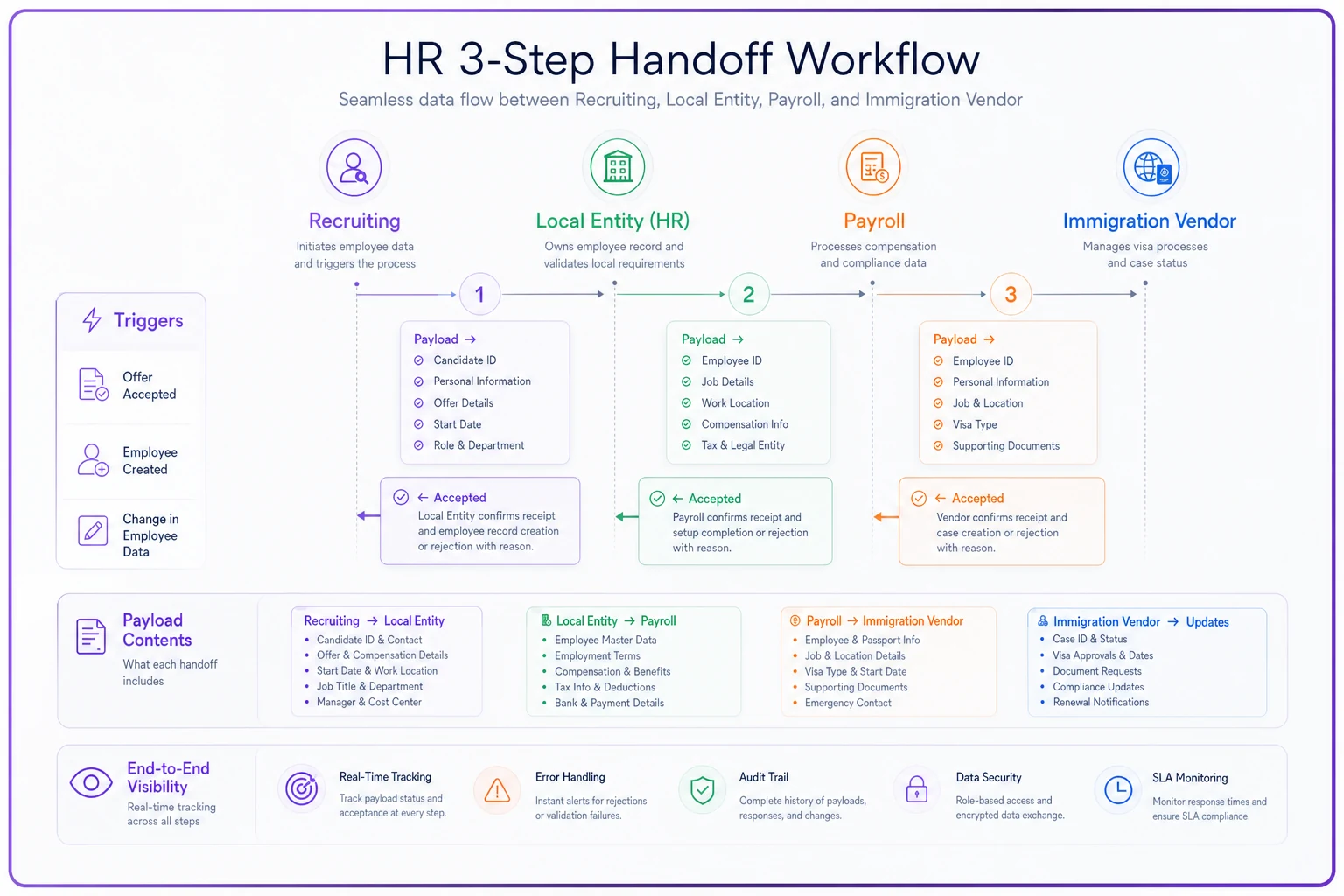
The visual shows the trigger → payload → acceptance flow across stakeholders so you can see where handoffs commonly fail.
Sample handoff scripts
Recruiting → Local entity (offer accepted): > "Offer accepted for [Name], start date [date], band [X]. Attached: signed offer, comp breakdown, role level. Local owner [Name] — please confirm receipt and flag any statutory benefit or contract adjustments needed within 2 business days. Payroll cut-off for this start date is [date] — confirm we're inside it."
Local entity → Payroll vendor (onboarding): > "New hire [Name], effective [date], gross [amount], [contract type]. Statutory deductions per [country] standard. Confirm this lands in the [month] run and flag if start date misses the cut-off. Confirm back by [date]."
Immigration vendor → Core + Local (visa milestone): > "Visa status for [Name]: [approved/pending/blocked]. Earliest legal start date: [date]. If this shifts the agreed start, both core recruiting and local payroll need to reconfirm timelines."
Scripts feel bureaucratic until the first time one saves you from a missed start date. The point is that the payload is fixed — nobody has to remember what to include because it's already in the template.
Payroll cut-off rules: the deadline nobody agrees on
Payroll cut-offs cause more cross-border friction than almost anything else, and the root cause is almost always the same: the core team assumes a global deadline, and each local vendor has a different one.
Country A's provider needs data by the 15th for month-end pay. Country B's needs it 10 days out. Country C processes twice monthly with two separate cut-offs. When you run one global "submit payroll changes by the 20th" rule, you've already missed two of your three countries.
The fix is a master cut-off calendar that inverts the logic. Instead of setting one global deadline, you collect every local provider's actual cut-off, then work backward to set an internal data-lock date that's early enough to satisfy the tightest one. Everything upstream — offer approvals, comp changes, terminations — has to clear before that internal lock.
-
One master calendar, owned by core, with each country's real cut-off documented
-
An internal data-lock date set before the earliest local cut-off, with buffer
-
A hard rule for late changes
anything after the lock goes into next cycle unless it's a defined exception (missed pay, legal requirement)
-
A single named owner per country responsible for hitting submission — this ties straight back to your local owner map
The thing most teams miss: payroll cut-offs aren't a payroll problem, they're a decision-timing problem. If comp approvals and headcount sign-offs don't have deadlines that sit comfortably before payroll locks, you'll keep making off-cycle corrections forever. Off-cycle runs are where errors and cost pile up.
What breaks at scale
The operating model that works at three countries fails at ten for predictable reasons. Worth naming them so you can watch for the early signs.
Exception creep. Every one-off local deviation that doesn't get folded back into the standard becomes permanent drift. At scale you end up with twelve "standards" instead of one.
Owner turnover. Local owners leave. If the mapping isn't documented and access isn't cleanly managed, each departure creates a small operational hole and a small audit gap. Ten countries means this happens constantly.
Handoff decay. Handoffs that work informally between two people who know each other stop working when either person changes or when volume rises. Informal handoffs don't scale — that's not a criticism, it's just how it goes.
Audit surface expansion. Every country adds records, retention requirements, and access points. Without a global retention schedule and clean local storage, an audit request that would've taken a day in one country takes weeks across ten.
The through-line: everything that was tolerable as a manual, relationship-based process becomes a liability once it's happening in parallel across many entities. The operating model exists specifically to convert relationship-dependent processes into rule-dependent ones.
Country-readiness checklist
Before you open HR operations in a new country, this is the minimum to have locked down. Skipping any of these is how "we're live in the new market" quietly becomes "we have a compliance problem in the new market."
-
[ ] Local owner named, with backup, for payroll / hiring / contracts / records
-
[ ] Employment contract template reviewed by local counsel and marked against the master
-
[ ] Statutory benefits and minimums documented and built into offer templates
-
[ ] Payroll vendor selected, cut-off dates added to master calendar
-
[ ] Comp bands localized with the flex rule defined (how much can local move without asking)
-
[ ] Records storage method confirmed as compliant with local data rules
-
[ ] Retention schedule mapped to local legal requirements
-
[ ] Access to HRIS/payroll granted per role, with offboarding process defined
-
[ ] Handoff scripts adapted for local vendors and confirmed with each
-
[ ] Escalation path to core documented with response expectations
If you're standing up multiple countries in a compressed window, sequence these — don't try to run all ten countries' checklists simultaneously. Get one country fully clean as your template, then replicate.
A real scenario
A B2B software company, roughly 220 employees, had grown from one country to seven over about eighteen months. HR was three people at the core plus a scattered set of local contacts. Nothing was formally owned. Payroll ran on whatever calendar each local provider used, and comp exceptions were approved over Slack.
The symptoms: two missed payroll cut-offs in a single quarter, both requiring off-cycle corrections. Offers going out with inconsistent benefits across countries. And an investor-driven due diligence request that took nearly three weeks to fulfill because employment records were scattered across local owners' individual drives.
They didn't rebuild everything. They did three things. First, they filled in the core vs local decision grid honestly — documenting how decisions actually got made, then fixing the "shared with no rule" rows. Second, they built the local owner map, naming a backup for every country. Third, they consolidated payroll into a single master cut-off calendar with an internal data-lock date.
Within about two quarters, off-cycle payroll corrections dropped to near zero. The next due diligence request was fulfilled in a few days instead of weeks because records ownership and retrieval were now defined. Nothing about the fix was clever. It was just writing down who owns what and when things are due.
When this level of structure makes sense — and when it doesn't
When it makes sense: You're past three countries, or you're about to cross that line intentionally. The overhead of a formal operating model pays for itself the moment you have parallel processes running in enough places that relationships alone can't hold them together.
When it's overkill: One or two countries with a stable, small team. If you can fit everyone who touches HR in a single conversation, you don't need a decision grid — you just need to talk. Formalizing too early creates process theater that slows you down without protecting anything.
Who should not do this: Companies that are about to consolidate entities or shift to an EOR-only model in some markets. Building a heavy local-owner structure right before you're going to collapse it is wasted effort. If your entity strategy is in flux, stabilize that first, then build the operating model on top of the real footprint.
One more caution: don't let the operating model calcify. The whole point is that it makes decisions faster and cleaner. If the grid and the handoff scripts become things people route around because they're too rigid, you've recreated the original problem in a more official-looking form. Review the grid quarterly and fold in the exceptions that have become the norm.
Tooling reality
You can run all of this in spreadsheets and shared docs, and plenty of scale-ups do exactly that up to a point. The decision grid is a table. The owner map is a table. The cut-off calendar is a calendar. None of it requires software to exist.
What breaks the spreadsheet approach isn't the data — it's the coordination. When a handoff needs to trigger automatically off an event, when access changes need to sync with owner departures, when payroll cut-offs need to actually block late changes rather than just recommend against them, that's where a connected HRIS starts earning its cost. The value is in enforcing the rules you already defined, not in defining them for you.
AI-powered operational software can help here in a specific, limited way — not by redesigning your model, but by making sure the rules you've already written down actually get followed. Automated reminders that fire before cut-off dates, access provisioning that triggers when an owner changes, records retrieval that doesn't depend on one person knowing where things are stored. That's the practical value: less chasing, fewer gaps, the same ownership model running with less manual overhead.
If you're evaluating a platform change to support multi-country operations, the transition itself deserves its own plan — the HR tech migration playbook covers keeping hiring moving while you cut over, which matters a lot when you're mid-expansion.
Closing thought
A global HR operating model for scale-ups isn't really about global HR. It's about making the same handful of decisions — who owns comp, when is payroll due, who's accountable in each country, how does work move between core and local — answerable the same way every time, in every market.
The companies that scale cleanly aren't the ones with the most sophisticated model. They're the ones who wrote down the ownership split, named the backups, fixed the cut-off calendar, and then actually followed it. Everything else is detail.
A global HR operating model for scale-ups isn't really about global HR. It's about making the same handful of decisions — who owns comp, when is payroll due, who's accountable in each country, how does work move between core and local — answerable the same way every time, in every market.
The companies that scale cleanly aren't the ones with the most sophisticated model. They're the ones who wrote down the ownership split, named the backups, fixed the cut-off calendar, and then actually followed it. Everything else is detail.
Ready to transform your HR processes?
Join thousands of HR teams using Hiryly to hire faster, engage employees better, and stay compliant effortlessly.