



Most probation processes fall apart not at the decision, but in the three months leading up to it. The manager meant to document that missed deadline in week 4. The day-60 check-in slipped because of a product launch. Nobody wrote down that the new hire asked for training twice and never got it. Then day 90 arrives, someone wants to let the person go, and HR asks the one question that unravels everything: where's the evidence?
This is where conversion leakage actually lives. Not in the dramatic cases — in the quiet default-to-permanent that happens because no one gated anything. People convert because the clock ran out, not because they earned it. And when a genuine termination does need to happen, there's nothing on paper to support it, so it drags, gets disputed, or gets settled.
A real probation-to-permanent SOP fixes both leaks: it stops weak performers from sliding through on inertia, and it makes hard exits defensible by building the paper trail as you go, not in a panic at the end.
The two failure modes most teams never separate
When probation goes wrong, it's almost always one of two patterns, and they need opposite fixes.
Silent conversion. The probation period expires. No formal review happened, or one happened but it was a rubber stamp. The employee becomes permanent with full protections and nobody can point to a single documented performance conversation. Six months later when problems surface, you're managing out a permanent employee instead of declining a probationer — a completely different legal and time cost.
Contested exit. Someone decides the hire isn't working around week 7. But the manager has no contemporaneous notes, the expectations were never written down, and the two concerns they remember were never raised directly with the employee. The exit gets challenged. Even a weak claim costs legal review time, a possible settlement, and the manager's credibility.
What's striking is how often the same team suffers both. Silent conversions happen for the decent-but-unremarkable hires; contested exits happen for the clearly struggling ones — because neither group got structured gates. The gates are what separate a real decision from a default.
Why the evidence never exists when you need it
In real operations, the documentation gap isn't laziness. It's a timing problem. Managers are asked to recall and write up performance at the moment of the exit decision, which is exactly the moment it looks defensive and retaliatory. Notes written in week 3, week 6, week 9 — as things actually happen — are worth ten times more than a tidy summary assembled the week you want to fire someone.
Eliminate HR bottlenecks with smart automation.
Hiryly simplifies your HR operations so you can focus on people, not paperwork.
- Centralized candidate tracking
- Automated onboarding workflows
- Performance & compliance dashboards
No credit card required
-
The offer letter sets a probation period but never defines what "successful completion" looks like, so there's no standard to measure against.
-
Expectations live in the manager's head, never shared with the employee, so you can't show they knew what they were missing.
-
Check-ins happen verbally and leave no trace.
-
Support the employee requested — training, access, a mentor — was never logged, so you can't prove you held up your end.
That last one matters more than people expect. A significant portion of contested probation exits turn on the employee claiming they weren't set up to succeed. If you have a day-30 note where they confirmed they had everything they needed, that argument collapses. Without it, it's your word against theirs.
This is the same evidence discipline that separates a clean investigation from a messy one — the logic behind turning messy complaints into auditable outcomes applies directly here: capture the record as events happen, with owners and timestamps, not retroactively.
The gate structure: 30 / 60 / 85, not 90
Notice the last gate is day 85, not day 90. This is deliberate, and it's the single most common fix teams miss.
If your probation ends at day 90 and your final decision meeting is on day 90, you have zero room to act. You need notice periods, HR review, possibly a final written warning or an extension conversation. Decisions made on a deadline are almost always rushed and legally sloppy. Pull the final gate to day 85 — or day 80 in longer-notice jurisdictions — so there's actual runway to act.
Here's how the three gates split by purpose:
| Gate | Timing | Primary question | Evidence packet contents | Possible outcomes |
|---|---|---|---|---|
| Gate 1 | Day 30 | Is the setup working? | Confirmed access/tools, written expectations acknowledged, first-task feedback, support requests logged | On track / Needs support / Early concern flagged |
| Gate 2 | Day 60 | Is performance trending to standard? | Specific task outcomes vs. standard, documented coaching, improvement or decline notes | On track / Formal improvement plan / Extension candidate |
| Gate 3 | Day 85 | Convert, extend, or exit? | Full packet from Gates 1–2, manager recommendation, HR review sign-off | Convert / Extend with defined conditions / Exit |
The power isn't in the dates themselves — it's that each gate produces a packet, and each packet is the input to the next one. By Gate 3 the decision mostly writes itself, because the evidence was accumulated along the way instead of reconstructed under pressure.
What goes in an evidence packet
An evidence packet is what makes a conversion decision defensible. It's not a form the manager fills out at the end — it's a running record. Minimum contents at each gate:
-
Written expectations the employee acknowledged (not just KPIs — behaviors and standards too)
-
Specific examples of work meeting or missing those expectations, with dates
-
Coaching given, when it happened, and the employee's response
-
Support requested and provided — training, tools, access, clarifications
-
The employee's own input at each check-in, including any blockers they raised
-
Manager recommendation with reasoning tied back to the original expectations
The non-obvious item is capturing the employee's own input. What they said at each gate — especially when they confirmed things were going fine — is what prevents the "nobody told me" defense. A probationer who signed off at day 60 saying they felt supported can't credibly claim at day 85 they were set up to fail.
This is the same evidence discipline that separates a clean investigation from a messy one — the logic behind turning messy complaints into auditable outcomes applies directly here: capture the record as events happen, with owners and timestamps, not retroactively.
The real cost of getting this wrong
Take a mid-sized services firm hiring around 40 people a year, with a probation period on each. Before tightening their process, the pattern was consistent: around 6 to 8 hires a year were clearly struggling by week 6, but only 2 or 3 actually got exited during probation. The rest converted quietly because nobody wanted to assemble a case from nothing.
Those silent conversions became the following year's performance-management headaches. Each one that eventually needed managing out cost somewhere between three and five months of a manager's time, plus HR involvement, plus the occasional settlement when the documentation was thin. Conservatively, several thousand dollars of loaded cost per avoidable conversion — and that's before the drag on the team watching an underperformer stick around.
On the other end, the one contested exit that year — a termination at day 80 with no documentation — turned into a legal review and a settlement in the low five figures, mostly because there was nothing contemporaneous to show the person had been told about the problems.
After moving to timed gates with evidence packets, the shift wasn't dramatic in headcount terms. Maybe one or two additional exits happened during probation instead of after. But the exits that did happen stopped being challenged, because each one came with a dated trail. The leakage — people converting by default — largely closed. The quiet number nobody tracks, "we knew by week 6 but kept them," dropped close to zero.
Automated reminders and escalation: the part humans always drop
The gates only work if they actually fire. And the thing that kills gate processes is that they depend on a busy manager remembering a date. They don't. Gate 2 slips two weeks, then Gate 3 collides with the deadline, and you're back to rushed decisions.
-
Scheduled reminders fire to the manager 5 days before each gate, with the packet template pre-attached.
-
Missed-gate escalation triggers if a gate passes without a completed packet — the manager's manager and HR get notified automatically.
-
Decision-deadline lock flags any probationer approaching day 85 without a recommendation, so no one converts by silence.
-
Remediation path kicks in when Gate 2 flags a formal concern
an improvement plan with defined, dated conditions, not vague "do better" language.
This is where workflow software earns its place — not as a selling point, but because the escalation logic genuinely can't run on memory and calendar invites. A platform that owns the timeline, auto-assigns the packet owner, and escalates a missed gate to the right person removes the single biggest failure point in this whole process: the forgotten check-in. The same discipline that keeps onboarding steps from stalling — the kind of SLA and HRIS wiring described in this onboarding reconciliation SOP — is exactly what keeps probation gates from quietly expiring.
Here's a simple workflow diagram of the reminder and escalation flow.
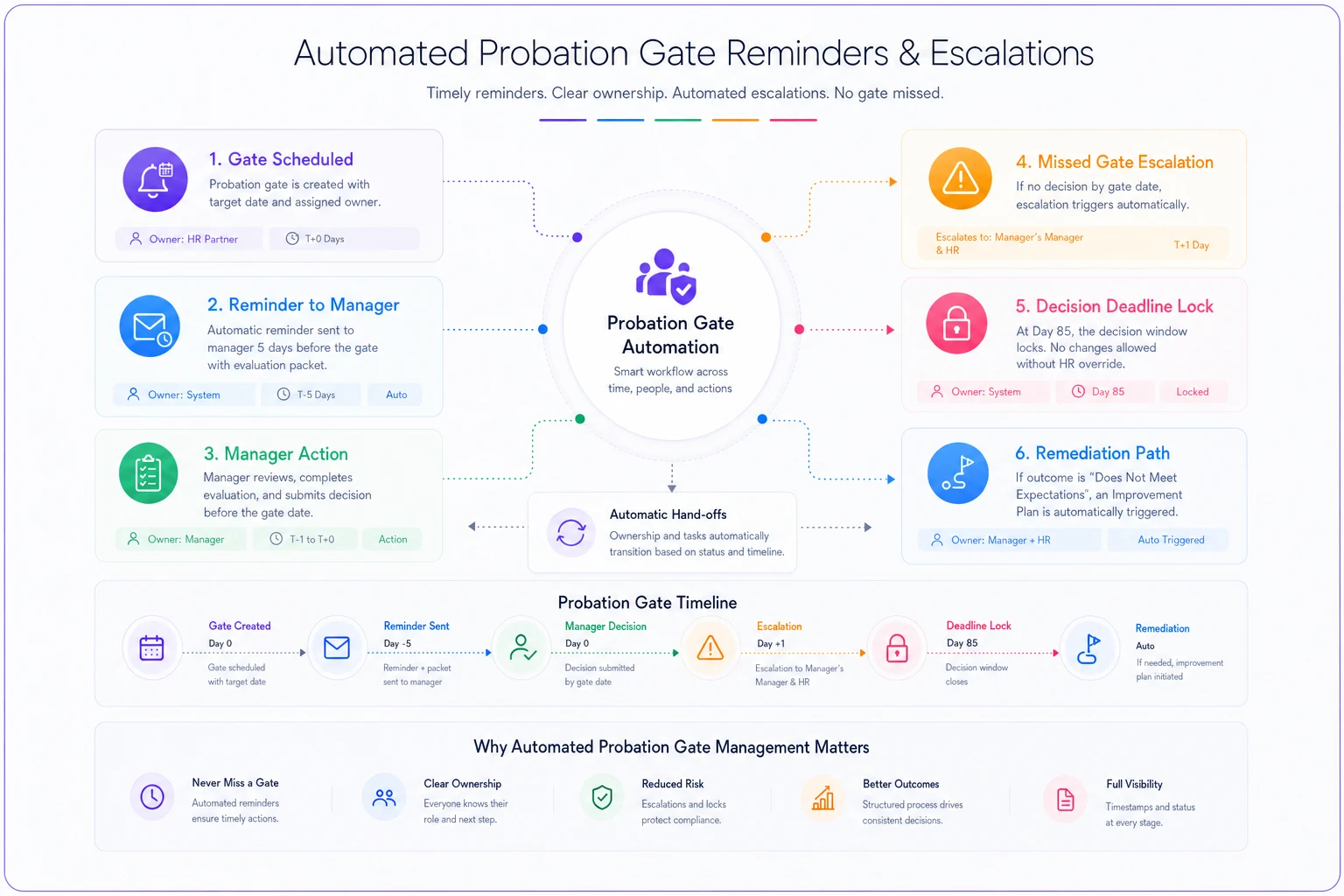
A visual like this helps explain why automation isn't optional: it shows the timeline, ownership, and the automatic escalations that stop checks from slipping.
Manager templates that cut the writing burden
Managers resist documentation because writing feels like extra work on top of the actual work. The fix is to make the packet mostly selection, not composition. Give them:
-
A check-in script for each gate so the conversation covers the required ground — expectations, examples, support, employee input.
-
A structured note template where they tag outcomes against pre-defined standards rather than writing paragraphs.
-
Pre-written improvement-plan language they can adapt, so a formal plan takes 15 minutes instead of an afternoon of nervous drafting.
-
A recommendation form at Gate 3 that requires the reasoning to connect back to earlier packets.
Pro-tip: pre-fill templates with role-specific examples so managers can select rather than compose, which dramatically lowers the activation energy to document.
When documentation drops from an hour to ten minutes, managers actually do it. The templates are what move the process from "policy that exists on paper" to "thing that happens every time."
Where this ties into onboarding
Probation gates work best when they're not a separate ritual bolted onto onboarding — they share the same timeline. The day-30 and day-60 milestones you're already using for onboarding checkpoints are the natural moments to run the probation gate too. If your onboarding already uses measurable milestones, you're most of the way there; the probation packet just adds the evidential and decision layer on top.
The first 90 days onboarding blueprint and the probation SOP should share dates, not compete for the manager's calendar.
When this makes sense — and when it doesn't
This makes sense when:
-
You hire more than a handful of people a year and probation decisions are inconsistent across managers.
-
You've had an exit challenged or settled because documentation was thin.
-
You suspect silent conversions — people becoming permanent without anyone actually making a decision.
-
You operate in jurisdictions where probation status gives meaningfully different termination rights, so letting it lapse matters.
This is overkill when:
-
You're a very small team where the founder personally knows and reviews every hire weekly. The formal gates add process you don't need yet.
-
Your probation period is so short — say, 30 days — that three gates don't fit. In that case, run one solid mid-point gate and one decision gate.
Who should not bolt this on blindly: teams that already have a performance-management process they don't follow. Adding a probation SOP on top of an ignored review process just creates two things nobody does. Fix the follow-through problem first — or build the escalation layer that forces follow-through — before adding more structure.
Getting it running
Start narrow. Pick one department, define what "successful completion of probation" actually means for those roles in writing, and set the 30/60/85 gates. Build the three packet templates and the manager scripts. Wire up reminders — even calendar-based ones to start — and add one escalation rule: a missed gate pings HR. Run it for a full probation cycle, see where managers struggle, tighten from there, then roll wider.
The goal isn't more paperwork. A process where the decision at day 85 is easy because the evidence was captured as events happened, where nobody converts by accident, and where the exits you do make hold up without a fight — that's the actual outcome. Probation leakage closes when you stop treating the decision as a single moment and start treating it as a timeline with gates: each one small, each one producing a record, each one making the next decision defensible.
The goal isn't more paperwork. A process where the decision at day 85 is easy because the evidence was captured as events happened, where nobody converts by accident, and where the exits you do make hold up without a fight — that's the actual outcome. Probation leakage closes when you stop treating the decision as a single moment and start treating it as a timeline with gates: each one small, each one producing a record, each one making the next decision defensible.
Ready to transform your HR processes?
Join thousands of HR teams using Hiryly to hire faster, engage employees better, and stay compliant effortlessly.