

Most HR tech stacks don't fail dramatically. They fail quietly. A new hire shows up on day one and can't log into the LMS. A terminated contractor keeps their email for three weeks. Payroll runs with a cost center that stopped existing after the last reorg. None of these are catastrophes on their own, but together they're the symptom of an HR systems architecture that was assembled rather than designed.
The difference matters more the bigger you get. At 80 employees, you can manually fix a provisioning glitch before anyone notices. At 1,200 across four countries, with a dozen downstream systems reading from your HRIS, the same glitch becomes a ticket queue, an audit finding, and occasionally a security incident. The architecture that got you here actively works against you at the next stage.
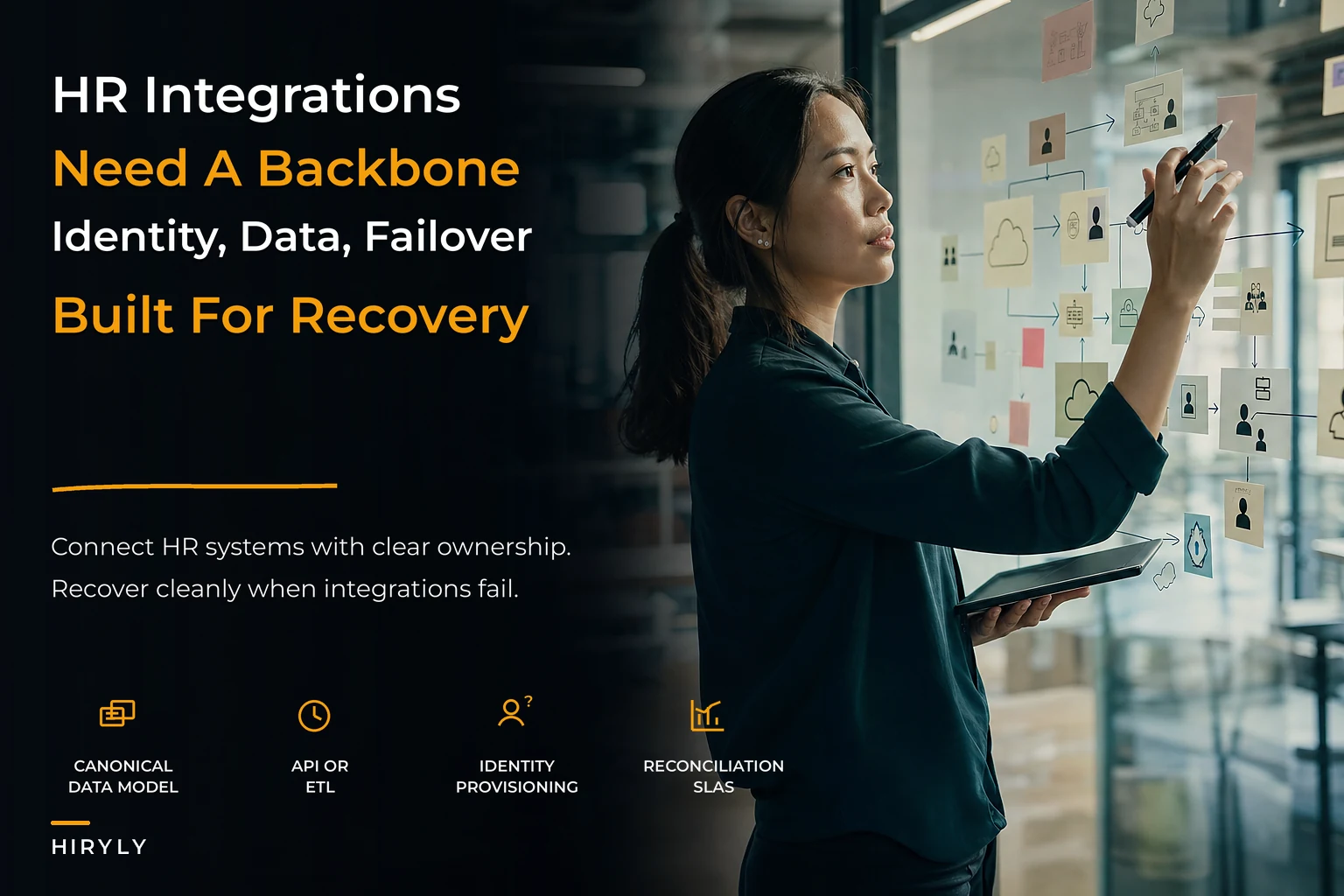
This is the part HR teams rarely get to design on purpose. The HRIS gets picked first, integrations get bolted on reactively, and identity provisioning becomes whatever the IT team wired up in a hurry. What follows is how to think about the whole thing as a system — the data model underneath it, how identity flows out of it, when to use APIs versus batch files, and what to do when (not if) something breaks.
Start with the data model, because everything downstream inherits its mistakes
Nobody tells you when you buy an HRIS that the system of record isn't really the HRIS. It's the data model the HRIS exposes to everything else. If that model is messy, every integration you build on top of it inherits the mess, and you end up reconciling garbage forever.
A canonical HR data model is just an agreed-upon shape for the core entities everyone downstream depends on. It's the contract. When the LMS, the badge system, payroll, and the expense tool all read the same definition of "worker" and "assignment," you stop having arguments about whose data is right.
The entities that actually cause trouble when modeled badly:
-
Person vs. Worker vs. Assignment. A person is a human. A worker is an employment relationship. An assignment is a specific role or position that worker holds. A rehire is the same person, a new worker record. A dual role is one worker with two assignments. Collapse these into one flat "employee" record and you will spend years untangling contractors who became FTEs, people with two managers, and leave-of-absence cases that break every downstream count.
-
Position vs. Job. A job is "Senior Analyst." A position is the specific, fundable seat someone sits in. Finance cares about positions. Recruiting cares about jobs. If your model can't tell them apart, headcount forecasting and backfill logic turn into spreadsheets.
-
Organization and cost center. These move constantly. The question isn't whether they'll change — it's whether your model stores effective-dated history so you can answer "who reported to whom on March 3rd" without guessing.
One pattern worth internalizing: effective dating is not optional at scale. Small companies treat HR data as "what's true now." Larger ones need "what was true on any given date," because audits, retroactive comp changes, and payroll corrections all live in the past. A model without effective dating forces you to reconstruct history from logs, which is miserable and often impossible.
The single most useful decision you can make here is picking a stable, meaningless primary key for person and worker. Not the email. Not the employee number that gets recycled. A key that never changes and means nothing on its own. Every downstream reconciliation gets easier when identity hangs off a key that can't drift.
Backfill stable keys during migrations to avoid long-term reconciliation headaches.
Here's a stripped-down canonical model as a reference:
| Entity | Key fields | Who reads it downstream | Common modeling mistake |
|---|---|---|---|
| Person | person_id (stable), legal name, national ID ref, DOB | Identity, background check | Reusing person_id on rehire |
| Worker | workerid, personid, type (FTE/contingent), status, hire/term dates | Payroll, IdP, badge | Merging contingent + FTE into one type |
| Assignment | assignmentid, workerid, positionid, managerid, FTE%, effective dates | Org chart, approvals, analytics | No effective dating |
| Position | positionid, jobid, cost_center, location, open/filled | Finance, workforce planning | Treating job as position |
| Organization | orgid, parentorgid, costcenter, effective dates | Reporting, routing, security | No history on reorgs |
The table above isn't meant to be copied wholesale — every org has quirks that complicate these boundaries. But it at least gives you something concrete to push against when your HRIS vendor insists their default schema is "industry standard."
If you want to go deeper on how ownership and access sit on top of this model, the mechanics in HR data governance for HR teams pair directly with the structure here — the data model defines what exists, governance defines who can touch it.
Identity provisioning is where the data model meets reality
Once you have a clean worker record, the next question is how it turns into access. This is the joiner-mover-leaver (JML) problem, and it's the single most visible way HR architecture succeeds or fails, because employees feel it immediately.
Eliminate HR bottlenecks with smart automation.
Hiryly simplifies your HR operations so you can focus on people, not paperwork.
- Centralized candidate tracking
- Automated onboarding workflows
- Performance & compliance dashboards
No credit card required
The pattern that works at scale is HRIS as the source of truth, identity provider as the distribution layer. The HRIS owns the fact that someone is hired, moved, or terminated. The IdP — whatever you use for single sign-on and directory — translates those facts into accounts, groups, and access across every connected app. HR shouldn't be creating accounts in individual tools. HR should be creating accurate worker records, and the provisioning should cascade from there.
-
Event-driven provisioning. The HRIS fires an event ("worker hired," "worker terminated"), and the IdP reacts in near real time. This is the right default for anything security-sensitive — especially deprovisioning. A termination should revoke access in minutes, not on the next nightly batch.
-
Scheduled sync. The IdP pulls a full worker feed on a schedule (nightly is typical). Simpler to build, easier to reason about, but it means a termination at 9am leaves access live until the 2am run. Fine for low-risk attribute updates. Dangerous for offboarding.
-
Attribute-based access (ABAC). Instead of manually assigning each new hire to groups, access is derived from worker attributes: department, location, job code, employment type. A worker in "Finance / Controller / full-time" automatically lands in the right groups. This is what lets you stop hand-managing access as you grow.
The mistake that shows up constantly: companies get joiner provisioning roughly right because new hires complain loudly, and they get leaver provisioning dangerously wrong because nobody complains when a former employee still has access. Movers are the worst of all — someone changes teams, gains the new access, and keeps the old. Over a few years you accumulate people with access to half the company. Auditors love finding this.
[HRIS Worker/Assignment Record Created or Updated] │ ▼ [Event fires to IdP — hire, move, or terminate] │ ├─► JOINER: Provision baseline access from attributes (2–3 days before start) │ ├─► MOVER: Recalculate attributes → remove old access, grant new │ └─► LEAVER: Immediate revocation → disable account → retain per policy
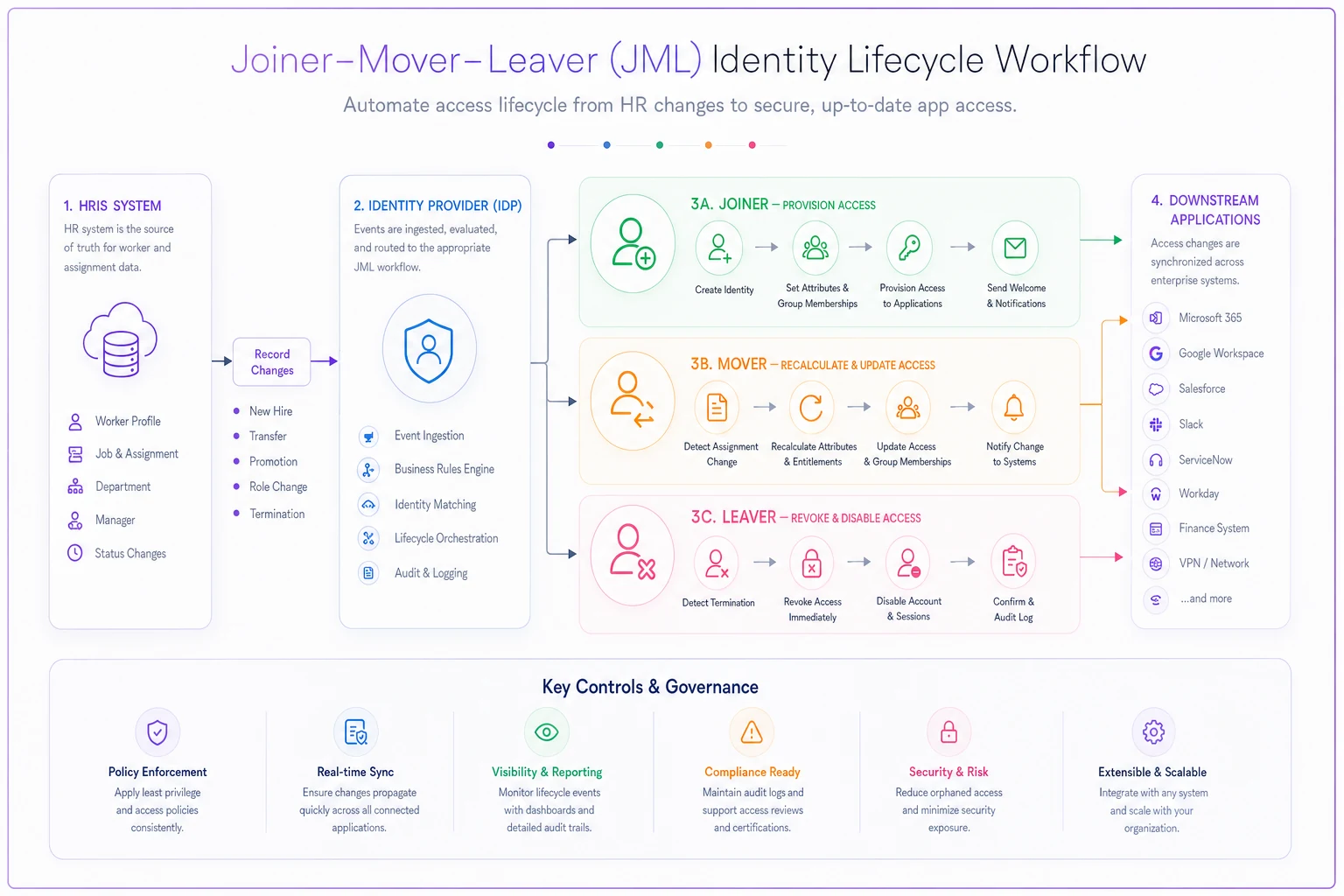
The diagram above shows the HRIS-to-IdP event flow and the three provisioning outcomes in plain terms.
Every step above is driven by a change to the worker or assignment record, not by someone filing a ticket. That's the whole point. If your provisioning depends on humans remembering to file tickets, it will fail exactly when you're busiest — which is usually during a reorg or a round of layoffs, when getting it right matters most.
API vs. ETL: stop defaulting to one
Teams tend to pick an integration style based on habit rather than fit. The IT-heavy shops API everything. The finance-adjacent shops batch everything. Both are wrong about half the time.
The real decision depends on four things: how fast the data needs to move, how much of it there is, how much the two systems need to stay transactionally in sync, and how brittle the endpoints are. Here's a matrix that reflects the actual tradeoffs:
| Factor | Lean API / real-time | Lean ETL / batch |
|---|---|---|
| Latency need | Access changes, terminations, approvals | Analytics, reporting, payroll feeds |
| Data volume | Small per-event payloads | Bulk loads, full-table refreshes |
| Failure tolerance | Low — must be current | Higher — can retry next run |
| System coupling | Needs confirmation/ack | Fire-and-forget acceptable |
| Vendor API maturity | Stable, well-documented | Weak API, CSV export only |
| Audit needs | Event log per transaction | Snapshot per run |
A few things worth saying plainly.
Security-sensitive flows should be real-time; everything else probably shouldn't be. Deprovisioning, approvals, anything where staleness creates risk — API. The nightly feed to your BI tool, the monthly file to a benefits broker — batch. Trying to make analytics real-time usually just buys you fragility you don't need.
Weak vendor APIs are the real constraint, not your architecture preferences. Plenty of HR-adjacent tools still only speak SFTP and CSV. You can design the most elegant event-driven architecture in the world and still get stuck with a benefits vendor who takes a flat file on the 1st of the month. Build for that reality. The integration surface you inherit is usually messier than the sales demo suggested — the HR tech migration playbook gets into this in more detail.
"File-based doesn't mean uncontrolled." A lot of the reconciliation pain with batch comes from treating files as throwaway. Keep every file you send and receive, with a record count and a checksum. When numbers don't match next month, you'll find out why in ten minutes instead of a week.
When it breaks: failover and reconciliation SLAs
Integrations break. The question is whether you notice in minutes or in a quarterly audit. Resilient architecture assumes failure and designs the recovery path deliberately.
Two concepts do most of the work here: failover (what happens when a flow is down) and reconciliation (how you prove the two systems agree after the fact). You need both. Failover keeps the business moving during an outage. Reconciliation catches the drift that failover inevitably introduces.
-
Identity drift (HRIS vs. IdP) compared daily. Any active IdP account with no matching active worker flagged within 24 hours, remediated within 48. This is the one that catches the ex-employee who still has access.
-
Payroll headcount vs. HRIS reconciled each pay cycle before the run locks. Discrepancies block the run until resolved — because paying someone who left, or not paying someone who started, is worse than a delayed run.
-
Org/cost center integrity monthly. Any assignment pointing at a dead cost center flagged and reassigned.
The failure modes worth planning for specifically:
-
Partial sync. The integration ran but only processed 60% of records before timing out. This is nastier than a full outage because everything looks fine. Record counts per run catch it.
-
Silent schema drift. A vendor adds a field, changes a date format, renames a value, and your mapping silently drops or misreads it. Validate the shape of what arrives, not just that something arrived.
-
Replay and ordering. Event-driven systems occasionally deliver events out of order or twice. A "terminate" arriving before a "hire" for a rehire can lock someone out on day one. Idempotent handling and sequence checks matter.
-
Duplicate identities. A rehire gets a fresh person_id, and now there are two of them. This corrupts analytics and security records permanently if not caught early — which is exactly why the stable-key decision pays off here.
A workable reconciliation workflow:
-
Each night, pull the active worker set from the HRIS and the active account set from the IdP.
-
Join them on the stable key and bucket every mismatch into one of three categories: account without worker (likely a missed deprovision, highest priority), worker without account (likely a failed provision, blocks the employee), and attribute mismatch (wrong department, manager, cost center).
-
Route each bucket to an owner with a resolution clock attached.
-
Over a few months, the categories of mismatches will tell you exactly which integration is the weak one — which is more useful than knowing individual records are wrong.
Running this consistently turns reconciliation from a quarterly fire drill into something closer to maintenance.
Governance: who owns what when something goes wrong
Technical architecture without clear ownership degrades fast. The most common organizational failure isn't a bad tool — it's that nobody actually owns the integration between two tools, so it rots in the gap between HR and IT.
-
Data owner (HR) owns the meaning and accuracy of worker data. Decides what "active" means, what employment types exist, what the retention rules are.
-
Data steward (HR ops) owns day-to-day data quality — the reconciliation queues, the exception handling, the "why is this record wrong" questions.
-
Integration owner (IT/HRIS admin) owns the pipes. The APIs, the batch jobs, the IdP connectors. Accountable for uptime and the failover plan.
-
Identity owner (IT/security) owns the access model — the ABAC rules, the deprovisioning SLA, the audit trail.
-
Governance forum a small recurring group where HR, IT, security, and often finance review drift metrics, failed syncs, and proposed changes before they ship.
The clearest sign governance is missing: when a termination doesn't revoke access, three teams point at each other, and nobody can say whose job it was. Write it down before that happens. If your organization runs analytics across distributed teams, the ownership patterns in the people analytics operating model for federated teams line up well with these roles — same principle, applied to reporting rather than provisioning.
Getting the governance forum established early is worth emphasizing. It doesn't need to be a long meeting. Even a 30-minute monthly review of drift metrics and failed syncs catches the slow decay that otherwise shows up as a security finding.
A real scenario
A mid-market company — around 900 employees across the US and two EU offices — had grown through a couple of acquisitions and ended up with the classic patchwork: one HRIS, a separate contractor system, an IdP wired up with mostly nightly syncs, and a benefits vendor on monthly CSVs.
The symptom that finally forced the issue: a security review found roughly 40 active accounts belonging to people who'd left, some more than six months prior. Deprovisioning ran on the nightly batch, and terminations that didn't get keyed cleanly in the HRIS simply never flowed through. Separately, every reorg left dozens of workers pointed at cost centers that no longer existed, which finance only discovered during the quarter-end close.
What changed over about four months wasn't a rip-and-replace. They picked a stable worker key and backfilled it, moved terminations specifically to event-driven revocation while leaving low-risk attribute updates on the nightly sync, and stood up a daily identity reconciliation that bucketed mismatches by type.
The orphaned-account count dropped to low single digits within two cycles and stayed there, because the reconciliation caught the stragglers the automation missed. Cost-center drift stopped being a quarter-end surprise because it was caught monthly instead. Nothing exotic — just the data model, the provisioning pattern, and the reconciliation SLA working together instead of independently of each other.
When this level of rigor makes sense — and when it doesn't
When it's worth it: you're past a few hundred employees, you have more than a handful of downstream systems reading HR data, you operate in more than one country, or you're facing audits that ask "prove access matches employment." At that point, ad hoc integration is already costing you in rework and risk — you just might not have added it up yet.
When it's overkill: under roughly 75 people with two or three systems, an event-driven, multi-pattern architecture is more machinery than you need. A clean HRIS, a decent nightly sync, and a human who checks a reconciliation report weekly will serve you fine. Don't build for 2,000 when you're at 60.
Who should not do this alone: HR teams without a committed IT or security counterpart. Identity and failover are shared responsibilities. If you can't get IT in the room for the governance forum, fix that before you touch the architecture — because the handoff gaps between teams are exactly where these systems rot.
Pulling it together
Resilient HR systems architecture isn't a product you buy or a single integration you get right. It's four things holding each other up: a canonical data model with stable keys and effective dating, identity provisioning that cascades from worker records instead of tickets, integration patterns chosen per-flow rather than by habit, and reconciliation SLAs that assume things will break and catch the drift when they do.
The teams that get this right aren't the ones with the fanciest tools. They're the ones who decided, deliberately, what their worker record means, who owns each pipe, and how they'll know when something has quietly gone wrong. That last part — knowing when something is wrong before an auditor tells you — is the part that takes the most intention to build and the most discipline to maintain.
Start with the data model. Everything else is downstream of that decision, including every mistake you'd rather not be untangling a year from now.
Start with the data model. Everything else is downstream of that decision, including every mistake you'd rather not be untangling a year from now.
Ready to transform your HR processes?
Join thousands of HR teams using Hiryly to hire faster, engage employees better, and stay compliant effortlessly.