

Most succession plans are theater. They exist as a slide deck refreshed once a year, usually right before a board meeting, and they answer exactly one question: "if someone quits, whose name goes in the box?" That's not succession planning. That's a name-swapping exercise that gives leadership a false sense of coverage.
The problem shows up the moment a real departure hits. The "successor" on the slide turns out to be 18 months away from ready, or already overloaded, or interviewing elsewhere themselves. Meanwhile the role that actually broke wasn't even flagged as critical, because "critical" was defined by title seniority instead of what the role actually does to keep revenue and operations moving.
Treat this like an operating system, not a document. The goal isn't to predict who leaves. It's to reduce the risk attached to roles — so that when someone leaves, the disruption is measured in weeks instead of quarters, and you're not making a panicked internal promotion or an expensive external hire under pressure.
Start with role risk, not people
The single biggest reset in a working succession framework is this: you tier roles by risk before you ever talk about people.
If you start with people, you anchor on your strongest performers and build plans around keeping them happy. That's retention, not succession. Succession asks a different question — which roles would hurt the most if they emptied out tomorrow, and how exposed are we right now?
A role's risk comes down to two things: impact if vacant and difficulty to backfill. A role can be senior and still low-risk if three people could step in next week. A role can be mid-level and genuinely high-risk because one person quietly holds all the knowledge of a legacy billing system nobody ever documented.
What shows up consistently across organizations is that the highest-risk roles are almost never the ones at the top of the org chart. They're the connector roles — the ops lead who knows every vendor's quirks, the senior engineer who's the only one who understands the data pipeline, the payroll specialist who's been manually reconciling the same edge cases for six years. Those are the roles that empty out and leave a smoking crater, and they're the ones most succession decks completely ignore.
Building the critical-roles inventory
Before tiers, you need an inventory. Not a headcount list — a risk-scored list of roles that actually matter.
Eliminate HR bottlenecks with smart automation.
Hiryly simplifies your HR operations so you can focus on people, not paperwork.
- Centralized candidate tracking
- Automated onboarding workflows
- Performance & compliance dashboards
No credit card required
A practical critical-roles inventory captures, for each role:
-
Impact score
revenue exposure, customer-facing dependency, compliance/legal exposure, and operational single-point-of-failure risk
-
Backfill difficulty
internal bench depth, external talent scarcity, time-to-productivity, and specialized or tacit knowledge held
-
Current readiness of named successors
how many, and how ready
-
Knowledge concentration
how much lives in one person's head versus documented systems
-
Recent flight risk signals
not to profile individuals, but to weight urgency
You don't need a data science project for this. A workshop with function leads, a consistent scoring rubric, and a few hours of honest conversation gets you most of the way there. The honest part is the hard part — leaders overrate their bench depth almost every time.
A simple scoring rubric
Score each dimension 1–5, keep the definitions concrete, and force raters to justify anything above a 3.
| Dimension | 1 (Low) | 3 (Medium) | 5 (High) |
|---|---|---|---|
| Impact if vacant | Minimal disruption, absorbed by team | Noticeable slowdown for a few weeks | Revenue/compliance hit within days |
| Backfill difficulty | 2+ internal candidates ready now | Some internal potential, needs 6–12 mo | No internal option, scarce externally |
| Knowledge concentration | Fully documented, shared | Partially documented | Lives in one person's head |
| Successor readiness | Ready now | Ready in ~12 months | None identified |
Multiply impact by backfill difficulty for a raw risk number, then layer knowledge concentration and successor readiness as modifiers. You'll end up with a natural spread that sorts itself into tiers.
Risk tiers and what each one demands
Not every role deserves the same investment. A tiered model tells you where to spend your limited development budget and where "documentation plus a hiring plan" is honestly enough.
-
Tier 1 – Mission critical, thinly covered. High impact, hard to backfill, weak or no successor. These get active development paths, knowledge-transfer plans, and quarterly review. Most of your energy goes here.
-
Tier 2 – Critical but manageable. High impact but you have a credible successor in development, or the external market is reasonable. Annual development check-ins and a defined backfill plan.
-
Tier 3 – Important, replaceable. Meaningful roles with real bench depth or an accessible talent market. Documentation and a clean hiring playbook are enough.
-
Tier 4 – Low risk. Standard hiring covers it. Don't over-engineer these.
The mistake is spreading development evenly across everyone because it feels fair. Fairness isn't the objective here — coverage is. A working framework concentrates development spend on Tier 1 and a subset of Tier 2, and lets the rest run on hiring and documentation.
Readiness metrics that mean something
"Ready in 1–2 years" is the phrase that quietly kills succession plans. It's untestable, so it never gets challenged, and it stays on the same slide for three years running.
Readiness has to be measurable against the actual role, not against a general impression of someone's potential. A usable readiness score breaks into a few components:
-
Capability readiness — does the person demonstrably have the skills the role requires, verified through actual work, not opinion?
-
Experience readiness — have they operated at the required scope, or handled the situations this role regularly throws at you?
-
Behavioral readiness — do they lead, decide, and communicate the way the role demands?
-
Willingness — do they actually want the role? Skipping this is how you promote someone into misery.
Rate each 1–5, and be strict about what a 5 means. A common and honest output is something like: "capable and willing, but never operated at this scope" — which tells you exactly what the development path needs to close. That specificity is the whole point.
This is also where calibration matters. Readiness ratings drift the same way performance ratings drift — some managers are generous, others are brutal, and you can't compare across teams without a leveling conversation. The same discipline that keeps performance reviews consistent applies here. It's worth borrowing the mechanics from a structured calibration process so readiness scores are actually comparable across functions instead of just reflecting who rates hard.
Development paths and stretch assignments
Once you know the gap, the development path is just the sequence of experiences that closes it. The mistake most organizations make is defaulting to training courses when the real gaps are almost always experience gaps.
You don't close a "never operated at this scope" gap with a leadership workshop. You close it by giving someone a scoped version of that scope — a stretch assignment with real stakes, real exposure, and a real chance to be observed under pressure.
A useful stretch-assignment template captures:
-
The readiness gap it targets — tied directly to the readiness score
-
The specific outcome the person owns
-
Scope and authority — what decisions they actually get to make
-
Duration and checkpoints
-
Who observes and evaluates
-
The safety net — what happens if it goes sideways, so it's a real test and not a career gamble
Tie stretch assignments to measurable outcomes and checkpoints so you get clear evidence of readiness.
A typical example: a senior analyst who's a Tier 1 successor for an ops manager role but has never managed a P&L. Instead of sending them to a finance course, you hand them ownership of a small budget line and a vendor negotiation for two quarters, with the current manager coaching from the side. At the end you have evidence of readiness, not a certificate.
Stretch assignments also function as a retention tool. People who see a concrete path stay longer. A lot of succession plans fail not because there's no successor, but because the organization keeps hiring externally over its own developed bench — which is exactly the failure a well-built internal mobility operating model is designed to prevent.
The sample dashboard: what leadership actually needs to see
The dashboard is where succession either becomes a live operating tool or dies as a document. Leadership doesn't need 40 rows of names. They need a coverage picture and a short list of what's at risk.
Here’s a simple workflow view of how the dashboard is kept up-to-date.
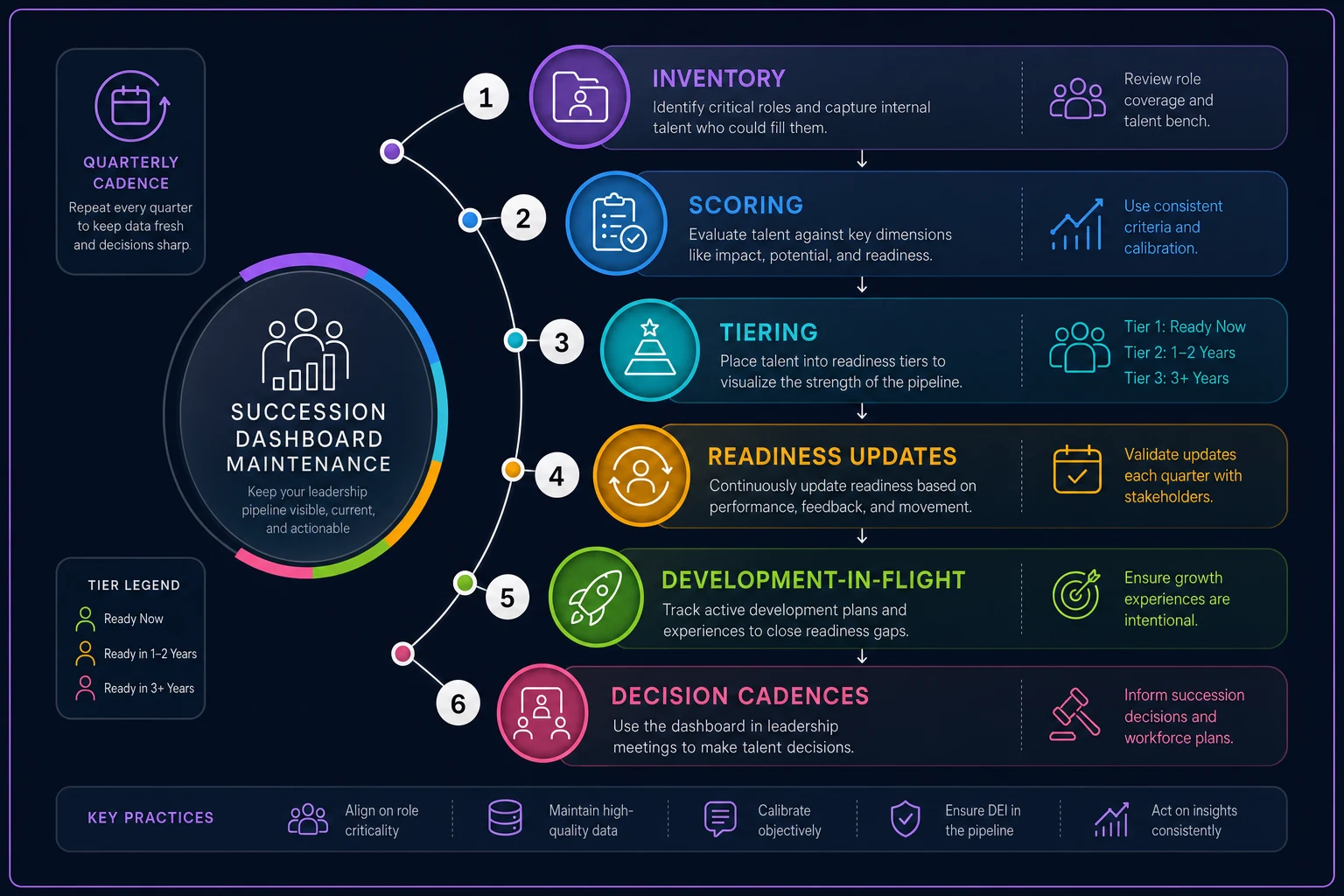
A workable succession dashboard shows:
-
Coverage by tier — % of Tier 1 roles with at least one "ready now" or "ready within 12 months" successor
-
Roles at risk — Tier 1/2 roles with zero ready successors, sorted by risk score
-
Bench depth — number of successors per critical role, flagged where it's a single point of failure
-
Readiness movement — who advanced a readiness level this quarter, who stalled
-
Development-in-flight — active stretch assignments and their checkpoint status
-
Knowledge concentration flags — critical roles where documentation hasn't caught up
The most useful single number on that whole dashboard is Tier 1 coverage. If it's sitting at 40%, that's the headline risk and everything else is detail. Watching it climb quarter over quarter is the actual proof the framework is working.
Keeping a dashboard accurate depends heavily on where the underlying data lives and who owns it. If readiness scores, role tiers, and development status are scattered across spreadsheets owned by different managers, the dashboard rots within a quarter. This is where treating succession data with the same rigor as any other people-data domain pays off — clear ownership, consistent definitions, and a refresh cadence, the same principles behind a solid people analytics operating model.
Decision cadences: promotion and backfill
A framework without a cadence is just a snapshot. The whole thing only works if there's a rhythm of decisions attached to it.
-
Quarterly – readiness review. Function leads update readiness scores and development status for Tier 1 and 2 roles. Twenty minutes per function if the data's been maintained. This is where you catch stalled development early.
-
Quarterly – risk refresh. Re-score any role that changed materially — reorg, a big departure, a new system dependency. Don't re-score everything; only what actually moved.
-
Semi-annual – deep succession review. Leadership looks at coverage by tier, roles at risk, and makes real decisions: fund a development path, start an external pipeline, accelerate a stretch assignment.
-
Trigger-based – backfill decision. The moment a critical role is confirmed vacant, a pre-agreed decision runs: is there a ready successor? Promote. Nearly-ready? Interim-plus-accelerate. No one? Launch external search and interim coverage simultaneously.
The trigger-based backfill decision is the piece almost everyone skips, and it's the one that saves you when a Tier 1 role goes empty. If you've pre-decided the logic — "if X, then promote; if Y, then interim; if Z, then external" — you're not making a rushed emotional call at the worst possible moment.
A quick backfill decision rule
-
Ready-now successor exists → promote, run a structured handover, document the vacated role's knowledge before it too becomes a gap
-
Successor ~6 months out → interim coverage from a peer, accelerate the successor's development path, set a target promotion date
-
No internal successor → launch external search immediately, appoint interim leadership, and open a Tier 1 flag — this vacancy proved your bench was thinner than the plan claimed
That last note matters. Every forced external hire into a critical role is a signal something in the framework was wrong. Feed it back in.
When this framework makes sense — and when it doesn't
This is not a universal prescription. The full risk-tiered machinery is worth building when you have enough critical roles that informal coverage stops working — roughly the point where you can't hold the whole picture in one leader's head anymore.
When it makes sense:
-
You've got a meaningful layer of specialized or connector roles with thin coverage
-
You've been repeatedly forced into expensive external hires for roles you should have covered internally
-
Growth is outpacing your ability to develop people into critical roles
When it's overkill:
-
Very small teams where everyone knows the full picture and cross-training is informal but real
-
Organizations where roles are genuinely interchangeable and the external market is deep and fast
Who should not do this: anyone who's going to build the inventory, tier the roles, and then never run the cadence. A one-time succession audit that never refreshes is worse than nothing — it gives false confidence against data that's stale within two quarters. If you can't commit to the quarterly rhythm, don't build the dashboard. Just maintain a lightweight critical-roles list and a hiring playbook.
A real scenario
A mid-market professional services firm, around 240 people, had a "succession plan" that was a two-tab spreadsheet with names in boxes. Over about 14 months they lost three senior people — two of whom were "covered" on paper. Both named successors turned out to be nowhere near ready, and both roles ended up filled externally after searches that dragged on for three to four months each, with interim coverage stretching the surrounding team thin.
When they rebuilt it as a tiered framework, the first surprise was the inventory itself. Several roles they'd assumed were critical turned out to be Tier 3 — replaceable with a decent hiring plan. Meanwhile two mid-level operations roles nobody had flagged scored as Tier 1 because of pure knowledge concentration; one person in each held years of undocumented process knowledge that existed nowhere else.
They put six people into scoped stretch assignments tied to specific readiness gaps and started a quarterly readiness review. Roughly a year in, Tier 1 coverage moved from around 35% to just under 70%. The clearer win came with the next critical departure — a Tier 1 role emptied and they promoted an internal successor within a few weeks instead of running a multi-month external search. The scramble that used to define these moments basically disappeared.
None of that required exotic tooling. It required an honest inventory, readiness scores tied to the actual job, and a cadence that forced the plan to stay alive.
The takeaway
Succession planning fails when it's treated as an annual document instead of a running system tied to role risk. Tier the roles first. Measure readiness against the actual job, not a gut feel. Close gaps with real experience, not just training. Keep a dashboard that shows leadership where the exposure is, and attach a cadence of decisions so the plan can't quietly go stale. Do that, and the next departure in a critical role stops being a crisis and starts being something you've already planned three moves ahead of.
Ready to transform your HR processes?
Join thousands of HR teams using Hiryly to hire faster, engage employees better, and stay compliant effortlessly.