


Most recruiting functions still operate like a fire department. A req opens, someone runs to fill it, the fire gets put out, and then everyone moves on to the next alarm. Six months later the same role reopens and the team starts from zero — new sourcing, new outreach, new pipeline, as if nobody had ever recruited a mid-level product designer before.
That's the core failure. Talent supply gets treated as a set of disconnected projects instead of a continuous system. Once you look at recruiting this way — as a supply chain rather than a queue of tickets — the leaks become pretty obvious. Warm candidates going cold in an ATS nobody touches. Internal people applying externally because your own team never flagged them as available. Sourcers rebuilding pipelines that already existed three quarters ago.
Talent supply orchestration is the practice of connecting all of that: external sourcing, silver-medalist reuse, internal mobility, and contingent bench, into one continuously managed flow with owners, cadences, and conversion metrics. Not a tool. A way of running the function. This article walks through how to build that system, where it usually breaks, and what changes as you scale from a two-person recruiting team to a distributed one covering multiple business units.
The Mental Shift: Candidates Are Inventory, Not Events
In a well-run supply chain, you don't manufacture every unit from scratch when an order comes in. You keep inventory, you know your lead times, and you have suppliers on standby. Recruiting rarely thinks this way, which is strange because the economics are almost identical.
When a role opens, you actually have four supply sources available:
-
Fresh external sourcing — the expensive, slow one everyone defaults to
-
Reusable prior candidates — silver medalists, past finalists, sourced-but-not-pursued profiles
-
Internal mobility — people already on payroll who could move or stretch
-
Contingent/bench — contractors, alumni, boomerangs, referral pools
Most teams only really operate the first one. The other three exist in theory but have no owner, no cadence, and no data. So when a req lands, the default path is always the most expensive one.
A useful reframe: your job isn't to fill roles. It's to keep supply flowing to predictable demand. Filling a role is just the moment supply meets demand. If you only show up at that moment, you're always paying full price.
A Sourcing-to-Pipeline Taxonomy That Actually Holds Up
You can't orchestrate what you can't categorize. The first practical step is a taxonomy that classifies every candidate by where they are in the supply system, not just which req they're attached to. Attaching people only to reqs is exactly why they disappear when the req closes.
Eliminate HR bottlenecks with smart automation.
Hiryly simplifies your HR operations so you can focus on people, not paperwork.
- Centralized candidate tracking
- Automated onboarding workflows
- Performance & compliance dashboards
No credit card required
Here's a working structure:
| Supply state | Definition | Typical owner | Reuse-ready? |
|---|---|---|---|
| Raw sourced | Identified, no contact yet | Sourcer | Yes, high value |
| Engaged-cold | Contacted, no response | Sourcer | Yes |
| Engaged-warm | Responded, interested-later | Recruiter | Yes, highest value |
| Active pipeline | In process for a live req | Recruiter | N/A |
| Silver medalist | Finalist, not selected | Recruiter | Yes, very high |
| Internal-eligible | Employee flagged mobile | HRBP / mobility lead | Yes |
| Bench/contingent | Alumni, contractors, boomerangs | Program owner | Yes |
| Dormant | No touch >12 months | System | Needs re-qualification |
The point of tagging people this way is that the state persists after the req closes. A silver medalist for a Q1 backend role doesn't vanish when that role fills — they move into a reusable state and stay findable when the next backend role opens. Which it will.
The silver-medalist bucket alone, if actually maintained, can source somewhere between 15–25% of future hires for repeat roles. Almost nobody captures it, because the moment a role closes, attention moves on and the runner-up becomes invisible.
Nurture Cadences: The Part Everyone Skips
Tagging candidates as "reusable" means nothing if nobody stays in touch. A warm candidate who hears from you once and then goes silent for eight months is not warm anymore — they're just a name in a database with a stale phone number.
Nurture cadence is the discipline that keeps supply alive. It's not marketing spam. It's a light, role-appropriate rhythm of contact that keeps you top-of-mind without being annoying. And it should differ by supply state, because a silver medalist and a raw-sourced profile need very different treatment.
A realistic cadence set looks like this:
Silver medalists (highest value):
-
Personal note within 48 hours of the rejection, honest about why and that you want to stay connected
-
Check-in at roughly six weeks, ideally tied to something real (a relevant role, a team update)
-
Quarterly light touch after that — no more than four contacts a year
-
Priority re-engagement the moment a matching req opens
Engaged-warm ("interested later"):
-
Confirm the "later" — get a rough timeline from them
-
Contact aligned to that timeline, not your calendar
-
One value-add touch per quarter (industry note, referral ask, event)
Internal-eligible:
-
Career conversation logged, not just verbal
-
Skills and mobility interest captured somewhere recruiters can actually see
-
Notification path so internal people surface automatically when relevant roles open
Prioritize personal follow-ups for silver medalists to preserve high-value relationships.
The mistake is treating nurture as a one-size sequence. Blasting the same email to everyone burns your warmest relationships fastest. The silver medalist who came second for a director role does not want the same drip a cold-sourced junior gets.
And nurture dies without an owner. If it's "everyone's job" to keep warm candidates warm, it's nobody's.
Owner RLAs: Who's Actually Responsible for Supply Staying Alive
RLA here means Role-Level Accountability — a clear statement of who owns each supply state and what they're on the hook for. Not RACI theater. A short, enforceable answer to "if this candidate goes cold, whose problem is that?"
A functional model assigns ongoing accountability, not just task-level responsibility:
-
Sourcers own raw and cold-engaged states, including re-qualification of dormant profiles
-
Recruiters own warm and silver-medalist states with defined nurture cadences per quarter
-
HRBPs / mobility leads own internal-eligible pools and keep career-conversation data current
-
A program owner owns bench and alumni, including boomerang outreach
-
Someone owns the taxonomy itself — data hygiene, dormancy rules, dedup
That last one is the role most teams forget. Without a taxonomy owner, tags drift, duplicates pile up, and within a year your "reusable pipeline" is a graveyard of stale records nobody trusts. Then people stop searching it and you're back to sourcing everything fresh.
The RLA also needs a small number of measurable commitments per owner. A recruiter's silver-medalist RLA might be: "every finalist rejected in the last 12 months has at least one logged touch per quarter and a current status." That's checkable. "Keep candidates warm" is not.
Connecting Sourcing to Internal Mobility (Where the Real Leverage Hides)
The biggest structural gap in most talent-supply systems is that external sourcing and internal mobility run as completely separate machines — separate owners, separate data, no shared view. So a hiring manager posts externally for a role that three current employees could stretch into, and nobody connects the dots because those employees live in a different system entirely.
Fixing this is less about tools and more about making internal supply visible at the moment of demand. When a req opens, the intake process should surface internal-eligible candidates alongside external pipeline, in the same view, before external sourcing spins up. If your process forces recruiters to check two disconnected places, they'll check one — the external one, because that's the muscle they've built.
If you're building the internal side of this, it's worth pairing this orchestration layer with a real internal mobility operating model — skills taxonomy, shortlisting rules, and secondment approvals. Orchestration tells you when to look internally; the mobility model gives you the rules for how to move people once you find them. One without the other creates either frustration (roles you could fill internally but have no process for) or chaos (internal moves with no governance).
A practical rule that works: for repeat and mid-level roles, internal candidates get a defined look-window — say five business days — before external sourcing begins in earnest. Senior and specialized roles may run both tracks in parallel. Junior or high-volume roles usually stay external. The window isn't a bureaucratic gate; it's a forcing function that makes internal supply actually get considered.
Mobility-to-Hire Conversion Metrics That Tell You If the System Works
Orchestration lives or dies on a handful of conversion metrics. If you can't measure whether your reuse and mobility efforts actually produce hires, you'll quietly defund them the first busy quarter. Numbers worth tracking:
-
Reuse rate — % of hires sourced from reusable states (silver medalists, warm, dormant-requalified) vs fresh sourcing
-
Internal fill rate — % of eligible roles filled by internal moves
-
Mobility-to-hire conversion — of internal candidates who enter a process, what % get placed
-
Nurture-to-pipeline conversion — of nurtured candidates, what % re-enter active pipeline when contacted
-
Time-to-fill by source — reused and internal candidates should show meaningfully shorter cycles
-
Cost-per-hire by source — the number that justifies the whole system
Internal fill rate on its own is a vanity number. You can hit a great internal fill rate by only counting the easy lateral moves people were going to make anyway. Mobility-to-hire conversion is the honest metric — it tells you whether people who enter internal processes actually land, or whether internal mobility is a nice brochure that quietly rejects everyone in favor of external hires.
Attribution: Giving Credit So the Right Work Keeps Happening
Attribution sounds like an accounting problem. It's actually a behavioral one. If a hire gets attributed only to the recruiter who ran the final process, nobody has any incentive to maintain silver-medalist pools or do the slow work of nurture. The person who kept that candidate warm for three quarters gets zero credit, so they stop doing it.
A simple attribution template that keeps the system healthy:
| Attribution type | Credit split | What it rewards |
|---|---|---|
| First-touch (original sourcer) | Partial | Sourcing quality |
| Nurture-touch (kept them warm) | Partial | Ongoing relationship work |
| Converting recruiter | Primary | Closing |
| Internal mobility referral | Partial | Surfacing internal supply |
You don't need this to be perfect or to drive comp. You need it accurate enough that people doing invisible upstream work see their contribution reflected somewhere. Otherwise the supply system decays into "whoever closes gets everything," and upstream work stops.
This connects directly to funnel visibility more broadly. If you're already tracking where candidates leak through your pipeline, you have most of the attribution plumbing you need — you're just extending it upstream into reuse and internal supply rather than only measuring the active funnel.
A Real Scenario: Mid-Market SaaS Company, ~180 Hires a Year
A B2B software company running roughly 180 hires annually kept reopening the same eight or nine engineering and CS roles. Every reopening triggered fresh sourcing. Their recruiters were genuinely good, but they were rebuilding pipelines they'd already built.
When they audited it, they found something pretty typical: over the prior year they'd interviewed close to 40 finalists who came in second for roles that later reopened. None had been contacted again. Every one of those roles was re-sourced from scratch.
They didn't buy anything dramatic. They introduced a supply-state taxonomy, assigned silver-medalist nurture to recruiters as a real quarterly RLA, and added a five-day internal look-window on repeat roles. Within about two quarters, the results were meaningful without being miraculous:
-
Reuse rate on repeat roles went from basically zero to around 20%
-
Time-to-fill on those roles dropped by roughly 12–18 days
-
Internal moves covered a handful of roles that would have gone external, saving agency spend on two of them
The compounding is what matters. Every reused candidate is a sourcing cycle you didn't pay for again, and those savings recur every time the role reopens.
Where Operational Software Actually Helps
Once you're maintaining persistent supply states, quarterly nurture cadences across hundreds of candidates, and cross-system visibility between external pipeline and internal mobility, spreadsheets stop working. Not because they're bad tools, but because nobody maintains a nurture cadence for 300 candidates by hand. The process collapses exactly when the team is busiest, which is always.
This diagram shows the core workflow and where automation typically plugs in.
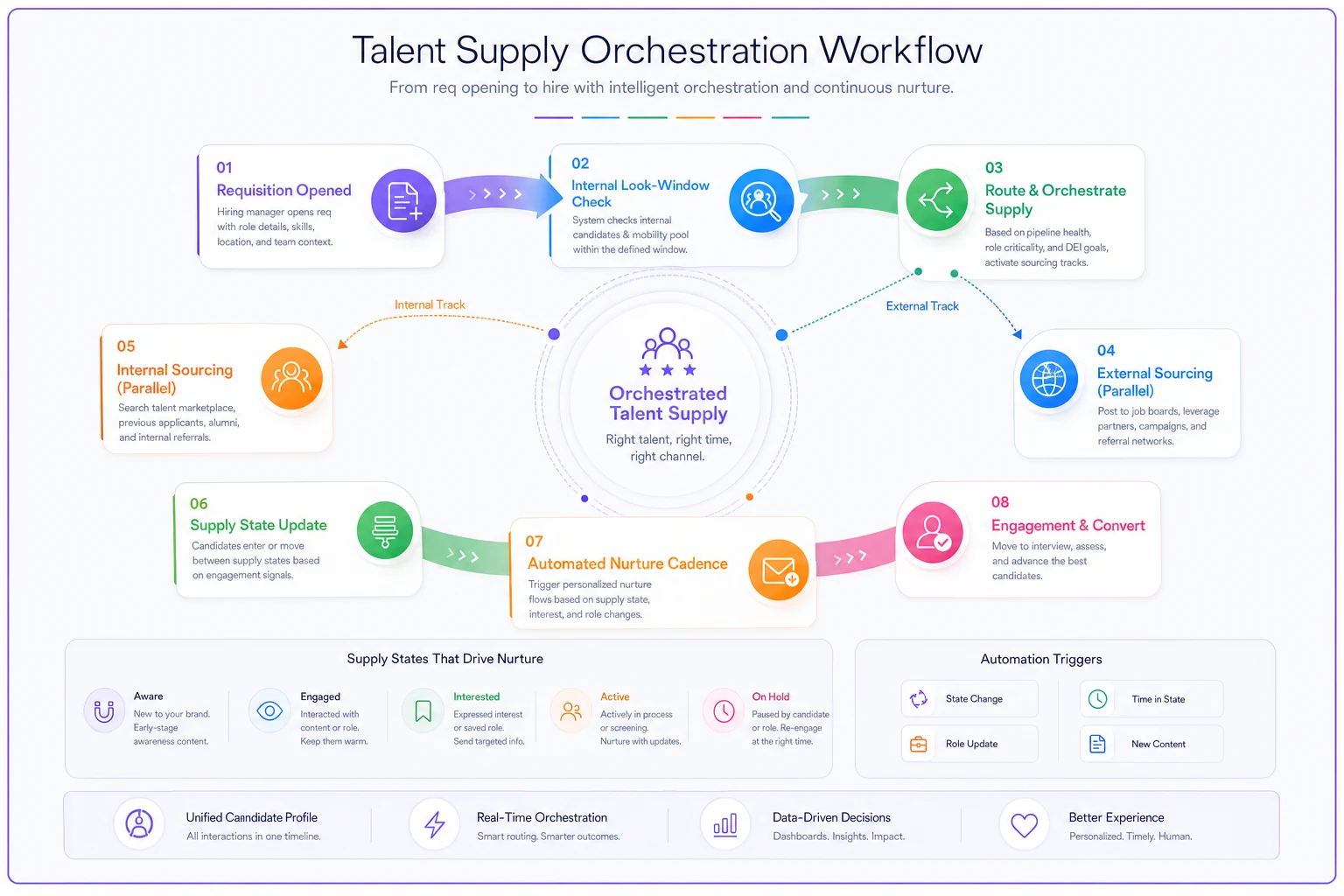
This is where an AI-powered operational platform earns its place — one that keeps supply-state tags persistent across reqs, handles routine nurture touches so recruiters only deal with the personal ones, surfaces internal-eligible people at intake, and tracks conversion and attribution without someone rebuilding a report every month. The value isn't automation for its own sake. It's that the system stays alive when volume spikes, which is exactly when hand-maintained processes fall apart.
The trap to avoid: buying tooling before you have the taxonomy and owners defined. Software will happily automate a broken supply model and just make the mess move faster.
When This Makes Sense, and When It Doesn't
When orchestration pays off:
-
You have repeat roles that reopen predictably
-
You run enough volume that silver medalists and warm pools actually accumulate
-
You have internal talent that could plausibly move but currently doesn't surface
When it's premature:
-
You're hiring fewer than roughly 30–40 roles a year with little repetition — the overhead outweighs the reuse
-
Every role is genuinely bespoke and one-off
-
You don't yet have basic funnel measurement in place; orchestration assumes you can already see your pipeline
Who should not start here: If your active funnel is leaking badly — candidates ghosting, offers falling through, stages nobody owns — fix that first. Building a sophisticated supply system on top of a funnel that loses people is pouring water into a bucket with holes. Getting your candidate experience measurement working, so you understand where and why people drop, is the prerequisite. Orchestration multiplies whatever your funnel does — including its losses.
The teams that move fastest on hiring aren't the ones with the most sourcers. They're the ones who stopped treating every req as a fresh start. They built supply that persists between openings, gave it owners who are accountable for keeping it alive, and connected their external and internal talent into one flow they can measure.
It's a genuinely different way to run recruiting — less heroic firefighting, more steady supply management. Harder to build, but once it's running, each new req costs less than the last one for the same role. That compounding is the whole point, and it's why talent-supply orchestration is worth the setup even though it never feels as urgent as the fire currently burning.
Ready to transform your HR processes?
Join thousands of HR teams using Hiryly to hire faster, engage employees better, and stay compliant effortlessly.