

Most companies don't have a total-talent problem. They have two separate talent problems that never talk to each other. Recruiting owns full-time hiring. Procurement owns contingent labor. Finance sees two budget lines that never reconcile. And somewhere in the middle, a hiring manager just made a decision that violated three policies at once — not out of malice, but because nobody gave them a clear rule for when to use a contractor versus a headcount slot.
That gap is where a total-talent operating model either exists or it doesn't. In most mid-market companies, it doesn't. What passes for one is usually a slide deck claiming "we consider all talent options holistically," followed by workflows that route contingent and FTE requests into completely different systems, with different approvers, different pay rhythms, and different definitions of what "filled" even means.
This post is about building the actual operating machinery — the decision gates, the classification logic, the pay-cadence alignment, and the budget ownership rules — that make total talent a real system instead of a talking point.
The real failure: decisions get made before the model kicks in
There's a pattern that shows up constantly. A team is short-staffed. The manager needs someone in six weeks. FTE hiring will take twelve. So they open a contractor req. Nobody asks whether this is actually a permanent need dressed up as a temporary one. Six months later, that "contractor" is doing core work, sitting in team standups, and has quietly become a co-employment risk that legal doesn't know about yet.
The decision — contingent or full-time — got made based on speed of access, not on the nature of the work. And once that call is made, every downstream system just executes it. The classification never gets challenged. Budget ownership stays fuzzy. Pay cadence follows whatever vendor contract was already in place.
A functioning total-talent model flips the order. The decision comes through the model, not before it. Which means the model has to be fast enough that managers don't route around it. If your gate takes two weeks to give an answer, people will keep opening whatever req gets approved fastest, and you're back to two disconnected systems that don't talk.
Start with the classification gate, not the org chart
Before you decide contingent versus FTE, you have to answer something more basic: what kind of work is this, and does it legally and operationally belong in one bucket or the other. This is the classification gate, and it's the part most models skip because it feels like legal's job.
Eliminate HR bottlenecks with smart automation.
Hiryly simplifies your HR operations so you can focus on people, not paperwork.
- Centralized candidate tracking
- Automated onboarding workflows
- Performance & compliance dashboards
No credit card required
-
Is this ongoing core work or bounded project work? Ongoing core work defaults toward FTE. Bounded work with a defined end defaults toward contingent.
-
Who directs the day-to-day? If your managers control how, when, and where the work happens, you're leaning employee — regardless of what the contract says.
-
Is the skill needed continuously or in bursts? Burst demand is a contingent signal. Steady-state demand is an FTE signal.
-
What's the co-employment exposure? Roles embedded in your teams, using your tools, on your systems, carry higher risk.
-
Is there a knowledge-retention cost if this person leaves? High retention cost pushes toward FTE even when the work looks project-shaped.
Keep the classification gate to a five-minute checklist so managers don't bypass it for speed.
Most misclassifications aren't malicious — they're convenience-driven. Someone needed a fast fill and picked the path with the shortest approval chain. The gate exists to force a five-minute honest answer before the convenience path takes over.
When this gate is missing, what breaks at scale is predictable. You end up with a shadow workforce — contractors doing FTE work — that inflates your effective headcount without showing up in your headcount plan. Finance thinks you have 400 people. You actually have 400 plus 90 contingent workers doing permanent jobs, and nobody owns that number.
The decision tree: contingent vs. FTE vs. vendor vs. direct
Once classification is clean, you've got a second decision that most models collapse into one — but it's really two. First: contingent or FTE. Second, if contingent: sourced through a vendor or engaged directly.
| Situation | Classification signal | Default path | Sourcing rule |
|---|---|---|---|
| Ongoing core role, steady demand | Employee | FTE | Direct hire |
| Bounded project, specialized skill, <6 months | Contractor | Contingent | Vendor if skill is scarce; direct if you have the network |
| Recurring seasonal burst | Contractor | Contingent | Vendor (staffing partner manages pool) |
| Ongoing role but hiring freeze on headcount | ⚠️ Misalignment | Escalate — don't convert to contingent by default | Requires budget-owner sign-off |
| High-volume, low-complexity, short tenure | Contractor | Contingent | Direct or MSP, whichever is cheaper per fill |
| Strategic skill you'll need permanently, testing fit | Employee (trending) | Contingent-to-hire | Direct, with conversion clause |
The row that causes the most damage is the "ongoing role but hiring freeze" one. When headcount is frozen but the work is real, teams quietly convert permanent needs into contingent spend. It's the single most common way total-talent models get corrupted, because it moves cost from the headcount line — where it's watched — to the contingent line, where it often isn't. That row should never auto-resolve to contingent. It should trigger an escalation to whoever owns the budget.
On the vendor-versus-direct question, the rule that actually holds up is about where sourcing effort creates leverage. Use vendors when the skill is scarce, demand is spiky, or the compliance burden of engaging directly (background checks, insurance, tax) outweighs the markup. Go direct when you already have the network, the volume justifies building your own pool, or vendor markups on high-volume roles are quietly eating margin. On a large contingent program, the difference between a 40% vendor markup and a 12% direct-engagement cost, spread across dozens of roles, isn't a rounding error — it's a real line item you can either defend or explain away.
Pay-cadence alignment: the coordination problem nobody plans for
This part gets almost no attention and causes a disproportionate amount of operational friction. FTE and contingent workers get paid on different rhythms, by different systems, approved by different people. Full-timers might run semi-monthly. Contractors invoice monthly or net-30 through a vendor. Direct contingent workers might be on weekly billing.
-
Map every worker type to a pay rhythm and an approval deadline. Weekly contingent → timesheet locked Monday noon. Monthly vendor → invoice due by the 5th, approved by the 10th.
-
Assign a single reconciliation owner per cadence. Not "finance" — a named person who closes each cycle.
-
Set a cutoff calendar that everyone shares. Late approvals crossing a month-end boundary are the number one source of contingent cost surprises.
-
Align contingent accruals with the FTE close. If your FTE payroll closes on the 15th and contingent spend isn't accrued until invoices arrive weeks later, your month-end labor number is fiction.
Pay cadence is where a total-talent model quietly tells the truth about whether it's real. If you can produce a single, timely view of total labor cost across FTE and contingent in the same reporting period, you have a model. If you can't, you have two systems and a spreadsheet pretending to be one. This connects directly to the discipline you'd apply in a mid-market total rewards operating blueprint, where cadence and approval workflows determine whether comp decisions are governable at all.
Budget ownership: the question that resolves every argument
Every fight in total-talent management traces back to one unanswered question: who owns this budget, and who has authority to convert one type of spend into another?
In the typical broken setup, FTE budget belongs to the business unit and HR, while contingent budget lives with procurement — sometimes not tracked as "people cost" at all. So when a manager burns through headcount and shifts to contractors, they've effectively moved money between two budgets reporting to two different executives, and neither one saw the full picture.
The fix is a single total-labor budget owner per business unit — one person accountable for the combined FTE and contingent spend, with explicit authority over conversions between them. The gates and decision trees feed into that owner. When the "ongoing role, frozen headcount" scenario triggers, it lands on their desk. When a contractor crosses six months on core work, the classification gate re-fires and that owner decides: convert, terminate, or accept the documented risk.
Without that single owner, the model has no teeth. Decision trees are just diagrams if nobody has authority to enforce the branch that says "escalate."
Bench-strength metrics: measuring the thing that actually matters
Most talent metrics measure flow — time-to-fill, requisitions closed, contractor headcount. A total-talent model needs a different lens: bench strength. How resilient is your access to talent across both worker types, and where are you dangerously dependent on a single source?
-
Coverage ratio by critical skill. For each critical role, how many people (FTE plus reachable contingent) could realistically cover it? A ratio of 1 is a single point of failure.
-
Contingent-to-core conversion rate. How often does contingent work turn out to be permanent? A high rate means your classification gate is failing upstream.
-
Vendor concentration. What percentage of your contingent fills come from one vendor? Above roughly 60% and a single vendor problem becomes your problem.
-
Internal fill rate before external. How often do you look inside before opening any req? This ties directly into an internal mobility operating model, because a strong internal bench reduces both FTE hiring pressure and contingent leakage.
-
Time-to-access, not just time-to-fill. How fast can you get any qualified person — FTE, contingent, or internal move — onto a problem?
Teams obsess over time-to-fill and ignore coverage ratio, then get blindsided when one specialist quits and there's no bench at all. Flow metrics tell you how busy you are. Bench metrics tell you how exposed you are.
A real scenario: where the model paid for itself
Take a mid-market technology services firm — roughly 380 full-time employees and, on paper, "a handful" of contractors. When someone finally reconciled the actual numbers, the contingent count was closer to 110, and about 35 of those had been doing steady core work for over eight months. The contingent spend was flowing through procurement, invisible to the headcount plan.
The problems compounded from there. Three of those long-tenure contractors were clear co-employment risks. Vendor markups on high-volume roles were running above 35% when direct engagement would have cost less than half that. Month-end labor numbers were consistently off because contingent invoices landed a cycle late.
They didn't fix it with new software first. They fixed the decisions. A classification gate went in at the front of every talent request. A single total-labor budget owner was named per business unit. Pay cadences were mapped and given hard cutoffs. Within about two quarters, they'd converted the roles that were genuinely permanent, moved a chunk of high-volume contingent work from vendor to direct sourcing, and — the quiet win — could finally produce one labor-cost number that finance trusted. Annual savings from markup reduction and eliminated duplicate spend landed somewhere in the low-to-mid six figures, but the bigger outcome was that the shadow workforce stopped being a surprise.
When this model makes sense — and when it doesn't
When it's worth building: You're past roughly 150–200 employees, you use contingent labor for more than occasional overflow, and your FTE and contingent budgets report through different functions. That's the profile where the two-systems problem is actively costing you money you can't see.
When it's overkill: If you have 40 employees and hire a contractor twice a year, you don't need a formal total-talent operating model. You need one person who asks "is this actually a job?" before opening the req. Building decision trees for that volume is process for process's sake.
Who should NOT do this yet: Companies mid-way through an HR system migration, or without any reliable workforce forecast. The model depends on knowing your demand — trying to align contingent and FTE without a real forecast is guessing in two directions at once. Get the forecast working first; the quarterly workforce planning process is the prerequisite, not an optional add-on.
Where the workflow actually lives
Walk the workflow end to end and you can see where a total-talent model either holds or collapses. A need surfaces. It hits the classification gate — five minutes, honest answers, a default recommendation. The decision tree routes it: FTE, contingent-direct, contingent-vendor, or escalation. The budget owner sees it against a combined labor budget, not a siloed one. The pay cadence is assigned at engagement, not discovered at invoice time. Bench metrics update so coverage gaps stay visible. And when a contingent engagement crosses its tenure threshold, the classification gate re-fires automatically instead of waiting for someone to notice.
A simplified workflow diagram can make the handoffs clearer.
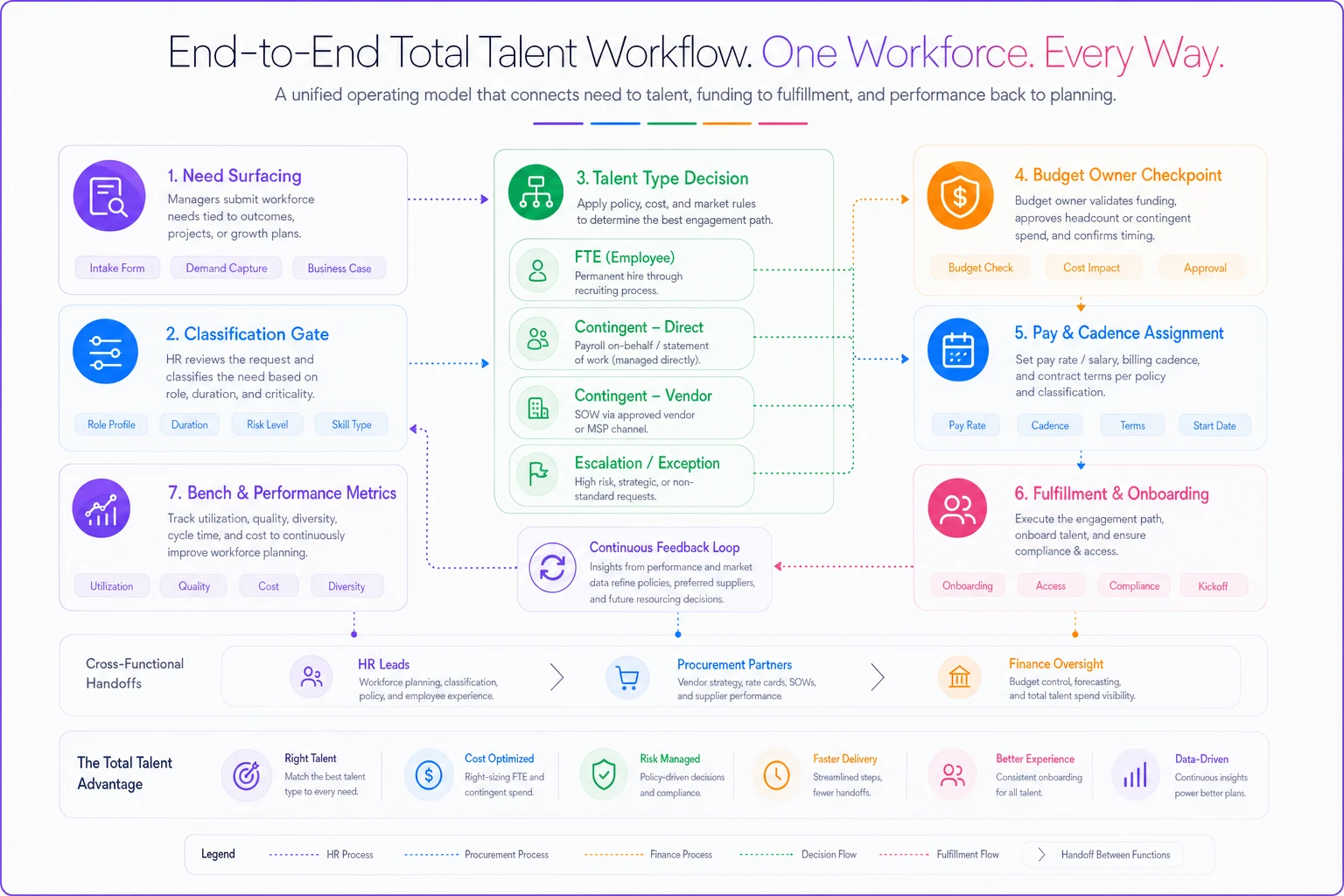
The reason this breaks so often isn't that any single step is hard. It's that the steps live in different systems owned by different functions, and the handoffs between them leak.
This is the practical case for centralizing the workflow — not because software is magic, but because a total-talent model with its gates, budget ownership, and cadence tracking scattered across procurement tools, an ATS, and finance spreadsheets will always drift back into two disconnected systems. When the classification gate, the routing logic, the combined budget view, and the pay-cadence calendar share one source of truth, the model stops depending on everyone remembering to coordinate.
The bottom line
The difference between companies that actually do total talent and companies that just say they do comes down to one thing: whether the decision about worker type runs through the model, or gets made first and rationalized after.
Classification gates force the honest question early. Decision trees make the routing consistent. Pay-cadence alignment keeps your cost picture real. Budget ownership gives someone the authority to enforce the hard branches. Bench metrics keep you focused on exposure, not just activity.
Get those five pieces working together and you don't just save on vendor markups or avoid a co-employment claim — though you'll do both. You get something rarer: the ability to look at your entire workforce as one system, make trade-offs between contingent and full-time deliberately, and actually trust the number when someone asks how many people it takes to run your business.
Get those five pieces working together and you don't just save on vendor markups or avoid a co-employment claim — though you'll do both. You get something rarer: the ability to look at your entire workforce as one system, make trade-offs between contingent and full-time deliberately, and actually trust the number when someone asks how many people it takes to run your business.
Ready to transform your HR processes?
Join thousands of HR teams using Hiryly to hire faster, engage employees better, and stay compliant effortlessly.